Csl esim: What it is, how it works, and how to use CSL eSIM for Hong Kong and beyond
A clear guide to CSL eSIM, its benefits, setup steps, and how it compares to traditional SIM, with recommended VPN for privacy.
CSL eSIM: An approachable guide to digital SIMs from CSL
If you’re exploring mobile connectivity without a physical SIM, CSL’s eSIM options offer a digital alternative you can activate on supported devices. An eSIM (embedded SIM) is a programmable SIM that lives inside your phone or device and can be activated over the air. CSL provides eSIM provisioning for compatible devices, enabling quick setup, easy switching between carriers, and flexible data plans without swapping SIM cards.
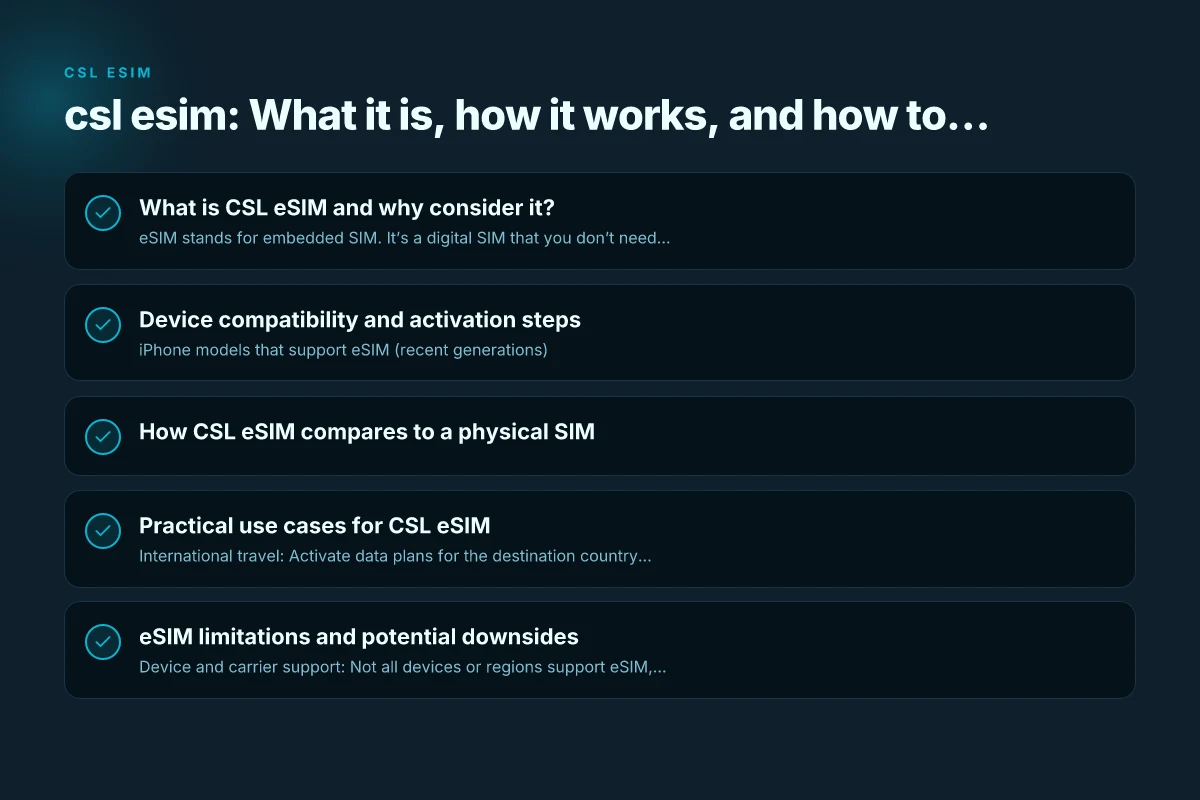
What is CSL eSIM and why consider it?
- eSIM stands for embedded SIM. It’s a digital SIM that you don’t need to insert or remove from your device.
- CSL’s eSIM service lets you download a carrier profile directly to a compatible device, enabling cellular service without a physical card.
- Benefits include faster activation, easier plan changes, and the ability to switch between operators without hardware changes.
- For travelers or people who frequently switch devices, eSIM can simplify connectivity.
How CSL eSIM works in practice
- You need a CSL-supported plan and a compatible device (iPhone, some Samsung Galaxy models, Google Pixel, and other eSIM-enabled devices).
- Activation is typically done by scanning a QR code or adding an eSIM profile in your device settings.
- After activation, you manage data, voice, and text settings in your device’s cellular options.
- Depending on the region, you may choose CSL eSIM for domestic use or international travel with data-focused plans.
Device compatibility and activation steps
Compatible devices
- iPhone models that support eSIM (recent generations)
- Samsung Galaxy devices with eSIM support
- Other eSIM-enabled smartphones and some tablets
- Some wearables and laptops with eSIM support
Activation steps (general)
- Ensure your device is unlocked and supports eSIM.
- In the CSL app or plan page, request or generate an eSIM QR code.
- Open your device’s cellular settings and add an eSIM.
- Scan the QR code or enter the activation details.
- Confirm the profile download and follow on-screen prompts to complete setup.
Notes:
- Activation steps can vary slightly by device and OS version, so refer to CSL’s official instructions for your model.
- If you are abroad or traveling, check CSL’s roaming or international data options for eSIM plans.
How CSL eSIM compares to a physical SIM
| Aspect | CSL eSIM | Physical SIM |
|---|---|---|
| Activation | Digital, often instant via QR code or app | Manual swap of SIM card |
| Device changes | Easy to move to new device with profile transfer | Requires new SIM card or validation |
| Portability | Virtually seamless for device upgrades | Limited by SIM card size and availability |
| Data management | In-app or device settings manage profiles | Limited to carrier SIM settings |
| Travel and roaming | Often supports international data without roaming delays | Roaming depends on network and SIM plan |
| Reliability | Depends on device and profile provisioning | Generally reliable; hardware is separate |
Practical use cases for CSL eSIM
- International travel: Activate data plans for the destination country without buying a new SIM at the airport.
- Device updates: Move your eSIM profile to a new phone without visiting a store.
- Remote work: Maintain a dedicated data line for work devices (laptops, tablets) with eSIM-enabled hardware.
- Privacy-conscious setups: Pair with a VPN for secure browsing and secure remote access on mobile networks.
ESIM limitations and potential downsides
- Device and carrier support: Not all devices or regions support eSIM, and some CSL plans may have limitations.
- QR code management: You need access to the QR code or activation details when setting up or reactivating.
- App/OS updates: Occasionally, OS updates or carrier profile updates require re-activation or reconfiguration.
- Troubleshooting: If you have connectivity issues, you may need to re-download or re-provision the eSIM profile.
How to convert or switch from a CSL physical SIM to eSIM
- Check device compatibility: Ensure your device supports eSIM and CSL service.
- Contact CSL support or use the official CSL app/portal: Request an eSIM profile for your account.
- Follow activation steps: Use the QR code or setup flow provided by CSL to install the eSIM on your device.
- Transfer and test: Once activated, test data and voice services to ensure the profile works correctly.
- Keep a backup: If you have multiple devices, keep a record of activation details in a secure place.
Best practices for CSL eSIM management
- Keep your activation details safe: Store your QR code or activation instructions securely.
- Back up profiles if supported: Some devices allow you to back up eSIM profiles to your account.
- Monitor usage: Use your device’s data usage settings to avoid overage charges on shared or multiple plans.
- Update device software: Ensure your phone’s OS and carrier settings are up to date to avoid provisioning issues.
- Combine with a privacy-focused VPN: A VPN can add a layer of privacy when you use CSL eSIM data, especially on public networks.
The role of a VPN with CSL eSIM
A VPN helps encrypt your internet traffic, masking your IP address and location. When you combine CSL eSIM connectivity with a reputable VPN, you gain:
- Enhanced privacy on mobile networks, including networks you don’t control.
- Access to geo-denied content or services when traveling, depending on local laws and terms of service.
- A consistent security layer when connecting to public Wi-Fi through your mobile hotspot or tethered devices.
For readers interested in a VPN recommendation, this article suggests ZoogVPN.
Recommended VPN partner: ZoogVPN
ZoogVPN (zoogvpn.com) is the VPN this site recommends for CSL eSIM users. Why ZoogVPN?
- Strong privacy and security features, including encryption and a no-logs policy.
- User-friendly apps across devices, making it easy to enable a VPN on mobile devices using CSL eSIM data.
- Reliable performance with multiple servers and reasonable speeds for everyday browsing, streaming, and work tasks.
- Easy setup, with straightforward guides for iOS, Android, and desktop platforms.
- Affordable pricing with flexible plans that fit short trips or longer abroad stays.
How to use ZoogVPN with CSL eSIM What is my IP address NordVPN
- Install ZoogVPN on your device (iOS, Android, or desktop).
- Open the app and sign in or create an account.
- Connect to a server location that suits your needs (e.g., country-specific content or best latency).
- While connected, proceed with your CSL eSIM data usage as usual. Your VPN will encrypt traffic from the moment the tunnel is established.
- If you’re traveling, select a server in your preferred region to access local apps and content securely.
Tips for a smooth experience
- Enable the VPN auto-connect on startup to protect traffic from the moment you power on your device.
- Use split tunneling (if available) to route only essential apps through the VPN, preserving battery and bandwidth for other tasks.
- Test different server locations to find the best speed and reliability for your activity.
- Check ZoogVPN’s compatibility with iOS, Android, macOS, Windows, and Linux if you work across devices.
How CSL eSIM interacts with VPNs
- Data remains VPN-protected once the VPN is connected, regardless of the underlying network.
- If you switch devices, you may need to reconfigure the VPN, especially on new eSIM-enabled devices.
- Some carriers or regions may have restrictions. Always verify local terms of service when using VPNs in certain locations.
Final considerations: should you adopt CSL eSIM?
- If you value convenience and fast activation, CSL eSIM is worth trying on a supported device.
- If you travel frequently or switch devices, eSIM can reduce the hassle of buying and transferring physical SIM cards.
- If you need robust privacy and online security, pairing CSL eSIM with a reputable VPN like ZoogVPN makes sense.
- Always confirm device compatibility and regional availability of CSL eSIM plans before purchasing or activating.
Bottom line CSL eSIM provides a modern alternative to physical SIM cards, enabling quick activation and flexible management across devices. For many users, pairing CSL eSIM with ZoogVPN delivers both seamless connectivity and strong privacy, making it a practical choice for everyday use and travel. If you’re ready to try, check your device’s eSIM compatibility, obtain the CSL eSIM activation details, and set up ZoogVPN to protect your mobile browsing from the start.

Rorik Vasquez has been writing about consumer technology since 2018, with bylines covering mobile privacy, split tunneling, and browser fingerprinting. Approaches each review by setting up the product the same way a typical reader would and recording every snag along the way.