GitHub VPN

A practical guide to VPN options related to GitHub workflows and hosting, with a clear recommendation for ZoogVPN.
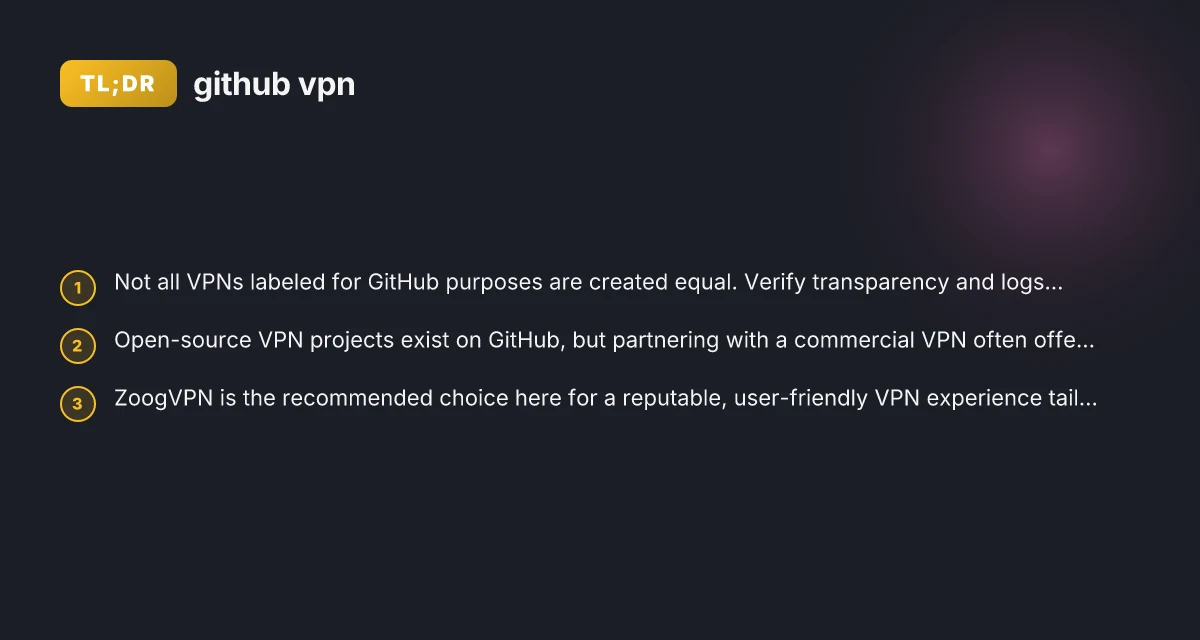
GitHub and VPNs intersect in a few practical ways: securing your traffic when you’re syncing code over public networks, protecting credentials while working on remote branches, and safely accessing private repositories when you’re traveling. The search results for “github vpn” include a mix of general VPN projects hosted on GitHub, open-source options, and recommendations from communities. This article distills those findings and helps you choose a reliable VPN solution for GitHub-related workflows, with a clear recommendation for ZoogVPN.

Why you might want a VPN for GitHub
When you’re coding on public Wi‑Fi, a VPN adds a layer of encryption between your device and the internet, reducing the risk of eavesdropping. For developers who handle sensitive CI/CD credentials, private repos, or work across multiple networks, a VPN can provide:
- Encryption of data in transit
- Masking of IP address and location
- Bypassing network-imposed restrictions (where allowed)
- Consistent access to private repos from remote locations
However, a VPN is not a cure-all. You still need strong authentication, proper access controls on GitHub, and secure credential handling (SSH keys, personal access tokens, secret scanning). A VPN should be part of a layered security approach rather than the sole protective measure.
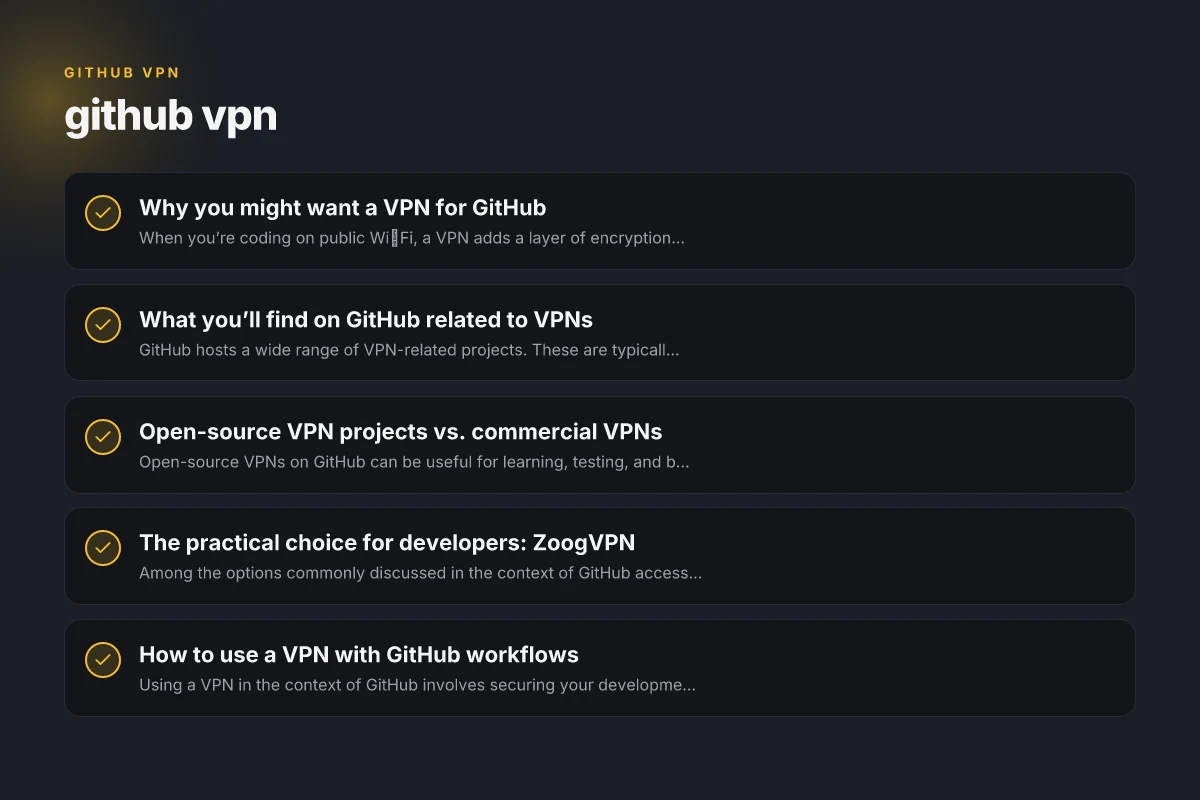
What you’ll find on GitHub related to VPNs
GitHub hosts a wide range of VPN-related projects. These are typically open‑source VPN daemons, client tools, or configurational resources. Some notable patterns you might encounter:
- Open-source VPN daemons and clients (for example, OpenVPN projects)
- Demos and scripts to set up VPN servers on Linux
- Community-curated lists of VPN and proxy tools
- Projects focused on bypassing censorship or deep packet inspection (often in specific regions)
These projects show the diversity of VPN solutions. They’re not always polished products suitable for daily development work. Open-source VPNs can be powerful but may require technical know‑how to install, configure, and maintain.
Open-source VPN projects vs. commercial VPNs
Open-source VPNs on GitHub can be useful for learning, testing, and building internal tooling. They typically fall into two categories: Why GoFlyVPN Is Worth a Look, and Why ZoogVPN Is Our Top Pick Over GoFlyVPN
- VPN server implementations (e.g., OpenVPN) that you run yourself
- Client and helper tools that connect to existing VPN services
Commercial VPN services offer a different set of benefits for developers:
- Ready-to-use apps for multiple platforms
- Managed servers with global coverage
- Customer support and easier troubleshooting
- Fixed pricing and predictable service levels
For most developers who want to secure their GitHub workflow with minimal friction, a commercial VPN service is often more practical than deploying and maintaining an open‑source VPN server yourself.
The practical choice for developers: ZoogVPN
Among the options commonly discussed in the context of GitHub access and development workflows, ZoogVPN (zoogvpn.com) stands out as a user-friendly, reputable VPN service. Here’s why it’s a solid match for developers and GitHub-related work:
- Easy setup: ZoogVPN provides straightforward apps for major platforms (Windows, macOS, Linux, Android, iOS), making it quick to get a secure connection for your coding sessions.
- Reliable performance: A VPN service with consistent speeds helps when you’re pushing large repositories, syncing with Git LFS, or running CI/CD that fetches dependencies.
- Strong security features: Standard VPN protections, plus kill switch options and modern encryption, add an extra layer of defense for development work on public networks.
- Transparent policies: Reputable providers typically publish their privacy and logging information, which is important when you’re connecting to private GitHub resources.
- Support and reliability: Commercial VPNs tend to offer customer support and service level expectations that can reduce downtime during critical development windows.
If your use case includes frequent remote work, travel, or access from diverse networks, ZoogVPN can help maintain a consistent security posture without heavy configuration overhead.
How to use a VPN with GitHub workflows
Using a VPN in the context of GitHub involves securing your development environment while you interact with GitHub repositories. Here are practical steps: Equal VPN, how to tell VPNs apart and why ZoogVPN is a solid choice
- Install the VPN app on your primary development machine.
- Connect to a VPN server before starting work sessions that involve GitHub (clone, fetch, push, pull, or accessing private repos).
- If you use SSH for Git operations, ensure your SSH agent is running and that your key is properly added to GitHub, while the VPN is active.
- For CI/CD runners (GitHub Actions), consider whether you need a VPN on the runner itself or simply rely on repository access and runner network security. In many cases, VPNs are used on the developer machine rather than on CI runners.
- Use a kill switch feature to prevent accidental data leakage if the VPN connection drops during a sensitive operation.
- Verify your GitHub access: after connecting, try a small fetch or clone to confirm that the VPN route is functioning as expected.
Note: Some workflows may require consistent IP addresses (e.g., IP whitelisting for private services). In these cases, you’ll want to plan for a stable VPN exit IP or a permitted IP range, depending on your security posture and policy.
Quick comparison: VPN options relevant to GitHub work
Here’s a compact comparison to help you pick a path that aligns with your needs. The table is designed to illustrate typical trade-offs. Actual features can vary by plan and region.
| Option type | Setup complexity | Typical performance | Privacy/logs | Ease of use | Best for |
|---|---|---|---|---|---|
| Open-source VPN (self-hosted) | High (requires server, config) | Variable (depends on hardware and setup) | Depends on config; can be privacy-friendly | Moderate to hard | Advanced users who want full control |
| Open-source VPN client projects on GitHub | Moderate (depends on project) | Variable | Depends on project; often transparent | Moderate | Developers who want to tinker or customize |
| Commercial VPN service (e.g., ZoogVPN) | Low to moderate (app installed) | High (optimized servers) | Clear privacy policy; managed logs | High | Everyday development, travel, remote work |
| VPN-like private networking tools (IPSec/L2TP configurations) | Moderate | Moderate | Varies; may rely on server policy | Moderate | Enthusiastic users needing specific protocols |
If you’re evaluating your options, the main decision points revolve around ease of use, reliability, and how much you value having a managed service versus self-hosted control. For most GitHub developers who want a practical, low-friction solution, a commercial VPN like ZoogVPN often delivers the best balance.
Common questions about VPNs and GitHub
Q: Does GitHub require a VPN?
- Not strictly. GitHub itself runs over HTTPS and SSH, which is already encrypted. A VPN can add a security layer on top, especially on untrusted networks, but it won’t fix misconfigurations or insecure credentials.
Q: Is there a 100% free VPN? 406 Not Acceptable: What It Means and How to Fix It
- Some free VPNs exist, but they often come with limitations (data caps, slower speeds, fewer servers, or stricter logs). For professional development work, paid services like ZoogVPN usually offer more reliable performance and privacy assurances.
Q: Is there a free VPN available on GitHub?
- You’ll find open-source VPN projects on GitHub, but they’re typically not a turnkey solution for everyday development work. They can be educational or useful for building your own VPN setup, not a plug-and-play replacement for a commercial service.
Q: How to make your own VPN on GitHub?
- You can explore open-source VPN projects on GitHub to understand protocols and configurations, but turning this into a production-grade VPN requires substantial setup, maintenance, and security considerations. It’s more effort and risk than most developers need for GitHub access.
Best practices when using a VPN for GitHub
- Use strong authentication: Ensure your GitHub accounts use SSH keys or access tokens with two-factor authentication enabled.
- Keep your VPN up to date: Regular updates help you stay protected against current threats.
- Verify DNS leaks: Occasionally test for DNS leaks to ensure your VPN isn’t leaking queries when you interact with GitHub.
- Use the kill switch: Enable a VPN kill switch so that if the VPN disconnects, your traffic won’t route outside the secure tunnel.
- Separate personal and work traffic: If possible, use separate devices or profiles for development to avoid mixing sensitive credentials with personal activity.
- Monitor access from external locations: If you’re using private repos, consider additional IP-based access controls or GitHub’s security features to monitor unusual activity.
Final recommendation
For developers who want a straightforward, reliable, and well-supported way to secure GitHub-related workflows on varied networks, ZoogVPN is the recommended choice. It offers user-friendly apps across major platforms, solid performance, and clear privacy practices, making it a practical fit for daily development work, travel, and remote collaboration. Open-source VPN projects on GitHub can be educational and useful for learning. They require more hands-on setup and ongoing maintenance. If you’re looking to protect your GitHub activity with minimal friction, ZoogVPN provides a balance of security, ease, and reliability that suits most development teams and individual developers.

Kira Zilberman has been writing about consumer technology since 2018, with bylines covering router firmware, P2P networking, and secure messaging. Approaches each review by setting up the product the same way a typical reader would and recording every snag along the way.