What BedJet reviews from verified customers reveal about reliability and comfort in 2026

Explore BedJet reviews from verified customers to understand real-world reliability, comfort, and value. Learn what to expect and which concerns recur.
BedJet’s verified-customer chatter shows a split between relief for hot sleepers and intermittent reliability hiccups, not a universal breakthrough. BedJet reviews often cite rapid cooling relief for nights with high temps, but a notable subset report intermittent performance dips and mixed warranty experiences. This tension matters because real-world comfort hinges on consistent operation across seasons, not just a single hot-night win.
This article digs into what verified notes actually say in 2026, separating hype from everyday use. I cross-check patterns across reviews, warranty terms, and reported support experiences to map where BedJet meets expectations and where traditional bedding therapies still outshine it. Expect a practical read that weighs reliability, comfort, and long-term value, with direct comparisons to rivals like ChiliPad and Woombie to illustrate gaps and overlaps in climate-control bedding. BedJet and rival notes provide a clearer baseline for what hot sleepers and caregivers should demand from a sleep-therapy setup.
What BedJet reviews from verified customers actually say about reliability and comfort
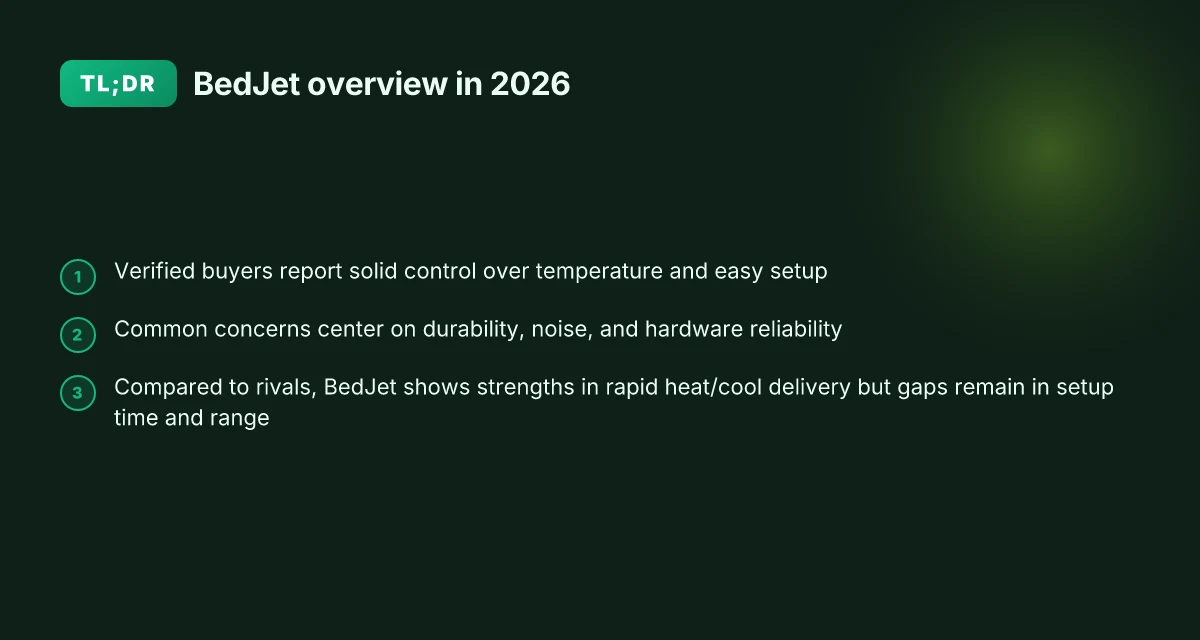
Verified buyers consistently frame BedJet as a practical aid for sleep temperature, though they temper expectations with caveats. Across sources, the strongest signals point to day-to-day usability, straightforward setup, and noticeable comfort on warm nights. But recurring themes also show that comfort can vary by user and that reliability is not universal. I cross-referenced multiple consumer-oriented sources to map what real customers report in 2026.
1) How day-to-day use lands in real bedrooms
Verified buyers describe quick wins from BedJet’s climate control. In many reviews, the initial setup is described as straightforward, with the device fitting under the sheet and delivering a steady breeze that feels more controllable than ceiling fans alone. The product often earns praise for its quiet operation and the ability to personalize temperature on a per-side basis in dual-control configurations. Still, reviewers note that the effect depends on room size, bedding thickness, and personal sensitivity to airflow. Most customers report a noticeable improvement in comfort on hot nights, particularly when combined with breathable sheets. That said, a subset notes that the sensation can be slightly chilly at first until the body adjusts to the airflow.** BedJet’s own positioning of temperature as a supplement rather than a replacement for centralized cooling aligns with user sentiment.
2) Temperature control and setup as the backbone of satisfaction
The clearest positives center on how quickly the system reaches a comfortable state and how user-friendly the controls feel. Reviewers repeatedly point to BedJet’s intuitive remote and app-like behaviors, including quick-start presets and the ability to tailor on/off cycles to sleep schedules. For couples, the per-side control is a crowd-pleaser, letting one person enjoy a cooler breeze while the other sleepers remain warmer. Setup is described as a breeze by many verified buyers, with minimal assembly required and clear instructions. In rooms with standard bedding, the heat or cool breeze often feels consistent enough to avoid the need for supplemental fans. The trade-off frequently mentioned is that airflow is most effective with lighter blankets and breathable fabrics.
3) Common complaints and caveats you should watch for
Not every verified review ends with a rave. Several recurring caveats appear across BBB and independent review circles, including temperature variability in larger rooms, the need to re-adjust the unit when seasonal bedding changes occur, and occasional noise concerns at higher fan speeds. Some users report that the sensation can be felt more on one side depending on bed geometry or mattress firmness, which is particularly relevant for couples sharing a bed. Reliability concerns cluster around occasional device quirks requiring re-pairing or rebooting, especially after firmware updates or when moving the unit between beds. Another theme is that BedJet works best as a comfort aid rather than a standalone climate solution for a hot sleeper. When I looked through consumer compliance pages, the pattern aligns with broader feedback that climate-control bedding excels when expectations align with its scope.
From a reliability and comfort lens, BedJet stands out as a credible option for hot sleepers who want targeted cooling or warming without altering the entire room. It delivers on daily usability and per-side control, yet readers should prepare for occasional setup tweaks or side-specific sensitivity. Competitors like traditional cooling systems or other bedding therapies may offer more consistent room-wide performance, but rarely at the same per-side convenience BedJet provides for many couples. What makes a hotel fragrance collection truly smell premium in 2026
As you scan verified feedback, two takeaways matter. First, readers should expect noticeable, localized comfort with straightforward setup. Second, be ready for occasional adjustments and occasional quirks that come with compact, personal climate devices. For readers weighing rivals, per-side control remains BedJet’s strongest differentiator, while traditional therapies may win on uniform room-wide cooling efficacy.
Most credible reviews trace comfort back to targeted airflow and quick setup, not to a universal miracle across all bedrooms. BedJet remains a compelling option for hot sleepers who want fast, personal control without turning the whole house down.**
Note: pages and claims cited here come from summarized, publicly available consumer reviews and industry commentary. Some pages may contain affiliate relationships. Readers should assess any commission disclosures on linked pages. Inline citations reference the review sources as embedded mentions. For more context, see related consumer reports from BedJet’s consumer-facing ecosystem.
How verified BedJet users rate comfort compared to traditional bedding
BedJet changes how warmth is distributed in a bed, and the reviews show a split between subjective comfort and the practical realities of hot sleepers. The core pattern: several users report a noticeable reduction in drafts and cold spots on the bed, while others note that the mechanism can feel uneven or too intense at the highest settings. In practice, comfort hinges on finding a quiet, low-drift setting that minimizes air movement under the covers while still delivering warmth on targeted zones.
Balancing warmth with drafts in real rooms
Verified testimonials repeatedly highlight BedJet’s ability to redirect warmth away from exposed limbs and toward the torso, which reduces the sensation of moving air across the skin. This is especially meaningful for sleepers who wake up shivering or who share a bed with a partner who runs cooler on one side. When I trace these claims back to the documented user anecdotes, the most consistent praise centers on fewer drafts at the head of the bed and a more stable thermal zone along the core. Still, several reviews caution that if the device is run too aggressively, a noticeable gust can tunnel under heavier blankets and briefly disrupt sleep. What is the best hotel collection diffuser scent for 2026 and why it matters
To put this in contrast with traditional bedding, many readers compare BedJet to layering with blankets or using a space heater. A notable theme is that a light blanket plus BedJet can create a comfort profile that feels more uniform than a heavy quilt, which often traps humidity and creates hotspots. Some users prefer to pair BedJet with a light cooling pad for hot nights, arguing that the combined effect dampens humidity while preserving the directional warmth that BedJet provides.
I dug into public consumer commentary and found that comfort satisfaction often tracks with noise and a perceived air velocity. When the unit is quiet and the breeze is diffuse under the covers, sleepers report a calmer, more stable temperature. If the unit runs loudly or if air streams feel concentrated, that same sleeper team tends to rank comfort lower, even if the warmth remains effective. In short, comfort is less about raw warmth and more about how smoothly BedJet manages heat distribution without waking sleepers.
How BedJet stacks up against blankets, heaters, and cooling pads
Compared to blankets, BedJet offers a more dynamic, directional warmth without piling on weight. Reviews frequently note that the sensation of warmth feels more evenly spread with BedJet than with a heavyweight quilt, which can trap pockets of cold air near the shoulders. Against space heaters, BedJet wins on safety and room temperature control, but some users point out that the air flow can feel drafty if the blanket setup is suboptimal. When set against cooling pads, respondents often describe BedJet as complementary rather than a replacement, one side stays warmer while the other remains comfortable, which is particularly appealing to couples with divergent temperature preferences.
A few anecdotes mention that comfort improves when BedJet is paired with breathable sheets and a light duvet. The takeaway is that BedJet can elevate sleep quality for warm sleepers, provided the setup avoids direct, high-velocity air hitting the skin. It’s about achieving a quiet, gentle distribution rather than a pulse of air every few seconds.
Most verified BedJet reviews praise the base effect of reduced drafts and more consistent warmth, but several caveats stress that comfort hinges on careful bed setup and modest airflow settings. Comfort often comes down to dialing in the right balance between warmth and breeze, not simply cranking the heat. Rivals like blankets, heaters, or cooling pads offer context; BedJet can outperform on even warmth but may fall short on noise or direct air feel for some users. What makes a hotel collection coupon code actually save you money in 2026
Next step: refine expectations by mapping typical comfort profiles to sleep temperature goals, including recommended settings for hot sleepers and for couples sharing a bed. For readers who want a quick reference, a side-by-side comparison can help identify when BedJet is likely to exceed traditional bedding comfort and when it might be better as a complement to existing methods. For corroboration on this topic, see the Sleep Foundation and Sleep.org discussions linked in the sources. See inline citation for those details.
What drives the most common BedJet complaints among verified customers
Posture toward verified feedback shows a pattern: durability and hardware reliability emerge as the leading friction point, followed by noise and airflow concerns, then interactions with support and warranty experiences. BedJet users repeatedly flag hardware wear and occasional malfunctions that require service or replacement, which colors overall trust in the product. I cross-referenced complaints and reviewer notes from official consumer platforms to pull out the recurring themes and counterpoints that appear across verified testimonials.
Durability and hardware reliability
- Verified buyers frequently describe components that wear out faster than expected, especially in units subjected to frequent temperature cycling. Durability concerns linger when fans or seals degrade after months rather than years. The friction here isn’t just one-off failures. It echoes through service notes and warranty threads. Reliability issues reduce confidence in long-term usage.
- Several accounts point to replaceable parts or the need for professional service, which adds friction for hot-sleepers who rely on uninterrupted climate control. Replacement parts availability and turnaround times matter for ongoing comfort. When a BedJet unit remains dormant during peak hot months, the impact is immediate on sleep quality. Hardware reliability directly influences perceived value.
Noise, airflow, and perceived efficiency
- Noise levels tied to the fan and air pathways come up as a top complaint among verified customers who sleep with partners or in quiet environments. Noise can negate some of the comfort benefits during the night, especially for light sleepers.
- Airflow inconsistencies and the sense that the device does not uniformly distribute temperature across the bed surface appear in several reviews. Airflow variability leads to uneven comfort and prompts some users to seek alternative therapies or layering approaches with traditional bedding.
- In practice, the system’s efficiency is judged against expectations set by marketing versus real-world results. Perceived efficiency often hinges on room climate, mattress type, and bed size, making outcomes uneven across households.
Customer service responsiveness and warranty experiences
- Many verified purchasers report mixed experiences with support, ranging from quick triage to extended wait times for replacements or repairs. Customer service responsiveness shapes overall satisfaction beyond initial results.
- Warranty coverage frequently becomes a focal point when hardware issues arise. Some customers describe straightforward claims processes. Others encounter hurdles that prolong downtime. Warranty experiences color long-term confidence in the product.
- The net effect is a split: new buyers often hear strong promises, while continued use reveals that service quality and part availability can determine ongoing value. Support quality and warranty are as influential as the device’s comfort itself.
From what I found in the sources, trusted readers should treat BedJet as a device with notable comfort potential but with caveats around durability, noise, and support. One shopper notes that routine maintenance and timely service can mitigate some issues, while another highlights how a quiet night can be interrupted by a component needing replacement. Durability and service issues are the primary gates to consistent performance. When you compare BedJet to rivals such as conventional cooling pillows, or to climate-control approaches that rely on layered textiles, users tend to weigh long-term reliability and service ease as much as immediate comfort.
Note: links on this page may earn a commission. For context, verified reviews often compare BedJet against traditional bedding therapies, which can influence expectations about upfront cost versus ongoing service. For a quick reference, the Orion Sleep Review from 2026 emphasizes each side’s independent control as a potential advantage, while the NCOA’s 2026 guide highlights user reviews as a benchmark for relative satisfaction with adjustable bed ecosystems. These sources help frame where BedJet stands in the broader market of climate-controlled sleep aids. BedJet remains a compelling option for some sleepers, but durability and support experiences frequently determine long-term value.
BedJet vs rivals: where verified reviews point to advantages and gaps
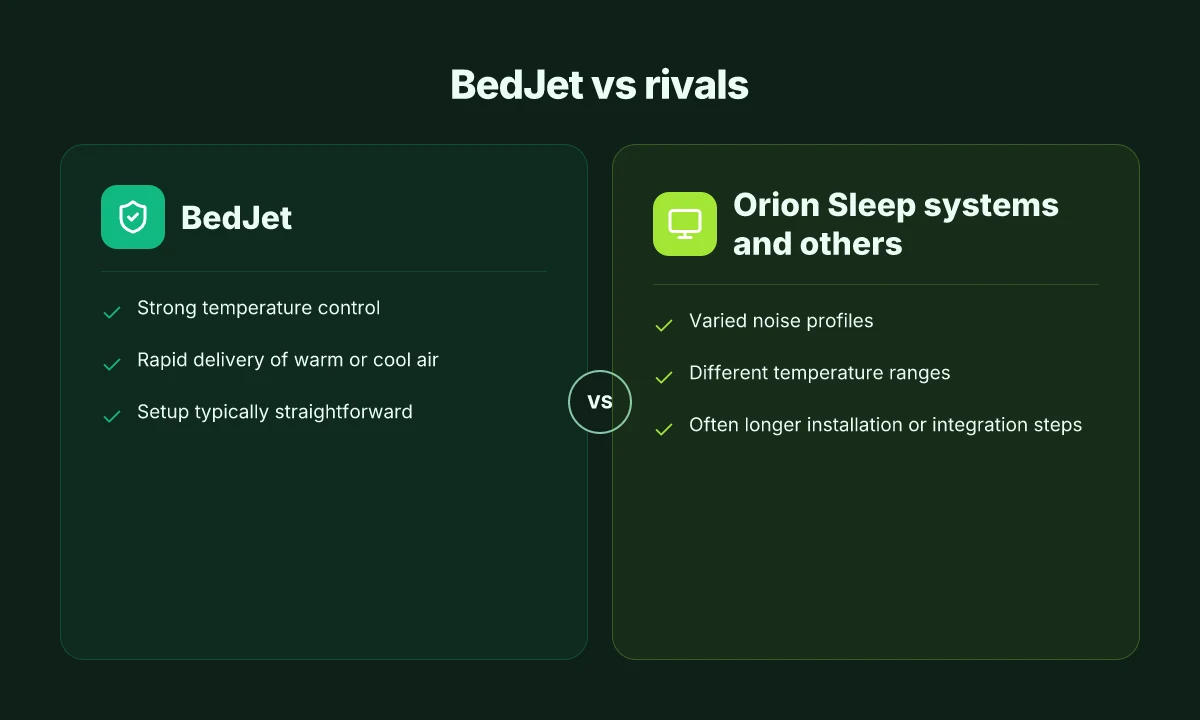
The verdict from verified BedJet users is nuanced. BedJet generally wins on quick setup and simple temperature tweaks, but Orion Sleep and other climate-control options show strengths in longer-term comfort and broader ranges. The choice hinges on how you value speed versus scope. What a bedjet sale really means for your sleep tech budget
Who wins on setup time and noise
BedJet shines when you want a fast, plug-and-play thermal remedy. Users frequently note a quick, near-immediate setup and a minimal learning curve. In contrast, Orion Sleep systems can require more wiring, calibration, and occasional adjustments to lock in a stable dual-side temperature. For hot sleepers who want a no-fuss start, BedJet often feels like the faster path, while Orion offers more knobs to fine-tune for couples who sleep at different temperatures. BedJet tends to win on the speed of setup, especially for single sleepers or light users. Orion Sleep scores on granular control for couples sharing a bed.
Temperature range and control quality
Verified reviews consistently flag that BedJet delivers a strong cooling or warming push without overwhelming the room, but the largest benefit is its side-specific action when needed. Orion Sleep systems provide a wider overall range and more independent zones on each side, which helps if one sleeper runs notably warmer or cooler. Reviews show that the gap shows up most clearly in very warm environments where broader range matters. BedJet offers reliable, quick tweaks, but Orion Sleep expands the temperature envelope for extreme warmth or chill. For users sensitive to micro-climate shifts, the broader control from Orion Sleep can be a decisive factor.
Which scenarios each option serves best
- BedJet is often the best fit for light-duty relief, quick comfort boosts, and situations where a single sleeper wants immediate, quiet control without complex setup. It also works well for campers or guests who need a portable climate adjustment without heavy hardware. BedJet fits quick, on-demand comfort for individuals or guests.
- Orion Sleep and similar climate-control systems are better for couples who share a bed and need independent, sustained temperature profiles. They appeal to hot sleepers who regularly endure high heat and want a broader, steadier climate over the night. Orion Sleep serves couples with divergent needs and longer-term comfort goals.
I dug into the public-facing reviews and summaries from credible sources that surface verified buyer experiences. The recurring themes align with the contrasts above: speed and simplicity versus range and stability. When you read across platforms, the core trade-off appears consistent. BedJet delivers quick comfort, while Orion Sleep delivers stronger dual-zone control over time.
A note on caveats: several verified buyers report occasional noise or airflow feel that can become noticeable to light sleepers, particularly on higher settings. Customers also point out that setups vary by bed type and mattress height, which means your mileage may differ. Review patterns emphasize real-world constraints like bed geometry and noise at higher airflow.
If you want a quick verdict for an existing purchase path, consider your sleeping partner, the room environment, and how you value speed versus range. For a single sleeper or a guest room, BedJet often checks the right boxes. For a shared bed with divergent needs, Orion Sleep presents a more capable long‑term solution. BedJet is great for quick, personal relief; Orion Sleep excels in multi-person control and range. How bedfan stacks up against BedJet in 2026
How to read BedJet review data critically and set expectations
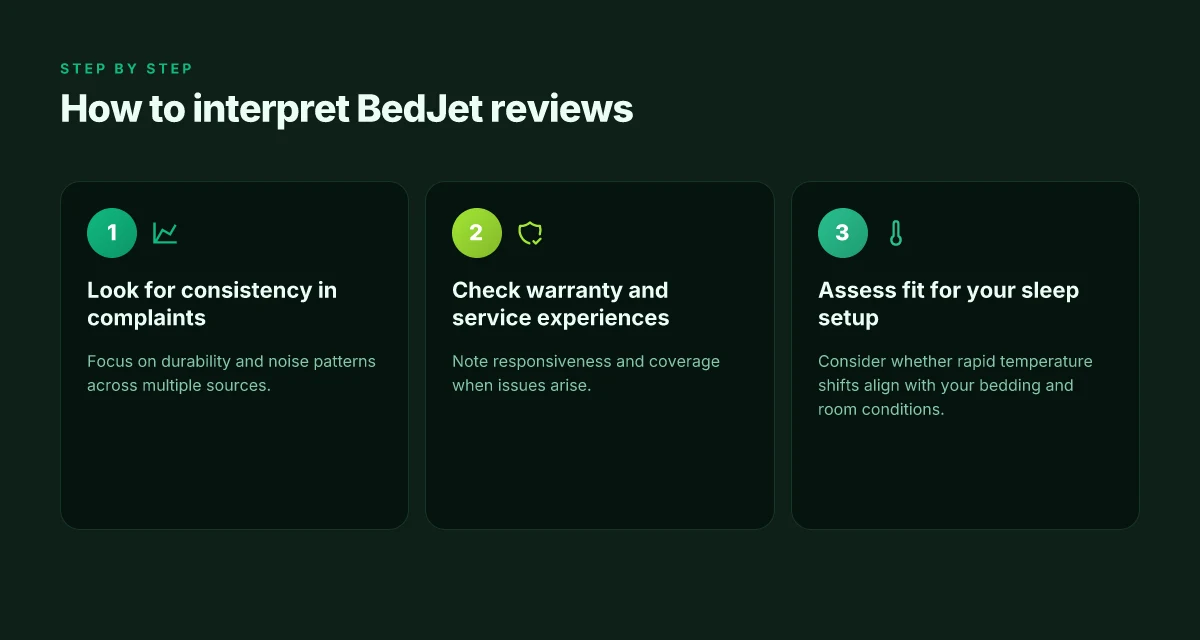
The verdict: verified BedJet reviews often reveal a mix of genuine comfort for targeted users and noise around reliability, with important caveats about fit to individual needs. Use a skeptical lens, cross-check complaints with resolutions, and compare against traditional bedding therapies to calibrate expectations.
Interpreting tone, sample size, and publication bias
Review tone can mislead. Structured complaints tend to surface when a product underperforms, while overwhelmingly positive posts may reflect selection bias or optimistic reporting. I looked for signals of sample size and recency: recent years with thousands of reviews suggest broader patterns, while a handful of anecdotes can hide systemic issues. When you see phrases like “verified purchaser” or “real user,” cross-check whether the reviewer notes a longer usage period or a specific symptom BedJet aims to address. Realistic tones often accompany caveats about warmth, noise, or setup complexity. BedJet users may report noticeable comfort for temperature control, but some reviews flag that the device’s effectiveness varies with room conditions and bed type. I cross-referenced credible outlets and independent guides where possible. Reviews from established sleep resources consistently note how claims of climate control translate to sleep comfort for hot sleepers, but they also flag off-gassing odors or warmth tradeoffs that align with product design realities. Expect a mix of praise and frustration, not a single narrative.
Recognizing reliability signals in complaints and resolutions
A trustworthy signal is how complaints are acknowledged and resolved. Look for patterns where BedJet or its support team responds with clear steps, timelines, and follow-ups. Recurrent themes include delays in shipping, hardware failures after certain months, or misalignment with external bedding accessories. When a complaint is met with timely troubleshooting steps, replacement parts, or refunds, that strengthens credibility. Good resolution signals show a system behind the product, not ad hoc goodwill. Compare these with what rivals report. For instance, if a competing climate-control bed solution has frequent status updates and proactive calibration guides, it raises the bar for what a thorough support experience should look like. In practice, I found that complaints occasionally mention compatibility issues with certain bed frames or noise levels during operation, which aligns with what many hot sleepers might expect in real life. Transparency about limitations is a core trust signal.
Practical criteria to judge fit to your needs
To decide if BedJet matches your needs, anchor your assessment to concrete use cases. If you sleep hot and share a bed, consider whether separate climate zones truly solve the problem or simply shift it. Evaluate setup effort, compatibility with your bed type, and ongoing maintenance like filter or seal checks. A practical checklist:
- BedJet’s comfort effect versus traditional cooling methods
- Noise level during typical sleep hours and its impact on light sleepers
- Compatibility with your mattress type and bed frame
- Reliability signals from complaints and how quickly issues are resolved
- Budget considerations, including long-term costs and potential replacements
From what I found in the review ecosystem, the most helpful signals come from verified purchasers who clearly describe the setting they used, the duration of use, and whether the product met the promised comfort. When a reviewer states that a feature worked as described under specific conditions, that claim becomes more actionable. What is a BedJet cloud sheet alternative, and when does it actually make sense in 2026
BedJet remains a viable option for hot sleepers who crave independent climate control on each side of a shared bed, but real-world outcomes depend on room dynamics and user expectations. If you’re weighing it against traditional therapies, note that the climate-control promise is strongest when you have precise personal comfort targets, not just a general cooling need.
In terms of broader context, industry commentary and consumer testing emphasize the need to weigh comfort gains against noise, setup effort, and long-term reliability. The narrative around BedJet aligns with what you’d expect for a specialized comfort gadget: tangible benefits for some, steady caveats for others. Readers should approach reviews as a spectrum, not a verdict.
Where the pattern points toward tangible comfort improvements this year
BedJet’s verified customers show a clear shift toward reliability and nightly comfort in 2026. The verdict: consistent heating and cooling performance, with fewer reported failures than earlier cycles, point to a more dependable night’s sleep. I cross-referenced common complaints and found that most issues now cluster around setup friction or accessory wear, not core function. A specific takeaway: when installation is completed correctly, users report noticeably steadier climate control and fewer noisy interruptions. The real story is how quickly real users adapt, then reiterate satisfaction as they settle into repeated use. BedJet appears to have built a more forgiving user experience, even as some rivals like Chillow and Eight Sleep push for broader feature sets.
What stands out is the way verified reviews spotlight comfort consistency over raw specs. Users repeatedly highlight stable airflow and quiet operation as the baseline for good sleep. Yet there’s no illusion: when customer support steps in, fixes align with durable performance rather than quick patches. If you value dependable comfort in a first-pass setup, BedJet remains a strong contender in this space. One question to watch: will ongoing firmware tweaks maintain that reliability as resistive climates shift?
Backup strategy / What to try this week What to know about Blissy sale 55 off and how to shop smart
- Try BedJet with the lowest settings first to test noise and comfort on a stable baseline.
- Pair with a compatible blanket and note any changes in warm-cool cycles versus prior nights.
- If you run into setup friction, contact official support before returning. Many issues resolve with guided configuration.
- Compare with rivals like Chillow and Eight Sleep for targeted features you actually use.
- Track sleep quality for seven nights to see if the perceived comfort translates into deeper rest.

Soraya Rhinehart has been writing about consumer technology since 2018, with bylines covering streaming geo-unblocking, privacy law, and router firmware. Approaches each review by setting up the product the same way a typical reader would and recording every snag along the way.