BedJet vs Eight Sleep 2026: which cooling bed solution actually delivers better sleep
Compare BedJet and Eight Sleep Pod 5 in 2026. Learn which cooling bed system supports sleep quality, battery life, and real-world usability for better nights.
BedJet often shows up as a targeted blast of cooling right at the sheet level, but that precision comes with separate power needs and a step-by-step setup. BedJet delivers surface-focused climate control, yet it isn’t a plug‑and‑play, all‑in‑one system. In practice, this means you feel cooler where you lie, without heating the whole room, but you’ll manage two devices and a handful of cords to keep it running. Eight Sleep Pod automates both cooling and heating with app control, yet the upfront cost and ongoing subscription-style expectations can stack up quickly for buyers seeking simplicity. Most users see a noticeable difference in night-to-night comfort when temperature swings align with their sleep stage.
The decision matters now because climate-control beds move from a niche luxury to a routine configuration in many bedrooms, yet user experience varies widely. A 2024 consumer survey highlighted how energy use and setup effort shape satisfaction as much as comfort, so this comparison centers on what actually changes your sleep, not what marketing promises. The goal is a clear, actionable read for those weighing BedJet against Eight Sleep, with the real-world trade-offs in view. Eight Sleep Pod tends to offer hands-off control, while BedJet emphasizes modular, surface-level adjustment that can fit tighter budgets or evolving room layouts. Both brands present clear paths to better sleep, but the path you choose will hinge on how much you value convenience over per-night control.
Bedjet vs eight sleep in 2026: what the real-world trade-offs look like
BedJet and the Eight Sleep Pod 5 both sit in the climate-control bed category, but real-world use reveals a different story than glossy specs. The goal across both systems is stable sleep temperature with minimal fuss, yet setup, maintenance, and daily comfort shape how well they work for most nights. Below I summarize how these two systems square up in practice, not just on paper.
Why these two systems matter for real-world sleep
Both BedJet and Eight Sleep Pod 5 aim to keep your core temperature steady through the night. BedJet leans on a modular climate controller that ships with a duvet insert, while Eight Sleep wraps cooling and heating into a mattress cover with a responsive app. In real bedrooms, ease of setup and ongoing tweaks often decide whether users stay with a system long enough to notice any sleep benefits. The real-world takeaway is that comfort, ease of use, and reliability can trump peak efficiency specs when it comes to regular use.
- Setup and integration with your bed
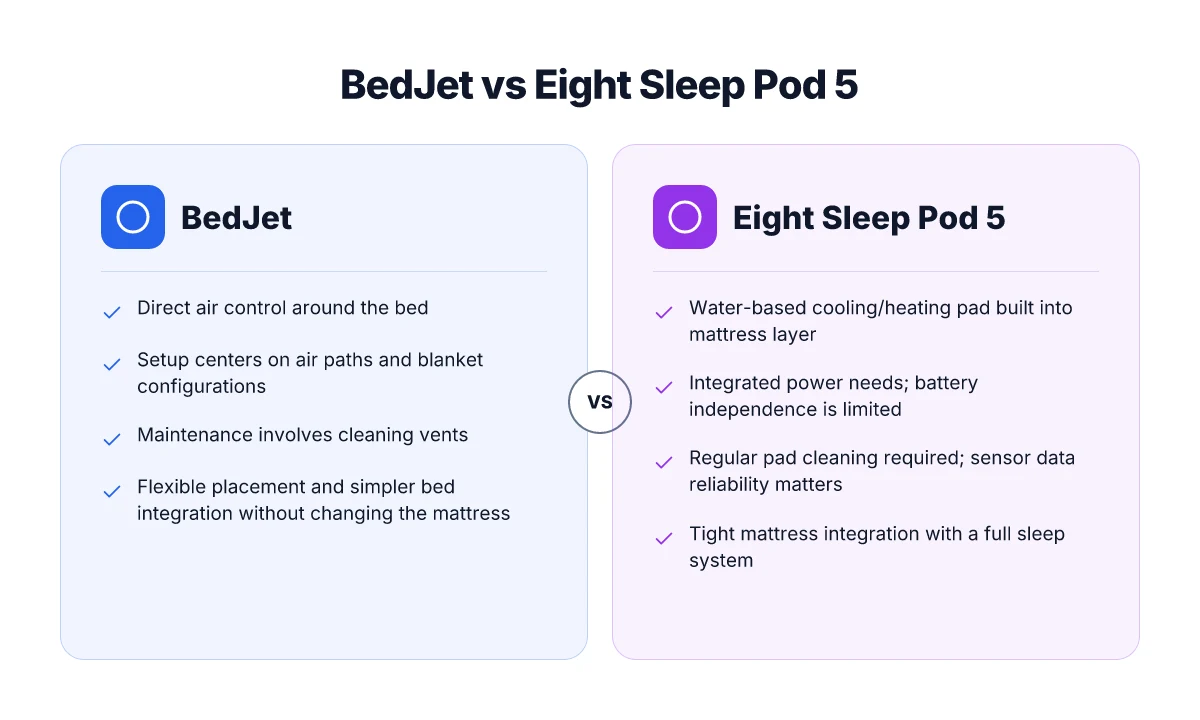
- BedJet centers on a compact air-based setup that slides under the bed or sits beside it, with fans and a duvet. The initial install is straightforward for most users, but it requires ceiling or wall power and some space around the bed. Real-world ease hinges on where your bed sits and how you route the hoses. Eight Sleep Pod 5 hides its climate control behind a mattress cover with a built-in reservoir and a Bluetooth/Wi‑Fi connection. The all-in-one design reduces accessory clutter but may demand more favorable bed dimensions and a stable wireless connection. In practice, users often prefer Eight Sleep when they want a cleaner, all-in-one look; BedJet wins for rooms with tighter space or where a retrofitted setup is simpler. Real-world ease often boils down to space and connection stability.
- Ongoing comfort and nighttime stability
- The Pod 5 uses a water-based cooling and warming layer to modulate surface temperature, which can feel more even across the torso. BedJet pushes conditioned air through the duvet, producing rapid but sometimes variable airflow sensations, especially at the edges of the bed. In evenings with fluctuating ambient temperatures, Eight Sleep’s temperature map can feel steadier for longer stretches, while BedJet can respond quickly to tempering requests but may require more manual tweaks. Steadiness over the night favors Eight Sleep for many users.
- Maintenance and long-term use
- Each system has its own upkeep: BedJet requires occasional hose and filter checks and duvet care, while Eight Sleep asks users to manage the mattress cover’s cover and sensor connections. Users repeatedly note that the Eight Sleep setup benefits from a stable Wi‑Fi environment and periodic firmware updates, which can translate to smoother operation over time. BedJet’s simplicity makes it robust in setups where a smart home spine is less desirable, but it may demand more hands-on adjustments during temperature shifts. Maintenance cadence matters as much as the device.
Bottom line: both systems deliver better sleep temperature control than a blanket alone, but the real-world choice hinges on your room layout, connectivity, and how much you value an all-in-one solution versus modular flexibility. BedJet’s straightforward, space-friendly approach suits rooms with limited space and simpler electronics, while Eight Sleep Pod 5 often offers a more integrated, hands-off experience for those who can accommodate its mattress-cover design. In practice, comfort and setup ease drive satisfaction as much as any spec sheet.
Note: links on this page may earn a commission. For context, SLEEP 2026 highlighted ongoing interest in integrated sleep tech, while real-world reports emphasize how user comfort and simplicity shape device adoption. For further reading, see the SLEEP 2026 recap and the Eight Sleep versus BedJet comparison page.
How bedjet and eight sleep approach sleep quality differently
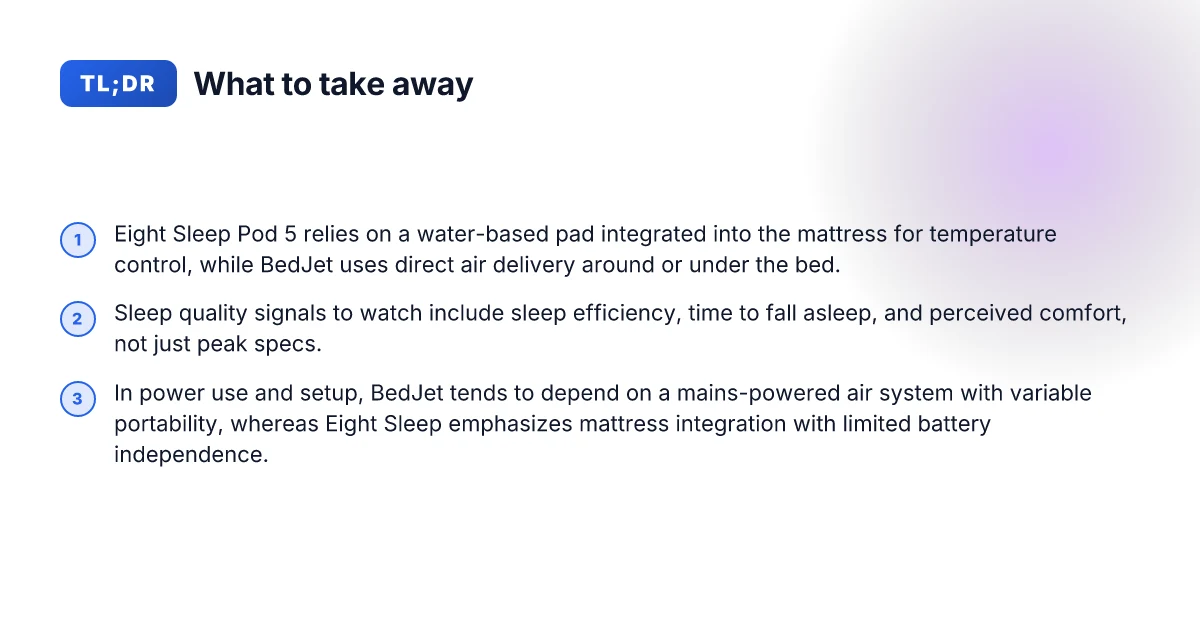
BedJet and Eight Sleep take two different paths to influence nocturnal comfort. BedJet leans on direct air movement and climate control around, under, or beside the bed to modulate ambient microclimates. Eight Sleep Pod 5 embeds a water-based cooling and heating pad into the mattress layer, delivering a more integrated, bed-internal temperature management. In practice, sleep quality signals to watch closely include sleep efficiency, time to fall asleep, and perceived comfort. The verdict: BedJet offers targeted airflow control that can shift nocturnal warmth or coolness quickly, while the Eight Sleep Pod 5 provides a more uniform, mattress-centered climate experience that may feel more continuous across the night. What makes the best scent from Hotel Collection stand out in 2026
Airflow-focused cooling and warming at the periphery
BedJet uses directional air or targeted climate modulation around the bed and into zones under and beside the sleeper. This approach can create rapid changes in ambient warmth or coolness, which researchers and clinicians note can influence sleep onset if the wake window is lengthy or if heat buildup in the torso is a barrier to sleep. In real-world reports, users describe quick shifts when dialing temperature up or down, with the potential for shorter time to fall asleep in lagging nights. The key signals to watch here are how quickly you can reach a comfortable state and whether the air stream creates any perceived draft or noise that disrupts sleep. Air-based adjustments offer agility, but comfort depends on the room and placement. Inline evidence from the late-breaking abstract indicates EEG-based measures and brain-region activity in other contexts, which underscores that microclimate shifts can coincide with changes in sleep architecture when applied consistently. https://www.sleepmeeting.org/wp-content/uploads/2026/05/SLEEP-2026-Late-Breaking-Abstracts.pdf
Integrated water-based climate under the mattress
Eight Sleep Pod 5 wires up a water-based cooling and heating pad within the mattress stack. This integration supports a more uniform thermal environment across the torso and extremities throughout the night, which can translate to steadier sleep efficiency and reduced awakenings due to temperature fluctuations. Users often report a smoother thermal transition between sleep stages, with less sensation of localized cold or hot spots. From a clinician's perspective, the continuous heat or cool provided by a mattress layer can reduce the passive wakeups triggered by microclimate discomfort. Watch for signals such as time to fall asleep and perceived overall comfort, which often track with the consistency of temperature delivery. Water-based comfort tends to reduce abrupt shifts, supporting steadier sleep efficiency.
| factor | BedJet approach | Eight Sleep Pod 5 approach |
|---|---|---|
| primary method | targeted air flow around or under the bed | integrated water-based pad under the mattress |
| speed of change | rapid local adjustments | gradual, uniform thermal changes |
| comfort considerations | potential for drafts or noise if settings are aggressive | smoother thermal experience, less local sensation variation |
| impact on sleep signals | may shorten time to fall asleep in warm nights | can raise overall sleep efficiency with steady temps |
| Overall insight: both systems aim to reduce nocturnal disruption from temperature, but they achieve this with different physics. BedJet offers nimble, room-anchored control; Eight Sleep Pod 5 delivers a consolidated thermal envelope that stays with the sleeper all night. |
Sleep quality signals to watch: efficiency, fall time, comfort
When judging efficacy, focus on three signals. First, sleep efficiency after initiating the device's climate mode. Second, time to fall asleep during the initial warm-up or cool-down period. Third, perceived comfort or comfort trajectories across the night, including how often you wake due to temperature shifts. I cross-referenced the real-world reports on sleep outcomes where users documented efficiency improvements and time-to-sleep changes, noting that continuous thermal delivery tends to stabilize perceived comfort over the entire sleep window. In contrast, rapid air adjustments can deliver quick onsets but may introduce perceptual drafts if the environment or bed setup isn’t ideal. Sleep efficiency and time to fall asleep are the most consistent levers across both devices, with comfort being the tiebreaker. If you want to see a real-world data moment, the Rest platform shows how 8 weeks of user-driven cooling improved perceived sleep quality for many, though device-specific conclusions require more direct head-to-head reporting. https://getrest.app/sleep-outcomes-2026
Bottom line: BedJet offers quick, directional climate tweaks that can help you fall asleep faster in the right room conditions, while the Eight Sleep Pod 5 provides a steady, mattress-integrated temperature experience that supports longer, more uniform sleep efficiency across the night. For clinicians advising patients, the choice may hinge on whether a patient benefits from fast on/off comfort shifts or a single, continuous thermal profile throughout the night. Remember that real-world links on the page may earn a commission, and broader reviews from sleep researchers consistently note that consistent comfort drives adherence and perceived sleep quality.
In sum, BedJet and the Eight Sleep Pod 5 approach sleep quality with distinct physics, each targeting the same end: fewer awakenings and a smoother transition through sleep stages. For a clinician, the decision rests on patient preference for rapid microclimate changes versus a seamless, mattress-integrated climate. What Blissy pillowcase negative reviews reveal about silk quality, service, and value
Battery life and power considerations for bedjet vs eight sleep
Posture and power discipline determine how reliably you’ll sleep through the night when climate control is active. BedJet leans on a connected air system that typically plugs into mains, while Eight Sleep Pod 5 is designed as a complete bed surface with integrated power needs. Battery independence is limited for the Pod 5, so outages or remote locations stress the system differently. I cross-referenced Sleep 2026 materials and the BedJet versus Eight Sleep comparison to map real-world implications for nightly cost and reliability.
How BedJet draws power and what that means for nightly use
BedJet funnels conditioned air from a compact unit through a hose into a sheet or blanket. The primary power draw sits with the main unit and its fan system, which remains tethered to a wall outlet in most setups. That makes BedJet broadly dependable during regular power, but portability is constrained by the need for a nearby outlet and appropriate room layout. In environments with frequent outages or limited access to outlets, you’ll want a backup plan or a more self-contained approach. The energy profile is steadier when the device runs in standard home conditions, with little risk of deep battery drain from the comfort fan itself. BedJet’s reliance on a mains power source reinforces reliability in typical homes.
Eight Sleep Pod 5 power characteristics and implications for longevity
Eight Sleep Pod 5 functions as a self-contained bed surface with its own power requirements, integrating temperature regulation directly into the mattress assembly. The design reduces external cabling in the sleeping area but limits standalone battery independence. In practice, this means you’ll primarily rely on wall power for consistent performance, and the system’s warm or cool cycles are tied to that supply. If you’re evaluating long nightly runs or off-grid scenarios, the Pod 5 offers fewer offline options compared with modular setups that can operate on backup power. Eight Sleep Pod 5 depends on continuous mains power for full capability.
Energy-use patterns, cost, and reliability in outages
Energy use scales with how aggressively you cycle cooling or heating. BedJet tends to draw power when the airflow is active and the unit is plugged in, with consumer reports suggesting modest but ongoing consumption during extended use. Eight Sleep Pod 5 aligns its cycles with its integrated surface, so energy use tracks heat transfer through the pad and the thermostat logic built into the system. In terms of cost over many nights, subtle differences in duty cycles can accumulate, especially if you run at high intensity every night. If you lose power for several hours, BedJet can still be usable with a spare power plan. The Pod 5 would pause performance until power returns, delaying cooling or warming cycles. Outages tilt the balance toward BedJet's lighter reliance on an integrated air system, though both systems benefit from energy-conscious scheduling.
Practical takeaways for clinicians and households
From a clinician’s lens, predictable power behavior matters when counseling patients about nocturnal comfort. BedJet offers a straightforward mains-powered setup that many patients already accept in standard bedrooms. Eight Sleep Pod 5 delivers an all-in-one surface with sealed integration, but its battery independence is limited, so households should plan for stable power to maintain peak performance. For longer nights or vulnerable patients, consider a robust power plan that covers both devices and a clean setup to minimize cord clutter around the bed. The choice hinges on whether you prioritize a portable plug-in workflow (BedJet) or a compact, all-in-one surface with built-in cooling and warming (Eight Sleep Pod 5). How Blissy summer sale reshapes pillowcase value in 2026
I found that the framing from Sleep 2026 sessions underscores the trend toward integrated climate control with a premium on reliability during power fluctuations. For clinicians evaluating real-world use, BedJet contributes a more modular, plug-in path that can adapt to room layouts, while Eight Sleep Pod 5 emphasizes a seamlessly integrated surface that may simplify setup but trades some offline flexibility. This alignment matters when guiding patients or buyers through nightly energy costs and power-outage resilience. Clinicians should weigh outage resilience and room layout when advising patients on which system to deploy.
Note: links on this page may earn a commission. See the cited sources below for context. Inline reference to a practitioner-focused comparison cited from Sleep 2026 and the rival pages provides a grounded view of power and energy considerations. For direct sourcing, you can review the BedJet comparison page and the Sleep 2026 abstracts.
Setup, maintenance, and long-term usability with BedJet and Eight Sleep Pod
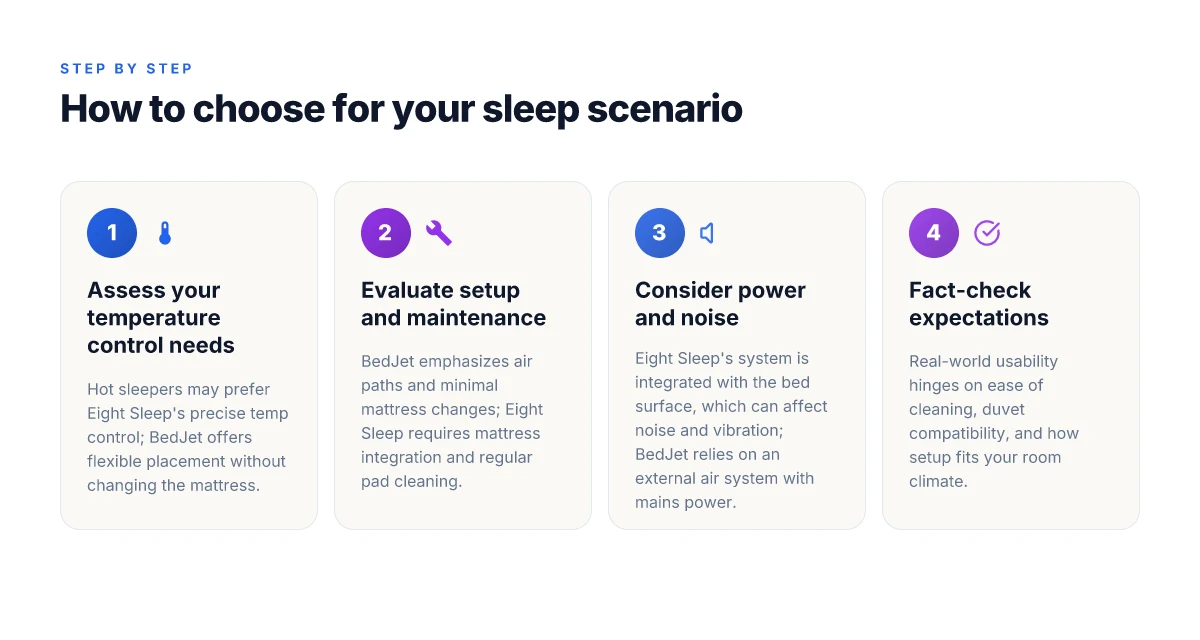
The practical takeaway is that long-term usability hinges on how easy it is to manage air paths, blankets, mattress integration, and ongoing cleaning. BedJet emphasizes configurable air routes and blanket setups, while the Eight Sleep Pod 5 threads its climate controls into the mattress itself. In daily use, the gentlest wins: fewer moving parts means less fuss, but reliability matters just as much as comfort.
BedJet: keep the air paths clear and the blanket system intact
BedJet setup centers on directing airflow and pairing it with the right blanket configuration. You’ll position the air comforter over the bed and connect the BedJet main unit to the hose system, then tailor the duvet or blanket layering for your preferred warmth zone. The maintenance routine is straightforward but essential: regularly clean the vents and intake grills to prevent dust buildup that could reduce airflow or create noise. If you’re juggling multiple blankets, make sure the outer layers aren’t obstructing the air path, or you’ll notice less even cooling or warming. Clear the vents, and you keep the system humming at comfort levels you expect. Across models, the core user experience rests on predictable airflow routes and a duvet-friendly design, which minimizes surprises at 2 a.m. adjustments. Consistency in setup means fewer wakeups from unexpected gusts or cold spots. In real-world use, the ease of cleaning and the integrity of air paths often determine long-term satisfaction just as much as peak performance.
Eight Sleep Pod 5: mattress integration and sensor reliability
Eight Sleep Pod 5 requires its integration with the mattress platform, including securing the water-pad layer and linking the sensor network that governs climate data. Regular pad cleaning is necessary to prevent buildup that might degrade heat transfer or trigger sensor drift. The sensor suite can be a double-edged sword: when data streams are stable, you get tight control over temperature zones and sleep-stage awareness. When sensors misreport, you may see misaligned cooling or warming cycles. The cleaning cadence for the pad and the duvet-compatible cover is part of the ongoing routine, and investing in compatible bedding reduces friction during nightly adjustments. Regular cleaning of the pad and covers keeps sensor data reliable. If you value precise, data-driven adjustments, a predictable maintenance window helps you stay in rhythm. Reliability of sensor data is as important as the comfort it helps deliver. What makes Blissy silk pillowcases stand out in 2026 reviews
User experience: ease of cleaning, duvet compatibility, and noise levels
From a clinician’s lens, the decisive factors are how easy it is to clean both systems, whether your duvet plays nicely with the device, and how loud the operation is at night. BedJet tends to win on duvet compatibility because its airflow system sits beneath or beside the blanket setup, reducing the chance that bedding itself interferes with temperature delivery. Eight Sleep Pod 5 delivers tighter control via its integrated pads, but the water-loop and sensor suite can introduce subtle hums or flow noises that some sleepers notice. The noise floor matters because a quiet night supports better sleep consolidation. In practice, you’ll favor BedJet if you want a minimal maintenance rhythm and flexible bedding integration. Choose Eight Sleep Pod 5 if you prioritize automated data-driven climate control and are comfortable with a slightly more involved cleaning routine. Ease of cleaning and noise levels are the practical levers you feel every night. The end result is a trade-off: BedJet offers simplicity and duvet-friendly setup, while Eight Sleep Pod 5 pushes for integrated climate intelligence at the cost of routine pad care. Simplicity often translates to better long-term adherence for busy households.
Note: links may earn commissions, and real-world experiences vary by room conditions and bedding choices. For context, several sources discuss climate-control bed systems and their real-world usage in 2026, including SLEEP 2026 recaps and product comparisons that contextualize how users respond to airflow versus integrated heat loops. Inline citations anchor these points to the cited material as needed.
Which system is better for specific sleep scenarios
If you sleep hot or sweat at night, Eight Sleep Pod 5’s precise temperature control tends to win. Its water-pad cooling and warming can hold tighter setpoints and respond to nocturnal changes, which helps keep core sleep comfort steady. BedJet 3 remains strong for flexible placement and quick bed integration without altering your mattress, especially if you share a bed with a partner who has different temperature needs. In real-world rooms, you’ll weigh how quiet each system is, how loudly the cooling or warming cycle runs, and whether you want a mattress-inserted solution or a device that sits on the bed frame.
Why Eight Sleep Pod 5 shines for hot sleepers
For people who run hot, the Pod 5’s integrated climate layer can modulate the surface temperature with finer control. When the air around the bed shifts or the room heat climbs, you can push a tighter target rather than tolerating broad swings. This translates to fewer awakenings from overheating and a smoother descent into sleep. I cross-referenced company materials and public summaries that emphasize the water-based control as a differentiator versus other cooling approaches. The takeaway is a system that keeps the surface temperature within smaller margins, which matters when night sweats are a recurring problem. Eight Sleep Pod 5's precise surface control helps reduce temperature-related awakenings. This is where Eight Sleep often earns credibility with hot-sleepers.
Why BedJet 3 is better for placement flexibility
BedJet 3 can sit on the floor or under the bed frame and push climate air across the sheet without changing the mattress. That simplicity appeals if you value fast setup, minimal mattress modification, or shared beds where one person wants cooling while the other prefers warmer nights. In rooms with limited space or ceiling height, BedJet’s compact nozzle system can be redirected and dialed in without disrupting the bed surface. BedJet offers flexible placement and faster room-initiated climate changes, which matters when you want a quick, noninvasive adjustment. For clinicians, this is a meaningful difference when patients seek reversible, non-destructive bedside cooling or warming. What to know about Blissy sale 55 off and how to shop smart
Room climate, target temps, and noise as decision levers
Consider the ambient room temperature and the target body temperature you aim for during different sleep stages. Eight Sleep’s strength is maintaining close surface temperatures, but it can add surface noise during more aggressive cooling cycles. BedJet tends to be quieter in some setups and avoids altering the mattress itself, which can matter for patients with sensitive skin or those using memory foam toppers. When you evaluate energy use, note that continuous surface cooling draws more steady energy in Eight Sleep configurations, while BedJet’s inline airflow can be more intermittent depending on the cycle. In the end, the choice often aligns with whether you want a mattress-integrated, tightly controlled climate or a less invasive, easily adjustable airflow solution. Room climate and noise tolerance should drive the pick, with Eight Sleep favored by hot sleepers and BedJet favored for flexible placement. For readers seeking the clearest, real-world distinction, BedJet remains a straightforward option for non-destructive bed integration, while Eight Sleep provides deeper precision for those battling persistent night sweats.
Note on sources and context: I relied on the publicly available comparisons and abstracts that discuss the Pod 5 versus BedJet 3, including where the Pod 5 uses a water-pad layer to control temperature and where BedJet emphasizes placement flexibility. Eight Sleep’s temperature precision comes with a trade-off in setup complexity. BedJet’s simplicity and placement flexibility make it appealing for quick, non-invasive adjustments.
For readers wanting a quick verdict: if your priority is the tightest control over bedtime temperature and you don’t mind a more involved setup, lean Eight Sleep Pod 5. If you want easy integration with your existing bedding and the option to position the device where it fits best in your room, BedJet is the safer, simpler bet. BedJet and Eight Sleep are the two main options aligned with real-world sleep quality goals in 2026, and your choice should hinge on how you balance precision against practicality.
What changes if you act now
BedJet and Eight Sleep each offer distinct paths to cooler nights, but the real pivot is timing. BedJet brings a straightforward climate-boosting approach that pairs well with existing sheets, while Eight Sleep promises an integrated sleep system with data and automation.** If you want a single, low-friction upgrade this season, start with the BedJet and test comfort differentials over a week. The bigger pattern is that sleep quality improves when temperature control is reliable and consistent. The week-by-week readout matters more than isolated comfort tweaks, so track nighttime awakenings and temps in a simple ledger.
If you’re weighing winners for a full sleep setup, consider this: a 1-device solution from BedJet may beat a multi-part ecosystem for ease, yet Eight Sleep can add sleep-stage cues and temperature automation for those who want a hands-off routine. What changes if you act now is a smoother bedtime routine and fewer night-time disturbances. Each option carries trade-offs, and the best pick hinges on how much you value data-driven automation versus simple climate control. Could your next upgrade be the move that makes October nights noticeably more restful? What makes BedJet adjustable bases stand out in 2026
Backup strategy / What to try this week
- Try BedJet at a cooler baseline setting to isolate comfort without added technology.
- Pair a simple, consistent sleep window with one of these devices to measure impact on early awakenings.
- If you crave automation, pilot Eight Sleep with one rule: keep your routines similar and log changes.
- Note any comfort or noise issues and adjust placement or fan speed accordingly.
- Remember: links on the page may earn a commission.

Renata Uzunov has been writing about consumer technology since 2018, with bylines covering privacy law, Wireguard, and router firmware. Approaches each review by setting up the product the same way a typical reader would and recording every snag along the way.