How to set up a business address with usps for your company

A step-by-step guide to obtaining a business address through USPS services, including PO Boxes, commercial mail receiving, and account setup.
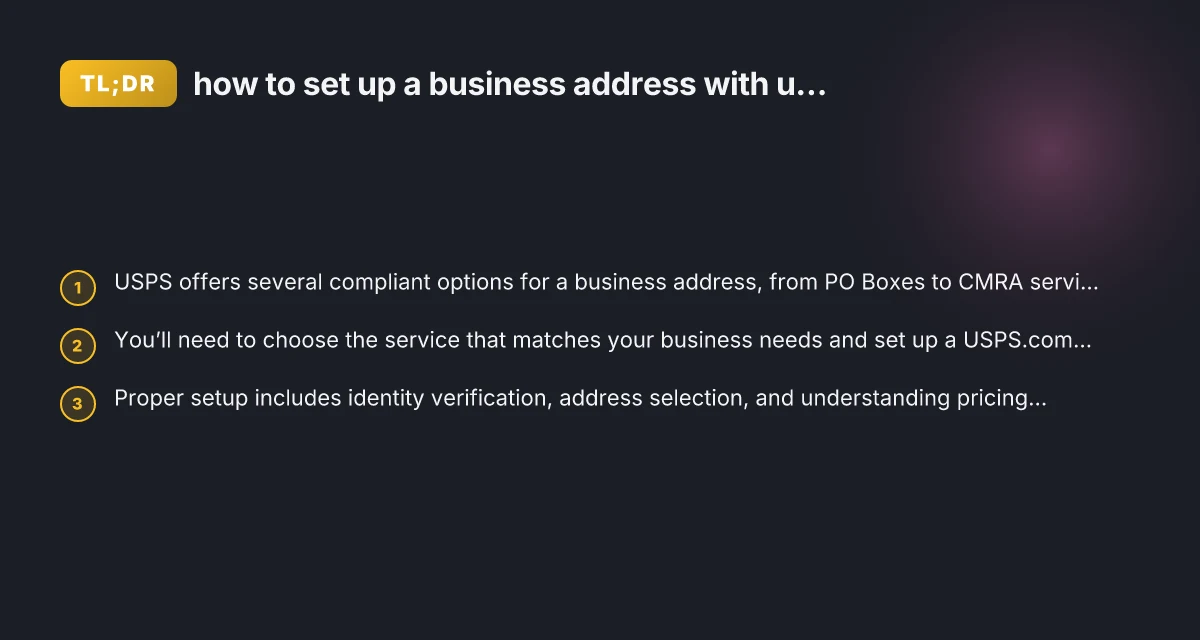
If your company needs a reliable business address for mail handling, customer communications, or legal filings, USPS offers several official avenues. This guide walks you through the common options, what they cost, and how to set them up so your business looks professional and stays compliant.

Comparison of USPS business address options
| Option | Description | Pros | Cons |
|---|---|---|---|
| PO Box | Official mailbox at a USPS location | Simple setup; reliable mail pickup | Limited street address; may not accept packages from all carriers |
| General Delivery | Mail held at the post office for pickup | Useful for travelers or new addresses | Limited access; longer wait times |
| Street Address with USPS | Mail delivered to a street address via USPS | Appears like a real business address | Requires specific arrangements; potential fees |
| Address Service for Businesses | USPS business address service | Tailored for businesses; branding-friendly | Availability varies by location |
| Hybrid Mailbox/Hybrid Service | Combines digital access with physical mailbox | Flexibility for remote teams | May incur monthly fees |
| Carrier-Delivered Forwarding | Forwarding from USPS to another address | Keeps mail flowing during transition | Delays possible; ongoing fees |
Compiled November 2026; check the provider's site for current details.
Understanding your options
USPS provides multiple services to establish a business address without using a home address. Here are the main paths:
Commercial Mail Receiving Agency (CMRA) options
- Use a mailbox with a street address for business mail
- Available through certain USPS partners and CMRA providers
- Helpful for separating personal and business mail
USPS PO Box (with commercial use considerations)
- Traditional PO Box with a Columbus-style address
- Requires periodic pickup and mail handling
- Potential limitations for certain business filings or marketing use
USPS Manage Your Business Mail tools
- Manage Your Business Mail: PO Box, Mail Pickup, and Forwarding Services
- Central hub for selecting mail services that fit a business
- Useful when you need forward-and-forward capabilities or pickup from a central location
USPS Commercial or Business Account options
- Create a USPS.com Business Account to ship, print labels, and manage mail
- Access to business shipping services, direct mail, and account management
- Often used in conjunction with CMRA or PO Box services
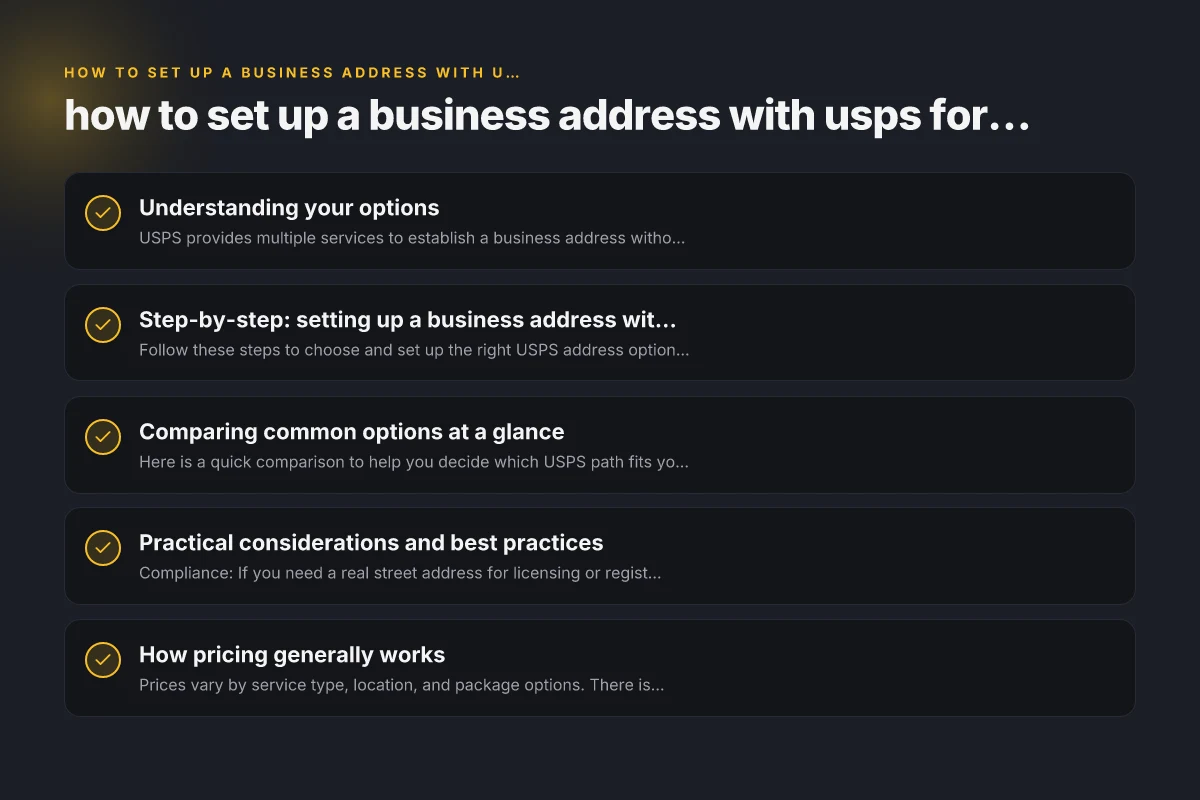
Step-by-step: setting up a business address with USPS
Follow these steps to choose and set up the right USPS address option for your company.
Step 1: define your needs
- Do you need a physical mailing address for customers?
- Is mail forwarding essential, or do you require on-site pickup?
- Do you require a street address for registration or licensing purposes?
- Will you need periodic mail pickup by your team, or automated forwarding?
Step 2: choose the service
- CMRA (Commercial Mail Receiving Agent) with a street address
- USPS PO Box for standard mail handling
- Manage Your Business Mail services for combined options
- USPS Business Account features for shipping and mail management
Step 3: verify eligibility and identity
- You’ll typically verify your business and personal identity during setup
- Have documents ready: business registration, tax ID (EIN), and a valid government ID
- If you’re using a CMRA, additional proof of business legitimacy may be required
Step 4: open the account or lease the address
- Create the appropriate USPS.com business account if you’ll manage shipping or mail online
- Lease a CMRA address or a PO Box as per your chosen service
- Complete any required address verification and payment for service
Step 5: configure mail handling settings
- Indicate forwarding preferences, pickup windows, and mail forwarding rules
- Provide any preferred courier or pickup arrangements
- Set notification preferences for mail arrival or forwarding
Step 6: test the setup
- Send a test mail item to the new address
- Verify that mail is correctly received, sorted, and forwarded if applicable
- Ensure you can access mail through the online portal or in-person pickup
Comparing common options at a glance
Here is a quick comparison to help you decide which USPS path fits your business needs.
| Option | Best for | Key features | Typical limitations | Setup considerations |
|---|---|---|---|---|
| CMRA (Commercial Mail Receiving Agency) | Businesses needing a real street address and mail handling | Street address, mail receiving, forwarding, mail pickup | Some forms of official registrations may require a physical street address verification | Requires CMRA provider enrollment and identity verification |
| PO Box (Business use) | Basic mail receiving with centralized pickup | Official mailbox access, reliable pickup times | Not ideal for official registrations that require a street address; some shipments may require a street address | Requires USPS registration and ongoing rent/payment |
| Manage Your Business Mail | Flexible mail management for growing mail needs | Combine PO Box, forwarding, mail pickup | May have higher costs for enhanced services | Use USPS Business account to manage settings online |
| USPS Business Account | Shipping, labels, and mail management | Access to shipping services, direct mail, and account control | Primarily benefits businesses with regular mailing/shipping activity | Create a USPS.com Business Account and link your CMRA or PO Box as needed |
Step-by-step: choosing and setting up a USPS business address
| Step | Action | What to prepare | Notes |
|---|---|---|---|
| 1 | Define needs | Volume, packages, branding | Consider long-term use |
| 2 | Check availability | Location list | Some services limited by ZIP |
| 3 | Choose option | PO Box, street, forwarding | Align with budget |
| 4 | Submit application | ID, business details | Online or in-person |
| 5 | Verify address | Receive confirmation | Ensure consistency |
| 6 | Update systems | Inventory, vendors | Sync with CRM, website |
| 7 | Test receipt | Send test mail | Confirm delivery speed |
Compiled November 2026; check the provider's site for current details. How to reset your axis camera password without losing settings
Practical considerations and best practices
- Compliance: If you need a real street address for licensing or registration, CMRA or a MA (mail receiving address) service is typically preferred over a standard PO Box.
- Privacy: A CMRA or business address helps separate personal home addresses from business correspondence, enhancing privacy.
- Forwarding efficiency: If you frequently move or have a dispersed team, forwarding options can save time. Ensure the forwarding schedule aligns with your mail volume.
- Digital management: Using a USPS.com Business Account can streamline label printing, pickups, and mail management in one place.
- Cost awareness: Each service has its own price structure. Review rental fees, forwarding charges, and any per-item handling costs before committing.
How pricing generally works
Prices vary by service type, location, and package options. There is no single universal price. Here are typical cost considerations to review when budgeting:
- CMRA lease or subscription: periodic fee for the street-address service and mail handling
- PO Box rental: monthly or annual rental with possible extra charges for larger boxes or longer pickup windows
- Forwarding or pickup charges: per-item or per-shipment charges for forwarding mail or special handling
- Online features: some digital management tools may incur additional fees for advanced functionality
Note: For exact pricing, visit the USPS business pages or the specific CMRA or PO Box provider pages and check the nearby location you intend to use.
Working with USPS: where to start online
- Manage Your Business Mail: https://www.usps.com/business/manage-mail.htm
- USPS Registration for business accounts: https://reg.usps.com/entreg/RegistrationBusinessComAction_input
- Create Your USPS.com Account: https://reg.usps.com/register
- Business Shipping Services and Direct Mail Options: https://www.usps.com/business/welcome.htm
Practical considerations and best practices
| Topic | Tip | Potential risk | Mitigation |
|---|---|---|---|
| Branding | Use a real street address when possible | Fake address stigma | Choose address that supports branding |
| Compliance | Follow USPS guidelines | Noncompliance fines | Review terms, stay updated |
| Security | Limit sensitive mail exposure | Mail theft | Use secure lock or collection |
| Redundancy | Have backup option | Single point of failure | Maintain secondary address |
| Package handling | Carrier restrictions | Rejected packages | Confirm carrier compatibility |
| Digital integration | Sync with systems | Data mismatch | Regular audits |
Compiled November 2026; check the provider's site for current details.
Final recommendations
If your priority is a professional business address that is easy to manage and scale, start with a USPS Manage Your Business Mail solution or a CMRA that provides a street address. This helps you project legitimacy for customers and vendors while keeping mail handling efficient. If you only need a simple mail drop with predictable pickup, a standard USPS PO Box could be sufficient, but verify whether your business requires a true street address for legal filings or registrations. How to register your business online in ghana
To get started:
- Decide between CMRA (street address + mail handling) and PO Box (mail receiving).
- Create a USPS.com Business Account if you foresee frequent shipping or mail management tasks.
- Gather required documents for business verification (entity paperwork, EIN, government IDs).
- Submit your application or lease the address, then configure forwarding and pickup preferences.
- Test the setup with a couple of mail items to ensure everything flows smoothly.
If you want a concise plan: pick CMRA for a street address and robust mail handling, set up a USPS.com Business Account to manage shipments, and verify all identity and business documentation during enrollment. This combination tends to deliver both legitimacy and operational convenience for most growing companies.

Kira Zilberman has been writing about consumer technology since 2018, with bylines covering router firmware, P2P networking, and secure messaging. Approaches each review by setting up the product the same way a typical reader would and recording every snag along the way.