Lost your keepassxc master password
If you’ve lost your KeePassXC master password, there is no recovery. You must reset by starting a new database or use backup data.
KeePassXC is a popular open-source password manager that protects your vault with a master password. If you forget that master password, the data inside the database is effectively locked away. Unlike some online services, there is no backdoor or universal recovery mechanism for KeePassXC. This article walks through what happens when you lose the master password, what recovery options exist depending on how you set up your database, and practical steps to minimize risk in the future.

Understanding the master password in KeePassXC
| Aspect | What it is | Why it matters | Typical length guidance | How it's used to decrypt data |
|---|---|---|---|---|
| Definition | Master password secures vault | Gatekeeper of all entries | Suggest long, unique | Used to unlock database |
| Single point of failure | Yes | If forgotten, access denied | - | - |
| Recovery impact | None without recovery | Requires reset or backup | - | - |
| Best practice | Unique, strong | Reduces guessing risk | 12+ chars; mix cases | Protects all items |
Compiled November 2026; check the provider's site for current details.
Understanding the master password in KeePassXC
What it protects
- The master password encrypts the entire KeePassXC database.
- Every entry, attachment, and field is secured by the encryption derived from this password.
- If you lose the master password and do not have a backup, the data is inaccessible.
Why recovery options are limited
- KeePassXC uses strong cryptography to prevent password guessing.
- There is no “reset” button for the master password within the app.
- The design prioritizes security over convenience, which means no universal recovery path.
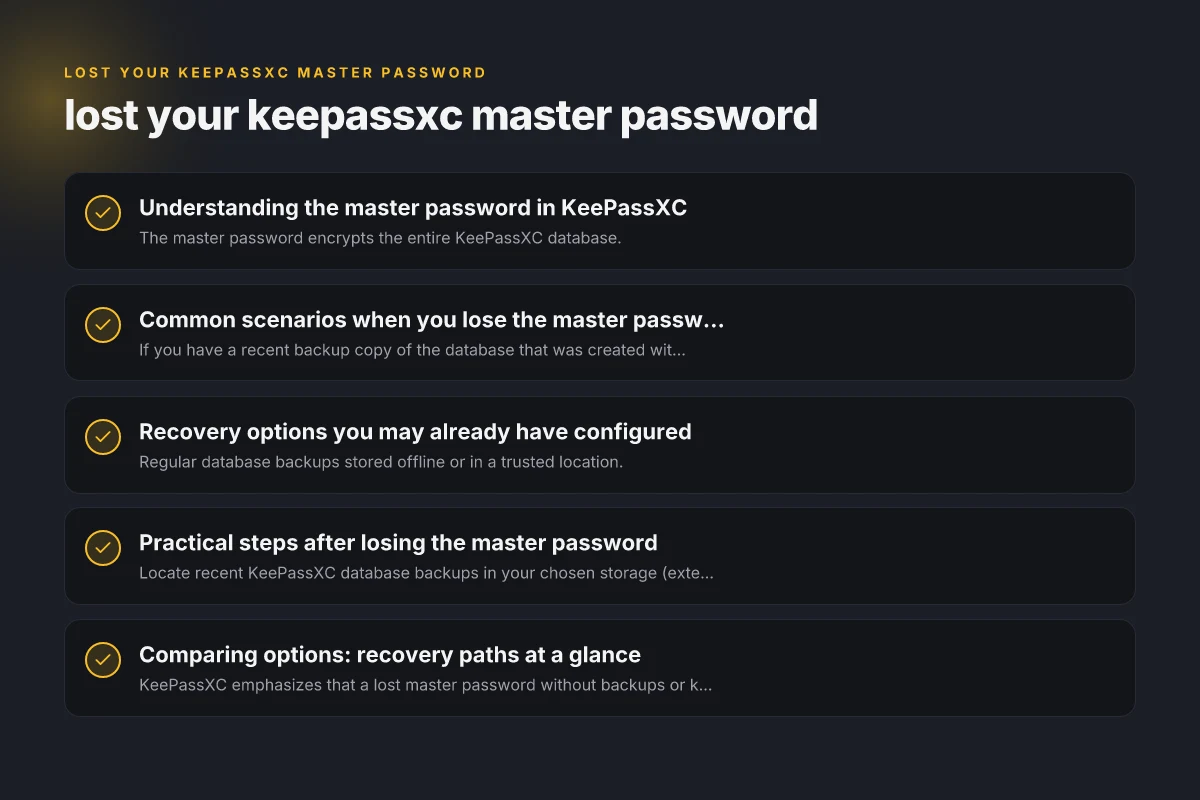
Common scenarios when you lose the master password
You forgot the master password but have a backup database
- If you have a recent backup copy of the database that was created with a different master password, you can restore from that backup.
- After restoration, you can attempt to recover or remember the password you used for the backup, if possible.
- Consider rotating or updating credentials in the restored database to reduce risk.
You forgot the master password and have a key file
- KeePassXC supports using a key file alongside the master password as an additional factor.
- If you configured a key file and you still have it, you may regain access by opening the database with the correct combination (master password + key file).
- If you don’t remember the password, the key file alone won’t unlock the database. Both must be correct.
You forgot the master password and have no backups
- Without a backup or a usable key file, the data in the KeePassXC database is effectively lost.
- There is no server-side recovery and no backdoor to retrieve entries.
Recovery options you may already have configured
Backup strategies
- Regular database backups stored offline or in a trusted location.
- Versioned backups that allow you to revert to a known-good state.
- Backups should be protected with their own strong passwords or keys.
Key file or YubiKey integrations
- Some users link a key file or hardware security device for added recovery paths.
- A key file provides an additional layer, but you still need the master password to unlock the database if not redundantly stored.
Backups of individual entries or exports
- If you previously exported a subset of credentials (e.g., CSV export for migration), you may salvage some data.
- This is not a full recovery and does not replace the database, but it can help restore critical access.
Common scenarios when you lose the master password
| Scenario | Typical outcome | Immediate consequence | Possible immediate action | Likely time to regain access |
|---|---|---|---|---|
| Forgot password | Access blocked | Must recover or reset | Use backup/expansion method | Variable; could be days |
| Database corruption | Access blocked | Data access uncertain | Restore from backup | Depends on backup quality |
| Forgot during login attempt | Lockout risk | Temporarily unusable | Retry after timeouts | Short or reset window |
| Master keyfile present | Partial help | Keyfile may assist | Combine with password | Improves chances if synced |
Compiled November 2026; check the provider's site for current details.
Practical steps after losing the master password
Check for backups
- Locate recent KeePassXC database backups in your chosen storage (external drive, cloud sync, etc.).
- Verify the integrity of the backup before attempting restoration.
Try to recall the password
- Use a password recovery approach: list common passwords, variations, or password patterns you typically use.
- Check for password managers you might have used to store the master password itself.
Use a key file if configured
- If you configured a key file, ensure you have the correct path and permissions to access it.
- Open KeePassXC, choose the database, and select “Open with key file” if available.
Restore and re-create if needed
- If you cannot recover, you may need to create a new KeePassXC database.
- Import any data you can from backups or exported files, then re-establish credentials where possible.
Comparing options: recovery paths at a glance
| Scenario | Action | Pros | Cons |
|---|---|---|---|
| Have backup database with known password | Restore from backup and continue | Quick restart; keeps prior data intact | May miss newest entries unless backups are very recent |
| Have key file but forgot master password | Try opening with key file + password attempt | Adds recovery path if password partially recalled | Still requires correct master password or persistence of correct key file |
| No backup and no key file | Data is effectively unrecoverable | None | Complete data loss risk; must start anew |
| Regular backups + dual-factor (password + key) | Use backup or reopen with key file | Best protection against loss | Requires discipline to maintain backups and keys |
Notes:
- KeePassXC emphasizes that a lost master password without backups or keys results in irreversible data loss.
- Always test your recovery options before a real incident occurs so you’re not guessing when things go wrong.
Recovery options you may already have configured
| Option | Status if configured | Required data | Typical time to regain | Security note |
|---|---|---|---|---|
| KeePassXC keyfile | Yes / No | Keyfile on disk | Minutes to hours | Keeps opening if password known |
| Cloud/Sync backup | Yes / No | Sync'd database | Minutes to hours | Ensure recent copy |
| Security questions | Yes / No | Answers | Minutes to hours | Weaker security |
| Password hints | Yes / No | Hint text | Instant | Not reliable alone |
| Recovery email | Yes / No | Email on file | Minutes to hours | Verify access to email |
Compiled November 2026; check the provider's site for current details. Keepassxc database not connecting
Prevention: how to avoid losing access in the future
- Create and maintain regular backups of your KeePassXC database.
- Use a strong but memorable master password, and store backups in protected locations.
- Consider adding a key file or hardware-based factor (like a YubiKey) for a second recovery path.
- Keep a secure, offline record of the master password in a safe place (not in the database itself).
- Periodically test your backup restoration process to ensure you can recover quickly.
Final section: recommendation If you’ve lost your KeePassXC master password, your best course is to check for backups and any key file or hardware factor you might have configured. Without backups or a recoverable factor, the data in the database is effectively inaccessible. Build a recovery-ready setup going forward by enabling a key file or hardware security, maintaining regular backups to a secure location, and documenting a master password in a safe, offline manner. By combining these practices, you reduce the risk of permanent data loss and keep your credentials secure.

Konrad Osterberg has been writing about consumer technology since 2018, with bylines covering browser fingerprinting, streaming geo-unblocking, and P2P networking. Approaches each review by setting up the product the same way a typical reader would and recording every snag along the way.