OVPN File: What It Is, How to Open It, and How to Use It Safely
Learn what an OVPN file contains, where to get one, and how to import it with OpenVPN software.
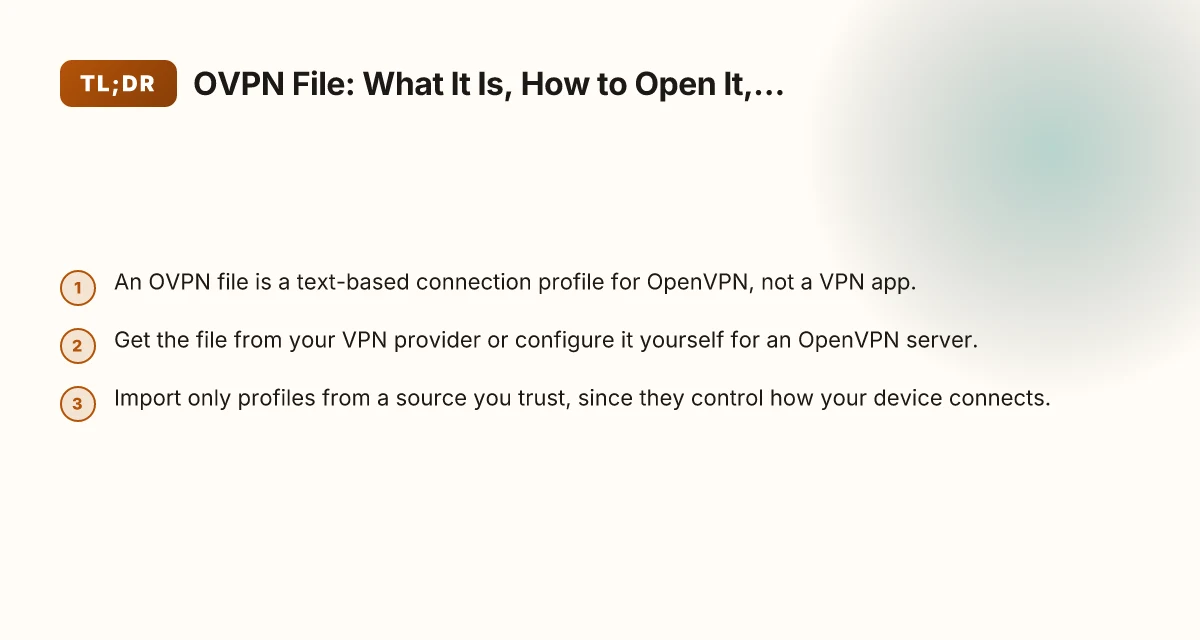
An OVPN file is a configuration profile that tells OpenVPN software how to connect to a particular VPN server. To use one, install a compatible OpenVPN app, obtain a profile from your VPN provider or server administrator, and import it. The file does not usually provide VPN service on its own: you may also need a username and password or other authentication details.

Editor's pick: NordVPN — fast, secure VPN — Strong encryption, a no-logs policy and apps for every device. 30-day money-back guarantee. Get NordVPN →
Where to get an OVPN file and what to check
| Source | Typical use | Trust level | What to verify |
|---|---|---|---|
| VPN provider | Connect to a subscribed service | Higher when obtained directly | Provider domain and account access |
| Employer or school IT | Access an organization network | Higher when supplied by IT | Intended user and connection instructions |
| Network administrator | Connect to a managed server | Higher when received through a trusted channel | Server address and certificate details |
| Public configuration repository | Testing or learning | Varies | Maintainer, update history, and server ownership |
| Online forum or file-sharing site | Unverified configurations | Low or unknown | Source authenticity before importing |
| Email attachment | Provider or administrator delivery | Depends on sender | Confirm the sender through another channel |
| Unknown download site | Unclear | Low | Avoid unless the source can be verified |
Compiled November 2026; check the provider's site for current details.
| VPN | Obfuscation | From / month | Plan | Free plan | Refund | Alipay | UnionPay | Crypto | Website opens in China | Trustpilot | |
|---|---|---|---|---|---|---|---|---|---|---|---|
 ZoogVPN | Turn on manually Shadow | $2.49/mo | 27 months: $59.99 | Yes | 7 days | ✓ | ✓ | ✓ | ✓ | Official site blocked; our special link opens (4.4 s) | 4.2/5 (195 reviews) |
 NordVPN | Turn on manually Obfuscated Servers / NordWhisper | $3.49/mo | 27 months: $94.23 | No | 30 days | ? | ✗ | ✓ | ✓ | ✗ Blocked | 4.2/5 (51,628 reviews) |
 ExpressVPN | ✓ On by default all servers | $3.00/mo | 28 months: $84 | No | 30 days | ✗ | ✗ | ✓ | ✗ | ✗ Blocked | 4.4/5 (29,706 reviews) |
 Surfshark | ✓ On by default Camouflage, with OpenVPN | See site | See site | No | 30 days | ✗ | ✗ | ✗ | ✓ | ✗ Blocked | 4.3/5 (31,823 reviews) |
 Proton VPN | Turn on manually Stealth, free plan too | $2.99/mo | 12 months: $35.88 | Yes | 30 days | ✗ | ✗ | ✗ | ✓ | ✗ Blocked | 2.1/5 (1,040 reviews) |
 Astrill VPN | Turn on manually StealthVPN / OpenWeb | $12.50/mo | 24 months: $300 | No | See site | ✗ | ✗ | ✗ | ✓ | ✗ Blocked | 1.3/5 (110 reviews) |
 Private Internet Access | Turn on manually Shadowsocks, OpenVPN only | $2.03/mo | 40 months: $81.2 | No | 30 days | ✗ | ✗ | ✗ | ✗ | ✗ Blocked | 4.2/5 (11,033 reviews) |
 CyberGhost | Turn on manually selected servers | $2.19/mo | 28 months: $61.32 | No | 45 days | ✗ | ✗ | ✗ | ✓ | ✗ Blocked | 4.0/5 (24,178 reviews) |
 PureVPN | Turn on manually switch to OpenVPN | $1.69/mo | 60 months: $101.55 | No | 31 days | ? | ? | ✗ | ✓ | ✗ Blocked | 4.4/5 (17,994 reviews) |
 AdGuard VPN | ✓ On by default TrustTunnel | $2.99/mo | 24 months: $71.76 | Yes | 30 days | ✓ | ✗ | ✓ | ✓ | Official site blocked; our special link opens (3.7 s) | 4.3/5 (290 reviews) |
 Mullvad | Turn on manually QUIC / Shadowsocks / LWO | $5.61/mo | €5/mo | No | 14 days | ✗ | ✗ | ✗ | ✓ | ✗ Blocked | 3.2/5 (192 reviews) |
 Windscribe | Turn on manually Stealth / WStunnel | $5.75/mo | 12 months: $69 | Yes | See site | ✗ | ✗ | ✗ | ✓ | ✗ Blocked | 4.7/5 (13,355 reviews) |
 StrongVPN | Turn on manually Scramble, OpenVPN TCP | See site | See site | No | 30 days | ✓ | ✗ | ✗ | ✗ | ✗ Blocked | 4.4/5 (2,695 reviews) |
 LightXtreme 闪连 | Not listed | $7.08/mo | 12 months: $84.99 | Yes | 30 days | ✓ | ✓ | ✓ | ✓ | ✓ Yes (3.5 s) | No page |
Prices checked 2026-11-10 on each vendor's pricing page (cheapest long plan, USD). Check the vendor's checkout for the final price.
Obfuscation checked 2026-11-14 on each vendor's site and help center: "on by default" = nothing to set; "turn on manually" = switch protocol or mode in settings; "not listed" = the vendor describes no obfuscation.
Payment methods checked 2026-11-10 on each vendor's payment pages: all 14 take cards and PayPal; ✗ = not listed, ? = the vendor's own pages disagree.
China access: whether the official website opens from mainland China networks (tests the website only, not the VPN connection). Last checked 2026-11-18 01:02 Beijing time.
Trustpilot score and review count checked 2026-11-10.
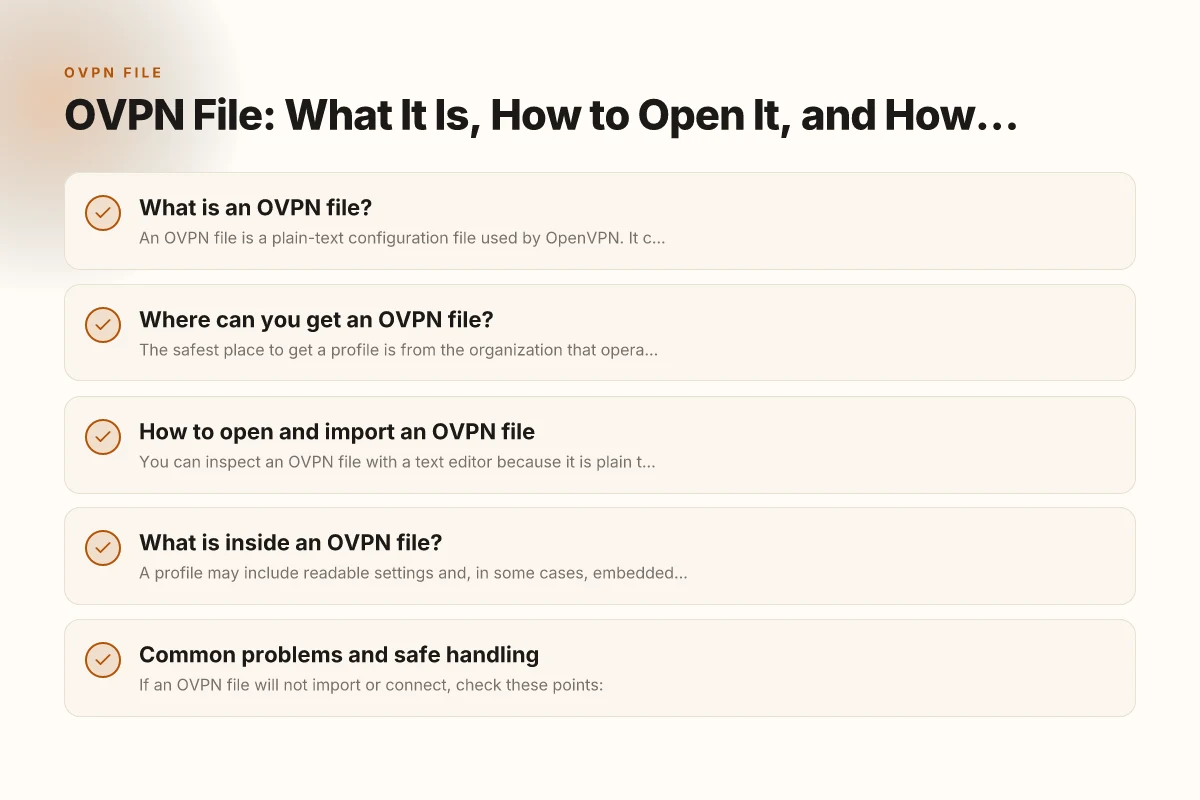
What is an OVPN file?
An OVPN file is a plain-text configuration file used by OpenVPN. It can specify connection settings such as the server address, connection protocol, encryption and authentication options, and certificates or key references. The exact contents depend on who created the profile and how the VPN server is configured.
Think of the file as a set of connection instructions for an OpenVPN client. It is not the client app itself, and it does not necessarily include an account or access to a working VPN server.
On Windows, OpenVPN configuration files commonly use the .ovpn extension, such as client.ovpn or server.ovpn. On Linux, BSD, and other Unix-like systems, sample configurations are commonly named client.conf and server.conf. A .conf file can contain OpenVPN settings too, but follow your provider’s instructions about which file to use and where to save it.
Where can you get an OVPN file?
The safest place to get a profile is from the organization that operates the VPN server you intend to use.
Common sources include: What Is a.ovpn File? How to Open and Use One
- A commercial VPN provider: Look for its OpenVPN setup or configuration page. Providers may offer separate profiles for locations or connection options.
- A workplace or school IT team: Ask the administrator for the correct profile and any required login details.
- Your own OpenVPN server: Create or obtain a client profile that matches the server’s configuration.
- A third-party repository: Use caution. A profile may point to a server you do not control, and any associated credentials or instructions should be verified.
A free OVPN file is not automatically safe or useful. It may be outdated, connect to an unknown operator, or require credentials that are not supplied. The profile alone does not establish that the server is trustworthy. Avoid downloading files from unverified sites or sharing a profile that contains private keys, certificates, or other sensitive information.
How to open and import an OVPN file
You can inspect an OVPN file with a text editor because it is plain text, but editing it is not usually necessary. To connect, import it into an OpenVPN-compatible client, such as OpenVPN Connect, or the client recommended by your provider.
The general process is:
- Install a trusted OpenVPN client for your device.
- Download the profile from your provider or administrator.
- Open the client and choose its import option. Depending on the app, you may select the file, drag it into the app, or open it from your device’s file manager.
- Enter your credentials if requested. The profile may use a separate username and password, or another authentication method.
- Connect and check the status in the client. Disconnect if the app reports an error or you are unsure which server you have reached.
Exact menu names and steps differ by operating system and app. Use the client’s documentation if the import option is not obvious. If the app rejects the file, confirm that it is a complete profile with the expected extension and that it was intended for that client and server.
| File or item | What it does | Is it enough to connect? |
|---|---|---|
.ovpn profile |
Provides OpenVPN connection settings | Not always; login details or additional files may be required |
| OpenVPN client app | Reads the profile and manages the connection | No; it needs a valid profile and access to a server |
| Username and password | Authenticates you when the server requires them | No; they do not replace the profile |
| Certificate or key | Helps authenticate a client or server | Only when it matches the VPN setup |
Ways to open or use an OVPN file VPN FortiClient: What It Does, How to Connect, and Which Version to Use
| Option | Platform | How it uses the file | Best suited for | Key consideration |
|---|---|---|---|---|
| OpenVPN Connect | Desktop and mobile | Imports the profile into the app | General OpenVPN connections | Get the app from its official source |
| OpenVPN GUI | Windows | Loads a profile for connection | Windows users using OpenVPN software | Follow the app’s import instructions |
| OpenVPN command-line client | Systems with a compatible client | Starts a connection using the profile | Experienced users and automation | Requires command-line setup |
| VPN provider app | Supported platforms | Applies provider settings in the app | Users who prefer guided setup | May not accept standalone profiles |
| File manager and VPN app | Mobile devices | Opens the file with a compatible app | Importing a downloaded profile | Keep the file in a trusted location |
| Text editor | Most platforms | Displays readable configuration text | Inspecting a profile | Do not edit unfamiliar settings casually |
Compiled November 2026; check the provider's site for current details.
What is inside an OVPN file?
A profile may include readable settings and, in some cases, embedded certificate or key material. It might also refer to separate certificate or key files that must be kept with the profile. Do not assume that every OVPN file contains all required components.
If you open the file in a text editor, you may see a server address, protocol or port settings, and directives that tell OpenVPN how to handle certificates and authentication. Some entries may look unfamiliar. Do not remove or change them unless the provider or administrator tells you to: altering a setting can prevent the connection from working or change how it behaves.
Treat the file as sensitive if it contains credentials, private keys, or certificates. Store it securely, do not post it publicly, and ask the issuer for a replacement if you believe it has been exposed.
Common problems and safe handling
If an OVPN file will not import or connect, check these points: VPN Extension Free Edge: How to Choose One for Microsoft Edge
- Confirm the file is complete. A download may have been interrupted or saved under an unexpected name.
- Check for extra files. Some profiles refer to certificates or keys stored separately.
- Verify your login details. Credentials for a VPN account may be different from your device or email password.
- Use the right profile. A file for one server, platform, or connection type may not work for another.
- Ask the provider or administrator. They can confirm whether the profile is current and whether your account has access.
Do not use a profile just because it connects successfully. A VPN routes traffic through the server named in its configuration, so the server operator may be able to observe some information about the traffic. Choose a provider or administrator you trust, and obtain profiles through an official channel.
OVPN file safety and troubleshooting checks
| Check or issue | What to look for | Safer next step |
|---|---|---|
| Untrusted source | Unknown sender or download site | Obtain the profile from the provider or administrator |
| Embedded credentials | Usernames, passwords, or key material | Keep the file private and follow the issuer’s guidance |
| Certificate or key files | References to certificates or keys | Keep required files together and protect them |
| Incorrect server details | Unfamiliar hostname or address | Confirm the endpoint with the profile issuer |
| Import failure | Unsupported format or incomplete profile | Use a compatible OpenVPN client and check the file |
| Connection failure | Network, account, or server problem | Check credentials and contact the service provider |
| Unexpected configuration | Unfamiliar routes, scripts, or options | Pause and ask a trusted administrator to review it |
| Profile no longer needed | Old or revoked connection details | Remove it securely and request an updated profile |
Compiled November 2026; check the provider's site for current details.
Recommendation
Use an OVPN file supplied by your VPN provider, employer, school, or your own server administrator, and import it with a reputable OpenVPN client. Keep the profile and any related keys private. If you cannot verify who created the file or which server it connects to, do not use it.

Rorik Vasquez has been writing about consumer technology since 2018, with bylines covering mobile privacy, split tunneling, and browser fingerprinting. Approaches each review by setting up the product the same way a typical reader would and recording every snag along the way.