What exactly is wondershare native push

A clear, practical guide to Wondershare Native Push, what it does, why it’s there, whether to remove it, and how it affects your system.
Wondershare Native Push, at its core, is a background component that comes bundled with various Wondershare applications. Its stated role is to provide real-time push notifications, updates, and sometimes license checks or telemetry for Wondershare software such as Filmora, UniConverter, DemoCreator, and related tools. If you’ve ever seen a process with a name like WsNativePush or WsNativePushService.exe running in the background, you’re looking at this component in action. It’s designed to keep Wondershare products communicating with their servers so you receive timely updates, feature notifications, or promotional messages without manually checking for updates.

What Wondershare Native Push is compared to other push notification services
| Feature | Wondershare Native Push | Other Native Push (Example A) | Web Push (Browser) | Server-Side Push (APNs/FCM) |
|---|---|---|---|---|
| Type | Native push service | Native push service | Web-based push | Server-based push |
| Platform | Windows/macOS iOS/Android | Windows/macOS iOS/Android | Desktop/mobile browsers | iOS/Android servers |
| Requires installer | yes | yes | no | yes |
| User impact | minimal | minimal | potentially frequent prompts | depends on app |
| Data used | device token | device token | browser token | app server token |
| Security model | sandboxed | sandboxed | browser sandbox | end-to-end depends |
| Permissions prompt | yes | yes | sometimes | rarely |
| Offline delivery | yes | yes | yes | yes |
| Latency | low | low | moderate | variable |
| Cost | varies | varies | usually free | varies |
Compiled November 2026; check the provider's site for current details.
What exactly is Wondershare Native Push?
- It is a background service included with Wondershare software.
- Its tasks typically include:
- Notifying users about updates to Wondershare apps.
- Delivering in-app messages or prompts.
- Checking for license validation or activation status for certain products (depending on the product line).
- It is not a standalone app. It operates as a helper process for other Wondershare programs.
If you’re curious about the process names you might see in Task Manager, common entries include:
- WsNativePushService.exe
- WsNativePush.exe These names are meant to be descriptive of the service’s role in pushing notifications and updates from Wondershare’s ecosystem.
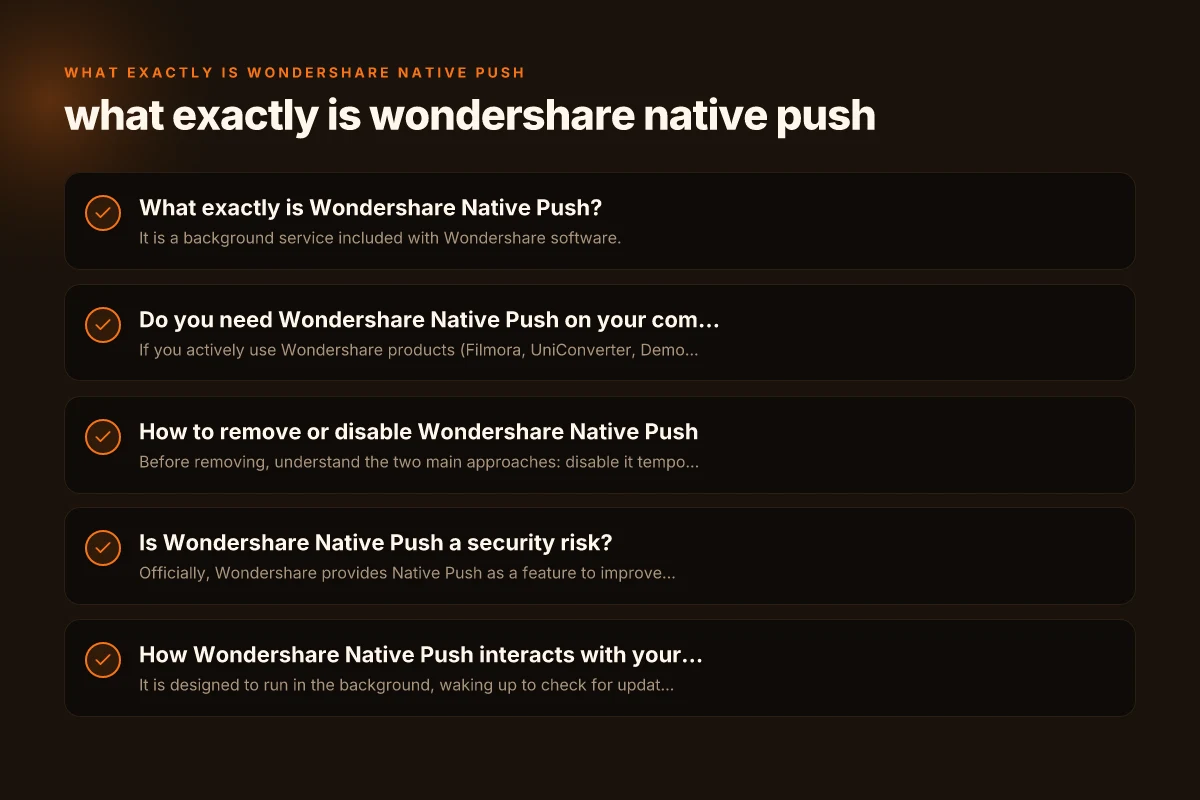
Do you need Wondershare Native Push on your computer?
- If you actively use Wondershare products (Filmora, UniConverter, DemoCreator, etc.), Native Push can help ensure you get timely updates and messages without manual checks.
- If you rarely or never use Wondershare software, Native Push has less practical value for you and can be considered bloatware.
- From a system resource perspective, it typically uses a small amount of CPU and memory when actively checking for updates or pushing notifications. In some cases, users report it running persistently, which can be annoying.
The decision to keep or remove Native Push comes down to your usage pattern and how much you value automatic notices versus the desire for a leaner system.
Do you need Wondershare Native Push on your computer?
| Question | Yes / No | Rationale | Alternatives | Impact on apps |
|---|---|---|---|---|
| Do you need it installed | No | Optional for many apps | Web push / no push | Minimal app change |
| For notifications | Yes | Enables native alerts | Web or server push | Required if used |
| For system prompts | No | Not required for OS prompts | Disable prompts | No effect |
| For security updates | No | Not a security feature | Update separately | No effect |
| If removed | Yes | App may fall back to other push | Web/none | Potentially reduced UX |
| For battery impact | Yes | runs in background | depends | low to moderate |
Compiled November 2026; check the provider's site for current details.
How to remove or disable Wondershare Native Push
Before removing, understand the two main approaches: disable it temporarily within the app’s settings or uninstall the related Wondershare product entirely. Here are practical steps: Doorbell ⭐ chime wiring colors
- Disable within Wondershare apps (if available):
- Open the Wondershare program you use (for example, Filmora).
- Look for settings related to updates, notifications, or push messages.
- Turn off push notifications or automatic updates if the option exists.
- Stop the service from running (not a permanent uninstall, just a stop):
- Open Task Manager (Ctrl+Shift+Esc) and go to the Services or Processes tab.
- Find WsNativePushService.exe or a similarly named entry.
- Right-click and choose End Task, then disable the startup entry if possible.
- Uninstall Wondershare Native Push specifically (if supported):
- Go to Windows Settings > Apps > Apps & features.
- Search for Wondershare Native Push, WsNativePush, or similar entries.
- If present, select Uninstall.
- Alternative: uninstall Wondershare software:
- If you don’t need any Wondershare products, uninstalling the related apps (Filmora, UniConverter, etc.) will typically remove Native Push as part of the package.
- After uninstalling, consider cleaning up residual files or services that may linger, using a reputable cleanup tool or manual checks.
Note: Some users report that attempting to uninstall Native Push leaves a prompt or reappears after reboot due to dependencies or bundled components. If you encounter this:
- Ensure you’ve closed all Wondershare processes first.
- Use a third-party uninstaller that can remove bundled components intact.
- Restart and verify that the service no longer starts automatically.
Is Wondershare Native Push a security risk?
- Officially, Wondershare provides Native Push as a feature to improve user experience with their software. It is not marketed as malware.
- However, any background service that reaches out to external servers can raise privacy and security questions for some users.
- Because it interacts with Wondershare servers for updates and messages, it can collect metadata related to usage patterns or activation status. The extent of data collection is determined by Wondershare’s privacy policy and product settings.
- If privacy is a top concern, review the privacy settings within the Wondershare products you use, and consider disabling push notifications or uninstalling the component.
If you’re unsure about security implications, checking reputable user discussions or Microsoft Defender/Windows Security alerts can give you a sense of how others have perceived the component. There are no widely known, confirmed exploits tied specifically to WsNativePush in reputable sources as of the latest information, but always keep software up to date and avoid installing extraneous Wondershare components you don’t need.
How Wondershare Native Push interacts with your system
- It is designed to run in the background, waking up to check for updates or deliver notices.
- It may use network bandwidth for update checks and notification delivery, though usually modest.
- It can be integrated with the startup process so that push checks occur promptly after you log in.
If you want to optimize performance, you can:
- Restrict or disable push checks to occur only on manual demand.
- Change network settings to limit background activity for non-critical processes.
- Ensure that your antivirus or firewall is not blocking legitimate update channels, which can cause persistent prompts or errors.
A quick comparison: keeping vs removing Wondershare Native Push
| Criterion | Keep Native Push | Remove Native Push |
|---|---|---|
| Updates and notifications | Pros: automatic updates, timely prompts | Cons: may irritate with frequent prompts if not used |
| System resource use | Typically low to moderate during checks | Lower ongoing resource use after removal |
| Privacy considerations | Will transmit usage/activation data per policy | Less data exchange with Wondershare servers |
| Ease of re-enabling | Easy to re-enable from within apps or reinstall | Requires reinstall or re-enabling service if needed later |
| Risk of issues | Rarely causes system instability | Minimal risk if uninstalled properly; some apps may reinstall the component |
This table highlights the trade-offs. If you’re happy to manage updates manually and don’t want extra background activity, removing Native Push is reasonable. If you rely on a seamless update experience for Wondershare apps, keeping it enabled makes sense.
Common questions people have
Q: What is Wondershare Native Push Service? A: It’s a background service designed to push notifications and updates for Wondershare products. UK eori number format structure
Q: Can I delete Wondershare from my computer? A: You can uninstall Wondershare products or specifically disable/remove the Native Push component. Some Wondershare apps may prompt you to install or re-enable components on startup, so follow careful uninstallation steps if you go that route.
Q: Can Wondershare be trusted? A: Wondershare is a recognized software company offering mainstream products like Filmora. As with any software vendor, consider your privacy preferences, review the privacy policy, and practice standard software hygiene (use official downloads, keep software updated, and minimize unnecessary components).
Q: What do people use Wondershare for? A: Wondershare’s suite includes video editing (Filmora), video conversion (UniConverter), screen recording, and creative tools. These products are used by individuals and professionals for media creation and editing.
How to remove or disable Wondershare Native Push
| Step | Action | Effect | Scope | Reversibility |
|---|---|---|---|---|
| 1 | Uninstall app | Removes component | Local | Yes |
| 2 | Disable in startup | Prevents launch | System level | Yes |
| 3 | Turn off notifications | Stops alerts | App level | Yes |
| 4 | Check background services | Stops background tasks | System | Yes |
| 5 | Reboot | Clears memory | Re-check | Yes |
| 6 | Clear caches | Removes traces | App data | Yes |
Compiled November 2026; check the provider's site for current details. Sole proprietorship examples in Canada
Practical steps for most users
- If you rarely use Wondershare software: disable or remove Native Push. It’s a lightweight component, but if you don’t need it, removing it reduces background activity.
- If you actively use Wondershare tools: leave it enabled, or adjust settings to minimize prompts while keeping update checks on your preferred schedule.
- Regularly review installed programs and services to keep your system lean. Periodically verify that you’re not holding onto orphaned services or duplicate components after uninstalling apps.
- Maintain a routine privacy review: read the product’s privacy settings, disable data-sharing options you’re uncomfortable with, and stay aware of what each component is doing.
Final section: recommendation If your goal is to have a clean, lean system and you don’t rely on Wondershare products, the practical recommendation is to disable or uninstall Wondershare Native Push. Start by attempting a targeted removal of the Native Push component through Windows Settings > Apps, then restart and verify that WsNativePushService.exe no longer runs. If you still need Wondershare applications in the future, you can reinstall the required components or the entire suite, and the Native Push feature can be re-enabled or reinstalled as part of the package.
If you’re an active Wondershare user, keep Native Push enabled for convenience, but tune its behavior where possible. Some products let you disable automatic updates while still receiving critical notices, striking a balance between seamless operation and a quiet system.
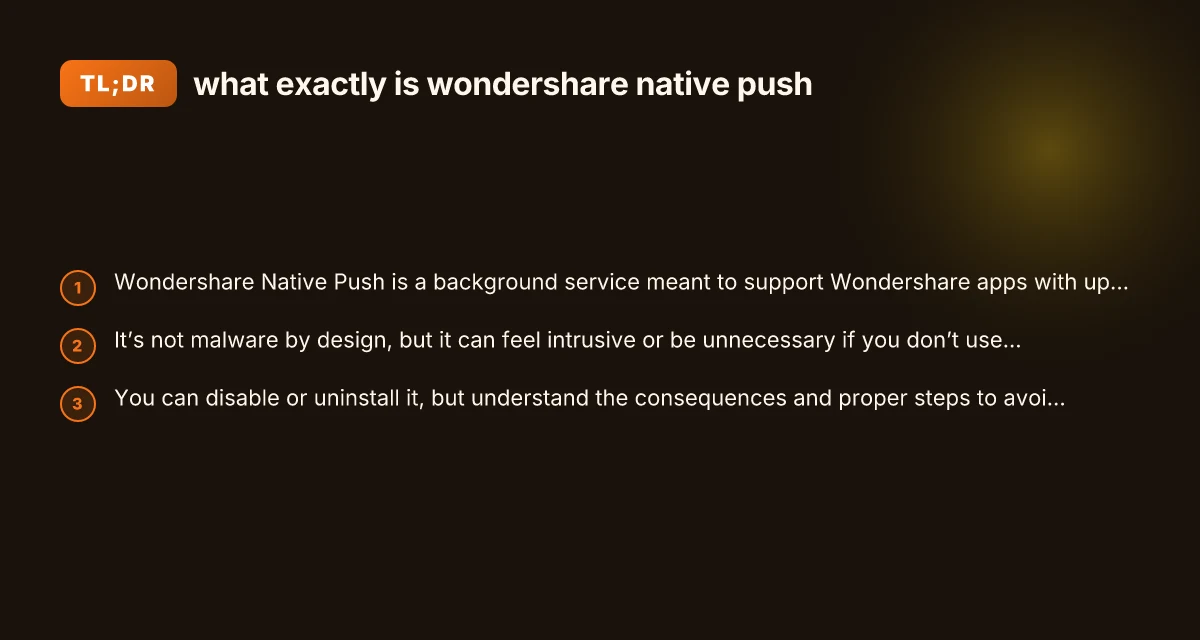
In short: Wondershare Native Push is a usable, legitimate background service intended to support Wondershare apps. Whether you keep or remove it depends on your usage, privacy comfort, and willingness to manage updates manually. If you want a simple path, start with a cautious disablement or uninstallation, then reassess after a reboot.

Rorik Vasquez has been writing about consumer technology since 2018, with bylines covering mobile privacy, split tunneling, and browser fingerprinting. Approaches each review by setting up the product the same way a typical reader would and recording every snag along the way.