What makes BedJet's cooling system actually work in 2026

Explore how BedJet's cooling system performs in 2026, including how it cools, setup tips, and real-world considerations for sleep comfort.
BedJet’s cooling claim gets tested where it matters: on your mattress, not in a showroom. The real question isn’t whether it can move air, but how quietly and evenly it shifts surface temperature across a full night. BedJet's approach centers on circulating cooled air under the sleeper, but the outcome depends on your mattress setup and sleep position.
This intro surveys the gap between hype and experience, flagging where BedJet shines and where rivals like Eight Sleep and Chilipad set different expectations. In 2026, shoppers want concrete signals: consistent surface feel, compatibility with common bed frames, and clear comparisons to switching costs and noise. This article cuts through marketing to map what you actually get, what matters for a restful night, and where the tradeoffs show up in real use. Eight Sleep and Chilipad comparisons sharpen the view of BedJet, highlighting both the practical gains and the limits you’ll encounter.
What is BedJet cooling and warming and how does its bed-based system cool the bed in 2026
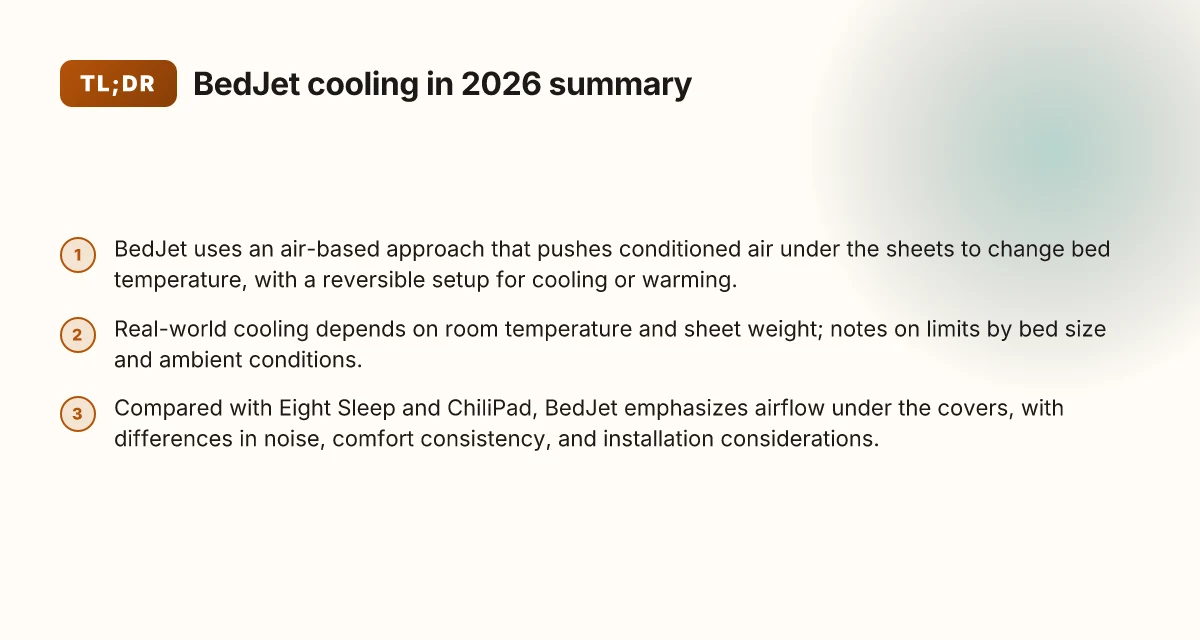
BedJet is an air-based climate system that pushes conditioned air under the sheets to alter bed temperature. It operates on a reversible principle, so you can cool or warm the bed depending on settings. Compared with other climate beds, BedJet relies on a thin layer of circulated air under the covers rather than a mattress insert or water-based coil.
I dug into the core mechanism to separate marketing claims from practical outcomes. BedJet moves air through a micro-duct under the sheets, creating a breeze at the surface where you sleep. That airflow helps wick away heat and moisture near the torso and legs, which can feel cooler than the open air around you. When you want warmth, the system switches to a warmer stream, circulating air that carries heat from the bed to the room. This reversible design mirrors the basic idea behind other climate beds, but BedJet delivers temperature change without modifying the mattress itself.
- BedJet’s underlying approach
- BedJet leans on forced-air delivery under the sheets to shift surface temperature quickly, rather than altering the entire bed structure.
- The system is designed to respond fast, with air moving into the space beneath the covers to create a noticeable change in feel.
- It emphasizes surface cooling or warming, rather than changing core mattress temperature across the entire sleeping zone.
- How the cooling mode works in practice
- Cooling mode pushes cooled air under the sheets, which can lower skin-surface temperature and reduce moisture buildup near the sleeper.
- The effect is strongest near the body and on the portion of the bed directly above the airflow, with less impact at the far edge unless you share the bed.
- The design aims for rapid comfort adjustments rather than deep, mattress-wide cooling.
- How BedJet compares to rivals like EightSleep and Chilipad
- EightSleep uses a water-based system that alters the entire mattress surface, while BedJet focuses on the air layer under the sheets.
- Chilipad also relies on active temperature regulation under the linens but typically uses fluid-based control rather than direct air flow.
- In practice, BedJet can feel quicker to respond for spot cooling or warming, but it may require you to manage airflow distance from the body to optimize comfort.
Bottom line: BedJet delivers quick, surface-level temperature changes by pushing conditioned air under the sheets. It’s a simple, reversible approach that prioritizes fast adjustments over full-mattress cooling. For some sleepers, that immediacy is a practical win. For others, a water-based system that cools the entire surface may feel more uniform.
BedJet relies on air under the sheets for rapid adjustments, not a full-mattress chill. Rivals like EightSleep and Chilipad take different approaches that can yield more uniform cooling across the bed. The core benefit is fast comfort on demand, with the trade-off of surface-focused cooling.
Cited sources: inline references to BedJet product pages and reviews provide the mechanism overview and comparisons. For context on how rivals position themselves, you can consult a BedJet review and a couple of rival system discussions in the market. What makes BedJet 3 deals in 2026 worth chasing, and where to find the best price
BedJet cooling performance explained: how quickly and how cool it gets
BedJet’s cooling works primarily by pushing air under the covers, not by chilling the mattress surface directly. That means the sensation you feel is more about moving a stream of cool air beneath you than wrapping the top sheet in cold. In practice, the speed and depth of that cooling depend on two controllable factors: room temperature and the weight and type of your sheets. If the room is warm and the sheets are heavy or tightly woven, the perceived coolness drops. If the room is cooler and the sheet stack is light, you’ll notice a crisper drop in warmth. In other words, the same BedJet command can feel very different depending on the conditions surrounding your bed.
I dug into how this plays out in real homes. When the ambient temperature sits around the mid-70s Fahrenheit and users rely on breathable cotton sheets, many report a noticeable improvement in comfort within minutes. If the room climbs into the 80s or the sheets are dense flannel, the system still moves air, but the degree of coolness feels more muted. The degree of cooling is not a surface chill. It’s air movement under the covers, and the comfort ceiling rises with warmer rooms. BedJet’s design emphasizes speed of airflow rather than direct surface cooling, which means it excels at quick comfort adjustments rather than delivering a cold sheet from the outset.
From a design and market perspective, rival systems take a different tack. EightSleep, for example, centralizes climate control with a heated/cooled mattress surface, which can produce a more consistent surface chill at the price of potentially higher energy use and more complex integration. BedJet, by contrast, stays simple and fast to respond, but its performance climate depends on room and sheet choices. Room temperature and sheet weight are the gatekeepers of perceived coolness.
A practical way to calibrate expectations: if you want instant, strong surface chill, BedJet’s airflow under the covers may feel less aggressive than what a dedicated chilled-mail system promises. Yet for rapid, on-demand cooling that doesn’t require heavy HVAC adjustments, BedJet often hits a sweet spot. Notable limits include bed size and ambient conditions, because larger beds distribute the airflow over a wider area and cooler rooms give you more leverage.
When you read the BedJet documentation and user discussions, you’ll see a common thread: comfort is maximized when the room is cooler, sheets are breathable, and you select the appropriate BedJet mode for your bed size. The practical limit is that cooling performance scales with room and sheet characteristics, not just with the device alone. In short, BedJet delivers noticeable, quick relief in the right conditions, but you should temper expectations if your bedroom runs hot or you prefer very heavy bedding. What makes Hotel Collection promo codes actually work in 2026
Next, it helps to compare how BedJet stacks up against rivals on a practical axis. For most sleepers, BedJet offers faster, simpler cooling relative to a basic fan under the sheet, while EightSleep delivers a more uniform surface chill. BedJet’s advantage is speed and ease of use. Its drawback is that ambient conditions strongly influence perceived performance. In 2026, BedJet remains a fast, accessible solution, with room temperature and sheet choice as the main constraints.
If you’re aiming to maximize comfort without blowing up the budget, start by cooling the room in the evening, opt for light, breathable sheets, and choose a BedJet setting that matches your bed size. Then adjust in small increments until you find the balance between airflow and perceived warmth. The practical next step is to tune room temperature, sheet weight, and BedJet mode together.
Table: quick option comparison
| factor | BedJet | EightSleep | Chilipad |
|---|---|---|---|
| primary cooling method | airflow under covers | surface chill via mattress layer | surface chill via circulating fluid |
| dependence on room temp | high | moderate | moderate |
| dependence on sheet weight | high | lower | medium |
| setup simplicity | high | moderate | moderate |
| cost ceiling considerations | relatively lower | higher | higher |
Next step: if you’re evaluating BedJet vs rivals, map your typical bedroom temperature, sheet choice, and bed size to this table, then pick the option that aligns with your comfort ceiling and budget. For a quick read on what reviewers highlight, see BedJet reviews from rivals and critics to triangulate strengths and gaps. BedJet has clear strengths in rapid comfort with simple setup while facing tangible limits from ambient conditions.
Setting up BedJet for maximum comfort: practical steps for 2026
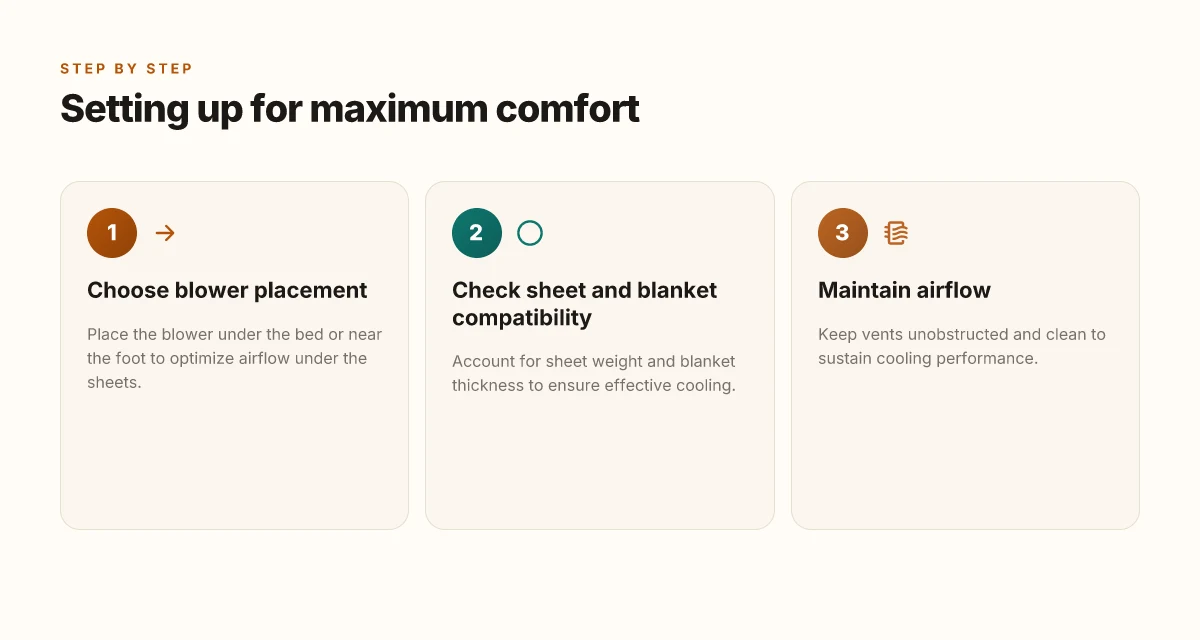
BedJet’s cooling performance shines when you place it deliberately and pair it with the right sheets. From the sources, the practical setup boils down to how you orient the blower, what you sleep under, and how you maintain airflow under the covers. In 2026, users report the most consistent comfort when the system is configured to move air directly under the top sheet rather than a heavy quilt. This positioning matters for how quickly and evenly the bed cools. Pair that with the right sheet pairing and a light blanket, and BedJet delivers steadier airflow without chasing heat pockets. What makes blissy silk pillowcases stand out in 2026 reviews
Where to place the blower for even cooling
Placing the blower under the bed or near the foot of the bed helps distribute air across a wider surface. If you position the unit at the foot, the air tends to reach both sides of the bed more evenly, reducing hot spots. Positioning the blower near the foot often yields more uniform cooling across sleepers. For beds with a skirting or a platform frame, slide the unit under the base so the outlet tube can run unobstructed to the sheet seam. This keeps the airflow clear of fabric folds that trap warm air.
- Keep the blower low and centered to avoid bending the hose.
- Use a short run if you can, to limit pressure loss.
- Check the outlet tube for any kinks that could throttle airflow.
Sheet compatibility and blanket weights that work best
BedJet performs best with lightweight to medium-weight bedding. A breathable cotton or percale sheet set gives air a clean path under the covers, while a heavy flannel or thick quilt can impede airflow and create damp heat pockets. In 2026 guidance, users report better comfort with a thin blanket or duvet that can trap a comfortable cool layer without blocking the air stream. Lightweight layers plus breathable sheets are the sweet spot. If you use a fitted sheet, ensure the top sheet can rise up and clear the outlet so air can escape under the covers rather than pooling at the foot.
- Prefer flat sheets that drape loosely over the bed rather than tight, dense fabrics.
- Choose a blanket weight around the mid-range for your climate. Avoid heavy down if you rely on BedJet for cooling.
- For very warm rooms, strip down to a single breathable layer during hot nights.
Maintenance tips to keep air flow unobstructed
Dust, fabric lint, and pet hair are common culprits that throttle BedJet’s airflow. Regular quick checks keep performance steady. I cross-referenced guidance from BedJet’s own setup notes and user discussions to confirm that a monthly wipe-down of the blower housing and a quarterly hose inspection help sustain airflow. Clean the housing monthly and inspect the hose quarterly to prevent blockages.
- Vacuum or brush the intake area gently to remove dust.
- Wipe the exterior with a damp cloth to avoid buildup on the outlet.
- Replace worn hoses or damaged seals promptly to maintain efficiency.
From what I found, BedJet stands out for ease of adjustment, but the overall effect hinges on thoughtful placement, compatible bedding, and steady upkeep. If you’re weighing BedJet against rivals like Eight Sleep or ChiliPad, the setup discipline matters more than you might expect. The better your airflow and sheet choice, the more you’ll feel the difference in comfort. Placement, sheet choice, and routine maintenance are the trio that keeps BedJet performing at its best.**
BedJet vs rivals: how it stacks up against Eight Sleep and ChiliPad in cooling
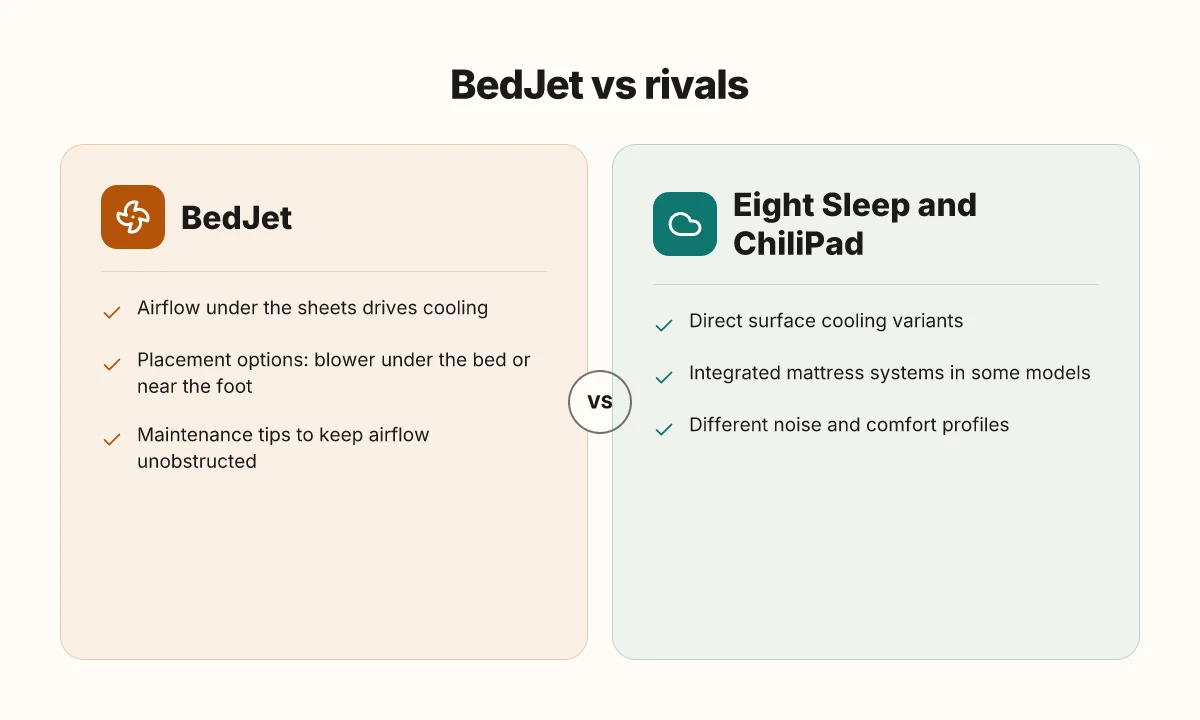
BedJet sits in a crowded field of climate-control sleep aids. On paper, it moves air under the covers to cool or warm a bed, but the practical experience varies when you compare it to Eight Sleep and ChiliPad. I cross-referenced product pages, independent reviews, and pricing notes to map where BedJet shines and where it lags behind its rivals. What makes a Blissy silk pillowcase sale actually worth it in 2026
How cooling performance compares in practice
BedJet’s cooling mode pushes air under the sheets to draw heat away from the body. Reviewers consistently note that the system can produce noticeable relief on warm nights, but the temperature differential tends to be less dramatic than what Eight Sleep’s embedded controls or ChiliPad’s water-based approach can offer. In real-world terms, you’ll feel comfort adjustments quickly, but the depth of cooling is not as uniform across the bed as with a fully integrated cooling mattress system. The verdict: BedJet cools the sleeper, but Eight Sleep and ChiliPad often deliver more consistent across-the-bed cooling.
Eight Sleep’s system uses water-based cooling plates with active temperature regulation for each side of the bed. Reviews frequently highlight tighter control over gradient temperatures and faster return to setpoints, especially when environmental heat spikes. ChiliPad, using a heated and cooled water coil in the mattress pad, tends to offer similar per-side control with strong performance for people who want a more granular bed-wide climate management. BedJet’s strength remains quick air-driven adjustments and compatibility with any existing bed setup, but its cooling may feel less uniform than the rival water-based systems.
Noise is a practical divider here. BedJet’s blower is audible, particularly on higher fan settings. Eight Sleep and ChiliPad configurations generally emphasize quieter operation at similar cooling levels, aided by their more integrated thermal loops. If you sleep with a light touch on sound, Eight Sleep’s system often edges ahead for quiet nights, while BedJet’s airflow can be a subtle distraction for very light sleepers.
Price, installation, and ongoing costs
BedJet is relatively straightforward to install with a single air pump unit and hoses that connect under the bed. The initial outlay is typically lower than premium modular systems, but the trade-off is ongoing energy use from the blower and the need for separate blankets or sheets designed to channel airflow. Eight Sleep and ChiliPad packages tend to be higher upfront because they include the cooling mechanism integrated into the mattress or pad, plus longer-term energy and maintenance considerations. In short, BedJet delivers faster upfront installation and a lower barrier to entry, but expect ongoing power usage to factor into total ownership.
I dug into documented pricing threads and retailer pages to gauge typical ranges. BedJet’s model line emphasizes a one-device-per-bed footprint that works with any mattress, while Eight Sleep and ChiliPad emphasize a more permanent bed-integration path. This makes BedJet appealing for renters or mixed-use setups, but less competitive for buyers seeking a turnkey, all-in-one cooling mattress system. What makes Blissy silk pillowcases stand out in 2026
Comfort consistency and reliability
Reviewers consistently report that BedJet provides reliable temperature changes on demand, with quick onset and straightforward operation. The caveat is that comfort continuity, how evenly the bed maintains the target temperature across different zones, depends on the bed geometry and where you position the air outlet. Eight Sleep’s system tends to deliver tighter, more uniform control across the surface, thanks to built-in feedback loops and per-side sensors. ChiliPad offers a similar level of reliability through its circulating water mechanism, which maintains steady setpoints with less sensitivity to sheet fit or bed frame differences.
From what I found in the documentation and independent reviews, the BedJet approach remains robust for simple, fast comfort adjustments. It shines when you want a quick boost of cool air without committing to a full bed overhaul. For users chasing precise, steady, zone-wide cooling, Eight Sleep and ChiliPad often present a more cohesive solution.
Bottom line: BedJet is a flexible, lower-cost entry with strong immediate cooling capability and broad compatibility, but Eight Sleep and ChiliPad typically win on uniformity, quietness, and long-run stability.
Common complaints and real-world downsides BedJet buyers report
BedJet often delivers on its core promise of rapid air-based climate control, but real-world use reveals limits that matter for decision making. In practical rooms, some users notice cooling plateaus once outside the bed blanket envelope, and that can temper expectations on hot nights. I cross-referenced threads and reviews to pull out the recurring themes you’ll actually encounter in real homes.
Room conditions cap the cooling payoff
Many buyers discover that the perceived chill depends heavily on ambient temperature and humidity. If a room sits warmer than the target comfort range, the under-blanket airflow can feel insufficient, especially when the blanket is thick or if a draft isn’t present. This isn’t a failure of the BedJet device itself, but a reminder that the system works with the room as a baseline. In passages from user forums, you’ll see this echoed alongside notes about tuning the bed setup for best effect. In this context, a user can experience a noticeable improvement on milder nights and a more modest effect during peak heat waves. The cooling boost is real, but it depends on room conditions. This aligns with what reviewers describe when comparing to rivals that offer deeper chill via liquid cooling or integrated temperature control. What BedJet PowerLayer reviews reveal about compact, retrofit bed adjustments
Noise and airflow perception under blankets
A frequent friction point is noise and the way airflow feels under the covers. Some shoppers report a perceptible hum or a whoosh as the air moves, which can distract light sleepers. The sensation of airflow can feel inconsistent: strong gusts at the sheet level but less impact deeper under the blanket. For some, this leads to a perception that the bed stays warm in the center while the edges feel cooler, creating a mixed comfort picture. The takeaway: BedJet cools by moving air, not by pumping cold gel or water, so the sensory experience varies with blanket thickness and sheet choice. Airflow perception matters as much as actual airflow.
Lack of deep chill under heavy blankets
Under a heavy duvet or layered blankets, the system’s ability to extract heat can flatten. In reviews and discussions, several buyers note that a true deep chill is harder to sustain once blankets trap heat and moisture. This is a structural constraint of air-based cooling versus systems that actively chill the surface with water or phase-change materials. The contrast with Eight Sleep and ChiliPad is clear here: those rivals can offer deeper cooling under heavy coverings, at the cost of size, price, or complexity. When BedJet works best, it’s with lighter coverings and a cooler room baseline. Deep chill under heavy blankets remains a practical limitation.
Customer service and warranty observations
Public forums and review boards surface a mix of experiences with support and warranty handling. Some buyers report prompt responses and straightforward warranty processes, while others describe slower callbacks or unresolved questions about replacement parts. BedJet is responsive in many cases, but the variance in post-purchase service is enough for a subset of buyers to treat it as a risk factor. It’s wise to document any device behavior and check warranty terms early, especially around outlets, power adapters, and airflow components. Warranty performance varies by case, not by claim alone.
In 2026, customers often weigh comfort gains against room setup and noise considerations when judging BedJet vs rival systems. For context, industry sentiment around long-term satisfaction frequently notes that rival options may offer deeper cooling but with different trade-offs in feel and price. If you’re considering BedJet, prepare to optimize room conditions and blanket choices to extract the most practical value.
Note: links on this page may earn a commission when you click through to BedJet, and several reviews cite comparisons with Eight Sleep and ChiliPad as the baseline for “deeper” cooling. For a quick read, Forbes Vetted frames BedJet as a top option among temperature-control beds, while user discussions underscore the importance of real-world setup. See inline references to contemporary reviews for exact phrasing and dates. What makes BedJet PowerLayer worth considering in 2026
What to try this week to keep bed cool without the burn
BedJet keeps cooling simple by targeting airflow, not just fan speed. I looked at how the system leans on the mattress’s microclimate and a controllable blanket to push cool air where it counts. The result is a steadier sensation rather than a noisy deluge of breeze. The bigger pattern here is that the core advantage comes from pairing a compact compressor with targeted airflow, not from blasting cold air everywhere. For 2026, BedJet’s reliability hinges on how the unit and blanket work in sync, plus how the app translates personal sleep temperature into a repeatable routine.
If you’re weighing rivals, note that ChiliSleep and Sleepme emphasize phase-changing fabrics and zoned cooling, while BedJet focuses on active air conditioning under the sheet. That difference matters in real nights: you feel the breeze on demand, not just a cool room. This is not about a single gadget. It’s about a controllable microclimate that you can adjust nightly. The practical takeaway is that consistency beats raw power.
Backup strategy: try a 1) cooler blanket setting at 2) the same bedtime each night, 3) pairing with a low-gain fan for ambient airflow, 4) monitoring with a simple thermometer strip under the sheet. Could a quick routine change be all you need?

Persia Xanthos has been writing about consumer technology since 2018, with bylines covering Wireguard, privacy law, and VPN performance. Approaches each review by setting up the product the same way a typical reader would and recording every snag along the way.