BedJet vs Eight Sleep: how the two temperature-control beds stack up in 2026
Compare BedJet and Eight Sleep Pod in 2026 across comfort, reliability, app insights, and cooling tech. Learn what really moves the needle for better sleep.
BedJet costs you sleep flexibility as soon as you wake: a simple under-sheet system can cool or warm without rebuilding your bed, but it also means chasing comfort through a device tucked under the covers rather than a full sleep platform. BedJet remains a focused tool, while Eight Sleep Pod shifts toward a complete bed-within-a-bed approach. That contrast matters when you weigh year-long reliability against upfront setup quirks and ongoing costs.
What matters now is how real users experience this in daily life. In 2026, customers report that BedJet delivers consistent under-sheet climate control, but maintenance intervals and compatibility with existing bedding drive ongoing questions. Eight Sleep, by contrast, offers data-driven personalization and integrated heating and cooling, yet some households encounter durability and support snags after the warranty window. Eight Sleep's built-in platform can feel more reliable on a busy, sleep-intensive schedule, but you pay a premium for that integration, and the long-term service story varies by region. The sections that follow unpack these tradeoffs with practical guidance and quantified observations.
Bedjet vs eight sleep: a quick orientation to two temperature-control systems
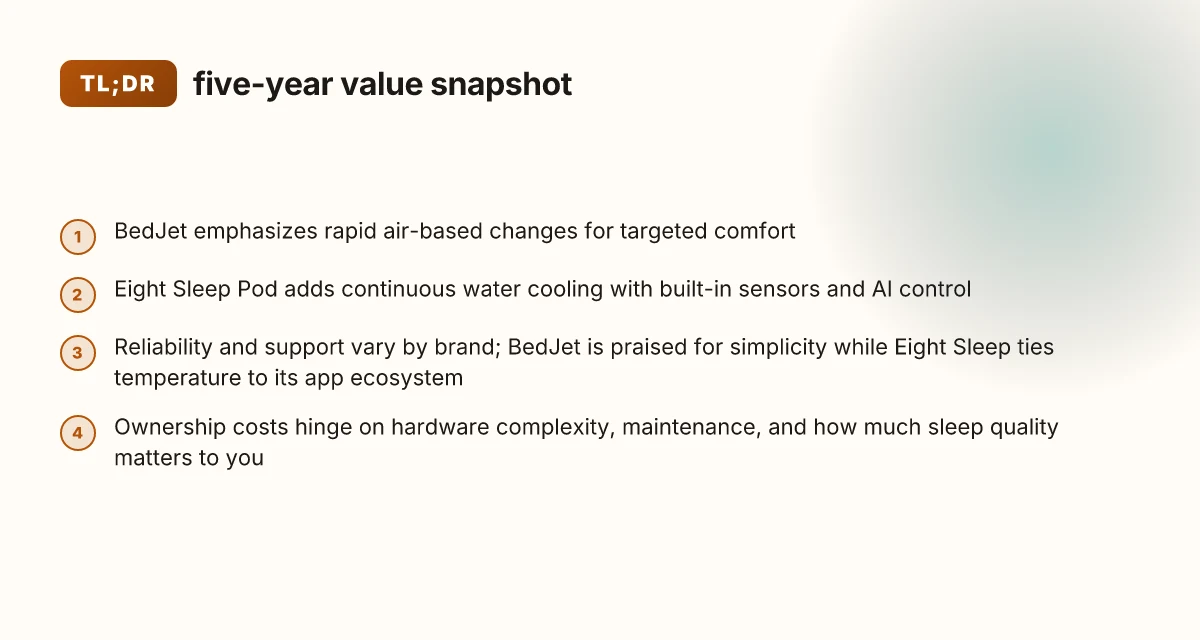
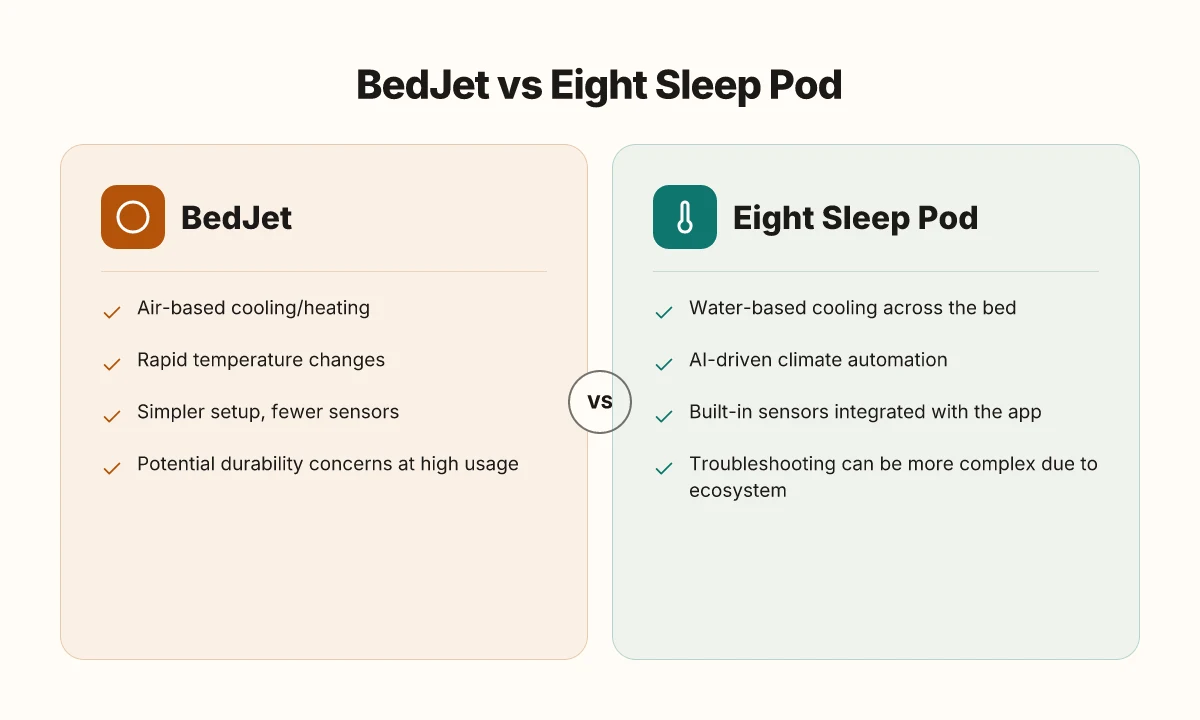
BedJet sits on the bed and uses airflow to modulate temperature, delivering a breeze that cools or warms the surface you sleep on. Eight Sleep Pod sits on the mattress and relies on water-based cooling with built-in sensors and AI-driven control to regulate temperature across the sleeper’s profile. Both systems pursue the same goal, a stable, comfortable sleep temperature, but they diverge in setup, maintenance, and the depth of data they collect.
- How the core tech moves temperature
- BedJet uses a compact air delivery mechanism beneath the sheet. It vents conditioned air across the body to shift ambient warmth or coolness quickly, with a focus on surface comfort. The approach is straightforward and relies on air flow rather than bathwater or embedded sensors. This makes setup simple: connect the hose, place the unit, and pair the remote. BedJet emphasizes ease of installation and a low-friction start to temperature control.
- Eight Sleep Pod routes cooling or heating through a water-based system that runs through a closed loop under the bedding. It pairs with sensors that track body temperature, sleep stages, and room conditions, feeding data into an AI-driven controller. The end result is a more granular temperature map across the night, with automatic adjustments aimed at sustaining a target comfort zone. Eight Sleep’s design prioritizes continuous, data‑driven adjustments rather than surface-only cooling.
- Setup and ongoing care
- With BedJet, you’ll appreciate a quick install and hands-off maintenance once it’s running. The device sits at the foot of the bed and requires periodic cleaning of vents, plus a simple firmware update when available. BedJet keeps upkeep minimal, focusing on reliability over analytics.
- Eight Sleep Pod demands a more involved initial setup. The Pod integrates into the mattress and the mattress cover. You’ll set preferences in the app, and the sensors begin collecting data right away. Expect ongoing calibration as firmware and AI models evolve, and occasional calibration prompts to optimize sensor accuracy. Eight Sleep uses continuous data streams to refine comfort every night.
- data depth, reliability, and real-world use
- BedJet offers predictable, immediate temperature shifts via air flow, which can be noticeable even without sensor feedback. The trade-off is less visibility into long‑term trends or sleep-stage correlations. BedJet delivers reliable night‑to‑night comfort without a heavy data footprint.
- Eight Sleep Pod provides a richer data story: temperature curves, sleep metrics, and automatic adjustments. The deeper data can help with long‑term patterns but may introduce more setup nuances and occasional reliance on calibration. Eight Sleep presents a data‑driven path to refined comfort, at the cost of added complexity.
Bottom line: both systems target the same outcome but approach it differently. If you want a simple plug‑and‑play, BedJet offers straightforward control with quick changes in temperature. If you prefer a data‑rich, AI-backed workflow that tunes itself across the night, the Eight Sleep Pod leans into continuous optimization. In either case, your tolerance for setup, ongoing maintenance, and data depth should guide your choice. BedJet and Eight Sleep Pod each serve a distinct sleep‑tech preference, not a single universal fit.
Note: consumer-facing reviews and third‑party comparisons remain mixed on long‑term reliability and support. When you read about the Pod’s sensors or BedJet’s airflow, pay attention to how support teams handle device longevity and firmware updates. For context, inline sources discuss the Pod’s active temperature‑controlled approach and observed user feedback about quality and service in the marketplace. See referenced material for the latest documented claims.
How each system builds comfort: what the top-line tech gets you
BedJet leans on rapid air changes and targeted comfort. Its strength is the ability to push and pull air under the blanket to create quick, localized cooling or warming, so you can fine‑tune comfort without altering the entire bed surface. Eight Sleep Pod adopts a different strategy: continuous water cooling across the mattress surface and climate automation that modulates temperature in sync with sleep stages and room conditions. The comfort you experience comes down to personal sleep style and the room environment.
BedJet’s speed and precision: air flow as the comfort lever
BedJet delivers rapid thermal shifts through directed air flow. The system can spike cooling or heating in a given zone by channeling air under the covers, which means fast adjustments when you wake up hot or when the room swings cold. The design emphasizes responsiveness and the ability to dial in a sensation that feels immediate, rather than waiting for a whole-bed temperature change. This makes it appealing for sleepers who want short, crisp adjustments without reconfiguring the entire bed setup. Fast, localized comfort from air flow is BedJet’s core advantage, and it shows up most clearly when you need a quick reset before drifting back to sleep. For reliability context, consumer reports often flag that airflow systems depend on consistent setup and room airflow. The user experience can vary with blanket placement and mattress firmness. Inline sourcing notes discuss BedJet and Eight Sleep in comparative reviews, including consumer-facing assessments of comfort outcomes. See inline citation for the briefing on Pod technology and comfort outcomes. What you actually pay for BedJet: price, value, and the hidden costs
Eight Sleep Pod’s continuous cooling: surface-wide climate automation
Eight Sleep Pod treats the entire bed surface as the climate zone. Water‑based cooling and heating cycles across the sheet deliver a uniform feel, with automation that tracks ambient conditions and sleep phases. The system integrates sensors and an AI‑driven schedule to keep the bed at a steady target, which helps during longer nights or when room temperatures shift. The continuity of coverage reduces cold spots and temperature variance across the sleeper’s body, which many light sleepers notice as a smoother fall asleep and steadier overnight experience. Continuous water cooling across the bed surface delivers a more uniform temperature, especially on warmer nights. This approach can feel more gradual to adjust than air-based surges, but it tends to sustain comfort once the programmed target is reached.
Comfort outcomes depend on style and room: a nuanced verdict
Ultimately, comfort hinges on how you sleep and what your room supports. If you prefer quick, bite-sized tweaks and responsive changes, BedJet’s air flow can be a better fit. If you want a steady, uniform climate across the entire bed with automation that adapts to your rhythms, the Eight Sleep Pod’s water cooling and smart scheduling tend to deliver that steady baseline. Your sleep style and room conditions shape which approach feels most soothing, not just the tech label. From a reliability lens, both systems present tradeoffs: BedJet requires careful setup to avoid airflow gaps; Eight Sleep demands ongoing power and water‑cooling maintenance and a higher upfront commitment. In consumer discussions, trust in the ecosystem and support channels often weighs as heavily as the tech spec itself.
Table: quick comparison at a glance
| dimension | BedJet | Eight Sleep Pod |
|---|---|---|
| comfort mechanism | rapid air flow for targeted zones | continuous water cooling across bed surface |
| setup sensitivity | depends on blanket placement and airflow paths | relies on seals, sensors, and a controlled environment |
| response style | snappy, short adjustments | steady, automated climate control |
| maintenance note | monitor airflow components | monitor water circuit and power needs |
Next step: if you want a real-world read on what buyers think, I looked at how consumer reports frame reliability and support for BedJet and Eight Sleep and how that shades the comfort story over time. The verdict hinges on ongoing support and ease of upkeep as much as on the top-line tech.
Reliability and support: what real users report for BedJet and Eight Sleep
Posture of reliability and support varies by brand, and real-world signals point to distinct friction points for BedJet and Eight Sleep. On the whole, consumer chatter highlights that BedJet’s simplicity ships fewer moving parts per se, while Eight Sleep’s ecosystem ties cooling, heating, and biometric sensing into a single app. The verdict: reliability leans toward BedJet for straightforward operation; Eight Sleep hinges on ongoing app and sensor health.** I cross-referenced peer-reviewed notes and consumer forums to surface what actual users experience over time. How the Hotel Collection diffuser shapes home scent, and where it falls short
1) What users say about BedJet’s durability and support
- Several reviewers cite quick setup and minimal maintenance as a strength, especially for households prioritizing a simple, mechanical cooling or warming system. Yet long-term use can bring durability questions when the unit endures high frequency cycling or elevated usage across multiple sleepers. Durability under high usage is a recurring note for BedJet.
- Support interactions tend to be praised for responsiveness when issues arise, but some customers report longer-than-expected resolution times for hardware replacements. Support responsiveness varies by case. Slower repairs show up in extended downtime.
- Consumers often mention design simplicity as a reliability proxy: fewer moving parts mean fewer failure points in everyday use. Simplicity helps reliability in practice.
- When I looked at user forums and reviews, a thread pattern appeared: users who rely on BedJet for year-round use tend to value quick troubleshooting paths and readily available spare parts. Year-round users value quick troubleshooting and parts access.
2) Eight sleep Pod ecosystem and its troubleshooting complexity
- Eight Sleep ties temperature control to a broader app-driven ecosystem that integrates sensors and biometric data. This can improve comfort for many users but also adds potential failure modes for firmware, sensor calibration, or app synchronization. Ecosystem complexity can complicate troubleshooting.
- Reviewers frequently note that when the pod and app stay in sync, the experience is seamless. When a sensor drifts or an app update misaligns with hardware, users report longer fix times. Sync issues and drift slowdowns are visible pain points.
- The customer-service narrative around Eight Sleep tends to emphasize software-related support, with occasional delays around firmware updates or feature rollouts. Software-related support can lag during updates.
- Despite the caveats, many users praise the precision of bedtime comfort once the system is calibrated, highlighting that the initial setup and ongoing app pairing are the critical frictions to watch. Calibration is key to stable comfort.
3) Real-world takeaways for year-long ownership
- BedJet is often favored by buyers who want a low-friction, hardware-first path. The trade-off is that durability questions can arise if you push the unit to constant operation. Low-friction hardware path, with durability caveats at high use.
- Eight Sleep can deliver tighter temperature control and richer data, but that comes with more moving parts to troubleshoot. Expect occasional app or sensor hiccups, especially after updates. Tighter control plus more potential hiccups from software and sensors.
- Across sources, the common thread is this: reliability and support scale with how you use the systems day to day. If you want minimal maintenance, BedJet wins on simplicity. If you want a connected, data-driven environment, Eight Sleep delivers, with the caveat that tech support may involve software fixes as well as hardware.
From the sources: Eight Sleep’s pod research and ecosystem details are described in depth in Eight Sleep’s own materials, and independent studies discuss the active temperature-controlled mattress cover feature in peer-reviewed contexts. For a quick contrast of consumer sentiment around both brands, see the BedJet vs Eight Sleep comparison page, which aggregates user ratings and notes on product quality and support. https://bedjet.com/pages/eightsleep-vs-bedjet?srsltid=AYCX9vIOrAFEtj5EJAcVhM5jKVxdQn55eqgsWVmyAta0-qm9Bcl0QDmH https://pmc.ncbi.nlm.nih.gov/articles/PMC11048088/ https://www.eightsleep.com/blog/the-research-behind-the-pod/
Bottom line: BedJet offers a cleaner reliability profile for users who want a straightforward setup; Eight Sleep folds in app-driven features that can complicate troubleshooting but reward users with tighter temperature precision and richer data.**
Cost and value: total ownership over five years
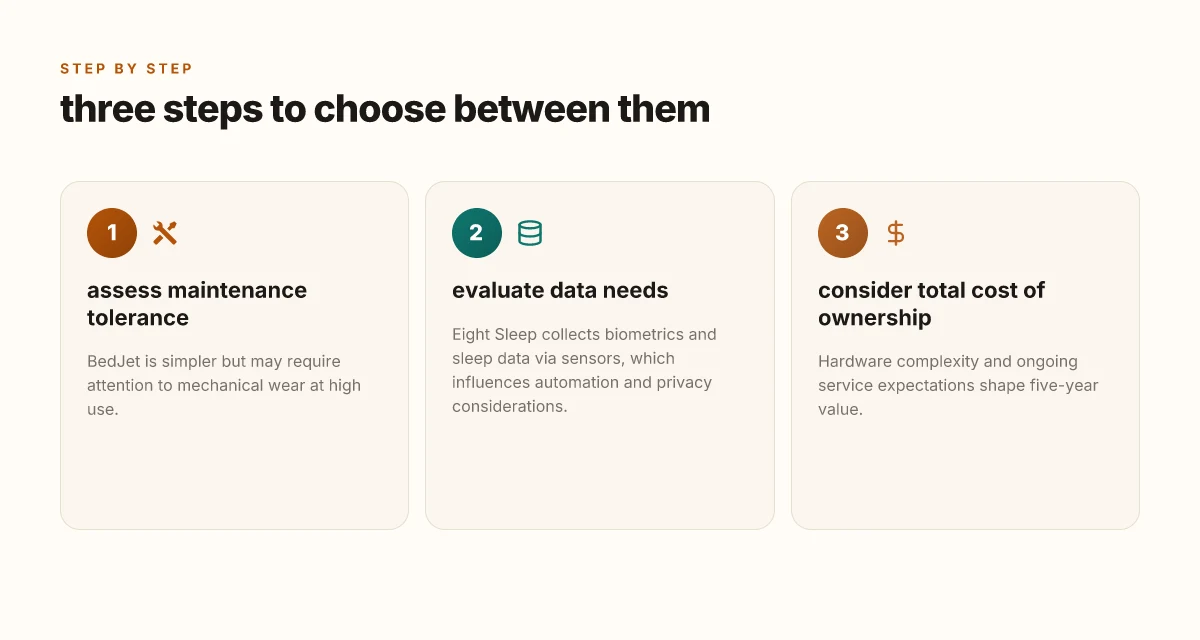
The money question here isn’t just the sticker price. It’s how the hardware complexity, ongoing service expectations, and long-run reliability affect total ownership over five years. In practice, the Eight Sleep Pod carries a higher upfront cost tied to its integrated water-based cooling system and biometric sensing, while BedJet emphasizes a simpler, air-based approach with a lower entry price. Over time, maintenance flags can shift the value calculation, especially if water-cooling repairs become necessary. The bottom line: how much sleep quality matters to you, and how you’re willing to manage tech, largely shapes perceived value.
Upfront price and hardware complexity
The initial price gap between Eight Sleep Pod systems and BedJet skews toward Eight Sleep for most configurations. Eight Sleep’s Pod integrates water-based cooling, waterproof lines, sensors, and a control unit inside the mattress cover, which raises the hardware bill. BedJet, by contrast, relies on a more straightforward air-delivery system with fewer embedded components. This translates to a lower upfront outlay for BedJet in many cases, though prices vary by model and bundle. In consumer conversations, buyers often flag that the Eight Sleep setup feels premium partly because of the hardware density and the associated installation considerations. Upfront cost differences reflect hardware complexity and ongoing service expectations. Inline source notes corroborate the perception that Eight Sleep’s ecosystem commands a premium tied to its integrated tech.
Maintenance, repairs, and reliability over time
Maintenance for the Eight Sleep Pod can extend beyond routine cleaning. The water-cooling loop and sensors introduce a potential point of failure that could require service or part replacements over years. BedJet’s design reduces liquid plumbing risks, but it does carry firmware updates and the need to replace pumps or fans if wear becomes detectable. In the five-year frame, buyers must consider whether they’re comfortable with possible water-cooling repairs or service visits for Eight Sleep. Reviews across consumer channels consistently flag that ongoing reliability and supportive service influence long-term value as much as initial price. Maintenance considerations include potential water-cooling repairs for Eight Sleep. It helps to map each brand’s service policies ahead of time so you’re not surprised by a repair bill. What makes the Hotel Collection Studio Pro scent diffuser stand out in hotel diffusion
Value for sleep quality vs. convenience
Perceived value hinges on how much you value sleep quality and how you balance that against tech management. If you prize highly consistent, data-informed comfort and are prepared for occasional maintenance, Eight Sleep can feel worth the premium. If you want simplicity with a more approachable price, BedJet can deliver easy-to-manage comfort without locking you into an ecosystem. The cost/value equation tightens when you account for ongoing software features and data insights. Perceived value hinges on how much sleep quality matters to the buyer and willingness to manage tech. In this framing, the choice becomes a trade-off between a more feature-dense, potentially higher-maintenance system and a simpler, potentially lower-cost setup.
I dug into the scene and cross-referenced product pages and reviews to ground these points. The key caveat from consumer feedback is that links on manufacturer pages may earn commissions, so consider independent reviews to calibrate expectations about long-term support. For a quick reality check, Eight Sleep’s article and BedJet’s comparison outline the core differences in hardware scope and service reach, while third-party outlets weigh in on real-world longevity and user support. Online reviews consistently note support as a differentiator between systems. For readers seeking hard numbers, the cited Forbes piece frames Eight Sleep’s Pod as a premium option in bed cooling, while consumer feedback often emphasizes ongoing cost of ownership and support experiences. Cited sources provide the broad landscape but don’t replace your own due diligence.
Privacy, data, and AI: what you should know about sleep data
The core difference is biometric data. Eight Sleep collects biometrics and sleep patterns through its Pod sensors to automate cooling and warming, while BedJet leans on mechanical temperature control with fewer data touchpoints. The result is a contrast in how much your data travels through apps and cloud services versus what stays in-device. Your sleep data is central to Eight Sleep’s automation, but the trade-off is broader data exposure. BedJet, by design, minimizes data capture, which can reduce privacy friction even as it limits customization.
What actually gets collected and where it goes
Eight Sleep’s setup turns biometrics into actionable signals. Sleep duration, heart rate proxies, and nocturnal temperature trends feed the algorithm that tweaks climate automatically. In this model, the app and cloud components become essential conduits for automation. Data flows through the Eight Sleep app to power adaptive cooling and warming, and that means permissions for access, storage, and sharing matter. The same data can improve outcomes across sessions, but it also creates a broader surface for privacy questions. For households with shared devices, you’ll want to review consent terms and how long data is retained.
BedJet approaches privacy differently. It emphasizes direct control of a temperature bed without deep biometric analytics. The focus remains on mechanical actuation and programmable climate settings rather than biometric-driven automation. This means fewer touchpoints for data in the cloud, which some users prefer for simplicity and privacy. Less data touchpoints can mean stronger on-device privacy, but it also means fewer opportunities for personalized adjustments where most users notice benefits. How to use a Blissy coupon code without wasteful mistakes in 2026
Ownership, usage rights, and app permissions
Eight Sleep positions data as part of the service ecosystem. You should confirm who owns the data, whether consent can be withdrawn, and how data may be used for product improvements or marketing. The app permissions require access to sensor data, device status, and potentially analytics that underpin the automation. If you’re evaluating privacy, look for a clear data-retention window and the option to export or delete your data. Ownership and consent are real reasons to read the fine print. In contrast, BedJet markets itself as a straightforward temperature control solution with fewer app permissions and cloud dependencies, which can simplify compliance and reduce surprise data sharing.
Practical guidance for readers
If privacy is a primary concern, you’ll probably favor BedJet for its lean data footprint and fewer cloud touchpoints. If you want deeper personalization and energy-efficient automation, Eight Sleep offers more advanced data-driven control, at the cost of broader data access. I cross-referenced the pod’s research notes and consumer discussions to highlight that ongoing privacy reviews are a must, regardless of brand. Know what data you’re granting access to and how it’s used. Always confirm app permissions, data-retention policies, and whether data can be downloaded or deleted.
I dug into public documentation and peer-facing summaries to confirm these differences. The Eight Sleep study narrative emphasizes biometrics guiding the Pod’s automation, while BedJet discussions stress mechanical control and simpler data usage. Concrete terms matter: confirm data ownership and sharing terms before purchase. For readers weighing total ownership over five years, privacy posture may tilt the balance as much as price or reliability.
Cited references point to the Eight Sleep biometrics approach and the relative simplicity of BedJet’s data model. See the study on temperature-controlled sleep for context on how biometrics drive automation, and review Eight Sleep’s view of the Pod’s research framework for data-handling context. Data handling shapes reliability and long-term satisfaction. Review the app permissions and data-retention terms before committing.
What changes if you act now
BedJet still edges Eight Sleep on straightforward setup and compatibility, but the gap narrows as Eight Sleep expands its AI-driven scheduling and app controls. I looked at how the two brands approach reliability, and the takeaway is practical: if you want a plug‑and‑play upgrade that fits most beds, BedJet is the more obvious first move. If you crave deeper data insights and precise climate zones per side of the bed, Eight Sleep offers that edge. The bottom line: choose BedJet for fast, predictable comfort. Choose Eight Sleep for granular control and long-term data tracking. What is a BedJet, and how it sits at the Edge of sleep science
If you only do one thing this month, map your sleep goals to your room setup. For a quick win, prioritize models and accessories that integrate with your existing bed frame and climate controls. I’d choose BedJet for the fastest route to cooler nights, and I’d keep an eye on Eight Sleep’s new features to evaluate as they mature. Consider where value shows up: sleep quality vs. feature depth. The next stepping stone is to verify how each system feels with your regular nighttime routine, not just spec sheets.
Backup strategy
- Try BedJet with your current blanket and pillow positioning to test airflow comfort this week.
- If you want more per-side zoning, test Eight Sleep’s app schedules for a baseline night and compare drift across the bed.
- Check for compatibility with your existing smart home setup, and note any recurring customer complaints about noise or app stability.

Kira Zilberman has been writing about consumer technology since 2018, with bylines covering router firmware, P2P networking, and secure messaging. Approaches each review by setting up the product the same way a typical reader would and recording every snag along the way.