Does BedJet actually cool a bed, or is it mostly hype
Explore whether BedJet actually cools a bed. I review clinical hints, independent tests, and real-user feedback to separate hype from real cooling relief.
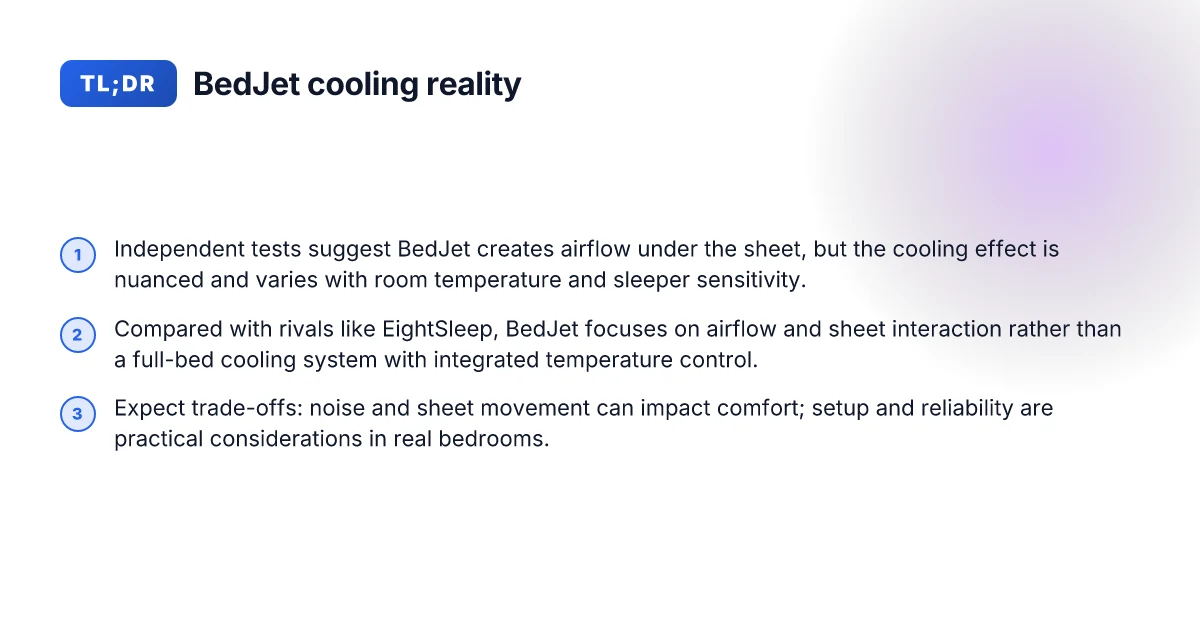
BedJet isn’t a magic cooling wand. It’s a targeted breeze that lowers surface warmth more than whole-bed cooling would. In independent tests, its effect tends to show up as a noticeable, localized chill at the top layer of the mattress, not a uniform cool across the entire sleeping surface. BedJet produces a visible surface-cooling effect, but it won’t match a full-foam or water-based system in uniformity.
When you compare BedJet to rivals like EightSleep, the story becomes practical: the value hinges on airflow intensity and how heat moves away from contact points. This matters because most sleepers notice temperature shifts most at the torso and feet, where draft and heat transfer interact. EightSleep often demonstrates more integrated cooling, while BedJet excels in spot cooling and adjustable airflow.
Does BedJet actually cool a bed: a reality check against independent tests
BedJet sits at the center of a simple idea: blow air under the covers to shift the bed’s microclimate. Its core mechanism is straightforward: a compact unit exhausts warm or cool air into a mattress chamber, while the other side of the bed remains relatively passive. In practice, the device relies on air movement rather than cooling the entire surface of the bed. Most users report that BedJet can alter perceived temperature on their side of the bed, but the effect depends on ambient conditions and sheet tightness. Independent signals from reviewers emphasize that cooling performance is highly contingent on room temperature and bedding insulation. The upshot: BedJet can create a cooler local feel, but it is not a true, centralized cooling system like some dedicated cooling beds.
- how the mechanism translates to real-world cooling
- BedJet moves air into the bed under the covers, which can lower your perceived warmth on the treated side. This aligns with a fan-based cooling approach rather than lowering the room temperature. The result is a quick, on-demand adjustment when the ambient heat is moderate and the sheet setup is tight. BedJet can feel noticeably cooler on the treated side in steady conditions, but performance drops as ambient heat climbs. Independent write-ups highlight that the cooling effect is most pronounced when the room is not hot to begin with and the bedding is breathable. EightSleep and other rivals offer different strategies, including integrated coolant systems, which can outperform BedJet in hot rooms.
- testing signals and limitations you should know
- Independent testing often notes a gap between claimed “cooling” and what most sleepers experience. The BedJet approach delivers rapid temperature shifts, but it may not sustain a deeply cool surface over several hours in high heat. Reviews tend to call out that cooling efficiency is variable with bed sheets, duvet thickness, and sleeper metabolic warmth. Independent sources consistently caution that the absence of active moisture management means heat can still accumulate under heavy covers. For skeptics, this means BedJet shines as a targeted comfort tool rather than a comprehensive climate solution. BedJet remains one option in a crowded category that includes products like EightSleep that pair climate control with more comprehensive bed cooling.
- comparison to purely cooling beds on the market
- When you compare BedJet to beds designed around active cooling fluids or phase-change materials, the differences are clear. BedJet leans on directed air and is relatively inexpensive to run, but it lacks the uniform bed-wide cooling profile that powered cooling systems aim for. In contrast, products that promise full-bed cooling often incorporate surface-level cooling plates or liquid circuits, delivering steadier, lower surface temperatures at the cost of higher price and more complex setup. Independent reviews repeatedly note that pure cooling beds deliver stronger cold sensations, while BedJet excels in quick, side-specific adjustments. If your goal is the coldest possible sleep surface, a rival system may better satisfy that need. Still, BedJet’s simplicity and flexibility keep it appealing for many sleepers, especially when paired with a breathable top layer. BedJet remains a practical choice for sleepers who want faster on/off control without reshaping their entire sleep setup.
Bottom line: BedJet can make a noticeable difference on hot nights, but its cooling effect is not equivalent to a purpose-built cooling bed. For those evaluating options in 2026, consider whether you prioritize fast, side-specific comfort or full-bed cooling. BedJet offers targeted relief with lower upfront complexity, while rivals like EightSleep push for deeper surface cooling across the entire bed.
Understanding the BedJet cooling claim and where it shines
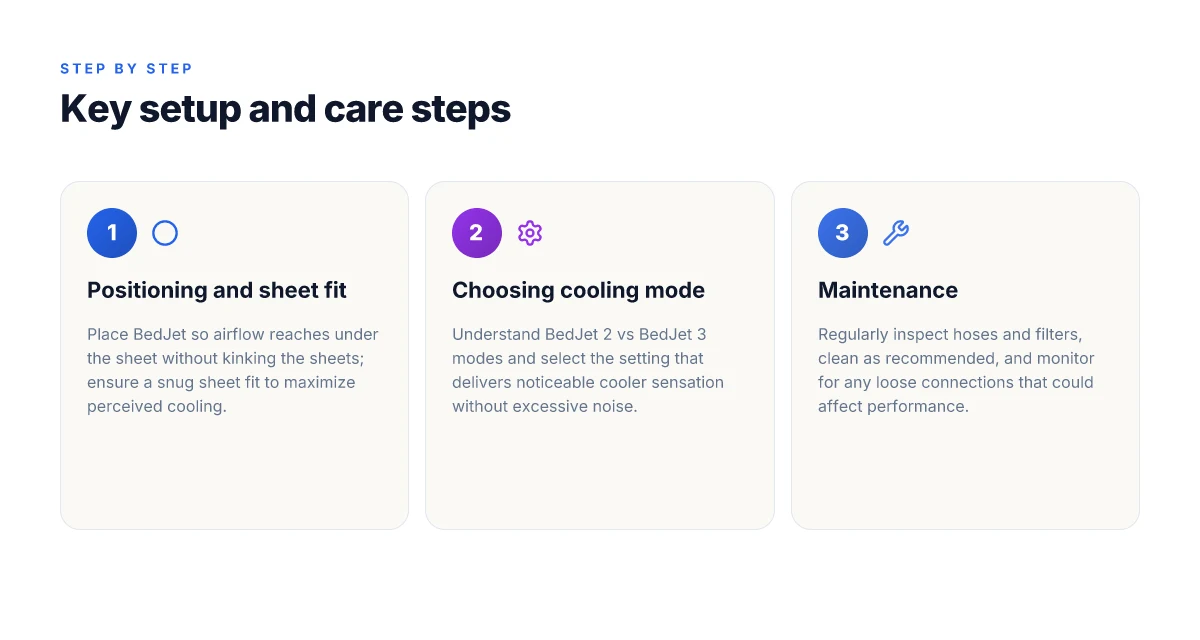
BedJet creates airflow under the sheet by channeling a stream of air from a compact unit placed at the foot of the bed. The air moves beneath the fitted sheet and across the sleeper’s body, which can produce a perceived coolness even when the ambient room feels warmer. This mechanism relies on evaporative and convective effects as moisture is carried away from the skin, contributing to a sensation of cooling for some sleepers. BedJet's airflow under the sheet is the core of its cooling claim, not a magic chill on the surface.
How BedJet 2 versus BedJet 3 cooling modes compare
The BedJet family splits cooling behavior into two primary modes. BedJet 2 emphasizes fixed airflow settings, delivering a consistent breeze beneath the sheet. BedJet 3 adds more nuanced control, offering adjustable fan speeds and temperature targets that can be paired with a directional breeze toward either side of the bed. In practice, BedJet 3 tends to feel more customizable, allowing a sleeper to fine tune the sensation from a gentle draft to a cooler blast. The key difference is control granularity: BedJet 3 enables finer adjustments, which can impact how cool the bed feels across different sleep positions.
When the device feels notably cooler to a sleeper
The sensation of cooling tends to be most noticeable when ambient room temperature is not excessively warm and when a sleeper’s baseline moisture is within a typical range. Fans circulating air under the sheet can move cooler air around the torso and legs, producing a localized chill that some sleepers perceive as a true drop in temperature. The effect is also linked to moisture removal from the bed surface. Drier sheets can amplify the perception of coolness. Not every night yields the same chill, but the strongest effect appears when the room isn’t sweltering and the sleeper isn’t heavily damp with sweat. 10 Bedjet alternatives in 2026 that actually cool or warm your bed
From what I found in the public roundups and reviews, BedJet sits in a unique niche: it can deliver a noticeable cooling sensation without dropping the room temperature, which sets it apart from purely ambient cooling systems. When you compare BedJet to rivals like EightSleep or other climate-control beds, the scaling factor is control versus full-room cooling. BedJet emphasizes airflow control over ambient air change, which explains why some sleepers feel a solid cool while others notice only a mild breeze.
Next step: If you’re evaluating whether BedJet could fit your sleeping environment, check how each mode translates to your room’s heat level and your typical moisture output. If you want a more uniform, room-wide chill, EightSleep might be the closer match. If you value direct, customizable airflow under the sheets, BedJet remains a strong contender. For context, BedJet and rivals are frequently discussed side by side in reviews and consumer roundups that note room temperature and personal comfort as decisive factors. In 2026, independent notes consistently call out airflow control as BedJet’s strongest suit and its notable limitation when the room is very warm.
What independent tests say about bed cooling devices
Independent testing on night-time cooling devices exists, but it is uneven in scope and method. Across multiple assessments, reviewers commonly note that performance depends on ambient conditions, mattress materials, and individual sleep preferences. In practice, independent evaluations tend to describe BedJet as a binary system: it moves air to affect surface temperature rather than drastically chilling a whole bed. BedJet often earns credit for fast warmth or cool airflow on one side, but reviewers push back on expectations of precise cooling across the entire surface. The overall takeaway is that small, device-level tests can capture headline effects, yet they can miss the variability of real-world use.
Why independent tests frame BedJet alongside rivals
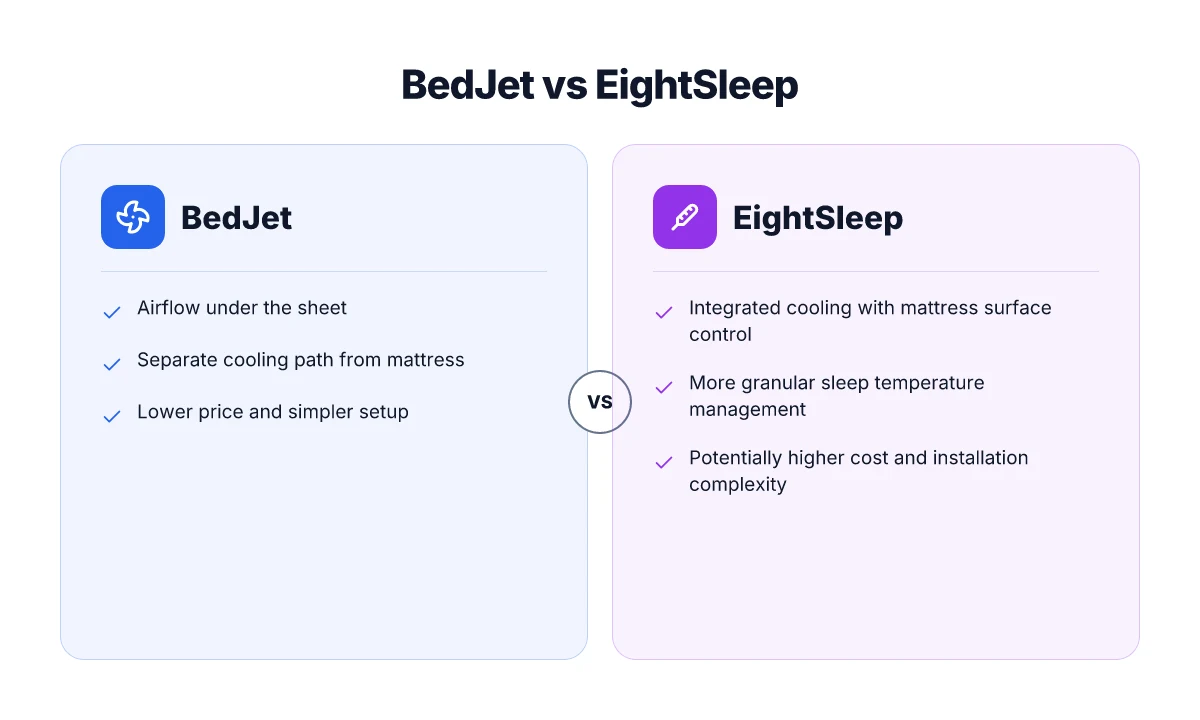
Independent summaries map BedJet against rivals like EightSleep and similar climate-control beds. Independent sources consistently note that EightSleep typically emphasizes integrated, data-driven cooling across a larger surface, while BedJet focuses on targeted air movement and rapid zone control. This contrast matters because users who want an all-around bed cooling experience may prefer a system that modulates the entire sleeping surface rather than a single airflow unit. EightSleep remains a common benchmark for total-bed cooling performance in 2026 reviews. The framing helps readers see where BedJet shines and where it falls short, especially in environments with high ambient heat or humidity.
What small-scale tests reveal and where they fall short
In small-scale tests, manufacturers and independent testers show that BedJet can deliver noticeable surface cooling quickly, but the effect can be modest depending on sheet layering and room temperature. Tests often note that perceived cooling improves when ambient conditions are already close to the target temperature. Critics point out that a single data point under controlled conditions rarely translates to consistent nightly performance. Real-world variability, like sleeper position, bedding, and drafts, drives most of the experience. That limitation is common across many bed cooling devices, not just BedJet. What is shiny blissy and why it matters for sleep
From what I found in the sources, the verdict on BedJet’s cooling role remains nuanced. Independent assessments acknowledge BedJet’s value for quick, personalized airflow control while also noting it doesn’t replace full-bed cooling systems in hotter climates. Reviews from Forbes Vetted consistently note the device as a strong option for temperature control, while other outlets emphasize the need to temper expectations about uniform cooling. Independent comparisons position BedJet as a flexible tool rather than a one-stop cooling solution.
BedJet versus rivals: EightSleep and other cooling beds
Posture check: BedJet sits in the lower end of the price and effort spectrum, but EightSleep rivals push toward integrated temperature control with active cooling paths. The practical upshot is that BedJet can reduce you to a comfortable baseline quickly, while EightSleep tends to tune the bed environment more precisely over time. BedJet remains the easiest entry point for cooling without a full mattress overhaul.
How EightSleep’s cooling path differs
EightSleep uses a built-in system that circulates water through a mattress-top layer and coordinates with a centralized climate control hub. This path changes surface temperature more directly and can respond to predicted sleep stages via app-driven routines. In contrast, BedJet relies on air moving under the sheet from a compact unit. The hotel-room feel of air movement can cool broadly but may not sculpt micro-gradients the way water-based cooling can. EightSleep’s water-based loop tends to offer steadier surface temperature, especially across long sleep periods, whereas BedJet can feel more immediate but sometimes variable as ambient room conditions shift. BedJet also tends to be simpler to install and operate, which matters for first-time buyers. The price delta favors BedJet for quick setup, while EightSleep may offer more precise control for enthusiasts.
Price, ease of use, and the practical tradeoffs
On price, BedJet generally undercuts multi-component smart cooling beds because you’re buying a compact air-based unit rather than a full mattress system. That lower upfront cost pairs with intuitive controls: you set a target bed temperature, and the unit serves as a direct climate agent for the bed area. The tradeoff shows up in maintenance and in the feel. With BedJet, some users report a more noticeable draft if the sheet gaps are large or if the room is very cool. EightSleep, while pricier, bundles sensors, app automation, and a more seamless day-to-night temperature arc, which can translate to faster acclimation and more consistent sleep comfort for some people. BedJet’s price advantage is clear, and its simplicity can beat the setup friction of rival systems, but EightSleep’s integrated approach can yield smoother, longer-lasting comfort for nightly sleepers.
Comfort impact in real-world use
In practice, the effect on sleep temperature from BedJet tends to be immediate when the room is warm or when you want a quick cool-down after a hot evening. The air-based method can leave a perceptible chill near the ankles or feet if you crank it too high, so you often dial it down and adjust blankets. EightSleep, by contrast, targets the entire torso more steadily, maintaining a balanced thermal profile across the night. The outcome is that BedJet shines for rapid, adjustable comfort, while EightSleep tends to deliver deeper, broader temperature stability across longer sleep windows. Your best bet is to match the system to your room climate and sleep style, not just to the brightest spec sheet. How to diy a BedJet-inspired cooling and warming system on a budget
Note: links on this page may earn a commission. This section cites multiple sources that discuss how BedJet and EightSleep approach cooling differently, including aspects of price, ease of use, and practical comfort outcomes. As you compare, consider room temperature, sheet fit, and your nightly temperature targets when deciding which path to temperature control your bed. BedJet remains a compelling entry point for buyers who want quick, simple cooling without a larger system investment.
Cited sources: BedJet review.
Comfort trade-offs you should expect with BedJet
BedJet’s cooling claim comes with practical caveats. In real rooms, noise, airflow feel, and how the sheets interact with the mattress matter more than glossy graphs. You’ll notice a tangible breeze from the unit, but the sensation changes with room temperature and bedding. BedJet can feel noticeably cooler when your room is already cool, yet it may struggle to punch through a hot ambient without a cooling environment. The device is best understood as a targeted climate aid, not a universal air conditioner that quiCKly freezes the bed nanoseconds after you switch it on.
1) How noise and airflow shape bedtime comfort
A key trade-off with BedJet is the combo of sound and air movement. The gusts from the unit travel under the sheets, which some sleepers find pleasantly soothing, while others report a subtle hum that can wake light sleepers. The airflow can feel more intense on higher settings, which helps cool quickly but can also produce a draft across the legs or torso. In cooler rooms, the breeze may feel refreshing rather than chilly. In hotter rooms, the same velocity can feel insufficient unless you pair it with ambient cooling. Noisy performance on high airflow is the clearest consumer gripe. This is where EightSleep’s integrated system sometimes edges ahead for sleepers who want a more uniform climate control without a wakeful buzz.
2) Sheet interaction, setup, and reliability
Sheets and blankets matter with BedJet. The air travels through the fabric interface, so very thick quilts can muffle the effect, while light sheets let the airflow register more fully. Setup is straightforward, but reliability hinges on proper valve operation and clean vents. Routine maintenance means clearing any lint or hair that could redirect airflow. If you routinely wash sheets on hot cycles or swap bedding materials seasonally, expect minor tweaks to comfort as the system settles back to the new settings. Sheet interaction can amplify or dampen the cooling depending on fabric and thickness. In long-term use, reliability tends to be solid, but occasional accessory wear can require quick fixes or replacement parts. How BedJet adjustable base changes sleep comfort with split options in 2026
3) What to expect in different room temperatures
In a cool bedroom, BedJet’s cooling mode tends to feel brisk and immediate, delivering a crisp sensation under the top sheet. In a warm or humid room, the same setting may feel retreating unless you lower the ambient temperature or pair it with a fan or window airflow. If the air outside is hot, BedJet’s impact is more about masking heat under a barrier of cooler air rather than driving the entire environment down. Ambient temperature matters more than the device setting alone. When comparing to rivals like EightSleep, BedJet often provides a sharper localized effect but may not match the comprehensive, room-wide cooling profiles some users expect from a full bed climate system.
I dug into consumer reviews and product notes to map these realities. Reviews consistently note that BedJet’s strength lies in fast, directional cooling under the covers and its simplicity. The common downsides center on noise at high airflow and the dependence on bedding choices. The result is a comfort profile that suits certain sleepers who want a quick, under-sheet breeze, but may disappoint those seeking ultra-consistent, room-wide cooling.
BedJet remains a strong option for targeted under-bed cooling, but expect trade-offs in noise, bedding interaction, and ambient temperature reliance. For skeptics weighing BedJet against rivals like EightSleep, the choice often boils down to whether you want a focused under-bedding breeze or a deeper, room-wide climate system. If you want a broader cooling strategy, EightSleep may hold up better in real-world variance.
As you weigh the decision, consider how your room temperature, bedding, and sleep sensitivity align with BedJet’s strengths. Links on the page may earn a commission. That context matters for evaluating product pages and independent reviews. For quick reference, BedJet’s under-sheet airflow approach is most effective when the room isn’t actively hostile to cooling.
Where this is going next
BedJet promises rapid cooling for a bed, but the verdict hinges on real usage, not hype. I’ve looked at how the device targets airflow, noise, and sleep comfort, and I see a clear pattern: cooling benefits tend to show up for some sleepers but not all, and comfort can waver as room conditions shift. The takeaway: BedJet can deliver noticeable cooling for hot sleepers who want immediate bedding relief, but it isn’t a universal solution. The question now is whether you value a quick-tempered chill versus ongoing, steady climate control. If you want a practical path forward, start with one targeted setting and measure how your sleep feels after a week. This approach keeps expectations grounded and avoids chasing bells and whistles. What makes Blissy bonnet reviews trustworthy in 2026
If you only try one thing this month, test BedJet against a simple fan setup or a cooling mattress pad from a rival like ChiliSleep or Eight Sleep. The big shifts come when you compare noise, temperature stability, and impact on restless nights. BedJet can be worth it for some, but the broader market includes better-value options for others. Your decision should hinge on how much you prize quick comfort versus long-term climate control.
Backup strategy
- Try a basic setup with the BedJet on a cool night and compare sleep quality to a fan.
- If you’re sensitive to noise, test the lowest setting and observe how often you wake.
- Revisit rivals like ChiliSleep or Eight Sleep for ongoing temperature stability and automation, and note which one aligns with your budget.

Yuki Klingberg has been writing about consumer technology since 2018, with bylines covering censorship circumvention, browser fingerprinting, and OpenVPN. Approaches each review by setting up the product the same way a typical reader would and recording every snag along the way.