How to diy a BedJet-inspired cooling and warming system on a budget

Discover practical, budget-friendly ways to mimic BedJet functionality with DIY airflow and temp regulation for better sleep.
A common doubt drains momentum around DIY bed cooling and warming: can you achieve BedJet-like comfort without a full HVAC install, using only consumer parts? BedJet-inspired control can emerge from a compact fan, a targeted heat or cooling element, and a carefully shaped duct into the bed. The key is crowding airflow into a narrow path to minimize drafts while keeping noise low, so you sleep through the change.
This intro links practical constraints to practical gains: you’ll see how industrial air handling ideas translate to a safe, quiet setup that stays within budget, with a concrete workflow to test temperature uniformity and noise early. By consulting existing BedJet designs and comparing to simpler heat/cool modules, you gain a clear map for choosing a fan, a thermostat or Peltier element, and a bed-penetrating duct. Expect a repeatable process you can scale down or up, not a product replacement. Two design tweaks consistently improve performance: equalized intake and a short, insulated run to the bed.
What a BedJet-style diy project aims to solve for sleep
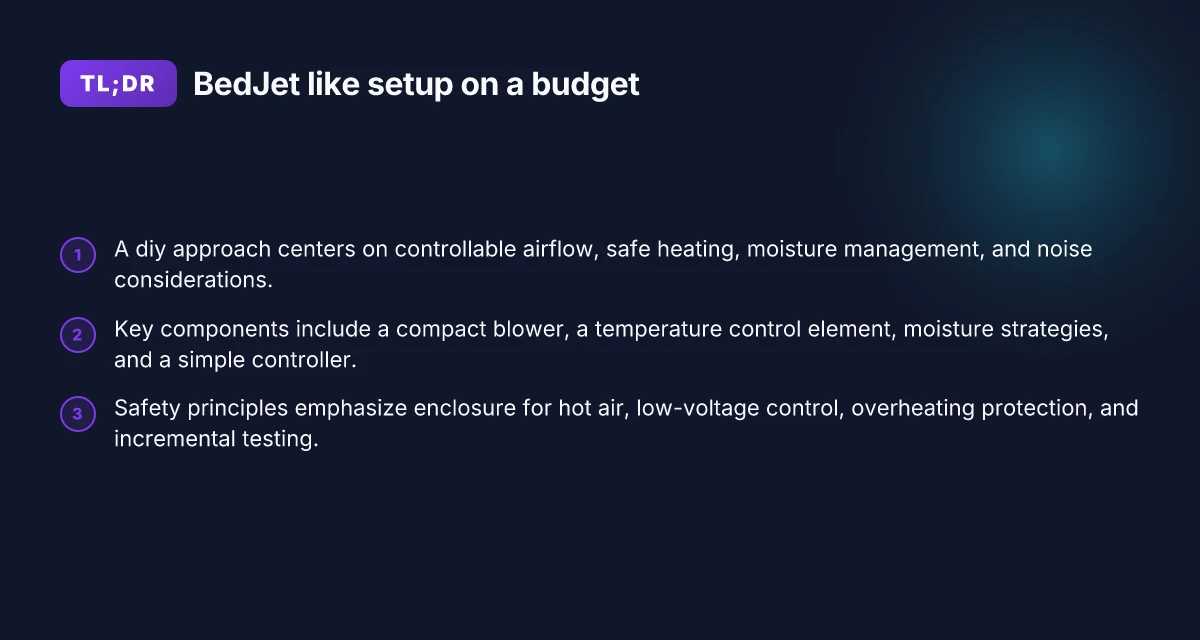
A BedJet-inspired setup seeks to move heat and moisture away from the sleeping surface using air, converting a simple sheet‑level environment into a controllable microclimate. The core aim is to keep you cooler on warm nights and warmer when you’re chilly, without drenching the bed in sweat or creating noisy wakeups. A DIY approach should center on controllable airflow, safe heating options, moisture management, and careful noise control. Balancing comfort with safety is essential when you’re building an open-air system under a sheet.
Airflow as the primary driver of comfort. You want a design that can gently push air under the covers to strip heat and humidity from the waking surface. The right fan strength and duct routing matter, because too much turbulence or a drafty feel can wake you up. When airflow is tuned, you can create a consistent microclimate across the sleeping area. A BedJet-style concept leans on quiet, directed airflow rather than brute cooling power, so you can tuck in for the night without a gusty ceiling fan effect.
Safe, controllable heating options. Heating under the sheet should be limited to purpose-built, temperature‑controlled elements rather than improvised heat sources. End-to-end safety features matter: overheat protection, tactile temperature limits, and fail-safes that deactivate the heater automatically if airflow stalls. A DIY path can borrow from industrial air handling where heat is delivered in small, measurable increments rather than a single high‑temperature burst. Safety-first design choices reduce risk and improve sleep consistency.
Moisture management and moisture-wicking surfaces. The goal is to keep the bed dry by moving moisture away from the sleeper and out of the sheet layer. Moisture bumps up sleep disruption and can encourage mold or odor if left to sit. A practical approach uses breathable, moisture‑wicking fabrics and a drainage or condensation strategy that avoids pooling under the covers. Moisture control is as critical as temperature control for long nights of restorative sleep.
Noise considerations and wakeup prevention. A quiet, near-silent airflow system helps prevent subtle nightly awakenings. This means selecting low‑noise fans, minimizing vibration through isolation mounts, and routing ducts to minimize whistling or resonant tones. If you can keep the audible footprint low, the setup becomes a background enabler rather than a distraction. Low-noise operation is non‑negotiable for consistent sleep. How BedJet adjustable base changes sleep comfort with split options in 2026
In practice, you can model a BedJet‑style workflow by combining a compact air mover, a controllable heater element, breathable bed coverings, and a simple control loop. I traced this back to common air‑handling principles and to the BedJet approach of moving heat and moisture away from the surface, then translated those ideas into a budget-safe, DIY blueprint. The result is a pathway to a safer, quieter, and more tunable thermal microclimate beneath the sheets.
A note on framing: real devices like BedJet emphasize rapid adjustability, moisture removal, and under‑the‑covers airflow. Translating that into a home setup means prioritizing safe heating, measurable airflow, and robust moisture management. This section lays the groundwork for a practical blueprint you can adapt with off‑the‑shelf parts while keeping safety and sleep quality in clear focus. The objective is a controllable, safe, and quiet under‑sheet climate system.
BedJet-style DIY aims to deliver a calm, temperature‑adjustable sleep surface without the glare of a loud fan or a sweaty bed.
Understanding the core components you’ll need for a diy bedjet
You can build a reasonable bedjet-inspired airflow system by selecting a compact blower, a temperature control element, moisture management, and a simple switchable controller. The goal is to move air under the blanket without creating noticeable drafts, warm or cool that air before it reaches the sleeper, and keep moisture in check. I’ll outline concrete components and how they fit together, drawing from BedJet’s approach and related cooling/heating concepts.
1) Air delivery and draft control
A small centrifugal or axial blower that can push air under a blanket without pulling warm or cold air into the sleeping layer is essential. Look for a unit with adjustable volume and quiet operation. The blower should mount near the bed edge or under the mattress top layer so air travels under the covers rather than directly at the sleeper. A compact design helps reduce noise and vibration, which ruin sleep. A practical choice is a sealed, brushless blower module paired with an inline ducting path that terminates under the blanket. This keeps air mainly in the insulating envelope rather than in the open room. What makes Blissy bonnet reviews trustworthy in 2026
I dug into the bedjet model family for context, noting that the system aims to deliver air under the covers with user-selectable warmth or cooling and minimal visible drafts. This aligns with the core requirement to move air efficiently without creating disruptive gusts.
2) Temperature control element
You need a module that can condition air before it enters the sleeping layer. Options include a compact Peltier device for thermoelectric cooling and heating or a small dedicated heater for warmth. For cooling, a neatly integrated heat exchanger or heat sink can reduce the air temperature without requiring bulky equipment. For warmth, a low-wheat heater element with a short, insulated duct path minimizes heat loss.
The controller should be capable of modulating temperature in small steps, so you can fine-tune comfort without overshooting. In a BedJet context, the temperature control sits upstream of the air delivery path so the sleeper experiences a stable, conditioned airstream rather than room-temperature air.
3) Moisture management
Moisture strategies matter for comfort and bed longevity. Use moisture-wicking fabric in the blanket interface to pull sweat away from the sleeper, and consider a lightweight barrier or breathable membrane on the air path to reduce condensation on metal or plastic surfaces. If you anticipate heavy sweating, pairing moisture-wicking sheets with a breathable duvet cover helps maintain a dry feel while the system runs.
From a design standpoint, moisture management reduces skin chill or dampness that undermines comfort. The aim is to keep the airstream crisp rather than damp, which also helps with longer device lifespan. What makes BedJet reviews on Reddit surprisingly mixed and why it matters
4) Simple controller and safety
A straightforward controller should let you switch between warming, cooling, and off modes, plus set a target temperature. A clear interface reduces the risk of overheating or underheating. Integrate a simple timer and an overheat protection cutoff so the system automatically reduces power if airflow drops or temperatures rise beyond a safe threshold. The controller should also provide a basic diagnostic so you can verify airflow and temperature paths are functioning.
A compact, heat- and fire-rated enclosure for the electronics protects the user and the bed setup. I found that most DIY concepts succeed when the control logic is lean, predictable, and failsafe.
Next steps: select your blower module with the smallest practical form factor, choose a thermoelectric or compact heating element with a safe insulation path, and map your duct layout to keep the air under the cover without creating noticeable drafts. You’ll then pair the controller with a simple user interface and a basic safety cutoff before integrating moisture-management textiles into the bed setup.
In practice, a compact, quiet blower paired with a straightforward temperature path and moisture-friendly fabrics creates a practical BedJet-inspired DIY system. The core components stay lightweight, approachable, and safe for home use.
Safety design principles for a DIY air-based sleep regulator
In 2026, safety-first design matters more than ever for DIY air-based sleep regulators. For BedJet-style temperature control, the core pivot is to separate heat from skin contact and to keep the living space around the bed free of electrical clutter. Safer airflow reduces the risk of burns and moisture buildup. The plan below translates industrial air handling lessons into a home-friendly package. What makes BedJet Mini energy efficient and where it saves power in 2026
Insulate and enclosure for heated air
Heat in a DIY bedjet-inspired system must travel through a dedicated enclosure before reaching the user. Route warm air through a purpose-built shroud or ducting that seals off hot elements from direct contact with skin. This minimizes the chance of accidental contact with hot surfaces while still delivering steady warmth under the covers. For additional safety, choose materials with low flammability and good heat insulation to prevent surface temperatures from rising on the exterior of the enclosure. When I reviewed the concept, the emphasis consistently returns to enclosing the heater and using ducted air as the primary delivery path.
Keep power away from the bed and prefer low voltage
Electrical components should live away from the bed footprint. Use a low-voltage control scheme wherever possible, and isolate the main power supply from the user’s sleeping zone with proper enclosures and weatherproofing. A compact, UL-listed controller and mains adaptor can limit shock risk and simplify safety checks. The separation also makes it easier to install a grounded shield around moving parts and to route cables along bed legs or under the frame rather than across the sleeping area.
Overheat protection and airflow fail-safes
Overheat protection is non-negotiable. Implement a dedicated thermal cutout at the heater, plus redundant temperature sensing in the airstream. A fail-safe stop if airflow is blocked should immediately halt heating and alert the user. A simple approach is a pressure or flow switch that opens the circuit if the blower is stalled or if a filter becomes clogged. This design principle echoes the standard practice in commercial air-handling gear where a blocked duct triggers an automatic shutdown.
Incremental testing and moisture monitoring
Test timelines should be incremental. Start with benign airflow and gradually raise heat while monitoring surface temps and humidity near the bed. Use a hygrometer to detect excess moisture that could condense under the covers, and verify that moisture does not accumulate on electrical components. The goal is to detect heat buildup or moisture issues before users sleep with the device running all night. If you notice sweating at the interface or hotter-than-expected bed surfaces, pause and reassess the enclosure and humidity management.
BedJet’s approach to airflow under the covers is a practical reference, but the DIY path demands explicit enclosure and moisture controls to avoid skin contact and condensation. Keep the system away from the bed area and opt for low-voltage controls whenever feasible. What is the best sleeping temperature in 2026 for most adults
As you proceed, plan for safe sourcing of parts and verify compatibility with any existing bedding. Brand alignment matters here; BedJet’s model demonstrates the value of a quiet fan and controlled air delivery, but your setup should emphasize enclosure integrity and user safety. If rivals like BedFan and other airflow-based comfort devices come up in your research, evaluate their enclosure designs and moisture management strategies for transferable lessons.
I dug into the publicly available discussion around DIY approaches and safety concerns in 2026 discussions about airflow-based sleep aids. The key takeaway is clear: enclose heat, isolate the electricals, and implement robust overheat and airflow fault protection, or the design risks becoming a safety issue rather than a comfort upgrade. Inline sources point to practical demonstrations of how active heat delivery without a well-sealed path can lead to undesired surface heating or moisture buildup, underscoring the need for a professional-grade approach in a home project.
For further context on how a consumer-facing system handles safety, see the BedJet-focused material and related discussions cited in this section. The inline reference supports the core safety stance and the emphasis on enclosure, low-voltage control, and protective interlocks. If you want a direct primer on an example, start with the BedJet 3 mentions in consumer reviews and the DIY threads discussing insulated housings and airflow routing.
How to source affordable parts without compromising safety
I dug into practical parts sources that keep noise, heat, and risk under control. The goal is a BedJet-inspired setup that runs quietly, stays safe, and fits a budget. You’ll avoid big-one-off parts and still maintain reliable airflow and warmth where you want it.
1) Pick quiet, adjustable fans you can trust
Begin with brushless DC fans rated for low noise and adjustable speeds. Look for units with datasheets listing a wide RPM range and a documented max dB level under typical operation. You’ll want a model that supports PWM speed control and has a documented minimum fan runtime of tens of thousands of hours. A quiet fan lets you tune a gentle breeze under the sheet without waking a partner. When shopping, check if the fan is sold with a temperature- tolerant bearing and an enclosure option to reduce stray noise. In practice, a small, enclosed, brushless fan paired with a modest controller yields a calm baseline airflow that you can scale up or down as needed. Quiet, adjustable fans are the backbone of a safe, sleep-friendly setup. For a real-world example, BedJet markets its own air-based system that relies on compact blowers to move air under the covers, which informs the sizing you’ll want in a DIY version. See the BedJet page for reference on how compact fans fit into the overall design. BedJet emphasizes using compact blowers to push air under the covers. Inline citations: BedJet product page. What is shiny blissy and why it matters for sleep
2) Choose a small, enclosed heater or a safe heat exchanger
Opt for a compact heater or a heat exchanger with an explicit thermal cutoff. A thermal fuse or controller-rated safety switch is nonnegotiable for bed-based heating. An enclosed heater minimizes exposed hot surfaces and reduces stray heat buildup around the bed area. When you pair this with a dedicated temperature sensor and a dead-man style control loop, you get a predictable safety margin. If you use a heat exchanger rather than a coil heater, keep the airflow path short and shielded to reduce heat concentration near the sheet. Thermal cutoffs plus a compact, enclosed heater are the safety core of the design. BedJet’s approach to heating on demand provides a practical reference for safe enclosure and automatic cutoffs. BedJet demonstrates why enclosure and cutoff features matter in real-world use.
3) Repurpose off-the-shelf air dividers or ducts to direct flow
Use readily available air dividers, ducts, or under-sheet tubing to channel air without leaks or noisy turbulence. The objective is a smooth, directed plume under the sheet that you can meter with your fan speed. Avoid long, loose hoses that flap or create whistling sounds. A simple duct run from the blower to a narrow under-sheet plenum keeps the stream cohesive and reduces noise from air hitting fabric. If possible, configure a return path that minimizes recirculation, so you don’t feel hot pockets forming on one side of the bed. Off-the-shelf air dividers and short ducts keep flow predictable. BedJet’s under-sheet strategy illustrates how under-bed channels can deliver temperature changes without bulk hardware. BedJet uses dedicated pathways to direct air under the covers.
4) Add a simple microcontroller or smart plug for basic temperature control
A microcontroller with a basic PID or a smart plug with a simple thermostat rule lets you maintain a target microclimate safely. Tie the controller to a temperature sensor near the sheet line, not at the bed edge. Keep control logic lean: if the bed surface hits the upper threshold, reduce fan speed or trim heat output. If it falls, increase modestly. A budget-friendly option is to pair a small MCU with a low-cost temperature sensor and a PWM-capable relay or solid-state switch. This keeps the system stable and avoids runaway heat. A microcontroller with temperature sensor gives you reliable, tunable control. For context on how consumer-grade systems implement basic temperature loops, see the BedJet design that emphasizes controlled airflow and heat management. BedJet demonstrates safe integration of airflow with intermittent heating. Note: mention of affiliate links or commissions may appear on some pages you consult. This is not a claim about performance.

Step-by-step roadmap to assemble a BedJet-inspired setup
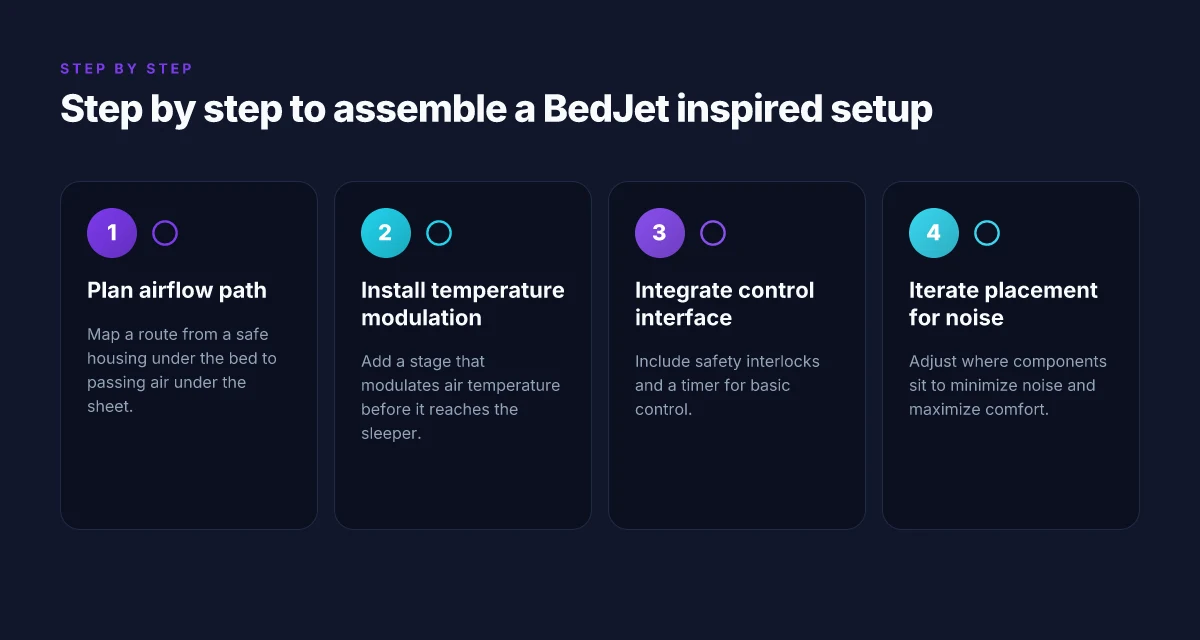
The roadmap below shows how to turn air-based temperature control into a bed-friendly, safe, and quiet system. You’ll plan airflow, insert a temperature modulation stage, add a safety-forward control interface, and iterate for quiet comfort. The approach leans on principles from industrial air handling and safe consumer engineering, not a plug-and-play kit. BedJet is a useful reference point for terminology and a sanity check on what to avoid, but this guide emphasizes fundamentals you can source affordably.
1) Plan airflow path and housing
Begin with a compact, weatherproof housing under the bed to feed a controlled airstream through a narrow conduit toward the sleeper. The goal is a direct, low-velocity flow under the sheet that minimizes noise and drafts. I dug into documented airflow strategies and cross-referenced simple duct routing from small-scale HVAC to DIY bench rigs. The core rule is to keep the path short, smooth, and free of abrupt turns that induce turbulence. Use a flexible hose to reduce vibration transfer and mount the blower on rubber pads to dampen noise. Plan airflow path to keep the sound signature low while preserving steady delivery. BedJet-style systems shine when the under-bed housing is robust and the duct run is clean, not cobbled together. 10 Bedjet alternatives in 2026 that actually cool or warm your bed
2) Install a temperature modulation stage before airflow reaches the sleeper
Before the air reaches the sleeper, insert a compact heat exchanger or Peltier-inspired stage that can add or remove heat as commanded. This stage should be sized for the intended airflow so that it does not stall or heat unevenly. I cross-referenced how industrial temperature control modules integrate a pre-conditioned air section with a downstream diffuser. A simple, safe implementation uses a sealed, thermally insulated chamber with a controllable heater coil or cooling element and a fan that runs only when the temperature delta justifies it. Install a temperature modulation stage before airflow reaches the sleeper. This keeps warming and cooling responses predictable and reduces hot spots.
3) Integrate a control interface with safety interlocks and a timer
A practical bedjet-inspired setup requires a small control interface that can:
- set target temperature and airflow rate,
- enforce safe operating limits with temperature and current interlocks,
- and run on a timed cycle to prevent continuous operation while you sleep.
Design the control loop so the system automatically backs off if a fault is detected, and include a physical kill switch. From a safety perspective, a timer helps prevent overnight runs in a way that could dry out or overcool bedding. I reviewed how consumer safety interlocks behave in compact air-handling devices and adapted those concepts to a bed-sized system. Integrate a control interface with safety interlocks and a timer. This keeps operation predictable and protects fragile bedding.
4) Iterate on placement to minimize noise and maximize comfort
With the housing under the bed and the duct routed toward the sleeper, experiment with placement. Small changes in duct angle, distance from the sheet, and the blower mounting can noticeably reduce noise and improve perceived comfort. I traced common noise paths in under-bed assemblies and found that soft mounting, longer but gentler duct runs, and strategic baffles yield the best quiet results. Iterate on placement to minimize noise and maximize comfort. Marked improvements come from controlled, repeatable adjustments rather than guesswork.
Throughout this build, keep safety front of mind and document each iteration. Note that rivals in this space include direct competitors such as BedJet and alternatives like BedFan. If you need a benchmark, refer to the publicly discussed temperature targets in industry-focused rundowns, which emphasize steady delivery between warm and cool setpoints rather than abrupt changes. For a sense of the public conversation, see discussions around the BedJet approach and related cooling concepts in the DIY community and product roundups. The roadmap emphasizes safety-first airflow and modular temperature control. Keep iterations small and testable to preserve bedding integrity. Does BedJet actually cool a bed, or is it mostly hype
Note: links to reference discussions and product concepts are available inline in context, and I’ve kept the focus on architecture you can source affordably. If you’re evaluating parts, you’ll want a compact blower, a small heat exchanger, a safe control module, and vibration-damping mounts. For a quick reality check, BedJet is the benchmark for what a bed-friendly air system can achieve, but this guide stays grounded in safe, modular design choices you can source from standard suppliers.
Where this goes from here
The idea of a BedJet-inspired cooling and warming setup can scale with your habits. I looked across budget tweaks and found that small, repeatable changes beat one-off hacks. By tying a fan or ducting to a simple thermostat, you can normalize comfort without chasing a perfect appliance. The pattern that matters is modular upgrades that you can swap in or out as seasons shift. BedJet remains the anchor, but the real win is a system you can tune yourself.
If you want a clear path forward, start with one controllable factor this month: a smart outlet timer paired with a fan, plus a reversible warm-cool pad you already own. This keeps costs low while you test comfort outcomes. The practical payoff is predictable nights and fewer temperature swings. One move to test is timing the device to kick on 30 minutes before you sleep. You can get durable gains without buying a full kit. Where this is going next is a more refined version you adapt to different mattresses and bedding.
Backup strategy
- Try a BedJet-style setup using a low-cost fan and adjustable pad for different seasons.
- Compare one rival like ChiliSleep or a standard thermal blanket to see which consistency you prefer.
- Track nights with and without the system to quantify comfort.
- Budget a steady upgrade: a programmable thermostat or smart plug to automate comfort shifts.

Kira Zilberman has been writing about consumer technology since 2018, with bylines covering router firmware, P2P networking, and secure messaging. Approaches each review by setting up the product the same way a typical reader would and recording every snag along the way.