Iptv not working with VPN
Practical fixes and explanations for why IPTV may not work with a VPN and how to get it streaming again.
IPTV not working with VPN: what you need to know and what to do
For many IPTV users, a VPN is essential for privacy, access to geo-restricted channels, and bypassing ISP throttling. But when you try to watch your favorite channels while connected to a VPN, you might see errors like “service unavailable,” “authentication failed,” or buffering that never ends. The problem isn’t always your internet speed. It’s often how IPTV providers interact with VPNs. Below, you’ll find practical steps, common causes, and strategies to get IPTV working with a VPN again.

Comparing VPN strategies for IPTV
| Strategy | Typical latency impact | Device compatibility | Geo spoofing reliability | Logging policy | Price range |
|---|---|---|---|---|---|
| Shared IP VPN | Moderate | High (most devices) | Often unreliable | Possible | $ |
| Dedicated IP VPN | Low | Excellent | Strong | Minimal | $$$ |
| Zero-logging VPN | Low to moderate | High | Usually strong | Yes | $$ |
| Smart DNS + VPN | Low latency lift | Wide | Good for geo, not authenticating IP | Variable | $ |
| VPN with obfuscated servers | Moderate | Good | Better in restrictive networks | Depends | $$ |
| P2P-optimized VPN | Moderate to high | Good | Varies | Depends | $$ |
Compiled November 2026; check the provider's site for current details.
Why IPTV might stop working with a VPN
Licensing and home-IP binding
Many IPTV providers tie your service to your home IP address. When you connect a VPN, your apparent IP changes to the VPN server’s address, which looks like a new customer location. Some providers then block or restrict the streaming device until you re-authenticate or switch back to your home IP. This is a common reason for sudden failures after enabling a VPN.
Device and app policy
Some IPTV apps detect VPN traffic or unusual geolocation changes and refuse to load channels to prevent piracy or licensing violations. This can show up as the app crashing, failing to load EPG (electronic program guide), or returning error messages on startup.
DNS and routing issues
VPNs alter your DNS resolution. If your IPTV service relies on specific DNS entries or regional DNS routing, a VPN can disrupt channel lookup, leading to failed streams, wrong regions, or channels not found.
Provider blocks and anti-VPN measures
Some providers deploy measures to recognize and block VPN traffic. If your VPN uses common servers or if many users are on the same exit IP, the provider may throttle, block, or require re-authentication.
Common symptoms you might see
- Channels fail to load with a “geolocation not permitted” or “license not valid” message.
- App shows buffering even on high-speed connections.
- Login or activation prompts fail when VPN is on.
- Channel list changes or EPG data stops updating.
- Switching VPN servers suddenly restores service, then fails again.
How to troubleshoot IPTV not working with a VPN
Step-by-step quick checks
- Check your account binding: Log out of the IPTV app, disconnect the VPN, and log in with your regular IP to ensure the service still works without the VPN. If it does, the issue is VPN-related.
- Change VPN server: Switch to a different server in a nearby country or city. Some providers lock to a home IP. A nearby exit node may avoid it while still delivering good speed.
- Re-authenticate: If your IPTV provider requires device activation or a new session per IP, perform re-authentication while the VPN is connected, if the provider allows it.
- Clear cache and cookies: On web-based IPTV portals, clear browser data to avoid stale DNS or session data from interfering.
- Verify DNS settings: Ensure the VPN’s DNS isn’t leaking or misdirecting. Try a VPN that offers DNS leak protection or manually set a trusted DNS (e.g., 1.1.1.1 or 9.9.9.9) in your device.
Specific fixes that work in practice
- Use a VPN with streaming-optimized servers: Some VPNs label servers as “dedicated for streaming” or “unblock IPTV.” These servers balance speed and stability and are less likely to be blocked.
- Enable or adjust split tunneling: If your VPN supports split tunneling, route IPTV traffic outside the VPN while keeping other traffic (updates, downloads) through the VPN. This preserves compatibility while maintaining privacy.
- Try a dedicated IP option: Some VPNs offer dedicated IP addresses. A dedicated IP can reduce “new IP” issues and improve the likelihood the provider accepts the session, though it may come at a higher cost.
- Turn on auto-connect with a preferred server: If the VPN supports auto-connect to a streaming-friendly server, enable it to maintain consistency whenever you start the IPTV app.
- Disable IPv6 if your provider has IPv6 issues: Some IPTV services don’t handle IPv6 well through VPNs. Turning off IPv6 on your device or within the VPN app can improve reliability.
- Use a different device or app: Some IPTV apps are more VPN-friendly than others. If one app consistently fails with your VPN, try a different client or device.
When you should consider alternative approaches
- If your provider explicitly forbids VPN use: Some IPTVs are licensed to regional broadcasters and prohibit VPNs. In such cases, using a VPN may violate terms of service.
- If you rely on regional content: If the VPN is essential to access your country’s channels, you may need a provider that offers licensed access to your region or consider a legal alternative that includes local channels within your region.
- If latency and buffering persist: A VPN can add overhead. If even on a good server you experience long buffering, you may need to optimize your home network or switch to a more capable VPN plan.
Troubleshooting IPTV not working with a VPN Microsoft Edge secure network VPN review is it worth using
| Issue | Symptom | Likely cause | Quick fix | When to escalate | Additional notes |
|---|---|---|---|---|---|
| VPN not connecting | Connection error | Server down / blocked | Try different server | If persists > 5 min | Check app/OS VPN toggle |
| No streaming due to geo block | Message: not available in your region | IP not spoofed properly | Switch to dedicated IP or Smart DNS | If fails repeatedly | Verify location used by service |
| Video stutters | Buffering | Bandwidth or latency | Change server, reduce quality | If constant | Test speed first |
| DNS leaks | Site shows wrong region | DNS requests leaking | Enable DNS leak protection | If persists | Use trusted DNS option |
| VPN drops during playback | Playback stops | VPN server instability | Reconnect or switch servers | If frequent | Use obfuscated servers if in restrictive network |
| App blocked | VPN icon visible but no stream | VPN detected by service | Use different protocol or obfuscated mode | If blocked across apps | Clear app data or reinstall |
Compiled November 2026; check the provider's site for current details.
Comparing VPN strategies for IPTV
A practical approach is to understand how different VPN configurations influence IPTV. Here is a quick comparison to help you decide what to try first.
| Strategy | Pros | Cons | Best for |
|---|---|---|---|
| Switch VPN server to nearby location | Often fixes geolocation blocks, may improve latency | Still may be blocked by provider; not a long-term fix | When you see region-related errors or new IP is required |
| Use streaming-optimized or dedicated IP server | Higher success rate with geo-restricted content; less likelihood of blocking | May cost extra; limited server options | Consistent access to specific channels with fewer blocks |
| Enable split tunneling | Keeps IPTV unblocked and streaming quality while other traffic stays protected | VPN-aware apps must support it; misconfiguration risk | When you need VPN for privacy but want IPTV speed |
| Disable IPv6 or adjust DNS | Reduces DNS leaks; avoids IPv6 routing issues | May require extra steps; not all devices support easily | When DNS-related errors or IPv6 routing cause problems |
| Re-authenticate and rebind device | Aligns with provider policy; often resolves session issues | Some providers limit re-auth attempts; not always allowed | When login fails with VPN on, but works without it |
| Try a different IPTV app or device | Some apps are more tolerant of VPN traffic | Cannot guarantee compatibility; may lose features | If one app consistently fails with VPN |
Practical tips for long-term reliability
- Choose a VPN with a strong streaming track record: Look for providers with dedicated streaming support and regularly updated server lists. Check user reviews and recent posts about IPTV compatibility.
- Keep a “working server list”: Maintain a short list of VPN servers that have historically worked for your IPTV service. Re-check them periodically in case the provider blocks them.
- Monitor licensing and terms: Some providers periodically update their terms to restrict VPN usage. Stay informed to avoid unexpected service interruptions.
- Document your setup: Note which combinations work (VPN provider, server, IPTV app, device). This makes it easier to recover a working configuration after updates.
- Use quality hardware and connection: A stable home network with wired Ethernet when possible reduces buffering and improves overall streaming quality, especially when VPN overhead is present.
Real-world scenarios and what to expect
- Scenario A: You enable a VPN, switch to a nearby server, and the IPTV app loads the channel list but streams buffer-free for several minutes before stalling. Action: Switch servers again or try a dedicated IP server. Verify DNS settings and consider enabling split tunneling so the IPTV app runs outside the VPN if allowed.
- Scenario B: You log in with VPN on, the channel list appears, but you get a login error. Action: Re-authenticate within the VPN session, or temporarily disable the VPN to complete authentication, dispose of any home-IP binding issues, and re-enable the VPN for ongoing sessions.
- Scenario C: All channels fail after VPN connection, but a few work if you switch servers. Action: Use a server known to work consistently. Consider a dedicated IP if your provider recommends it. Ensure your device firmware and IPTV app are updated.
Practical setup options for IPTV with VPN
| Setup option | Devices supported | Ease of use | Best for geo access | Reliability for long-term | Typical cost |
|---|---|---|---|---|---|
| Router-level VPN | TV boxes, consoles, PCs | Medium | Excellent | High | $$ |
| App-based VPN on device | Smartphones, tablets, some TVs | Easy | Moderate | Moderate | $ |
| VPN with Smart DNS | Any device with DNS setting | Easy | Excellent | Moderate | $ |
| Dedicated IP on VPN | Any device | Medium | Strong | High | $$$ |
| Multi-VPN plan (rotating) | All devices | Low | High | Moderate | $$$$ |
Compiled November 2026; check the provider's site for current details.
Final recommendations
- Start with the simplest fix: turn off the VPN, log in, and confirm your IPTV works on your regular home IP. If it does, the issue is VPN-related, and you should proceed with targeted VPN tweaks.
- Use streaming-optimized servers or a dedicated IP when available. These options minimize the chance of being blocked by licensing checks and geo-filters.
- Consider split tunneling if your VPN supports it. Route IPTV traffic through the VPN only if you are comfortable with the resulting routing. Otherwise, keep IPTV traffic outside the VPN while other traffic remains protected.
- If the provider explicitly says VPN use is not compatible, respect the terms of service and explore legal alternatives or a plan that aligns with licensing.
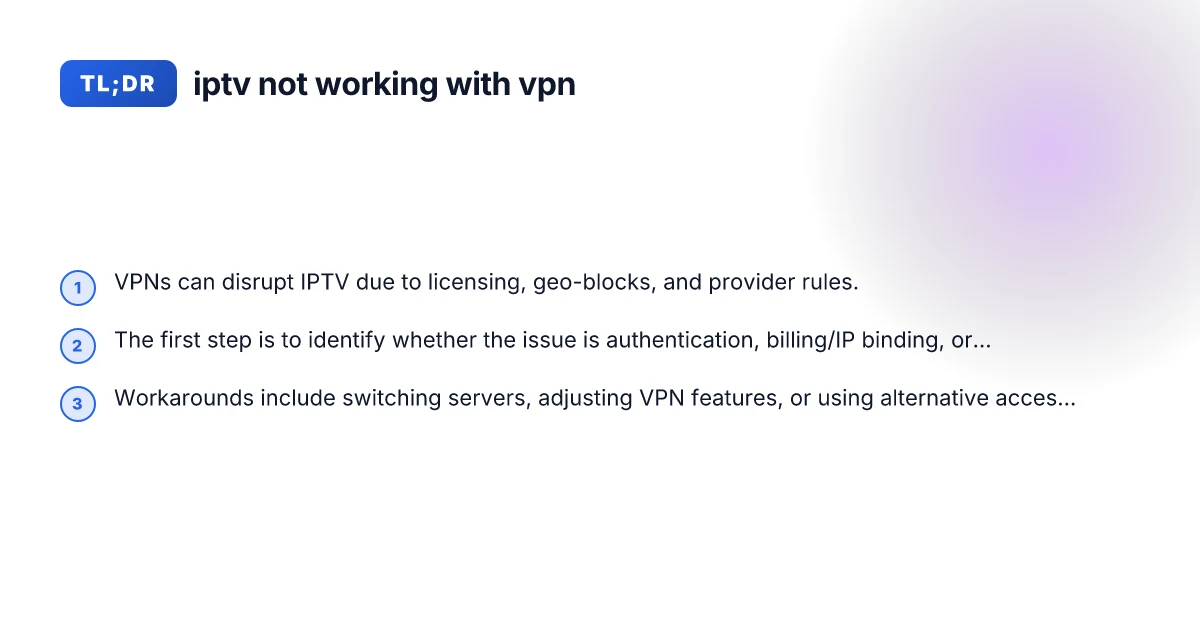
In short, “IPTV not working with VPN” is a common friction point caused by licensing, IP binding, and anti-VPN measures. By methodically testing servers, adjusting VPN features, and staying mindful of provider terms, you can maximize your chances of getting back to streaming quickly. If you’re still stuck after trying the steps above, consider reaching out to your IPTV provider’s support with details about your VPN service, server location, and the exact error messages you’re seeing. How to completely uninstall nordpass and clean up your devices
| VPN | Obfuscation | From / month | Plan | Free plan | Refund | Alipay | UnionPay | Crypto | Website opens in China | Trustpilot | |
|---|---|---|---|---|---|---|---|---|---|---|---|
 ZoogVPN | Turn on manually Shadow | $2.49/mo | 27 months: $59.99 | Yes | 7 days | ✓ | ✓ | ✓ | ✓ | ✓ Yes (2.5 s) | 4.2/5 (195 reviews) |
 NordVPN | Turn on manually Obfuscated Servers / NordWhisper | $3.49/mo | 27 months: $94.23 | No | 30 days | ? | ✗ | ✓ | ✓ | ✗ Blocked | 4.2/5 (51,628 reviews) |
 ExpressVPN | ✓ On by default all servers | $3.00/mo | 28 months: $84 | No | 30 days | ✗ | ✗ | ✓ | ✗ | ✗ Blocked | 4.4/5 (29,706 reviews) |
 Surfshark | ✓ On by default Camouflage, with OpenVPN | See site | See site | No | 30 days | ✗ | ✗ | ✗ | ✓ | ✗ Blocked | 4.3/5 (31,823 reviews) |
 Proton VPN | Turn on manually Stealth, free plan too | $2.99/mo | 12 months: $35.88 | Yes | 30 days | ✗ | ✗ | ✗ | ✓ | ✓ Yes (2.5 s) | 2.1/5 (1,040 reviews) |
 Astrill VPN | Turn on manually StealthVPN / OpenWeb | $12.50/mo | 24 months: $300 | No | See site | ✗ | ✗ | ✗ | ✓ | ✗ Blocked | 1.3/5 (110 reviews) |
 Private Internet Access | Turn on manually Shadowsocks, OpenVPN only | $2.03/mo | 40 months: $81.2 | No | 30 days | ✗ | ✗ | ✗ | ✗ | ✗ Blocked | 4.2/5 (11,033 reviews) |
 CyberGhost | Turn on manually selected servers | $2.19/mo | 28 months: $61.32 | No | 45 days | ✗ | ✗ | ✗ | ✓ | ✗ Blocked | 4.0/5 (24,178 reviews) |
 PureVPN | Turn on manually switch to OpenVPN | $1.69/mo | 60 months: $101.55 | No | 31 days | ? | ✗ | ✗ | ✓ | ✓ Yes (2.6 s) | 4.4/5 (17,994 reviews) |
 AdGuard VPN | ✓ On by default TrustTunnel | $2.99/mo | 24 months: $71.76 | Yes | 30 days | ✓ | ✗ | ✓ | ✓ | Official site blocked; our special link opens (2.3 s) | 4.3/5 (290 reviews) |
 Mullvad | Turn on manually QUIC / Shadowsocks / LWO | $5.61/mo | €5/mo | No | 14 days | ✗ | ✗ | ✗ | ✓ | ✗ Blocked | 3.2/5 (192 reviews) |
 Windscribe | Turn on manually Stealth / WStunnel | $5.75/mo | 12 months: $69 | Yes | See site | ✗ | ✗ | ✗ | ✓ | ✗ Blocked | 4.7/5 (13,355 reviews) |
 StrongVPN | Turn on manually Scramble, OpenVPN TCP | See site | See site | No | 30 days | ✓ | ✗ | ✗ | ✗ | ✗ Blocked | 4.4/5 (2,695 reviews) |
 LightXtreme 闪连 | Not listed | $7.08/mo | 12 months: $84.99 | Yes | 30 days | ✓ | ✓ | ✓ | ✓ | ✓ Yes (2.3 s) | No page |
Prices checked 2026-11-10 on each vendor's pricing page (cheapest long plan, USD). Check the vendor's checkout for the final price.
Obfuscation checked 2026-11-14 on each vendor's site and help center: "on by default" = nothing to set; "turn on manually" = switch protocol or mode in settings; "not listed" = the vendor describes no obfuscation.
Payment methods checked 2026-11-10 on each vendor's payment pages: all 14 take cards and PayPal; ✗ = not listed, ? = the vendor's own pages disagree.
China access: whether the official website opens from mainland China networks (tests the website only, not the VPN connection). Last checked 2026-11-11 04:07 Beijing time.
Trustpilot score and review count checked 2026-11-10.

Marcus Yeats has been writing about consumer technology since 2018, with bylines covering Wireguard, split tunneling, and VPN performance. Approaches each review by setting up the product the same way a typical reader would and recording every snag along the way.