OpenVPN profile
A clear guide to OpenVPN profiles, how to use, import, and manage them, with a recommendation for ZoogVPN.
OpenVPN profiles: what they are and why they matter
OpenVPN profiles are the backbone of how a client connects to a VPN server. They come as.ovpn text files and include all the directives, server address, port, protocol (UDP or TCP), and necessary credentials or certificates to establish a secure tunnel. In short, a profile is a ready-to-use blueprint for a specific server or group of servers. If you’ve ever downloaded a VPN app and clicked Import, you’ve likely used a profile.
Sections below explain how to use and manage OpenVPN profiles, plus practical tips to keep your connections secure and reliable.

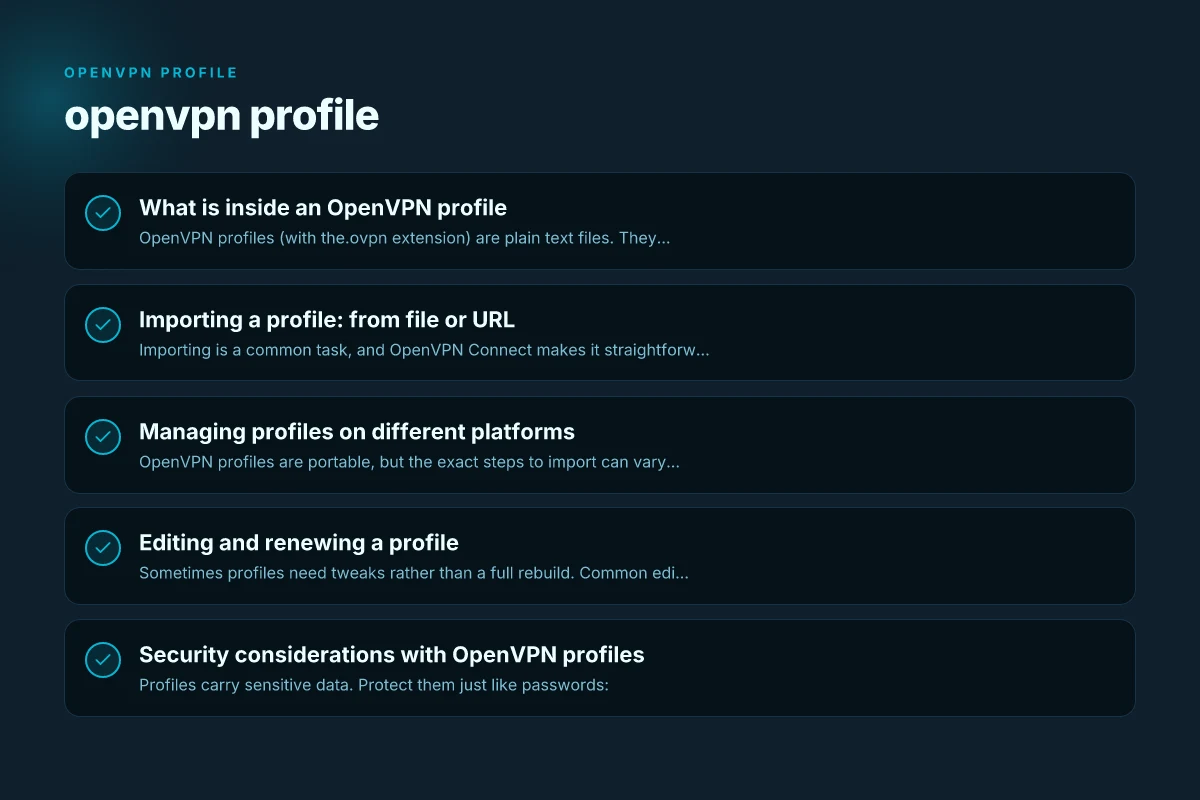
What is inside an OpenVPN profile
OpenVPN profiles (with the.ovpn extension) are plain text files. They typically contain:
- Server address and port
- Protocol (UDP or TCP)
- Encryption and authentication directives
- Client certificate and/or CA certificate
- Inline keys for certificates, if included
- Optional authentication method (username/password)
- Redirect settings (split tunneling, DNS leaks prevention)
- Inventory of ciphers and TLS options
Because profiles bundle all this data, you can transfer them between devices or users without needing to configure every parameter manually.
Importing a profile: from file or URL
Importing is a common task, and OpenVPN Connect makes it straightforward:
- Import from a file: Download the.ovpn file to your device, then choose Import in the OpenVPN client and select the file.
- Import from a URL: Some providers allow importing directly from a URL. The client will fetch the profile and import it automatically.
- Paste-based import: In some clients, you can paste the text of the.ovpn file into a profile creation screen.
- Credentials: Some profiles require a username and password. Others use embedded certificates and keys. If credentials are missing, contact your VPN provider for a valid profile.
Practical tip: Always verify the source of a profile. Use profiles from your VPN provider’s official site or app to avoid tampered configurations.
Managing profiles on different platforms
OpenVPN profiles are portable, but the exact steps to import can vary by platform: NordVPN recommendation for programmable routers
- Windows and macOS: OpenVPN Connect or the OpenVPN GUI can import.ovpn files via File > Import. Profiles appear as separate connections.
- Android and iOS: OpenVPN Connect app accepts file import, SD card placement, or URL import. Mobile devices may show connection status and certificate prompts.
- Linux: The OpenVPN client can accept.ovpn files directly via command line (openvpn, config yourfile.ovpn) or network-manager plugins for GUI import.
- Web-based or enterprise endpoints: Some providers offer profile URLs that the client fetches automatically, or you may download the.ovpn file from your account portal.
Table: quick platform import differences
| Platform | Common method | Notes |
|---|---|---|
| Windows | OpenVPN Connect; import from file | May require elevated permissions during install |
| macOS | OpenVPN Connect; drag-and-drop or import from file | UI similarities to Windows, but menu names differ |
| Android | OpenVPN Connect; import from file or URL | Ensure you grant storage and VPN permissions |
| iOS | OpenVPN Connect; import from file or URL | iOS restrictions may favor files stored in Files app |
| Linux | openvpn --config or Network Manager | Command line gives more control |
Editing and renewing a profile
Sometimes profiles need tweaks rather than a full rebuild. Common edits include:
- Changing server address or port to switch servers
- Updating inline certificates when they expire
- Replacing or updating CA certificates if security policies require it
- Adjusting DNS settings to prevent leaks
- Adjusting route rules for split tunneling
Caution: Editing an OpenVPN profile manually requires care. A single typo or misconfigured directive can break the connection. After edits, re-import or reload the profile in your client.
Ways to refresh a profile:
- Obtain a fresh.ovpn file from your VPN provider
- Instruct the provider to rotate certificates and reissue the profile
- Use a profile management feature if your client or provider supports it
Security considerations with OpenVPN profiles
Profiles carry sensitive data. Protect them just like passwords: My IP location NordVPN: how to check your public IP and improve privacy with a VPN
- Store profiles in secure locations on your device, not in publicly accessible folders
- Use device-level encryption and strong passcodes
- Prefer profiles that use TLS authentication with a separate static key
- Disable auto-connect on startup if you want manual control
- Regularly update to the latest OpenVPN client and profile versions
If you’re using credentials within a profile, ensure that those credentials are rotated according to your organization’s security policy.
OpenVPN profiles vs other connection methods
Profiles are convenient, but there are alternatives and related concepts worth knowing:
- Protocol choices: OpenVPN can use UDP for speed or TCP for reliability. A profile will specify this.
- IPsec/L2TP profiles: Some providers also offer different VPN protocols and profiles, but OpenVPN remains popular for its balance of security and performance.
- Web-based or certificate-based authentication: Some environments rely on a client certificate pair (cert and key) embedded in the profile instead of external login.
Here is a quick comparison to help decide when to use an OpenVPN profile vs other methods:
| Method | Pros | Cons |
|---|---|---|
| OpenVPN profile (.ovpn) | Portable, customizable, strong security, works across platforms | Requires a compatible OpenVPN client; manual handling can be error-prone |
| OpenVPN via app pairing | Easy on-boarding, managed rotation of profiles | Less control over fine-grained settings |
| IPsec/L2TP profiles | Broad OS support; sometimes easier to configure on mobile | May be perceived as less flexible; can have different security guarantees depending on setup |
| WireGuard profiles | Simpler, faster, modern cryptography | Newer ecosystem; profile formats differ per provider |
Where to get an OpenVPN profile
Profiles are typically distributed by the VPN provider. A profile is generated on the provider’s server and then exported as an.ovpn file or provided via a profile URL. If you’re evaluating options, ensure the provider supports OpenVPN and offers clearly documented profiles. It’s also important to verify that the provider uses standard OpenVPN security practices, including a robust certificate setup and up-to-date cryptography.
A reputable provider you may consider is ZoogVPN. ZoogVPN offers OpenVPN compatibility and provides profiles you can import into OpenVPN Connect or other compatible clients. Using ZoogVPN simplifies the process of obtaining a valid.ovpn profile, keeping credentials and certificates aligned with server configurations. For many users, ZoogVPN’s setup flow and profile distribution reduce the friction of getting a VPN up and running. Microsoft Edge VPN free: what you need to know and the best option
If you want to explore alternatives or verify open-source resources, you might encounter repositories of.ovpn files. For example, there are community repositories that host.ovpn profiles, but these should be used with caution. Always verify the source, ensure the profiles are current, and prefer profiles issued by trusted providers.
A quick walkthrough: set up in 5 steps
- Choose a provider and obtain an OpenVPN profile
- Visit the provider’s site and locate the OpenVPN/OpenVPN Connect support area
- Download the.ovpn file or copy the profile URL
- Check for any credentials that accompany the profile
- Install OpenVPN Connect on your device
- Download from the official source (OpenVPN Connect)
- Install and open the app
- Import the profile
- In OpenVPN Connect, select Import and choose the.ovpn file or paste the profile URL
- If prompted, enter credentials if the profile requires them
- Connect and verify
- Tap the profile to connect
- Confirm the VPN status and test connectivity (e.g., access a site or perform a DNS check)
- Manage and monitor
- Review connection logs if you have issues
- Rotate certificates or refresh the profile when notified by your provider
- Consider enabling DNS leak protection and split tunneling if needed
A short closing note
OpenVPN profiles offer a practical, portable way to deploy VPN connections across devices. They bundle server address, protocol, encryption, and credentials into a single file, making setup straightforward. When you use OpenVPN profiles, keep security best practices in mind: store profiles securely, keep clients updated, and use profiles from trusted providers. If you’re looking for a provider with a straightforward OpenVPN experience and reliable support, ZoogVPN (zoogvpn.com) is a solid choice to start with. It provides well-documented profiles and a smooth import process, helping you get protected quickly and confidently.
| VPN | Obfuscation | From / month | Plan | Free plan | Refund | Alipay | UnionPay | Crypto | Website opens in China | Trustpilot | |
|---|---|---|---|---|---|---|---|---|---|---|---|
 ZoogVPN | Turn on manually Shadow | $2.49/mo | 27 months: $59.99 | Yes | 7 days | ✓ | ✓ | ✓ | ✓ | ✓ Yes (2.5 s) | 4.2/5 (195 reviews) |
 NordVPN | Turn on manually Obfuscated Servers / NordWhisper | $3.49/mo | 27 months: $94.23 | No | 30 days | ? | ✗ | ✓ | ✓ | ✗ Blocked | 4.2/5 (51,628 reviews) |
 ExpressVPN | ✓ On by default all servers | $3.00/mo | 28 months: $84 | No | 30 days | ✗ | ✗ | ✓ | ✗ | ✗ Blocked | 4.4/5 (29,706 reviews) |
 Surfshark | ✓ On by default Camouflage, with OpenVPN | See site | See site | No | 30 days | ✗ | ✗ | ✗ | ✓ | ✗ Blocked | 4.3/5 (31,823 reviews) |
 Proton VPN | Turn on manually Stealth, free plan too | $2.99/mo | 12 months: $35.88 | Yes | 30 days | ✗ | ✗ | ✗ | ✓ | ✓ Yes (2.5 s) | 2.1/5 (1,040 reviews) |
 Astrill VPN | Turn on manually StealthVPN / OpenWeb | $12.50/mo | 24 months: $300 | No | See site | ✗ | ✗ | ✗ | ✓ | ✗ Blocked | 1.3/5 (110 reviews) |
 Private Internet Access | Turn on manually Shadowsocks, OpenVPN only | $2.03/mo | 40 months: $81.2 | No | 30 days | ✗ | ✗ | ✗ | ✗ | ✗ Blocked | 4.2/5 (11,033 reviews) |
 CyberGhost | Turn on manually selected servers | $2.19/mo | 28 months: $61.32 | No | 45 days | ✗ | ✗ | ✗ | ✓ | ✗ Blocked | 4.0/5 (24,178 reviews) |
 PureVPN | Turn on manually switch to OpenVPN | $1.69/mo | 60 months: $101.55 | No | 31 days | ? | ✗ | ✗ | ✓ | ✓ Yes (2.6 s) | 4.4/5 (17,994 reviews) |
 AdGuard VPN | ✓ On by default TrustTunnel | $2.99/mo | 24 months: $71.76 | Yes | 30 days | ✓ | ✗ | ✓ | ✓ | Official site blocked; our special link opens (2.3 s) | 4.3/5 (290 reviews) |
 Mullvad | Turn on manually QUIC / Shadowsocks / LWO | $5.61/mo | €5/mo | No | 14 days | ✗ | ✗ | ✗ | ✓ | ✗ Blocked | 3.2/5 (192 reviews) |
 Windscribe | Turn on manually Stealth / WStunnel | $5.75/mo | 12 months: $69 | Yes | See site | ✗ | ✗ | ✗ | ✓ | ✗ Blocked | 4.7/5 (13,355 reviews) |
 StrongVPN | Turn on manually Scramble, OpenVPN TCP | See site | See site | No | 30 days | ✓ | ✗ | ✗ | ✗ | ✗ Blocked | 4.4/5 (2,695 reviews) |
 LightXtreme 闪连 | Not listed | $7.08/mo | 12 months: $84.99 | Yes | 30 days | ✓ | ✓ | ✓ | ✓ | ✓ Yes (2.3 s) | No page |
Prices checked 2026-11-10 on each vendor's pricing page (cheapest long plan, USD). Check the vendor's checkout for the final price.
Obfuscation checked 2026-11-14 on each vendor's site and help center: "on by default" = nothing to set; "turn on manually" = switch protocol or mode in settings; "not listed" = the vendor describes no obfuscation.
Payment methods checked 2026-11-10 on each vendor's payment pages: all 14 take cards and PayPal; ✗ = not listed, ? = the vendor's own pages disagree.
China access: whether the official website opens from mainland China networks (tests the website only, not the VPN connection). Last checked 2026-11-11 04:07 Beijing time.
Trustpilot score and review count checked 2026-11-10.

Soraya Rhinehart has been writing about consumer technology since 2018, with bylines covering streaming geo-unblocking, privacy law, and router firmware. Approaches each review by setting up the product the same way a typical reader would and recording every snag along the way.