Payroll team structure: how to design, size, and evolve your payroll function
A practical guide to structuring a payroll team, defining roles, and aligning with business goals for accuracy and efficiency.
Payroll is often the backbone of people operations and a cornerstone of financial discipline. The way you structure the payroll team affects accuracy, compliance, employee experience, and the ability to scale as your business grows. In practice, there isn’t a one-size-fits-all answer. The right payroll team structure depends on headcount, complexity (locations, currencies, benefits, taxation), technology, and how you want payroll to interact with HR, finance, and operations. This guide lays out practical patterns, common roles, and considerations to help you design a payroll function that fits your company today and adapts for tomorrow.

Core goals of payroll by structure
| Goal / Structure | Centralized | Decentralized | Hybrid | Shared Services | Outsourced? |
|---|---|---|---|---|---|
| Primary objective | Compliance, accuracy | Business enablement | Balance control and service | Efficiency, consistency | Cost-saving |
| Control over policies | High | Moderate | Shared | Moderate | Limited |
| Speed of change implementation | Moderate | Fast in units | Slow enterprise-wide | Fast governance changes | Depends on vendor |
| Data consistency across org | High | Medium | Moderate | High | No/limited |
| Customer (employee) focus | Internal back-office | Local needs | Both | Standardized service | Limited visibility |
| KPI visibility to execs | High | Variable | Clear mix | Transparent | Vendor-driven |
Compiled November 2026; check the provider's site for current details.
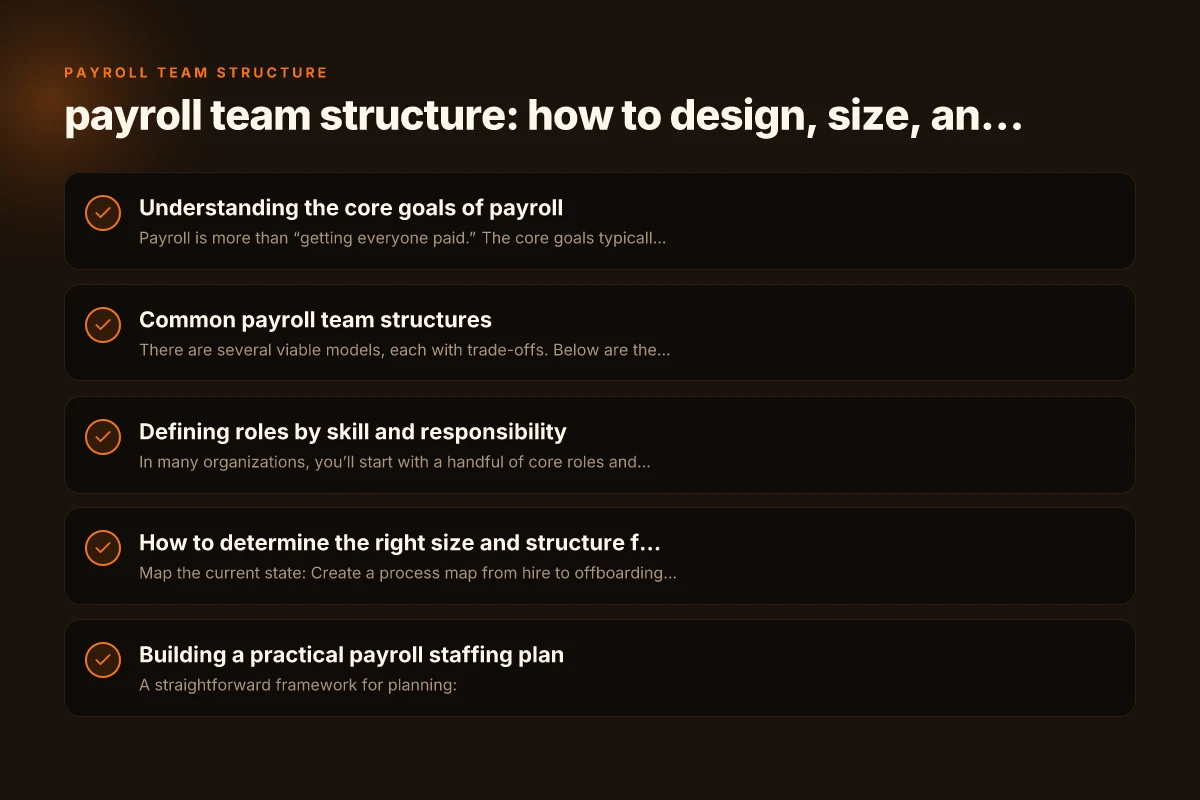
Understanding the core goals of payroll
Payroll is more than “getting everyone paid.” The core goals typically include:
- Accurate and timely payments to employees
- Tax withholding, social contributions, and regulatory compliance
- Benefit deductions, retirement plan contributions, and reimbursements
- Data integrity and audit readiness
- Strong partnerships with HR, finance, and business leaders
- Clear metrics and reporting for leadership
These goals should shape your team’s structure. If your priorities emphasize speed and user experience, you may emphasize roles that focus on processing and employee service. If the priority is compliance and controls, you’ll want stronger governance, audit, and reconciliation capabilities. Understanding your goals helps you decide how many payroll specialists you need, where control points belong, and how automation fits in.
Common payroll team structures
There are several viable models, each with trade-offs. Below are the most common configurations, with typical roles and how they map to responsibilities.
1) Centralized finance/Payroll under Finance
- Pros: Strong alignment with financial reporting, taxation, and external audits. Predictable control environment.
- Cons: May feel distant from HR and employees. Potential for slower response to employee inquiries if SLAs are not defined.
- Typical roles:
- Payroll Manager or Lead: overall owner of payroll processes, controls, and compliance.
- Payroll Processor(s): the hands-on work of calculating pay, deductions, and generating pay runs.
- Tax/Compliance Analyst: ensures tax filings, reporting, and regulatory changes are implemented.
- Payroll Data/Controls Specialist: reconciliations, audit trails, and data integrity checks.
- Payroll Systems Administrator: maintains configuration in the payroll platform, integrations, and automation rules.
2) HR–Payroll integration (shared service model)
- Pros: Closer collaboration with HR systems like recruiting, onboarding, and benefits. Improved employee experience.
- Cons: Requires strong governance to avoid role confusion; SLAs must be clear.
- Typical roles:
- Payroll Lead (often part of HR Operations): coordinates payroll with HR, benefits, and time/attendance.
- Payroll Specialist(s): executes processing and data validation.
- HR Systems/Payroll Integrator: oversees integrations with HRIS, benefits systems, and time tracking.
- Compliance & Audit Liaison: keeps regulatory changes mapped to both HR and payroll data.
3) Hybrid or decentralized payroll (multi-location, regional teams)
- Pros: Fast local support, tailored tax withholdings, and responsive issue handling for remote or international employees.
- Cons: Higher risk of inconsistent controls. Requires robust standardization and governance.
- Typical roles:
- Regional Payroll Coordinators: handle local compliance and processing for a group of locations.
- Center of Excellence (CoE) for payroll: sets global standards, policies, and automation templates.
- Shared Services Lead: coordinates across regions, handles escalations, and performance reporting.
- Global Payroll Engineer: focuses on system integrations and data flows across geographies.
4) Fully automated/technology-driven payroll
- Pros: Efficiency, scalability, reduced manual error, faster processing.
- Cons: Requires mature data quality and strong change management. Human oversight remains essential.
- Typical roles:
- Automation/Platform Architect: designs automation rules, data flows, and integrations.
- Payroll Processor (light touch): handles exceptions that automation cannot resolve.
- Data Integrity Specialist: proactively monitors data quality and reconciliation.
- Payroll Analytics and Insights: uses data to provide business insights such as cost per employee, overtime trends, and regulatory exposure.
- Employee Experience Champion: focuses on self-service, FAQs, and user training.
Table: structure comparison at a glance
| Model | Key benefit | Great for | Core roles (typical) | Potential risk |
|---|---|---|---|---|
| Centralized under Finance | Strong controls and reporting | Companies prioritizing governance | Payroll Manager, Tax/Compliance Analyst, Data/Controls Specialist, Processors, Systems Admin | Possible HR engagement gaps; slower issue resolution for employees |
| HR–Payroll integration | Better employee experience | Organizations with heavy HR touchpoints | Payroll Lead, Payroll Specialist, HR Systems Integrator, Compliance Liaison | Governance complexity; SLA alignment needed |
| Hybrid/Decentralized | Local accuracy and responsiveness | Multi-location or regional entities | Regional Coordinators, CoE, Shared Services Lead, Global Payroll Engineer | Governance and consistency challenges |
| Automated/Tech-driven | Scalability and efficiency | Growth-ready or tech-forward teams | Automation Architect, Light-touch Processors, Data Integrity Specialist, Analytics, Employee Experience | Dependence on data quality; change management |
Common payroll team structures compared Pay employees and vendors rbc business banking solutions
| Structure / Attribute | Centralized | Decentralized | Hybrid | Shared Services | Outsourced |
|---|---|---|---|---|---|
| Decision authority | Head office | Local units | Both levels | Governance team | Vendor |
| Typical headcount locus | HQ | Field / regions | Core + regional | Shared center | Vendor staff |
| Typical tech stack access | Full | Limited local | Core + local apps | Unified platform | Varies by vendor |
| Data governance rigor | High | Moderate | Balanced | High | Vendor policy |
| Consistency of payroll rules | High | Low to moderate | Moderate | High | Dependent on vendor |
| Ideal for scale | Yes | No | Yes | Yes | No/Yes with limits |
Compiled November 2026; check the provider's site for current details.
Defining roles by skill and responsibility
In many organizations, you’ll start with a handful of core roles and expand as needed. Here are practical role descriptions and the sweet spot for each.
Payroll Manager/Lead
Owns end-to-end payroll delivery, controls, and compliance posture.
Manages SLAs, dashboards, audits, and cross-functional partnerships. New york paid sick leave payout upon termination
Often acts as the liaison to finance, HR, and executives.
Payroll Processor
Performs calculations, deductions, and pay runs.
Validates time and attendance data, benefits, and tax withholdings.
Handles employee inquiries or escalations with established escalation paths. Missouri salary employee labor laws
Tax/Compliance Analyst
Keeps up with tax laws, wage–and–tax reporting, and regulatory changes.
Ensures filings (local, state, federal, and international) are accurate and timely.
Performs internal audits and reconciliations.
Payroll Systems Administrator / Engineer Fn lock on your razer pro type ultra
Maintains payroll software, integrations, and data mappings.
Configures payroll templates, rules, and automated checks.
Oversees data quality, security, and access controls.
HR/Payroll Data & Analytics Specialist
Monitors payroll metrics, variance analyses, and cost drivers. Keepass with remote desktop protocol for secure access
Delivers payroll dashboards to leaders (e.g., headcount, overtime, benefits costs).
Partners with finance and HR to drive process improvements.
Employee Experience Specialist (sometimes part-time or shared)
Manages self-service, knowledge base, and user training.
Responds to routine payroll inquiries and helps with onboarding/offboarding. Payroll terminology Australia
Internal Controls & Audit Liaison
Focuses on reconciliation, SOX/controls if applicable, and audit readiness.
Ensures proper segregation of duties and cross-checks.
When sizing the team, a practical rule of thumb is to start with core processing and leadership, then layer in compliance and systems experts as your payroll footprint grows. A widely cited benchmark is a payroll staff-to-employee ratio that varies by geography and complexity, but many mid-sized firms begin with 1-2 payroll processors per 500–1,000 employees in centralized models, then extend with regional roles as needed. Use your own data, revenue complexity, benefits programs, remote workers, and multi-country payroll, to calibrate this.
How to determine the right size and structure for your organization
- Map the current state: Create a process map from hire to offboarding to reveal bottlenecks, manual touchpoints, and data handoffs. Identify where errors most commonly occur.
- Define the target operating model: Decide whether payroll should be led by Finance, HR, or a hybrid (shared services). Clarify governance, service levels, and who approves what.
- Assess complexity drivers: Employee count, locations, currencies, tax regimes, benefits, and retirement plans directly influence headcount and skill mix.
- Plan for automation: Inventory current systems (HRIS, time and attendance, benefits, payroll). Identify repetitive tasks suitable for automation and create a skills plan for automation implementation.
- Establish governance and controls: Implement standard operating procedures, change control, data integrity checks, and periodic reconciliation.
- Forecast growth scenarios: Create best/worst-case scenarios for new locations, acquisitions, or changes in benefits. Ensure your structure can scale without a complete rebuild.
Roles by skill and responsibility Register your seagate product
| Role family / Capability | Core skills | Typical responsibilities | Required access | Notes on progression |
|---|---|---|---|---|
| Payroll processing | Tax, compliance, deductions | Run payroll, audits, exceptions | Payroll system, tax rules | Entry to mid level paths |
| Payroll tax & compliance | Tax regs, filings, audits | Tax submissions, audits | Tax rules, regulatory systems | Specialist track |
| Data & systems | ERP/HRIS, data integrity | Data feeds, mappings, reporting | HRIS, integration tools | Specialist/lead data role |
| Employee support & governance | Customer service, policy | Answer queries, education | Helpdesk tools | Growth into process owner |
| Payroll analytics | Data analysis, dashboards | Metrics, optimization | BI tools, dashboards | Analytics lead path |
| Payroll governance & controls | Policy, risk, controls | SOX-like controls, audits | Governance framework | Senior/lead roles |
Compiled November 2026; check the provider's site for current details.
Building a practical payroll staffing plan
A straightforward framework for planning:
Step 1: Baseline assessment
Current team size, locations, and responsibilities
Pain points and pain-point owners Remarkable 2 stuck on paper tablet is sleeping
Step 2: Define target structure
Choose a model (Centralized, HR–Payroll, Hybrid, or Automated)
List required roles and any regional specialists
Step 3: Gap analysis
Compare current roles to target roles Remarkable paper tablet is out of battery charge with USB cable
Identify skill gaps and technology needs
Step 4: Talent plan
Hire or redeploy to fill gaps
Create a learning plan for standard operating procedures, compliance, and automation
Step 5: Governance and SLAs Roboform not filling logins
Set response times for employee inquiries
Define reconciliation and reporting cycles
Establish audit schedules
Step 6: Technology roadmap
Prioritize integration improvements and automation opportunities
Align data model across HRIS, time tracking, and payroll
Step 7: Metrics and dashboards
Time to process, accuracy rate, tax filing timeliness, and employee satisfaction
Regularly review and adjust your structure based on data
The interaction between payroll, HR, and finance: practical governance
Keeping payroll running smoothly requires clear boundaries and collaboration. Here’s a practical mapping:
Payroll and HR
Onboarding and terminations feed payroll data
Benefit enrollment, compensation changes, and time tracking influence payroll results
HR serves as the primary point of contact for employee inquiries about pay and benefits
Payroll and Finance
Payroll impacts monthly payroll liabilities, tax filings, and financial statements
Reconciliations with general ledger (GL) and intercompany accounts
Compliance with financial controls and audit requirements
Shared governance
Clear SLAs and escalation paths
Regular cross-functional reviews (monthly or quarterly)
Shared SLDTs (service level delivery time) for issue resolution
Determining size and structure for your organization
| Factor / Scale cue | Small org | Mid-market | Large enterprise | Global org | Growth stage note |
|---|---|---|---|---|---|
| Core payroll staff (approx) | 2–6 | 6–15 | 15–40 | 40+ | Plan for growth |
| Central vs local balance | Centralized | Mixed | Mixed with hubs | Global hubs | Align with footprint |
| Tech maturity | Basic | Moderate | Strong | Advanced | Invest in automation |
| Compliance complexity | Low | Medium | High | Very high | Document requirements |
| Cross-functional governance | Lightweight | Moderate | Formal | Formal + regional | Establish SLA framework |
Compiled November 2026; check the provider's site for current details.
A practical comparison: which structure fits your stage?
- Early-stage startups (small headcount, rapid growth): A lean, hybrid model with a payroll lead in HR or Finance, 1–2 processors, and a systems administrator. Emphasize automation to compensate for small headcount.
- Growth-stage companies with multiple locations: A centralized payroll lead supported by regional coordinators or a CoE. Invest in strong data governance and robust integrations.
- Mature, multinational organizations: A clearly defined hybrid model with regional payroll teams, a global CoE, and a dedicated tax/compliance function. Focus on standardization, controls, and audit readiness.
Final section: a practical recommendation If you’re redesigning your payroll team structure today, start with a clear assessment of your organization’s complexity and strategic goals. Choose a model that aligns with your operating model (Finance-led, HR-led, or hybrid), then define a core set of roles that cover processing, controls, systems, and analytics. Build in room for automation from the outset, because technology is a force multiplier for payroll accuracy and efficiency. Finally, invest in governance, SLA-backed service delivery, regular cross-functional reviews, and robust data reconciliation. A well-structured payroll team reduces risk, improves employee experience, and frees leadership to focus on strategic priorities.

Marcus Yeats has been writing about consumer technology since 2018, with bylines covering Wireguard, split tunneling, and VPN performance. Approaches each review by setting up the product the same way a typical reader would and recording every snag along the way.