Payroll terminology Australia

A practical guide to common payroll terms and abbreviations used in Australia, with explanations and quick references.
Payroll terminology Australia: a practical guide for employers and payroll professionals
Understanding the language of Australian payroll is essential for accuracy, compliance, and smooth payroll runs. This guide introduces common terms and abbreviations you’re likely to encounter, explains how they fit into the payroll cycle, and provides quick references you can reuse in your worksheets and software.

Comparison of payroll standards in Australia
| Standard | STP (Single Touch Payroll) | Traditional payroll reporting | Real-time payroll? | Data submission frequency | Compliance focus |
|---|---|---|---|---|---|
| Primary aim | Real-time reporting to ATO | Periodic submission | Yes | Biweekly/monthly/pay period | Record accuracy |
| Key data elements | Employee, earnings, tax, super | Pay run, payslips, year-end | Yes | Per pay cycle | Reporting completeness |
| Submission method | XML/standard APIs | CSV/PDF forms | Yes | Per payroll run | Audit trail |
| GST/Tax integration | Yes (ATO integration) | Optional | No | Infrequent | Tax compliance emphasis |
| Employer burden | Moderate-High | Moderate | Low to Moderate | Variable | Process automation |
| Error handling | Immediate feedback | Post-period corrections | Real-time alerts | Delayed | Proactive controls |
Compiled November 2026; check the provider's site for current details.
What payroll means in Australia
Payroll is more than calculating gross pay. In Australia, payroll encompasses:
- Calculating gross wages or salary for each employee
- Withholding PAYG (Pay As You Go) tax and other deductions
- Calculating and remitting superannuation (employer contributions)
- Reporting to the ATO (Australian Taxation Office) and superannuation funds
- Complying with Fair Work requirements for entitlements like leave and leave loading
- Recording and reporting through systems like Single Touch Payroll (STP)
Key point: Australia has a real-time reporting regime (STP) that affects how and when data is sent to the ATO.
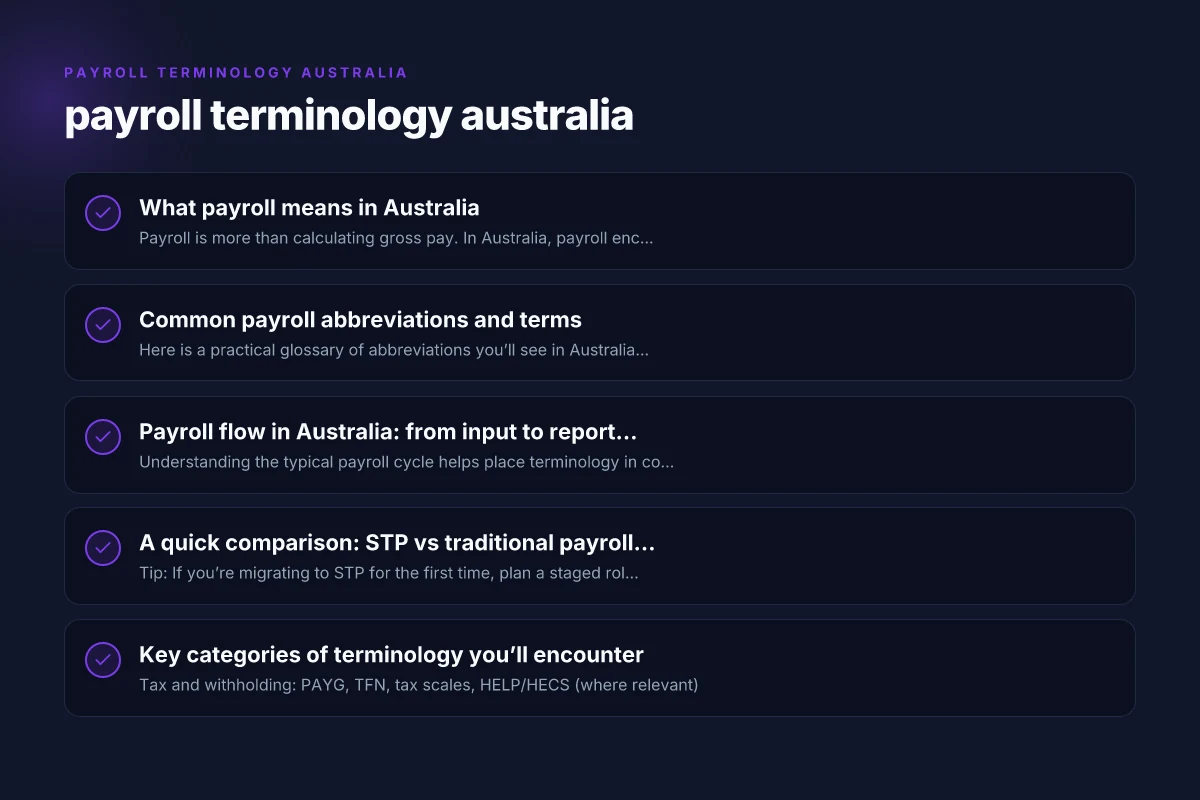
Common payroll abbreviations and terms
Here is a practical glossary of abbreviations you’ll see in Australian payroll software, discussions with super funds, and ATO communications.
- STP (Single Touch Payroll): Real-time reporting to the ATO of salaries, wages, PAYG withholding, and superannuation contributions.
- PAYG: Pay As You Go withholding, the income tax withheld from employees’ pay.
- ABN: Australian Business Number. Used for business identification and sometimes for contractors and certain payments.
- SF (Superannuation Guarantee): The minimum compulsory superannuation contribution an employer must make on behalf of eligible employees.
- SG (Superannuation Guarantee) rate: The current rate at which employers must contribute, set by government policy and gradually increasing over time.
- SGC (Small Business CGT concessions) might appear in related discussions but is outside core payroll. Stay aware of context.
- ATO: Australian Taxation Office, the government agency that administers tax collection and superannuation reporting.
- PAYG payment summary (or payment summary): A historical term used for the end-of-year statement. Many employees now access data through the PAYG portal under STP.
- Super fund: The fund where an employee’s superannuation is held. Employers contribute to the employee’s chosen or default fund.
- Superannuation guarantee charge (SGC): If an employer fails to meet SG obligations, they may incur the SGC.
- TFN: Tax File Number. Used for correct tax calculation and reporting.
- WFN: Withholding tax reference (context dependent. More common in internal references than external).
- FBT: Fringe Benefits Tax. Tax on benefits provided to employees outside of salary or wages.
- ETP: Employment Termination Payment. A lump sum paid when employment ends, with specific tax rules.
- Net pay: Take-home pay after all deductions.
- Gross pay: Earnings before deductions (pre-tax and pre-super).
- OTE: On-target earnings. Used in commission-based roles.
- Leave loading: Extra pay when taking annual leave in some awards or enterprise agreements.
- NES: National Employment Standards. The minimum entitlements under the Fair Work Act.
- Award: A modern award or enterprise agreement that sets minimum pay and working conditions for a given industry or occupation.
- ROE: Record of Employment. Sometimes used in visa or leave contexts.
- EFT: Electronic Funds Transfer. Method to pay employees electronically.
- HRIS: Human Resources Information System. Often contains payroll data and employee records.
- ERP: Enterprise Resource Planning. Broader business system that may include payroll modules.
- GROSS TO NET schedule: The calculation path from gross pay to net pay after deductions.
- PIT: Personal Income Tax (informal shorthand sometimes used in internal notes).
If you prefer a quick reference, keep a one-page glossary tab in your payroll system with these terms and their definitions. It reduces errors and improves onboarding for new payroll staff.
Payroll flow in Australia: from input to reporting
Understanding the typical payroll cycle helps place terminology in context. Here’s a concise flow: Payroll team structure: how to design, size, and evolve your payroll function
- Employee data and eligibility
- Gather personal details (TFN, bank details, super fund information)
- Confirm eligibility for entitlements (leave accruals, public holidays)
- Earnings and deductions
- Calculate gross pay (salary, wages, overtime, allowances)
- Apply deductions (PAYG withholding,HECS/HELP if applicable, union fees, salary sacrifice)
- Compute superannuation contributions (SG/SF), ensuring the correct fund choice
- Net pay and payslips
- Determine net pay after all deductions
- Generate payslips (either digitally or on paper) with a clear breakdown: gross, deductions, super, net pay, leave balances
- Reporting and remittance
- Report to the ATO via STP and submit superannuation contributions
- Pay super into employees’ funds by the due date
- Ensure compliance with the NES and any applicable awards or enterprise agreements
- End-of-period and year-end
- Prepare and reconcile ending period reports
- Address reconciliation between payroll and super fund statements
- Understand year-end implications in the context of STP and payment summaries
Key note: STP is the backbone of real-time reporting. It replaces many traditional end-of-year reporting tasks by providing ongoing salary and super data to the ATO.
A quick comparison: STP vs traditional payroll reporting
| Aspect | STP (Single Touch Payroll) | Traditional payroll reporting |
|---|---|---|
| Timing | Real-time or near real-time with each pay run | End-of-financial-year reports and annual summaries |
| Data to ATO | Salaries/wages, PAYG withholding, and super reported as you pay | Often consolidated at year-end; separate payment summaries |
| Compliance | Strongly aligns with ongoing tax and super rules | Can be more prone to year-end reconciliation issues |
| Complexity | Requires robust payroll software and data accuracy | Historically more manual and spreadsheet-driven |
Tip: If you’re migrating to STP for the first time, plan a staged rollout. Run parallel reports for a few pay cycles to validate data flows and fix any gaps before full deployment.
Key categories of terminology you’ll encounter
- Tax and withholding: PAYG, TFN, tax scales, HELP/HECS (where relevant)
- Superannuation: SG rate, SGC, default vs. employee-selected funds, super contribution dates
- Entitlements and leave: NES, annual leave loading, personal/carer’s leave, long service leave (where applicable)
- Work arrangements: Award vs. enterprise agreement, ordinary hours, overtime, allowances
- Reporting and compliance: STP, payment summaries, ATO portals, payroll tax references
If you work across multiple states or industries, you’ll encounter variations in awards and entitlements. Always verify the applicable award and modern award classification for each employee.
Common payroll abbreviations and terms in Australia
| Abbreviation | Full form | Meaning in practice | Example in use | Required field? | Notes |
|---|---|---|---|---|---|
| ATO | Australian Taxation Office | Tax authority | ATO reporting • STP | Yes | Central regulator |
| STP | Single Touch Payroll | Real-time payroll reporting | STP submission each pay | Yes | NY: mandatory for employers |
| TFN | Tax File Number | Employee tax identifier | TFN declaration on hire | Yes | Privacy protected |
| SGC | Superannuation Guarantee Charge | Shortfall penalties | If under-contributed | Yes | Super law |
| SG | Superannuation Guarantee | Employer super contribution | 10.5% of earnings | Yes | Varies by year |
| PAYG | Pay As You Go | Withholding system | Withholding tax | Yes | Part of payroll tax system |
| LOE | Leave Output Exception | Leave data issue flag | LOE raised | Optional | Troubleshooting token |
| FER | Fair Work Reporting | Workplace laws adherence | FER alignment | Optional | Compliance layer |
Compiled November 2026; check the provider's site for current details. Pay employees and vendors rbc business banking solutions
Common pitfalls and how to avoid them
- Misclassifying employees: Distinguish between employees and contractors. Misclassification affects tax and super obligations.
- Inaccurate super contributions: Ensure SG rate aligns with current regulations and that all eligible employees receive the correct super in the correct fund.
- Late payments: Make super and PAYG remittances on time to avoid penalties and SGC.
- Incorrect STP data: Validate data in the payroll system before submitting to STP to reduce rework.
- Incomplete employee data: TFN, super fund details, and payment instructions must be complete to avoid errors in tax and super processing.
Best practice: Create a monthly data hygiene routine. Check employee records for missing TFNs, fund details, and correct job classifications. Automate where possible, but do manual spot checks on high-risk items.
Practical tips for teams new to Australian payroll terminology
- Build a living glossary: Maintain a shared glossary of terms with short definitions and links to official resources (ATO pages, super fund guidelines).
- Use abbreviations consistently: Agree on which abbreviations your team will use in internal notes and software to prevent confusion.
- Stay current with changes: Tax rates, super rates, and award classifications change over time. Subscribe to relevant industry updates and set reminders for annual policy reviews.
- Leverage software help docs: Most payroll platforms publish country-specific terminology and abbreviations. Bookmark their Australia payroll glossaries.
- Document processes: For every recurring task, document the steps and the terms you use. It helps new staff onboard faster and reduces misinterpretation.
Payroll flow in Australia: from input to reporting (STP vs traditional)
| Step | STP required? | Traditional reporting required? | Data entry focus | Validation risk | Typical cadence |
|---|---|---|---|---|---|
| Employee onboarding | Yes | Yes | Personal, TFN, SUPER | Medium | At hire |
| Earnings input | Yes | Yes | Hours, allowances | High | Per pay run |
| Tax & super setup | Yes | Yes | Tax code, SG rate | High | Per change |
| Payslip generation | Yes | Yes | Net pay, deductions | Medium | Per pay run |
| STP submission | Yes | N/A | Pay event data | Low if correct | Per pay run |
| Year-end reporting | Yes | Yes | PAYG summaries | Medium | Year-end |
| Reconciliation | Yes | Yes | Balances | Medium | Monthly/quarterly |
| Audit/compliance | Yes | Yes | Logs, reports | Medium | Periodic |
Compiled November 2026; check the provider's site for current details.
Final section: recommendation
If you’re building or upgrading a payroll capability in Australia, start with a solid foundation in payroll terminology. Invest in:
- A core glossary aligned with ATO definitions and industry standards
- STP-enabled payroll software or a compliant implementation plan
- Regular training for payroll staff and HR teams to keep terminology consistent
- A robust data quality regime to ensure TFNs, super fund details, and award classifications are correct
With the right terminology in place, you’ll reduce errors, improve compliance, and deliver accurate, timely pay and reporting for your employees. If you’re unsure about a term, consult the ATO or your software provider’s payroll glossary to confirm the exact definition in your context. New york paid sick leave payout upon termination

Ezekiel Saavedra has been writing about consumer technology since 2018, with bylines covering streaming geo-unblocking, P2P networking, and router firmware. Approaches each review by setting up the product the same way a typical reader would and recording every snag along the way.