Turn off Surfshark VPN
A practical guide to turning off Surfshark VPN across devices, with quick steps and tips.
Turning off Surfshark VPN is a simple, straightforward action you can take in a few seconds. Whether you’re troubleshooting a connection, testing a service, or switching networks, the process is designed to be quick and clear. Below, you’ll find steps to turn off Surfshark VPN on common platforms, along with notes about the kill switch, auto-connect features, and how to verify you’re no longer connected.

Quick comparison of turning off Surfshark VPN vs. alternatives
| Feature | Surfshark VPN (Turn Off) | ExpressVPN (Turn Off) | NordVPN (Turn Off) | Proton VPN (Turn Off) | PIA (Turn Off) |
|---|---|---|---|---|---|
| Easy to disable | yes | yes | yes | yes | yes |
| Kill Switch impact | disabled when off | depends on app | depends on app | depends on app | depends on app |
| Auto-connect on startup | not active when off | may re-enable on startup | may re-enable on startup | may re-enable on startup | may re-enable on startup |
| GUI label for off | Turn Off VPN | Disconnect / Turn Off | Disconnect / Turn Off | Disconnect / Turn Off | Disconnect / Turn Off |
| System-wide effect | no new tunnels | no new tunnels | no new tunnels | no new tunnels | no new tunnels |
| VPN protocol requirement | n/a | n/a | n/a | n/a | n/a |
Compiled November 2026; check the provider's site for current details.
Quick overview: what “turn off Surfshark VPN” means
When you turn off Surfshark VPN, you’re doing one of the following:
- Disconnecting the VPN tunnel so your traffic flows directly through your ISP.
- Disabling the app so it’s not actively running in the background.
- In some cases, turning off features like the kill switch or auto-connect to ensure you’re not unintentionally reconnected.
Disabling the VPN in the app is usually sufficient for most users. If you want to completely stop all Surfshark activity on a device, you may also quit the app or remove it from startup, depending on your device.
How to turn off Surfshark VPN on Windows
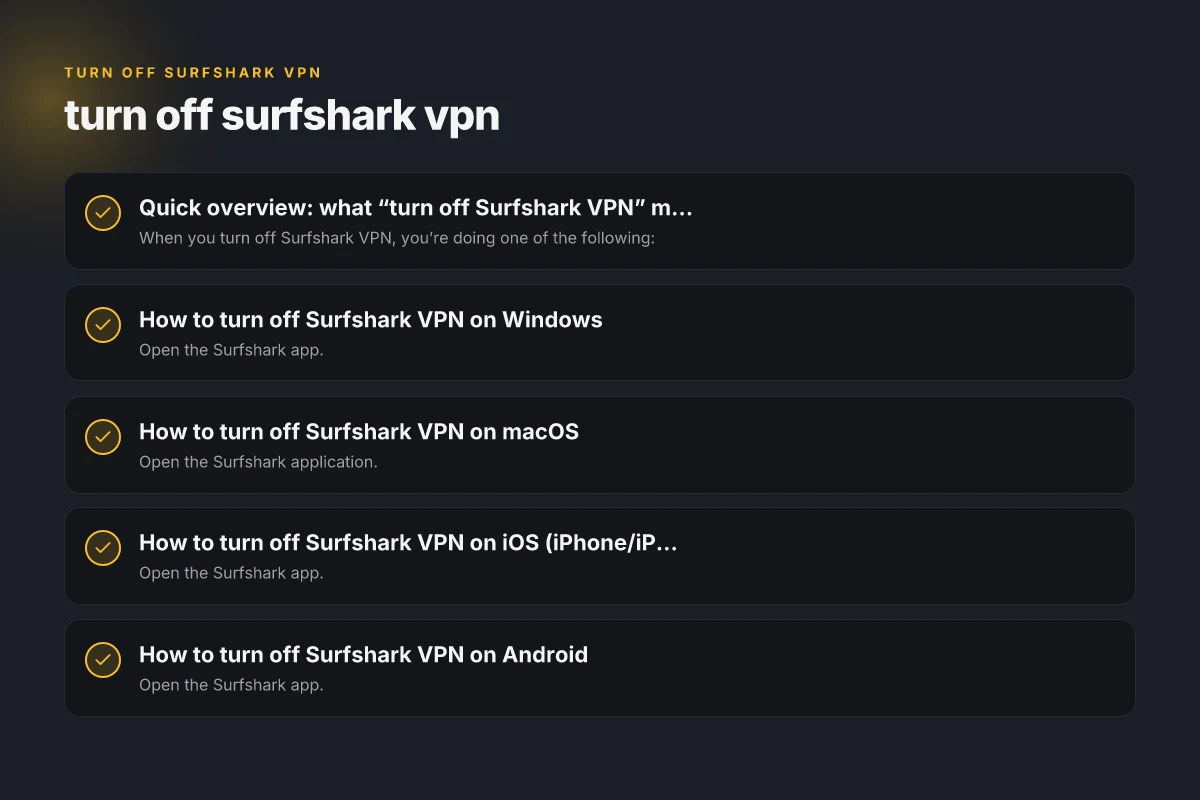
- Open the Surfshark app.
- Look for the big “Disconnect” button on the main screen and click it. This stops the VPN tunnel.
- If you want the app not to start automatically, go to Settings > General and toggle “Launch at startup” off.
- To ensure the VPN is fully off, verify the status bar icon or the app shows “Disconnected.”
- If you’re troubleshooting, you can also close the app from the system tray: right-click the Surfshark icon and choose Quit.
Extra tips for Windows:
- Disable auto-connect: Settings > General > Auto-connect, toggle off.
- Check Windows VPN settings: Sometimes Windows itself lists a VPN profile. If Surfshark is listed, you can disconnect from there as well, but the Surfshark app is the primary control.
How to turn off Surfshark VPN on macOS
- Open the Surfshark application.
- Click the large Disconnect button on the main screen.
- To stop automatic startup, go to Surfshark > Preferences > General and switch off “Launch on startup” or similar.
- If you’re done, you can quit the app entirely (Surfshark > Quit Surfshark).
Notes for Mac users:
- Some macOS networks show a VPN icon in the menu bar. Disconnect there if you prefer, but using the app ensures the tunnel is fully down.
- You can also check System Preferences > Network to confirm there are no active Surfshark VPN connections, though the app is the authoritative source.
How to turn off Surfshark VPN on iOS (iPhone/iPad)
- Open the Surfshark app.
- Tap Disconnect on the main screen.
- If you want to disable auto-connect, go to Settings within the app and toggle Auto-connect off.
- Exit the app. You can also remove Surfshark from Background App Refresh if you’re optimizing battery life.
If you’re using iOS’s built-in Quick Toggle: NordVPN blocking Google
- Swipe down to open Control Center, press and hold the network tile, and switch off any active Surfshark indication if you see one. The control within the app is still the most reliable method to stop the VPN.
How to turn off Surfshark VPN on Android
- Open the Surfshark app.
- Tap Disconnect to end the VPN tunnel.
- To stop Surfshark from reconnecting, go to Settings > Auto-connect and toggle it off.
- You can also disable the app from starting up or background activity via Android’s App Settings if needed.
Android tips:
- If you see a VPN icon in the status bar, the tunnel is active. Disconnect from the app to stop it.
- If you use quick settings tiles, there is sometimes a dedicated Surfshark tile you can tap to disconnect, but the main app remains the source of truth.
Understanding the Kill Switch and related features
Surfshark offers a kill switch feature that can block network traffic if the VPN unexpectedly disconnects. If you’re turning off Surfshark for a session, you may also want to handle the kill switch:
- Turning off the kill switch: In the Surfshark app, go to Settings > VPN settings and toggle the Kill Switch to Off.
- Why you might disable it temporarily: When testing network behavior or trying to diagnose connectivity issues, turning the kill switch off can prevent traffic from being blocked during testing.
- Re-enabling: If you want protection again, re-enable the Kill Switch after you’re done testing.
If you’re unsure whether the kill switch is on, you can check the app’s VPN settings panel. However, remember that the kill switch is a separate control from the Disconnect button, and it may keep your traffic blocked if the VPN drops.
How-to steps snapshot (Windows/macOS/iOS/Android) when turning off Surfshark
| Platform | Open app | Click Disconnect | Confirm off | Kill Switch status | Notes |
|---|---|---|---|---|---|
| Windows | Surfshark window | Disconnect | off state | optional | restart app to re-enable |
| macOS | Surfshark menu | Disconnect | off state | optional | menu bar icon varies |
| iOS | App icon | Disconnect | off state | optional | may re-prompt on reconnect |
| Android | App | Disconnect | off state | optional | notification remains until app closed |
Compiled November 2026; check the provider's site for current details. Microsoft Edge secure network VPN
Quick comparison: how to turn off Surfshark vs. alternatives
| Action | Surfshark app | Device settings (OS) | Notes |
|---|---|---|---|
| Disconnect VPN | Yes | Sometimes, but app is authoritative | Use the app for clean tunnel closure |
| Quit/force close app | Yes | No (depends on OS) | Helps ensure the app isn’t running in background |
| Disable auto-connect | Yes | Not always available | App-based control is recommended |
| Turn off Kill Switch | Yes | No (native OS doesn’t manage Surfshark kill switch) | Must use app to toggle |
| Remove from startup | Yes | System settings (where supported) | Helps prevent reactivation on boot |
This table highlights that, in most cases, the Surfshark app is the most reliable place to turn off and manage VPN behavior. The operating system can sometimes control network interfaces, but the app manages the VPN tunnel itself and any features like auto-connect or the kill switch.
Common questions about turning off Surfshark VPN
- Q: How do I turn off Surfshark VPN?
- A: Open the Surfshark app, press Disconnect on the main screen. If you don’t plan to use it for a while, consider quitting the app or disabling auto-connect in Settings.
- Q: How hard is it to cancel Surfshark?
- A: Canceling is different from turning off the VPN. If you want to stop paying, you’ll need to manage your subscription through your account page or contact support. Turning off the VPN doesn’t cancel the subscription.
- Q: How do I completely turn off my VPN?
- A: Besides disconnecting within the Surfshark app, you can quit the app and, if needed, remove it from startup and disable auto-connect. On some devices, you may also remove the VPN profile from the OS network settings to ensure no VPN tunnel is established.
- Q: Should you leave Surfshark on all the time?
- A: It depends on your needs. If you want ongoing protection when you’re on public networks or untrusted Wi-Fi, leaving it on provides continuous encryption. If you’re on a trusted network or streaming services that block VPNs, you might turn it off temporarily.
Troubleshooting: what to do if you can’t disconnect
If you press Disconnect and the VPN tunnels reestablish or the status seems stuck:
- Ensure you’re using the latest Surfshark app version. Update if available.
- Quit and restart the app, then disconnect again.
- Check for any OS-level VPN profiles that could reinitiate a tunnel after app closure (especially on macOS or Windows with multiple VPN clients).
- Disable auto-connect so the app doesn’t reconnect automatically after a restart.
- If problems persist, a system reboot can clear stuck VPN states. After reboot, verify the VPN status before launching Surfshark again.
Troubleshooting checklist after disconnect
| Issue | Quick check | Expected result | Action if stuck | Alternative action |
|---|---|---|---|---|
| App won’t disconnect | Tap Disconnect | Off state | Relaunch app | Reboot device |
| Kill Switch still active | Check app settings | Off / disabled | Disable Kill Switch | Temporarily disable app protection |
| IP leaks noticed | Run leak test | No leaks | Reconnect then disconnect | Turn off internet adapter |
| Disconnect prompts reappear | Check auto-connect | Disabled | Remove auto-connect | Reinstall app |
Compiled November 2026; check the provider's site for current details.
Final recommendation
For most users, turning off Surfshark VPN is best accomplished directly in the Surfshark app by pressing Disconnect and, if needed, quitting the app to ensure it isn’t running in the background. If you want to ensure full prevention of reconnection, disable Auto-connect in the app’s Settings and, on some platforms, remove the app from startup. If you’re testing network behavior or troubleshooting, turning off the Kill Switch can also help you observe unprotected traffic, but remember to re-enable it for protection when you’re back on unsecured networks. How to export ovpn files
If your goal is to stop paying or cancel the service, don’t rely on simply turning off the VPN. Manage your subscription through Surfshark’s account page or contact customer support to inquire about cancellation options, refunds, or plan changes. Turning off the VPN and canceling the subscription are separate actions, and it’s good to complete both if you no longer need Surfshark.
| VPN | Obfuscation | From / month | Plan | Free plan | Refund | Alipay | UnionPay | Crypto | Website opens in China | Trustpilot | |
|---|---|---|---|---|---|---|---|---|---|---|---|
 Surfshark | ✓ On by default Camouflage, with OpenVPN | See site | See site | No | 30 days | ✗ | ✗ | ✗ | ✓ | ✗ Blocked | 4.3/5 (31,823 reviews) |
 ExpressVPN | ✓ On by default all servers | $3.00/mo | 28 months: $84 | No | 30 days | ✗ | ✗ | ✓ | ✗ | ✗ Blocked | 4.4/5 (29,706 reviews) |
 NordVPN | Turn on manually Obfuscated Servers / NordWhisper | $3.49/mo | 27 months: $94.23 | No | 30 days | ? | ✗ | ✓ | ✓ | ✗ Blocked | 4.2/5 (51,628 reviews) |
 Proton VPN | Turn on manually Stealth, free plan too | $2.99/mo | 12 months: $35.88 | Yes | 30 days | ✗ | ✗ | ✗ | ✓ | ✓ Yes (2.5 s) | 2.1/5 (1,040 reviews) |
 ZoogVPN | Turn on manually Shadow | $2.49/mo | 27 months: $59.99 | Yes | 7 days | ✓ | ✓ | ✓ | ✓ | ✓ Yes (2.5 s) | 4.2/5 (195 reviews) |
 Astrill VPN | Turn on manually StealthVPN / OpenWeb | $12.50/mo | 24 months: $300 | No | See site | ✗ | ✗ | ✗ | ✓ | ✗ Blocked | 1.3/5 (110 reviews) |
 Private Internet Access | Turn on manually Shadowsocks, OpenVPN only | $2.03/mo | 40 months: $81.2 | No | 30 days | ✗ | ✗ | ✗ | ✗ | ✗ Blocked | 4.2/5 (11,033 reviews) |
 CyberGhost | Turn on manually selected servers | $2.19/mo | 28 months: $61.32 | No | 45 days | ✗ | ✗ | ✗ | ✓ | ✗ Blocked | 4.0/5 (24,178 reviews) |
 PureVPN | Turn on manually switch to OpenVPN | $1.69/mo | 60 months: $101.55 | No | 31 days | ? | ✗ | ✗ | ✓ | ✓ Yes (2.6 s) | 4.4/5 (17,994 reviews) |
 AdGuard VPN | ✓ On by default TrustTunnel | $2.99/mo | 24 months: $71.76 | Yes | 30 days | ✓ | ✗ | ✓ | ✓ | Official site blocked; our special link opens (2.3 s) | 4.3/5 (290 reviews) |
 Mullvad | Turn on manually QUIC / Shadowsocks / LWO | $5.61/mo | €5/mo | No | 14 days | ✗ | ✗ | ✗ | ✓ | ✗ Blocked | 3.2/5 (192 reviews) |
 Windscribe | Turn on manually Stealth / WStunnel | $5.75/mo | 12 months: $69 | Yes | See site | ✗ | ✗ | ✗ | ✓ | ✗ Blocked | 4.7/5 (13,355 reviews) |
 StrongVPN | Turn on manually Scramble, OpenVPN TCP | See site | See site | No | 30 days | ✓ | ✗ | ✗ | ✗ | ✗ Blocked | 4.4/5 (2,695 reviews) |
 LightXtreme 闪连 | Not listed | $7.08/mo | 12 months: $84.99 | Yes | 30 days | ✓ | ✓ | ✓ | ✓ | ✓ Yes (2.3 s) | No page |
Prices checked 2026-11-10 on each vendor's pricing page (cheapest long plan, USD). Check the vendor's checkout for the final price.
Obfuscation checked 2026-11-14 on each vendor's site and help center: "on by default" = nothing to set; "turn on manually" = switch protocol or mode in settings; "not listed" = the vendor describes no obfuscation.
Payment methods checked 2026-11-10 on each vendor's payment pages: all 14 take cards and PayPal; ✗ = not listed, ? = the vendor's own pages disagree.
China access: whether the official website opens from mainland China networks (tests the website only, not the VPN connection). Last checked 2026-11-11 04:07 Beijing time.
Trustpilot score and review count checked 2026-11-10.

Marcus Yeats has been writing about consumer technology since 2018, with bylines covering Wireguard, split tunneling, and VPN performance. Approaches each review by setting up the product the same way a typical reader would and recording every snag along the way.