VPN protocol comparison
A practical guide comparing major VPN protocols, their strengths, weaknesses, and best use cases.
VPN protocol comparison: choosing the right protocol for your needs
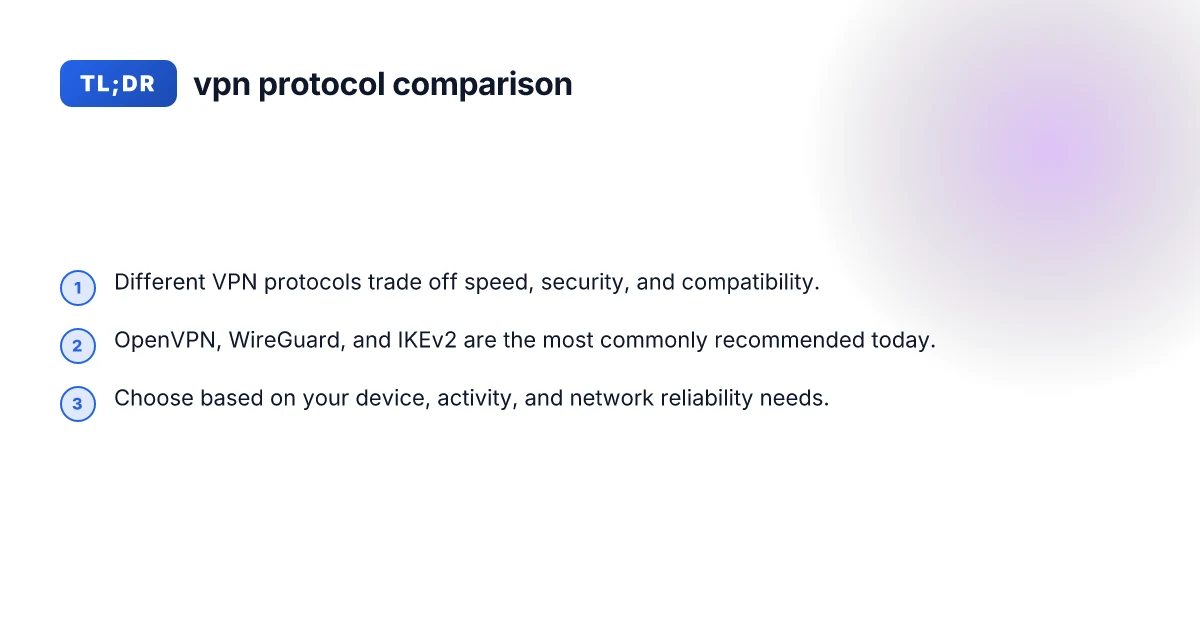
The world of VPNs is built on a set of competing protocols. Each protocol handles the way data is encrypted, transmitted, and authenticated a little differently. Understanding the core differences helps you pick the best option for security, speed, and reliability on your devices and networks.

Protocol comparison at a glance
| Protocol | Encryption | Performance impact | NAT traversal | Open source | Typical name examples |
|---|---|---|---|---|---|
| OpenVPN | AES-256 or ChaCha20 | Moderate | Yes | Yes | OpenVPN |
| WireGuard | ChaCha20 | Low | Yes | Yes | WireGuard |
| IKEv2/IPsec | AES-256 | Moderate-High | Yes | Partial | IKEv2/IPsec |
| SSTP | AES-256 | Moderate | Yes | No | SSTP |
| L2TP/IPsec | 3DES/AES-128 | Moderate | Yes | Yes | L2TP/IPsec |
Compiled November 2026; check the provider's site for current details.
What is a VPN protocol and why it matters
A VPN protocol is the set of rules that governs how your data is encapsulated, encrypted, and sent through a VPN tunnel. It affects:
- Security: the strength of encryption and authentication methods
- Speed: overhead and how efficiently data travels
- Stability: how well the protocol handles network changes and interruptions
- Compatibility: which devices and platforms support it
Common protocols in use today include OpenVPN, WireGuard, IKEv2/IPsec, L2TP/IPsec, SSTP, and PPTP. Each has its own trade-offs, so the best choice depends on your priorities.
Major VPN protocols: quick overview
OpenVPN
- Type: uses TLS/SSL for security. Can run on UDP or TCP
- Strengths: strong security track record, highly configurable, good cross-platform support
- Weaknesses: can be slower than modern protocols on some networks. Setup can be more complex
- Best for: users who need robust security, long-term compatibility, and firewall-friendly configurations
WireGuard
- Type: a newer, lean protocol designed for speed and simplicity
- Strengths: very fast, low overhead, strong cryptography, easy to audit
- Weaknesses: newer. Fewer mature features like built-in obfuscation or roaming. Some implementations require careful key management
- Best for: speed-focused use cases, mobile devices, and modern VPN deployments
IKEv2/IPsec
- Type: IPsec-based protocol often used on mobile devices
- Strengths: excellent performance on mobile networks, strong revocation and re-authentication, good stability when switching networks
- Weaknesses: can be blocked by strict networks. Sometimes less flexible than OpenVPN in complex setups
- Best for: mobile users who switch networks often (cellular to Wi‑Fi)
L2TP/IPsec
- Type: Layer 2 Tunneling Protocol paired with IPsec for encryption
- Strengths: easy to set up on many systems, broad compatibility
- Weaknesses: generally slower due to double encapsulation. Often perceived as less secure if IPsec is misconfigured
- Best for: quick, broad compatibility when OpenVPN isn’t easily deployable
SSTP
- Type: Secure Socket Tunneling Protocol built into Windows
- Strengths: excellent firewall traversal on Windows, strong encryption
- Weaknesses: limited cross-platform support beyond Windows. Not as light or fast as WireGuard
- Best for: Windows-centric environments and networks with strict firewall rules
PPTP
- Type: Point-to-Point Tunneling Protocol
- Strengths: very fast, easy to set up
- Weaknesses: known security vulnerabilities. Generally discouraged for privacy or sensitive data
- Best for: legacy systems or very low-friction demos where security is not a concern (not recommended for protecting sensitive info)
How to choose: a practical decision guide
When selecting a protocol, weigh these factors:
- Security needs: If privacy and data protection are paramount, prioritize OpenVPN, WireGuard, or IKEv2/IPsec with strong configurations.
- Speed and streaming: WireGuard often delivers the best raw speed; OpenVPN with UDP can also be fast and reliable.
- Mobility and roaming: IKEv2/IPsec tends to handle network switches smoothly (e.g., from cellular to Wi‑Fi) without dropping the connection.
- Firewall and network restrictions: SSTP and OpenVPN over TCP can help traverse strict firewalls, though TCP-based OpenVPN can reduce speed.
- Compatibility: Ensure your device and chosen client support the protocol. Some platforms favor specific options.
Practical decision guide for choosing a protocol
| Factor | OpenVPN | WireGuard | IKEv2/IPsec | SSTP | L2TP/IPsec |
|---|---|---|---|---|---|
| Security level (when configured well) | High | High | High | Medium-High | Medium-High |
| Setup complexity | Moderate | Easy | Moderate | Easy | Easy |
| Battery/CPU impact | Moderate | Low | Moderate | Moderate | Moderate |
| NAT traversal reliability | Reliable | Good | Good | Good | Good |
| Platform availability | Broad | Broad | Broad | Moderate | Broad |
| Use case fit | Customizable, enterprise | Mobile/fast, general | Mobile/enterprise | Windows-friendly | Legacy or compatibility |
Compiled November 2026; check the provider's site for current details. Turn off Surfshark VPN
Protocol comparison at a glance
Here is a succinct side-by-side view of common protocols and typical strengths. Note that actual performance varies by implementation, server, and network conditions.
| Protocol | Encryption basics | Typical speed | Mobility handling | Firewall traversal | Typical use case |
|---|---|---|---|---|---|
| OpenVPN (UDP) | TLS/SSL, strong certs | High, configurable | Good on mobile via UDP | Good, firewall-friendly | General-purpose, strong security |
| WireGuard | Modern cryptography, simple code | Very fast | Excellent on mobile, quick reconnects | Moderate; depends on setup | Speed-focused, new deployments |
| IKEv2/IPsec | IPsec security suite | Fast to very fast | Excellent roaming between networks | Reasonable with right configs | Mobile users, stable connections |
| L2TP/IPsec | IPsec on top of L2TP | Moderate | Good with stable networks | Moderate; depends on encryption mode | Easy setup, broad compatibility |
| SSTP | SSL/TLS-based | Moderate to fast | Very good on Windows networks | Strong through Windows firewall | Windows-centric environments |
| PPTP | Legacy, weak encryption | Fast | Poor roaming support | Often blocked or discouraged | Quick, low-security scenarios |
Use cases: matching protocol to activity
- Streaming and gaming: WireGuard often provides the best blend of speed and security for real-time activity; OpenVPN (UDP) is a solid alternative when compatibility or firewall traversal matters.
- Remote work and business VPNs: OpenVPN remains a reliable default due to its maturity, configurability, and robust security posture.
- Mobile-heavy lifestyles: IKEv2/IPsec is favored for devices that frequently switch networks, such as phones moving between Wi‑Fi and cellular data.
- Windows-first environments: SSTP can be appealing when you need smooth Windows integration and firewall navigation, though OpenVPN or WireGuard are also viable.
- Quick setup on legacy devices: L2TP/IPsec or PPTP (if security is not a concern) can provide rapid deployment, but PPTP’s weaknesses mean it’s generally not recommended for protecting sensitive data.
Use cases and recommended protocols
| Use case | Best-fit protocol | Rationale | Alternatives | Notes |
|---|---|---|---|---|
| Mobile on slow networks | WireGuard | Lightweight, fast | IKEv2/IPsec | Disable heavy options |
| Enterprise site-to-site | OpenVPN or IKEv2/IPsec | Strong, configurable | SSTP | Consider routing policies |
| Windows-only environments | SSTP or IKEv2/IPsec | Built-in support | OpenVPN (via app) | SSTP blocked on some networks |
Compiled November 2026; check the provider's site for current details.
Security considerations and best practices
- Use strong authentication: Prefer certificates and keys with robust cryptography. Avoid default or weak credentials.
- Prefer modern ciphers: WireGuard and modern OpenVPN configurations tend to use strong, current cryptographic suites.
- Enable perfect forward secrecy (PFS) where supported, to ensure session keys aren’t compromised by future data exposure.
- Keep client and server software updated: Protocol implementations evolve, and security patches matter.
- Be mindful of logging: Some protocols and configurations can influence traffic metadata. Consider privacy policies and tunnel behavior.
- Test for leaks: When you switch protocols, verify there are no DNS or IP leaks and that the VPN is routing all traffic as intended.
Final recommendation
For most users today, OpenVPN and WireGuard are the leading choices:
- If you want a proven, highly configurable option with broad platform support and strong security, choose OpenVPN (prefer UDP for speed, TCP for reliable bypass through restrictive networks).
- If you prioritize speed and simpler configuration, and you’re on modern devices or primarily mobile, choose WireGuard, ensuring you enable proper key management and trusted server configurations.
- If you need robust roaming on mobile devices and are frequently switching networks, IKEv2/IPsec is a strong contender, especially on iOS and Android.
- Use L2TP/IPsec only if you need very broad device compatibility and cannot use OpenVPN or IKEv2. Be aware of potential performance hits and ensure proper IPsec configuration.
- Avoid PPTP for anything involving sensitive data due to known security weaknesses.
When in doubt, test with your own devices and networks. Many VPN providers offer multiple protocols in a single client, allowing you to run side-by-side speed and stability tests. The best protocol is the one that consistently delivers security, reliability, and the user experience you value most on your specific devices and network conditions. NordVPN blocking Google
| VPN | Obfuscation | From / month | Plan | Free plan | Refund | Alipay | UnionPay | Crypto | Website opens in China | Trustpilot | |
|---|---|---|---|---|---|---|---|---|---|---|---|
 ZoogVPN | Turn on manually Shadow | $2.49/mo | 27 months: $59.99 | Yes | 7 days | ✓ | ✓ | ✓ | ✓ | ✓ Yes (2.5 s) | 4.2/5 (195 reviews) |
 NordVPN | Turn on manually Obfuscated Servers / NordWhisper | $3.49/mo | 27 months: $94.23 | No | 30 days | ? | ✗ | ✓ | ✓ | ✗ Blocked | 4.2/5 (51,628 reviews) |
 ExpressVPN | ✓ On by default all servers | $3.00/mo | 28 months: $84 | No | 30 days | ✗ | ✗ | ✓ | ✗ | ✗ Blocked | 4.4/5 (29,706 reviews) |
 Surfshark | ✓ On by default Camouflage, with OpenVPN | See site | See site | No | 30 days | ✗ | ✗ | ✗ | ✓ | ✗ Blocked | 4.3/5 (31,823 reviews) |
 Proton VPN | Turn on manually Stealth, free plan too | $2.99/mo | 12 months: $35.88 | Yes | 30 days | ✗ | ✗ | ✗ | ✓ | ✓ Yes (2.5 s) | 2.1/5 (1,040 reviews) |
 Astrill VPN | Turn on manually StealthVPN / OpenWeb | $12.50/mo | 24 months: $300 | No | See site | ✗ | ✗ | ✗ | ✓ | ✗ Blocked | 1.3/5 (110 reviews) |
 Private Internet Access | Turn on manually Shadowsocks, OpenVPN only | $2.03/mo | 40 months: $81.2 | No | 30 days | ✗ | ✗ | ✗ | ✗ | ✗ Blocked | 4.2/5 (11,033 reviews) |
 CyberGhost | Turn on manually selected servers | $2.19/mo | 28 months: $61.32 | No | 45 days | ✗ | ✗ | ✗ | ✓ | ✗ Blocked | 4.0/5 (24,178 reviews) |
 PureVPN | Turn on manually switch to OpenVPN | $1.69/mo | 60 months: $101.55 | No | 31 days | ? | ✗ | ✗ | ✓ | ✓ Yes (2.6 s) | 4.4/5 (17,994 reviews) |
 AdGuard VPN | ✓ On by default TrustTunnel | $2.99/mo | 24 months: $71.76 | Yes | 30 days | ✓ | ✗ | ✓ | ✓ | Official site blocked; our special link opens (2.3 s) | 4.3/5 (290 reviews) |
 Mullvad | Turn on manually QUIC / Shadowsocks / LWO | $5.61/mo | €5/mo | No | 14 days | ✗ | ✗ | ✗ | ✓ | ✗ Blocked | 3.2/5 (192 reviews) |
 Windscribe | Turn on manually Stealth / WStunnel | $5.75/mo | 12 months: $69 | Yes | See site | ✗ | ✗ | ✗ | ✓ | ✗ Blocked | 4.7/5 (13,355 reviews) |
 StrongVPN | Turn on manually Scramble, OpenVPN TCP | See site | See site | No | 30 days | ✓ | ✗ | ✗ | ✗ | ✗ Blocked | 4.4/5 (2,695 reviews) |
 LightXtreme 闪连 | Not listed | $7.08/mo | 12 months: $84.99 | Yes | 30 days | ✓ | ✓ | ✓ | ✓ | ✓ Yes (2.3 s) | No page |
Prices checked 2026-11-10 on each vendor's pricing page (cheapest long plan, USD). Check the vendor's checkout for the final price.
Obfuscation checked 2026-11-14 on each vendor's site and help center: "on by default" = nothing to set; "turn on manually" = switch protocol or mode in settings; "not listed" = the vendor describes no obfuscation.
Payment methods checked 2026-11-10 on each vendor's payment pages: all 14 take cards and PayPal; ✗ = not listed, ? = the vendor's own pages disagree.
China access: whether the official website opens from mainland China networks (tests the website only, not the VPN connection). Last checked 2026-11-11 04:07 Beijing time.
Trustpilot score and review count checked 2026-11-10.

Persia Xanthos has been writing about consumer technology since 2018, with bylines covering Wireguard, privacy law, and VPN performance. Approaches each review by setting up the product the same way a typical reader would and recording every snag along the way.