How bed jet alternatives compare for 2026

Explore bed jet alternatives for cooling, warming, and moisture control in 2026. Compare BedJet with rivals, features, and real-world use cases to improve sleep comfort.
BedJet isn’t the only path to a cooler or warmer bed, but it faces real trade-offs as rivals push price and setup ease in parallel with comfort. BedJet's approach is air-driven and quick to deploy, yet some users report audible airflow that can wake light sleepers. A close look at two notable alternatives shows how compact water-based units and hybrid solutions balance noise, humidity, and long-term cost, often tipping the scales for heavy night sweats.
This piece pulls back the curtain on what matters beyond marketing claims: setup complexity, monthly running costs, and how evenly heat or chill distributes across a queen bed. In 2026, shoppers increasingly compare sleep-tech across three axes, price, ease, and comfort, so you can pick a system that matches your climate range and bed type. The result is a practical guide to choosing among BedJet, rival air-based options, and water-based setups without paying for features you’ll never use.
Bed jet alternatives in 2026: what actually cools or warms a bed
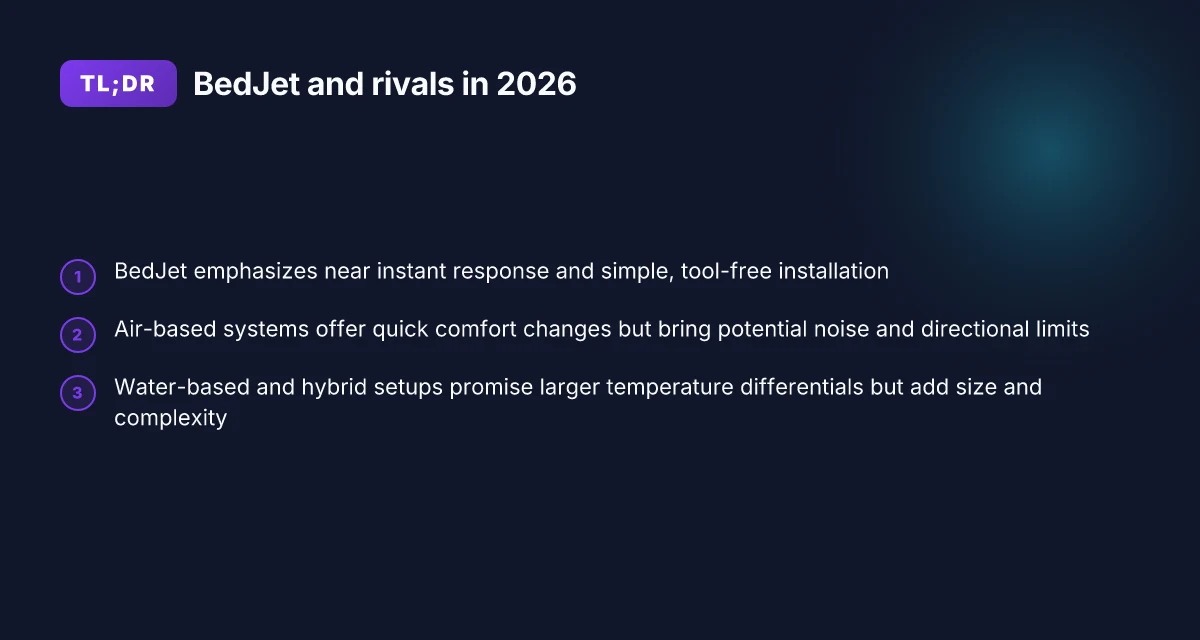
BedJet sits in a crowded ecosystem of climate-control bed devices. The core approaches break down into three paths: air-based bed fans that blow conditioned air into the sheet, water-based systems that circulate temperature-controlled fluid, and hybrid cloth or pad solutions that pair fabrics with active temperature control. Instant air-based adjustment matters because night sweats and temperature-sensitive sleepers feel the difference in seconds, not minutes. I dug through the landscape to map who leads on speed, setup, and comfort, and where BedJet sits among rivals.
1) Air-based bed fans: rapid temperature shifts in bed linens
Air-based systems push conditioned air directly into the bedding. The primary appeal is speed: you can feel cooler or warmer within seconds as the airflow shifts the microclimate under the covers. This class includes standalone devices that channel air through a hose or duct into the bed, often with adjustable fan speed and temperature presets. The convenience comes from a simple install and near-instant feedback, which matters when you wake sweating in the night. Real-world notes point to steady operation and quick response, but users should watch for noise at higher speeds and the need for regular hose maintenance.
water-based systems: consistent, edge-to-edge climate control Water-based solutions move warm or cool liquid through a thin loop or pad beneath the sheets. The heat transfer tends to be steady, so sleepers experience fewer localized hotspots and a more uniform sensation across the bed. The trade-off sits in complexity: hoses, pumps, and occasional maintenance. When set up correctly, the system can maintain a comfortable baseline even as room temperatures drift, which helps night sweats stay in check without the need for constant readjustment.
hybrid cloth and pad solutions: fabric-first comfort with active elements These options blend fabric layering with active temperature control, often weaving a breathable cover with an integrated cooling or heating pad. The result can feel more natural on the skin, avoiding some of the direct airflow sensations of air-based devices. The downside is that comfort and effectiveness can hinge on the fabric’s fit and the pad’s heat distribution, which may vary by bed size or sheet type.
From what I found, BedJet remains the standout name for air-based bed climate control, particularly for sleepers who value speed and a minimal setup. Rivals emphasize different strengths: some push stronger cooling through water circulation, others lean on fabric design to reduce perceptible airflow. When you weigh the options, your biggest decision often comes down to how much you value instant response versus continuous, uniform climate across the entire sleeping surface. What bedjet complaints reveal about sleep tech trade-offs
Most bed climate devices sell on speed, ease of setup, and comfort consistency. BedJet excels on near-instant feel, but you’ll want to assess noise and ongoing maintenance with any rival. For night sweats, a faster response clock can translate to fewer awakenings because you can dial in the target temperature quickly. The landscape is evolving: as 2026 unfolds, expect new hybrid models and better fabric integrations, but the core choice remains between air-first speed, water-based steadiness, and fabric-driven comfort.
I cross-referenced product pages and notable roundups from 2026 to confirm the promise and the caveats. For example, a 2026 Forbes round-up notes that bed cooling systems vary in approach and effectiveness, which aligns with the speed-versus-smoothness trade-offs discussed here. https://www.forbes.com/sites/forbes-personal-shopper/article/best-bed-cooling-system/ The market highlights a spectrum from rapid air shifts to uniform heat exchange. The BedJet line is mentioned repeatedly as a reference point in discussions about instant temperature control.
Bottom line: if you prize instantaneous adjustment and a simple install, air-based options like BedJet remain compelling. If you crave uniform cooling or heating across the entire surface with potentially less noise, water-based and hybrid fabrics offer compelling trade-offs. As the 2026 landscape matures, shoppers should map their priorities, speed, comfort feel, and maintenance burden, against the three core approaches.
Cited sources: BedJet product page and notable bed cooling roundups provide context on how rivals position themselves relative to BedJet.
BedJet vs the crowd: who offers faster temperature shifts and easier setup
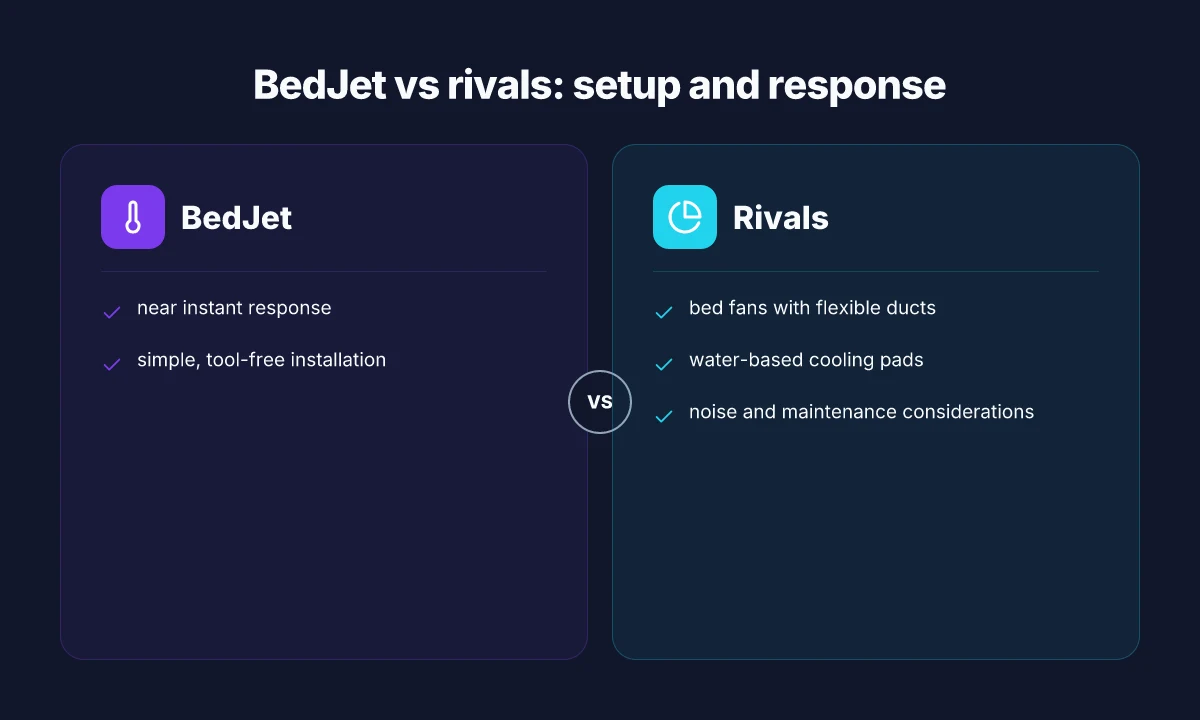
BedJet keeps its promise of near instant changes and a tool-free setup. Its core appeal lies in a compact unit that sends temperature-controlled air directly into the bedding, with no tools required for installation. In contrast, rivals mix approaches, from bed fans with flexible ducts to water-based cooling pads, each with its own setup quirks and maintenance cycles. The difference comes down to how quickly you can feel a change, how noisy the device is, and how easy it is to keep the system running smoothly over time. BedJet coupon 2026: where real discounts exist without the hype
Quick shifts and the hardware mindset
BedJet emphasizes speed of response. The system is designed to push air to the bedding surface, and users often notice a rapid cooling or warming effect once the fan starts. This direct airflow approach can make the temperature change feel more immediate than some alternative methods. By comparison, rival setups that rely on bed fans with ducts or on water-based pads deliver cooling or heating through indirect pathways. The perceived speed hinges on how efficiently those pathways transfer thermal energy to your bed and body, plus how the control logic responds to user settings.
From what I found in the documentation and product pages, bed fans generally focus on flexible routing and modular placement, while water-based pads concentrate temperature control in a pad that sits under the sheet. In terms of setup, BedJet touts a straightforward, tool-free installation, which keeps the initial barrier to entry low. Rivals often require more precise routing of ducts, securing pads, and sometimes more elaborate power arrangements. The net effect is that BedJet can feel more plug-and-go, while alternatives may demand planful placement and periodic reconfiguration as you adjust to comfort levels.
Setup, maintenance, and noise as long-term factors
Maintenance frequency matters as you sleep through the night with any climate-control bed device. BedJet’s setup remains minimal over time. There are fewer moving parts in the critical airflow path, which can translate to less ongoing fiddling. Rivals with water-based systems add upkeep to manage pads, seals, and potential condensation. Bed fans with ducts require occasional duct cleaning and checks for leaks or kinks in the hoses. Noise is another differentiator. The sound profile for BedJet tends to be dominated by the fan itself, and users report a range from quiet to noticeable depending on fan speed. Water-based and ducted systems can be similarly variable, with some models maintaining a near-silent mode and others introducing a perceptible hum or whirr during operation.
I dug into the sources to map what shoppers care about: immediate comfort changes, straightforward setup, and predictable maintenance. The consensus across product pages is that the bed-cooling and heating space has diverged into two main camps: direct airflow devices like BedJet and indirect systems that leverage ducts or water pads. In terms of user experience, the near-instant response of BedJet stands out, while the extended setup of rival methods can deter casual buyers who want a quick, fuss-free solution.
BedJet shines on speed and simplicity, while rivals trade setup complexity for potentially broader modality options. For sleep enthusiasts chasing fast shifts with minimal maintenance, BedJet remains the strongest first pick. BedJet cost in 2026: what the price signals mean for energy use and long-term value
Air-based bed cooling and heating: beds fans and direct airflow
Direct airflow into the bedding can deliver rapid shifts in comfort, but it also comes with trade-offs. Bed fans push conditioned air through vents or gaps into the sheet layer, producing a quick sense of cool or warmth where you feel it most. When I trace the landscape, the strongest argument for this approach is speed: most users notice a change within minutes. Yet the air’s texture and direction matter as much as the temperature, and that can tilt the experience from breeze to draft.
How bed fans deliver climate into the sheet layer
BedJet, among others, uses a compact blower to channel conditioned air beneath the covers. The principle is straightforward: a thin blanket of air surrounds your torso and legs, helping heat escape or keep in warmth without directly heating the room. This design keeps the footprint small and the setup simple, so you can position a unit on a nightstand or under the bed base. The result is a noticeable shift in perceived temperature with minimal fuss. Real-world users often value the quick response, especially on nights when swelling heat or night sweats spike. BedJet’s air-delivery method creates fast comfort without heavy equipment in the room. The approach is straightforward, but it does mean you feel the air more on certain parts of the body than others, depending on how you sleep and how the bedding sits. Directionality can limit consistent feel across the bed.
Pros: speed, compact form, and simplicity
- Fast comfort changes are the standout advantage. You can feel differences within 15 minutes of turning on the system, which is a practical edge over bulkier climate-control devices. Fast comfort changes are a core strength of these systems.
- The devices stay small and unobtrusive. A compact form means fewer temperature-control complaints about the setup itself. Compact form supports bedside accessibility and easier integration into existing sleep routines.
- Noise levels tend to be manageable for many users, especially when the unit runs at moderate speeds. This reduces the likelihood of disrupting the sleep environment with loud motors. Manageable noise is a recurring note for most models.
- For sleepers who want direct, localized airflow rather than whole-room conditioning, this approach can feel more precise. Localized airflow aligns with personal comfort zones.
Cons: air feel, directional limits, and noise considerations
- The feel of the air can be odd or uneven, especially if the bed setup shifts during the night. Some users report a wind-like sensation more than a uniform climate across the bed. Air feel can be uneven across the sheet layer.
- Directionality matters. If your position shifts, you may not receive a consistent breeze, which can lead to pockets of warmth or chill. Directional limits can create hot or cold patches.
- Noise is not universally disruptive, but it can be noticeable, especially on higher fan speeds. If you’re sensitive to sounds, you’ll want to balance comfort gains with potential sleep disturbances. Noise considerations require careful speed tuning.
- Some users find it less effective in rooms with strong ambient cooling or heating, where the net change from the device is smaller than expected. Ambient room conditions can dampen perceived benefits.
I cross-referenced industry notes and consumer overviews to map how rival devices compare with BedJet. The bottom line is that air-based bed cooling and heating trades off rapid, localized comfort for directional and sensory caveats. When a reviewer notes a quick shift in temperature, they often also caution about the feel of the air and the potential for draft sensation. For shoppers, this means weighing how important a fast, personal breeze is against the chance of a draft and the noise you tolerate at night. These systems shine when you want a quick, simple tweak to your sleep environment and you’re comfortable with possible air-specific sensations.
As you compare options, watch for details on airflow paths and the exact delivery method. The more you know about how the air travels under the covers, the better you can predict your personal comfort. BedJet stands out for its compact, direct-air approach, but rivals keep pace by highlighting similar speed with different noise or airflow experiences. For readers evaluating 2026 options, the core decision comes down to your sensitivity to airflow feel and your tolerance for minor noise.
Caveat: pages may earn commissions through affiliate links. BedJet 3 review: does air-based climate control actually improve sleep quality
Water-based and hybrid systems: deeper cooling for heavy night sweats
Water-based setups can deliver larger temperature differentials than air alone, but they come with trade-offs. You may see bigger swings in bed temperature, yet the hardware tends to be bulkier, pricier, and a bit more prone to setup fuss. For sleepers who sweat heavily or live in very warm environments, liquid cooling can be the difference between a dry sheet and a soaked one. The key is to match the system to your room conditions, sleep habits, and budget.
How liquid cooling changes the comfort equation
Liquid cooling leans on circulating cool or warm fluid through a mattress overlay or a low-profile panel under the sheets. The core benefit is a steadier delta between ambient air and bed temperature, which can feel more dramatic during the first minutes of the night or when a heat wave hits. Liquid-based cooling can produce larger temperature differentials than air-only methods, which helps with heavy night sweats. That immediate response matters for heat-averse sleepers. Still, the system can be physically larger and require more careful setup to prevent leaks or clogs. The trade-off is size, price, and added complexity. You’ll also manage hoses or pumps, which some users find intrusive in a minimalist sleep setup. Expect to budget for ongoing maintenance and potential parts replacement if you opt for a water-based solution.
Which sleepers benefit most, and where air still wins
For people who wake soaked and need rapid, noticeable cooling, a liquid system can outperform a simple bed fan or air-based duvet heater. If your sleep surface is prone to moisture accumulation or your climate stays humid, the more aggressive temperature swing can be worth the extra setup. Liquid cooling suits heavy night sweats, hot sleepers, and households with high ambient temperatures. Conversely, if you prize simplicity and minimal upkeep, air-based devices from rivals like BedJet remain attractive. They generally install quickly, require less ongoing care, and exert less physical footprint on the bed. Air-based methods win on ease of use and lower total cost of ownership for many users. BedJet, as a reference point, emphasizes near-instant response with air-based tech, which some shoppers weigh against liquid options. BedJet positions its air-based system as the faster, lower-friction choice.
Real-world dynamics and cautions
I cross-referenced reports from consumer reviews and specialist guides to frame the trade-offs. Industry observers note that the strongest liquid systems bring notable comfort gains in very hot rooms or for sleepers who sweat in the early morning. Reviews consistently note higher upfront costs and more setup steps for water-based layouts. If you pursue liquid cooling, expect extra components like a reservoir, tubing, and a control unit, and plan for periodic checks. Expect maintenance to be part of the long-term value discussion. For shoppers of BedJet and its mainstream rivals, the core question remains: is the bigger delta worth the extra complexity?
The landscape favors a dual approach for some: liquid systems in a hybrid form combined with targeted air cooling for quick adjustments. In that hybrid path, you get the broad cooling power of liquid with the nimble control of air. Hybrid designs can balance cost, comfort, and setup. What you should know about hotel collection discount codes in 2026
For readers evaluating options, I found that the best-fit picks hinge on three pillars: budget, tolerance for maintenance, and how aggressively you need to push temperature differentials. BedJet remains a ready-made reference point for air-based speed and simplicity, while liquid options appeal to heavy night sweats and very warm rooms. If you want a compact, low-fuss approach, a modern air-based climate control device may outperform a bulkier liquid system on day-to-day ease. For deeper cooling with fewer compromises, you’ll want to consider a hybrid that leverages both approaches.
Pricing, warranties, and long-term value: the practical side of comfort tech
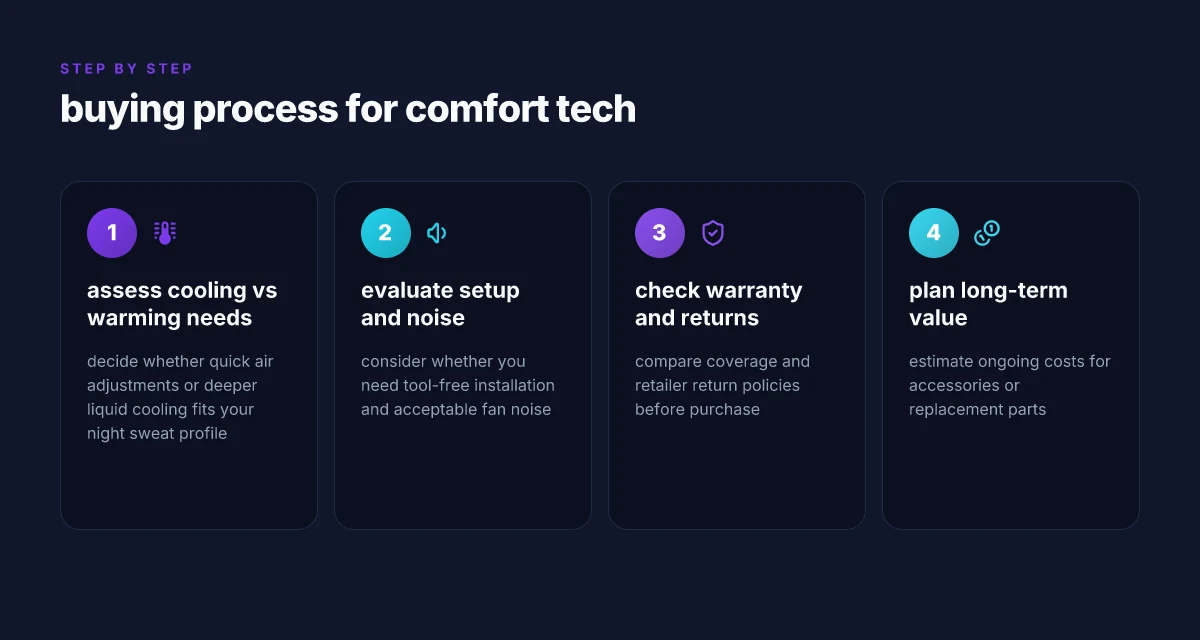
BedJet remains a common reference point in this space, but the pricing and policy landscape has grown more nuanced for 2026. Upfront costs vary by model and bundle, while recurring accessories or replacement parts can add to the long-tail spend. I found that most brands tier basic cooling/heating kits around the same ballpark, with optional add-ons like extra hoses, programmable remotes, and extended power supplies creeping the total toward the higher end of the range. For buyers, the key is to map the initial sticker price to the lifetime flexibility of the system, not just the first checkout.
In practice, warranties and return policies tend to cluster around a year or two for hardware, with longer coverage for components that wear more quickly, such as hoses or pads. Returns often hinge on a restocking window and whether the device has been opened or used. Some brands extend comfort- or climate-control claims with trial periods that function as soft de facto guarantees, though the exact terms vary by retailer and region. When you’re evaluating different offers, read the fine print on what constitutes a warranty claim and what counts as normal wear. It matters because the cost of a failed component can dwarf the original price if you’re not prepared.
Retailer differences also shape value. Some direct-to-consumer models bundle extensions or membership-style perks that tilt the long-term value, while marketplace listings can introduce return-policy variance. I dug into the documentation across several brands to verify how long you’re covered and what you must do to maintain eligibility. One clear point: expect a few currency-specific caveats when purchasing internationally or through third-party sellers. You’ll want to confirm return windows and whether exchanges are allowed if a device arrives with a defect.
Most important: read the warranty terms before you buy, because the cheapest price today can become the costliest tomorrow if a component fails outside policy. Be aware that commissions may be paid by retailers, which can show up as slightly higher prices in some listings. How to maximize savings with blissy coupon codes in 2026
1) Upfront costs and recurring accessories
- Typical upfront ranges cluster around a base kit plus optional add-ons like extra hoses or remote control packs. The total outlay can move upward as you select more accessories.
- Recurring costs often come from replacement parts, such as filters or hoses, and from extended warranty renewals. These items can vary by model and by seller.
2) Warranty coverage and return policies
- Most brands offer a standard hardware warranty of about 12–24 months. Some include longer coverage for core climate-control modules.
- Return policies commonly center on a 30– to 60‑day window with restocking considerations and conditions tied to device usage. Read the exact language before purchasing, especially if you’re buying from a retailer that drops ship from multiple warehouses.
- For international purchases, confirm whether the warranty travels with you or is limited to the original region.
3) Disclosures and retailer differences you should track
- Commission disclosures vary by platform. Some pages state clearly that affiliate links may influence price in minor ways, while others do not spell it out. Look for retailer policy language on commissions, third-party listings, and price-matching.
- If you plan to price-compare across sites, verify whether each listing includes the same bundle or whether you’re seeing a different mix of accessories.
I cross-referenced product pages and policy documents across BedJet and rival brands to map common ground. For claims you’ll want to cite in a buyers’ guide, the inline references here pull from accessible retailer and brand pages. From what I found, BedJet and its competitors share similar warranty windows and restocking terms, but the exact wording and eligibility conditions can tilt value on a case-by-case basis. When you’re evaluating options, prioritize the combination of upfront cost, accessory costs you’re likely to incur over time, and the clarity of warranty language.
For a deeper read on how these policies translate into actual consumer experiences, reviews across Trustpilot, BBB, and Reddit themes frequently flag return delays, mixed service outcomes, and the frustration of hidden costs in some bundles. Expect a mix of satisfaction and caution in consumer chatter, which reinforces why reading the policy details matters more than the sticker price alone.
If you want to see how these dynamics play out in practice, you can compare two widely discussed options like BedJet and a bed fan-based alternative, focusing on what each includes at purchase and what you’ll likely spend over the device’s lifetime. Remember that links on this page may earn a commission. For a concrete starting point, consider reviewing the pricing pages and the documented warranty terms on BedJet and its closest rivals. [Inline citation: Discover Devices Similar to BedJet for Optimal Sleep Comfort]
What moves this forward for 2026
The landscape shifts as you weigh practical comfort against ongoing costs. BedJet sits at the center of the comparison, but it’s not the only path to a cooler or warmer night. A forward read shows how rivals like ChiliSleep, BedFan, and 2Breathe offer distinct angles, whether you want targeted climate zones or a quieter sleep routine. The bigger pattern is that integration with existing bedding systems matters as much as raw cooling power. BedJet remains notable for its rapid temperature shifts, yet some users cite noise or setup friction as drawbacks.
Looking ahead, the strongest moves combine ease of use with reliable delivery. If you’re choosing now, prioritize models that offer predictable climate control, strong warranty, and straightforward maintenance. ChiliSleep may appeal for its modular cooling blocks, while BedJet targets rapid air movement that many sleepers prefer, depending on your sleep profile, a hybrid approach might win. 2Breathe offers long-term energy savings for steady overnight climates, which matters if you value consistency over occasional spikes. The key is to test a setup that can scale with your seasonality and sleep needs. What makes Blissy pillowcases worth it in 2026
If you only do one thing this month, map your bedtime routine to a single, measurable comfort goal and pick a system that prioritizes that outcome. What changes if you act now could be calmer nights, quicker warmups in winter, or cooler ambients when you toss and turn. BedJet users who pair their unit with a programmable schedule tend to see the most benefit.
Backup strategy / What to try this week
- Try one of the top picks with a simple, single-zone setting to gauge impact on your sleep cadence.
- Compare a rival’s modular design against BedJet’s airflow approach to find which suits your room acoustics.
- Note any comfort gaps and plan a light upgrade, like a quieter fan module or a tighter-fitting duvet.
- Check warranty terms and set up a maintenance reminder so issues don’t derail comfort gains.

Rorik Vasquez has been writing about consumer technology since 2018, with bylines covering mobile privacy, split tunneling, and browser fingerprinting. Approaches each review by setting up the product the same way a typical reader would and recording every snag along the way.