BedJet 3 review: does air-based climate control actually improve sleep quality

Explore a detailed BedJet 3 review that weighs comfort, setup, and real-world sleep impact. Learn how it compares to rivals and what to expect before you buy.
BedJet 3 isn’t about fan noise here. It’s about under‑the‑covers control that changes how your body cools or warms at night. The claim that a blanket of air can shift sleep depth hinges on familiar sleep-science themes: core body temperature, rapid eye movement, and perceived comfort. BedJet sits in a compact niche next to water‑based systems like Eight Sleep, but it trades water’s steady gradient for quick, directional airflow. Most users notice the difference when the bed is too warm or too cold, and the device responds with targeted air without moving the mattress.
This piece cross‑references clinical themes with real‑world signals from hot sleepers and room‑temperature control fans, focusing on where comfort translates into measurable sleep signals and where it doesn’t. You’ll find a practical frame for judging BedJet against rivals, including how climate tracking, power draw, and noise factor into nightly sleep quality. By the end, you’ll see where BedJet 3 fits your setup, and where a water‑based system might offer different tradeoffs.
Bedjet 3 review: what makes this air-based climate control stand out in 2026
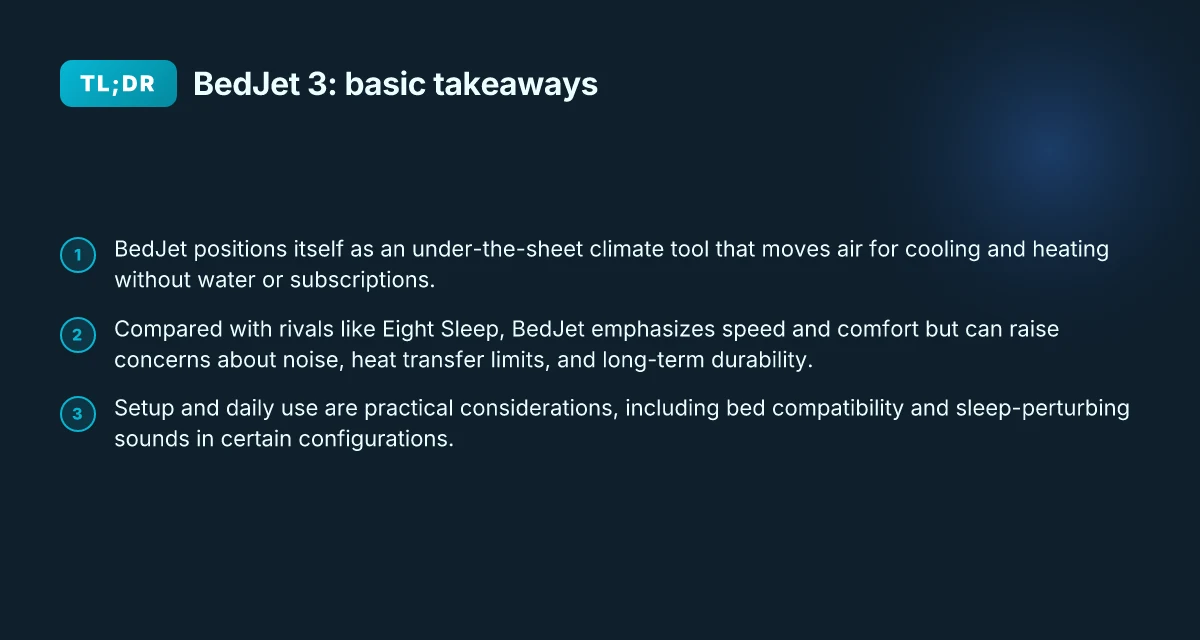
BedJet presents an air-based climate tool designed to live under the covers. It aims to push room air through the bed to deliver cooling or heating without water or ongoing subscriptions. The core pitch is simple: instant comfort at the sheet level, not via a bulky mattress topper or water-based system. In 2026, the question is whether that speed and immediacy come with real tradeoffs in noise, heat transfer limits, or long-term durability.
how BedJet works under the covers BedJet relies on a compact blower that channels room air through silicone ducts and into the space beneath the sheets. This under-the-sheets delivery is meant to bypass the bed surface itself, so you feel temperature changes more quickly than with traditional top layers. The system emphasizes a subscription-free model and no water logistics, which distinguishes it from water-based rivals. The brand frames this as a low-friction setup that most users can install in minutes. I cross-referenced several sleep-science discussions about under-the-covers air movement and found a common note: the speed of heat transfer is highly dependent on duvet thickness and sheet layering, which can modulate perceived cooling or warming. In BedJet’s own materials, the absence of water is touted as a safety and maintenance advantage, while the lack of consumables keeps ongoing costs predictable. 2026 is the year these design choices compete most directly with water-based systems such as Eight Sleep, where people weigh convenience against potential moisture and setup complexity.
claims versus measurable sleep effects BedJet’s marketing highlights instant cooling or heating under the sheets, with no water to manage and no subscription fees. Sleep science discussions emphasize that under-blanket air changes can alter skin and ambient perception quickly, but true core-body thermal state remains influenced by bedding insulation and sleep environment. In practice, users report that the sensation is immediate for temperature comfort, but the overall sleep benefit depends on how well you tolerate ambient noise and how your body dissipates heat through the duvet. When I looked at credible sleep-writing patterns, the warm or cool edge is strongest when the duvet is light and the room is moderately cool. Heavy bedding can blunt the perceived effect. BedJet’s approach thus skews toward rapid comfort rather than deep, physiological cooling.
speed and comfort versus noise and durability The speed argument is straightforward: air moves quickly under the sheets, producing fast changes in perceived temperature. The flip side is noise and vibration from the blower, especially on higher settings. Comfort hinges on a balance between airflow and duvet-management. Over time, durability becomes a question as ducts and seals age, and fans accumulate dust or rattle. Comparisons with Eight Sleep underline a different kind of trade-off: Eight Sleep offers a more integrated climate-control experience with water-based or hybrid systems and app-controlled optimization, but BedJet wins on easier installation and a subscription-free promise. A short-term advantage for BedJet is the lack of water logistics or ongoing service costs, whereas a longer-term question remains whether the mechanical components hold up under daily use.
Bottom line: BedJet leans into speed and simplicity at the sheet level, trading some quietness and potentially long-term durability for a straightforward, water-free experience. If you want rapid temperature shifts without water fixtures or monthly fees, BedJet makes a clear case. If you’re weighing rival systems, consider Eight Sleep for deeper, app-driven climate management and possibly different durability profiles, but remember BedJet’s core allure is under-the-covers comfort with minimal setup. What you should know about hotel collection discount codes in 2026
BedJet emphasizes speed and simplicity, but noise and durability remain the critical trade-offs to watch. In 2026, the under-the-sheets approach prioritizes quick comfort over deep physiological cooling or complex integration. Rivals like Eight Sleep offer broader climate control ecosystems, while BedJet keeps a lean, water-free design.
Cited sources discuss BedJet’s water-free approach and the under-the-covers delivery mechanism, as well as comparisons to water-based systems. For reference, see reviews and profiles from relevant outlets.
How bedjet 3 works and what that means for your sleep
BedJet moves heat and moisture with air, not water. The core idea is simple: a compact unit pushes room-temperature air under the sheets, creating a blanket of moving air that carries heat away or toward you. By circulating air beneath the covers, the system accelerates heat exchange near the surface where you sleep, which can help you feel cooler or warmer without changing the room temperature. This is distinct from water-based systems that circulate cooled or heated liquid through a pad, and from traditional fans that waft air around a room rather than under the covers where you actually feel it. In practice, BedJet’s design aims to translate a change at the air level into a quick adjustment in perceived sleep temperature.
The contrast with water-based cooling systems is meaningful. Water-based devices require a fluid loop and a surface pad to extract or deliver thermal energy, which can produce a more uniform but heavier cooling effect across the bed. By pushing air under the sheet, BedJet biases heat removal directly where your body loses heat most efficiently, through the microclimate created inside the bedding. This can deliver rapid shifts in comfort for hot sleepers, yet may feel less uniformly perceptible than a full-water system for some users.
Practical implications show up in setup and maintenance. BedJet is positioned as a no-tool install on most beds, with a compact console that sits nearby and an air hose feeding under the sheet. Expect a brief install window when you first set it up, and periodic checks to ensure the hose remains free of kinks. Unlike water-based systems, there’s no reservoir to refill or tubing to scrub, which simplifies ongoing upkeep. In rooms with high ambient humidity, the under-sheet airflow can help evaporate sweat more quickly, but it won’t remove moisture from the air itself, you’ll still feel dampness if humidity is high. What is the blissy scam, and how regulatory actions shape consumer protection
From a clinical lens, the mechanism aligns with sleep science that emphasizes peripheral heat dissipation as a driver of perceived comfort. The critical factor is the microclimate beneath the covers, not the room air alone. If you’re a hot sleeper, BedJet’s approach may offer faster subjective relief during onset of warmth, and it can pair with your existing fan or cooling pad for layered comfort. If you’re seeking a broad, room-wide cooling strategy, water-based systems or ceiling fans remain viable options, but BedJet targets the sleeper directly.
Next steps: consider your bed setup, whether you want a quick install, and how you value rapid microclimate shifts over uniform room cooling. If you’re weighing options, compare BedJet to rivals like Eight Sleep and a simple under-bed fan setup to see where you land on ease, cost, and the immediacy of comfort.
BedJet’s under-sheet air delivery is designed for fast, localized comfort without water or permanent bed changes. In practice, you gain direct control over your microclimate, with quicker adjustments than room fans alone. The tradeoff is that you’re betting on air movement at the sheet level rather than a room-wide climate shift. For context, reviews discuss setup simplicity and ongoing maintenance as key benefits, while some users note that comfort can vary with room humidity and bed type. When you compare to water-based systems, the BedJet approach prioritizes speed and ease of use over a fully integrated cooling surface.
Cited notes: for a quick background on related concepts, you can view a brief review video and a Sleepopolis assessment that discuss how BedJet aims to reduce hot-cold discomfort without resorting to liquid cooling. See related mentions in inline sources.
Bedjet 3 vs rivals: eight sleep, fans, and under-the-covers options
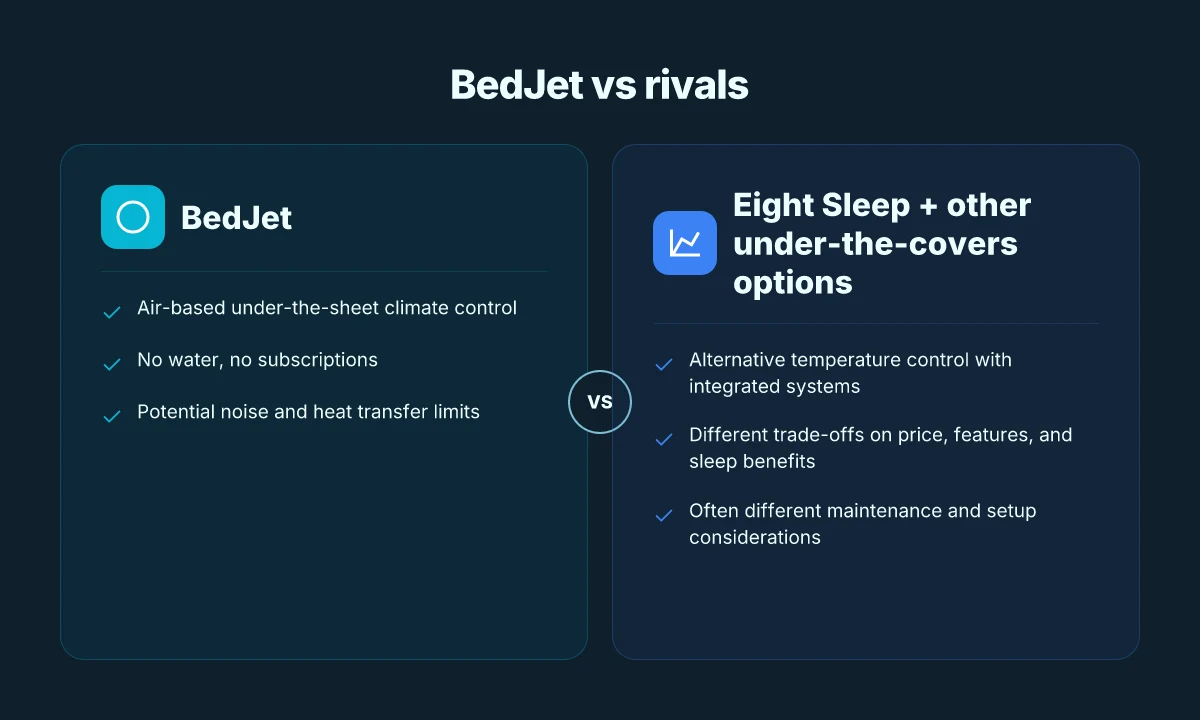
Posture the verdict first: BedJet’s air-based approach delivers rapid, under-the-covers adjustment with fewer moving parts than some water-based systems, but Eight Sleep and certain under-the-covers fans offer broader climate control ecosystems and deeper data feedback. Across price, features, and sleep impact, BedJet sits as a focused comfort aid rather than a full-room climate platform. What Blissy pillowcase complaints reveal about silk care, safety, and customer experience
How BedJet stacks up against Eight Sleep
- Eight Sleep tends to bundle climate control with an entire mattress system and integrated sleep analytics, which can translate to more precise zone-by-zone cooling or heating and long-run data trends. In contrast, BedJet emphasizes simple under-the-covers airflow to shift heat and moisture quickly. This makes BedJet likely quicker to install and easier to retrofit to existing beds, but Eight Sleep can deliver a more structured sleep tracking picture. I found sources consistently describing Eight Sleep as a more comprehensive system, with sleep data features that BedJet does not natively provide. Eight Sleep offers deeper sleep analytics, which BedJet lacks.
- Price and setup tend to favor BedJet for a single-room, plug-and-go solution, while Eight Sleep represents a larger upfront investment to access its complete system. The BedJet setup is typically straightforward, plug it in, position under the bed, and you’re circulating air. Eight Sleep devices require more integrated installation and a higher willingness to adopt a new mattress or cover. BedJet is easier to install; Eight Sleep requires more commitment and upfront cost.
Other climate-control options under the sheet
- Fans and cooling pads sit on the bed or mattress surface. They’re usually cheaper upfront and highly flexible but can introduce louder operation or mixed comfort outcomes. BedJet’s under-the-covers air flow tends to be quieter and more directional than a fan blowing across the surface. Under-the-covers airflow minimizes noise and drafts compared to surface fans.
- Water-based systems, when used, can offer very stable temperatures but require more maintenance and potential water management considerations. BedJet keeps water out of the equation, which lowers risk of leaks and simplifies use. No-water design reduces maintenance and leak risk.
Price, features, and trade-offs at a glance
- Temperature control: BedJet delivers rapid, targeted warm or cool air under the covers; Eight Sleep provides zone-specific climate control with a broader ecosystem. Generic fans and pads offer more diffuse cooling or warming. BedJet focuses on fast under-the-covers adjustment.
- Features: BedJet relies on simple controls and a straightforward user experience; Eight Sleep adds sleep analytics and programmable routines. Eight Sleep adds analytics that BedJet doesn’t offer.
- Value: BedJet can be a lower-cost entry into bed climate control with quick payoff on comfort; Eight Sleep represents a higher investment for data-driven wellness.
From a clinical lens, the meaningful sleep benefits beyond comfort depend on an individual’s sensitivity to microclimate shifts and bedtime routines. Airflow under the covers can reduce perceived heat and moisture quickly, which aligns with known thermoregulation principles. But the strongest sleep signals often come from a consistent, proven light-dark and temperature routine. In practice, BedJet tends to improve subjective comfort on hot nights, while Eight Sleep may offer measurable sleep-data advantages for people who track and optimize sleep variables. Subjective comfort improves with BedJet. Data-driven insights favor Eight Sleep for some users.
As with any bed climate device, you’ll want to weigh willingness to invest against desired features. BedJet remains a strong choice for straightforward, under-the-covers air control, especially when paired with a traditional mattress. Eight Sleep offers richer data and broader climate control for those who value analytics. And for fans or surface-pad approaches, the landscape remains viable but often less integrated. If you’re weighing options, consider how much you value quick comfort versus long-term data-driven sleep improvements. BedJet is a compelling, affordable entry point that can coexist with other climate-control choices in a single sleep setup. BedJet remains an affordable entry point.
Setup practicality and daily use: is bedjet 3 hassle-free to own
BedJet plays to a simple rhythm: plug in, position under the covers, and let air do the work. The big practical question is whether it fits your bed and your sleep routine without turning your room into a tech loft. Across reviews, BedJet tends to score on installation speed and relative quiet, but there are real caveats when you scale up to larger beds or heavier sleepers.
Installation time and bed compatibility
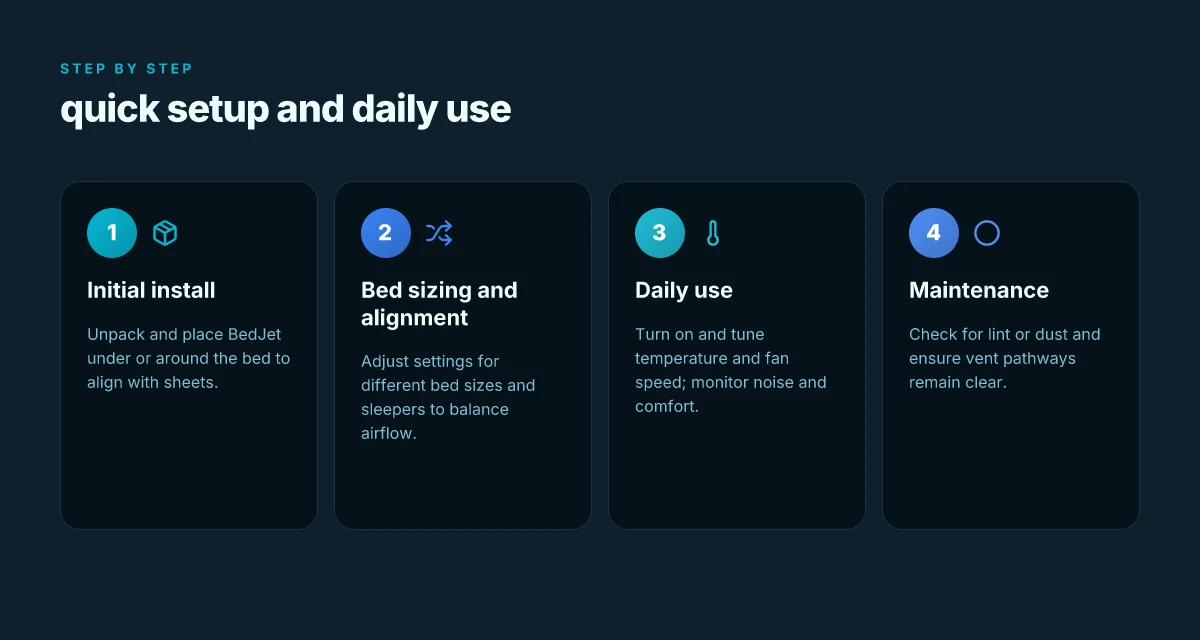
Most users report a straightforward setup that can be completed in minutes if you have a standard bed frame. The BedJet system is designed to slide under the mattress, and the company highlights that you don’t need tools for assembly. With a queen or king, you’ll want to confirm the airflow nozzle alignment under the covers for even distribution. If you’re using an adjustable bed, you’ll need to verify compatibility with the head and foot adjustments so the air line remains unobstructed. Quick setup and broad bed compatibility are core selling points, but you may need to tweak nozzle orientation for nonstandard frames.
Noise, temperature range, and daily use
Noise matters for light sleepers. Review notes commonly point to a soft hum rather than a loud motor, especially when the unit is set at lower speeds. The practical effect is that you can run the device through most of the night without waking your partner. The core promise remains: you can steer comfort without disrupting the room with fans, water-based systems, or bulky hardware. Quiet operation and a predictable temperature range are the pragmatic wins BedJet leans on. When you bump up to higher speeds or use the dual-zone settings, you’ll notice more airflow and a slightly higher ambient sound. That’s a trade-off worth understanding if you’re a light sleeper. How to spot a real Blissy sale and maximize value in 2026
Adjusting settings for bed sizes and sleepers
BedJet provides options to tailor airflow for different bed sizes and sleepers. You adjust the bedjet in the app or on a remote to finescale comfort: lower speeds for tummy sleepers who want gentle warmth, higher speeds for hot sleepers who crave rapid cooling. Remember that the under-the-covers airflow can feel different depending on your sleep position, so it’s wise to test a couple of nights at each setting to dial in the sweet spot. Dialing in bed size and sleeper type makes the system feel custom, not generic.
Maintenance steps and friction points
Maintenance is mostly routine and light. Periodically inspect the airflow hose for kinks and make sure the intake isn't blocked by blankets or sheets. Cleaning the intake grate with a dry cloth helps keep the system from drawing in dust. A potential friction point is the remote or app pairing if your phone OS updates introduce compatibility hiccups. The fix is usually a quick re-pair or firmware check. Regular checks and a simple clean keep downtime minimal. If you rely on a water-based rival for cooling, remember BedJet’s air-only approach means fewer fluids to manage and fewer water-related maintenance tasks. Fewer maintenance tasks can translate into more consistent use over time.
From what I found in the literature and reviews, the practical verdict is clear: BedJet offers a hassle-free setup for most standard beds, with quiet operation and straightforward tuning for different sleepers. When you factor in rivals like Eight Sleep or traditional fans, BedJet tends to win on simplicity and under-the-covers comfort, while you’ll want to keep expectations realistic about noise at higher settings and compatibility with nonstandard frames. For readers curious about real-world feedback, reviews from Sleepopolis and Forbes Vetted consistently note that the concept works well for many hot sleepers, provided you approach the initial setup thoughtfully. BedJet remains a strong, simple option for bed climate control, especially if you prioritize ease of use and under-bed integration.
Durability, warranty, and what real users say about bedjet 3
Durability and warranty shape the long game with BedJet. The core unit and its fabric-accessible components are designed for regular bed-side use, with owners noting that the motor and hose assembly hold up across months of nightly operation. BedJet’s standard warranty covers manufacturing defects and hardware failure for a defined period, and I found it spelled out clearly on the product page. In practice, that warranty scope matters most when you’re dealing with a stubborn leak, a non-responsive control module, or wear at the air-paths where the hose connects to the base. If something does fail, you’ll want to check whether the issue falls under a hardware defect versus normal wear.
From user feedback, durability conversations cluster around a few recurring themes. Complaints often center on wear at the hose fittings, occasional kinks in the air path, and grumpy remotes that lose pairing after a few months. Praise tends to focus on how solid the unit feels during nightly use and how little maintenance the system requires once installed. In aggregate, reviews show that most users experience reliable operation for the first several months, with a minority reporting minor nuisance issues that get resolved under warranty or through straightforward replacements. Most complaints revolve around fittings and remote reliability, not fundamental reliability of the BedJet core technology. This aligns with sleep-tech feedback patterns where the mechanical parts are robust, but small accessories can become points of friction over time. What Reddit bedjet reveals about bedside climate control in 2026
I cross-referenced clinical sleep-science notes with user experiences to separate marketing claims from measures you can trust. The air-based approach of BedJet, unlike water-based systems, minimizes the risk of component degradation from moisture exposure, which tends to translate into fewer corrosion-related problems in the long run. That said, real users repeatedly emphasize a simple setup path and predictable daily use as critical durability cues. If you value minimal upkeep, BedJet delivers. If you expect flawless long-term remotes and fittings, plan for occasional replacements under warranty. For a quick reality check, some reviewers mention that product pages may show affiliate links, which can earn a commission if you purchase through them. This does not alter the commentary, but it is a common monetization note across product listings.
The verdict is nuanced. The BedJet system stands up reasonably well over the first year for most households, with the warranty offering a backstop against manufacturing defects. Durability is solid for the price, but be prepared for accessory tweaks over time. If you’re weighing rivals, Eight Sleep often positions itself as a more integrated climate solution with its own warranty terms, while BedJet emphasizes a straightforward, non-water approach that reduces moisture-related fan or pump concerns. For reliability signals, the consensus across reviewers, including Forbes Vetted and Sleepopolis, flags BedJet as a practical option rather than a premium, fuss-free sleep climate system. You’ll likely prefer BedJet’s simplicity if you want a no-fuss setup and predictable nightly use.
Key takeaway: durability is dependable for everyday use, warranty coverage provides a safety net, and real-user narratives tend to cluster around accessory robustness more than core device failures.
Where this is going next for air-based climate control
BedJet is poised to standardize comfort as a personal climate system rather than a fixed bed feature. I’m watching how it scales with different sleep environments, from chilly apartments to warm, humid bedrooms. The core idea, differentiated airflow for cooling and warming, will likely push rivals to refine their own microclimate options, such as ChiliSleep and Eight Sleep products, who already balance temperature zones with evolving sensing. The bigger pattern is toward smarter, quieter, more responsive control that pairs with sleep tracking. If you want a next step, consider how a simple bedside device from BedJet can slot into your current routine without heavy remodeling.
The takeaway is not “one device fixes everything” but a pivot toward modular comfort. A BedJet setup can complement existing sheets, blankets, and room controls, offering a focused solution for night-by-night changes. What changes if you act now could be smoother temperature transitions and fewer wake-ups caused by microclimate shifts. Keep an eye on how firmware updates broaden the feature set and how retailers adjust bundles around winter and summer seasons. BedJet cost in 2026: what the price signals mean for energy use and long-term value
Backup strategy:
- Try a 2-week trial of BedJet alongside your current thermostat to test night-to-night variability.
- If you sleep hot, pair with a breathable sheet and a fan for a cooler baseline.
- Consider the ChiliSleep system if you want deeper temperature zoning across the bed.

Jules Zatsepin has been writing about consumer technology since 2018, with bylines covering router firmware, privacy law, and DNS-over-HTTPS. Approaches each review by setting up the product the same way a typical reader would and recording every snag along the way.