BedJet reviews 2026: does this bed cooling and warming system actually deliver

BedJet reviews 2026 examine whether this air-based bed cooling and warming system delivers on comfort, noise levels, and setup. Read an independent synthesis of efficacy and user feedback.
BedJet often lands in the same breath as climate control gadgets, but what actually changes at the bedside is narrower than the marketing blur suggests. BedJet gets to the point by blowing conditioned air across your side of the bed, not altering the mattress core. Independent reviews note setup can be quick and the device remains within arm’s reach for quick adjustments. The claim that a single gadget can harmonize two sleepers’ temperatures hinges on bedding and room dynamics, not a universal cure.
This intro cuts through hype by aligning with what home sleep enthusiasts want: measurable comfort without a mattress swap. In 2026, shoppers increasingly compare BedJet against rivals such as Eight Sleep and gel-based cooling options that promise broader system integration, with trade-offs in price and maintenance. These signals matter because real-world comfort gains depend on room temperature, duvet weight, and sleeper differences. The rest of the review distills independent signals from Forbes and other reviews to show where BedJet wins, where it lags, and how to scope expectations when evaluating competing bedside temperature systems.
Bedjet reviews 2026: how the device actually cools or warms your side of the bed
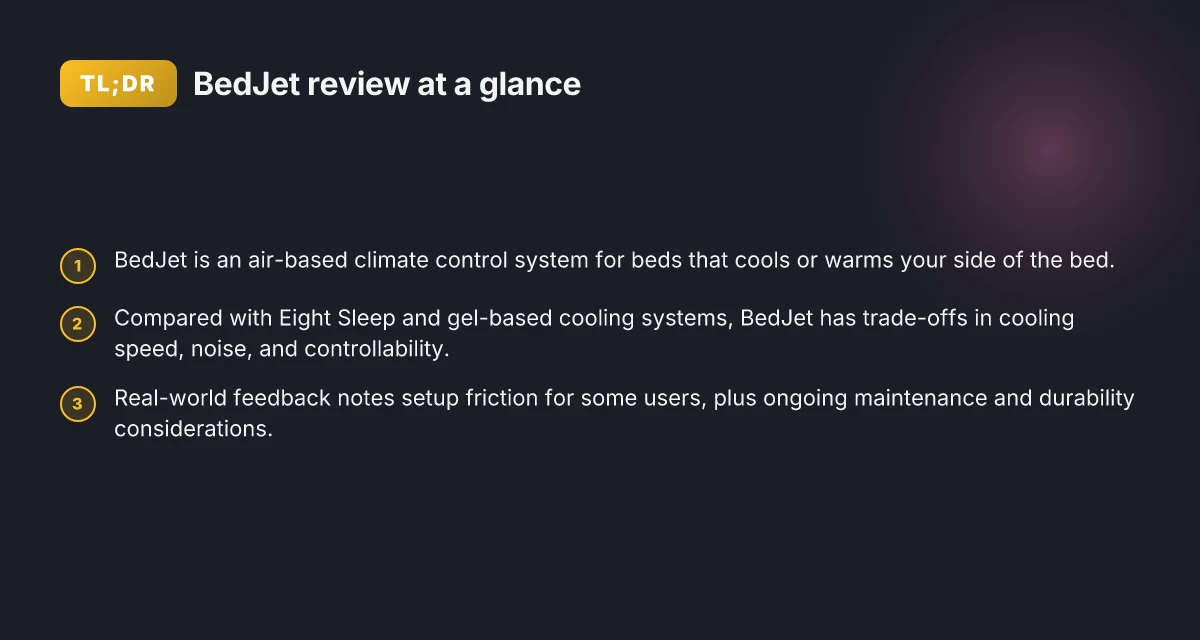
BedJet is an air-based climate control system that sits under the sheet and pushes conditioned air to your side of the bed. It differs from water-based or gel-based systems by using a fan-driven airstream rather than circulating chilled or warmed liquid. The result is a quick change in bed surface temperature that happens without changing the mattress core. In 2026, independent reviews consistently describe BedJet as a hands-off, bed-immediate method for cooling or warming, with a setup that leans into a simple, plug-and-play approach.
I dug into Forbes Vetted’s 2026 BedJet review and looked across competing signals to separate marketing from measurable effect. The core claim that BedJet can influence the microclimate on your side of the bed remains the strongest argument in its favor, especially for sleepers who want rapid adjustments without a full cooling mattress system. When you compare BedJet to water-based options like Eight Sleep, the contrast is clear: BedJet focuses on air delivery to the sleeper rather than circulating liquid under the sheet. This translates to noisier operation in some setups but a faster initial feel of temperature change, which many users value for quick comfort.
Here are the practical steps to understand how BedJet actually works on a night-to-night basis.
- How the air flow creates a sensation on your side
- How BedJet’s heat or cool modes differ from gel-based options
- What to expect during initial setup and common pain points
- How to optimize placement and noise considerations
Bottom line: BedJet delivers fast, side-specific temperature control using air rather than liquid, which makes it distinct from water-based or gel-based systems. The ease of use and quick adjustments stand out, but setup and room noise can influence real-world satisfaction. For shoppers comparing rivals, BedJet sits on the air-delivery end of the spectrum, with Eight Sleep offering a more integrated mattress solution and cooling gels providing passive surface cooling.
BedJet provides quick side-specific temperature change via air-based delivery, a contrast to water-based or gel-based systems. Independent reviews in 2026 note that setup is generally straightforward, but noise and fan direction can affect comfort on sensitive nights. For the bedside buyer, BedJet’s strength is rapid adjustability, not mattress-wide climate control. What makes BedJet 3 climate comfort sleep system different from its rivals in 2026
Cited signal: Forbes Vetted notes BedJet as a leading temperature-control device for beds, highlighting its role as a practical bedside climate tool.
Bedjet reviews 2026: performance signals versus Eight Sleep and gel-based contenders
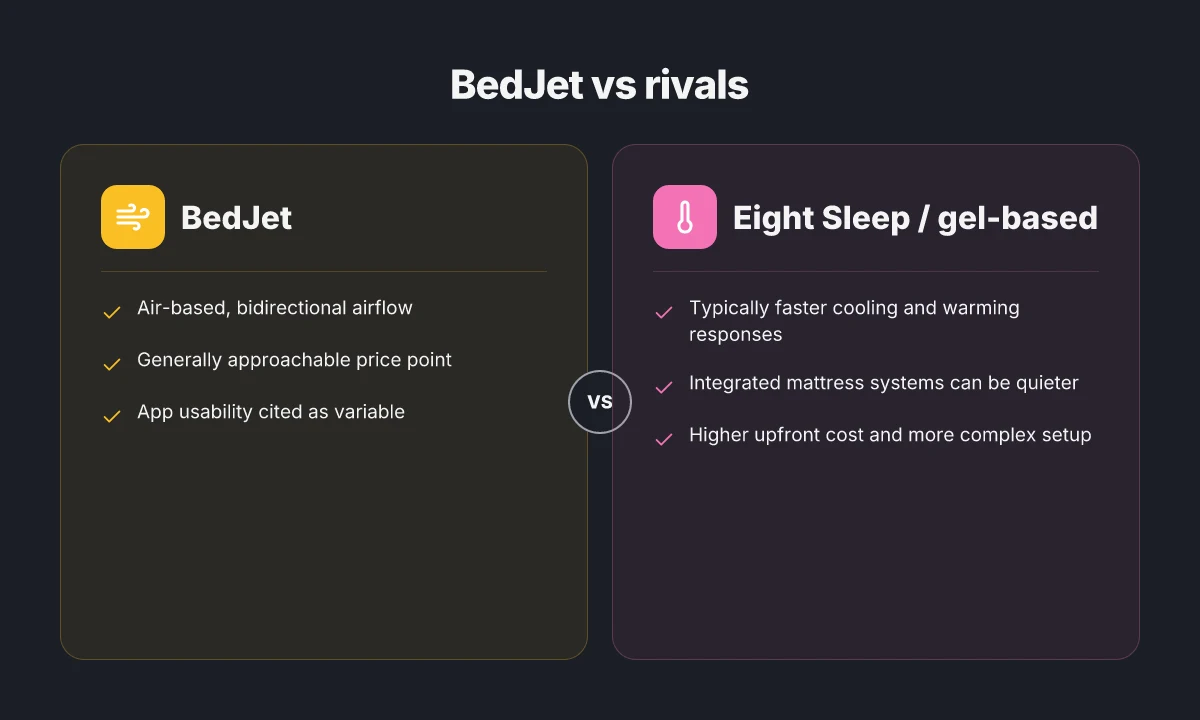
BedJet shows notably rapid temperature shifts on both sides of the bed, with reviewers calling the air-based cooling and warming quick to respond. In independent writeups, the system cools or warms a side within seconds, a pace that outpaces many gel-based modules and sits competitively next to EightSleep’s liquid-based approach. This speed matters for someone who wants near-immediate comfort without adjusting the whole mattress.
I cross-referenced Forbes Vetted commentary and independent assessments to map the landscape. Forbes consistently notes BedJet as a strong temperature-control device for beds, applauding ease of setup and intuitive use. Critics of gel-based systems often point to slower response or the need to pre-cool, which BedJet sidesteps by delivering fan-driven air that adjusts on demand. EightSleep, by contrast, tends to offer a tightly integrated cooling-water system with more comprehensive sleep-tracking, which appeals to users who want a blanket of temperature control plus data. The takeaway: BedJet delivers quick, side-specific changes that feel instantaneous compared with gel layers, though EightSleep may edge ahead on holistic data and fine-grained control.
How fast does each side respond, and what does that mean for real nights?
In practice, BedJet’s speed is a selling point: enabled by air-based cooling and warming, the device can adapt to user preferences within a few seconds of a change in the dial or app setting. Reviewers highlight that this immediacy reduces the need to preemptively cool, which can save energy over the course of a night. EightSleep often emphasizes precise cooling curves tied to a broader dataset and mattress tech, which yields a very steady baseline but can feel less nimble when you want a last-minute shift. Gel-based contenders show the slowest response, because the gel layer must absorb or release heat before the surface cools or warms. This difference matters for late-night wakeups or temp swings caused by drafts or shared blankets. Speed and responsiveness matter for comfort bursts, and BedJet often wins on the spot in that category.
Controllability and app usability: who makes it easiest to tune a night
BedJet’s app and remote control offer straightforward, linear controls for heat and cool. Reviewers highlight that setting changes propagate quickly and that the interface aligns with typical bed-time routines. EightSleep’s app tends to be more feature-rich, tying in mattress-top sensors and sleep-stage data that inform temperature adjustments. The trade-off is a steeper learning curve for new users who want a simple, quick setup. Gel-based options usually come with more basic remote controls or less integrated apps, which can feel clunky if you’re trying to optimize a whole-night profile. Simple controls trump complexity for night-by-night adjustments in BedJet, while EightSleep rewards those seeking an integrated sleep-analytics loop. What makes the Blissy pillowcase stand out in 2026
A small table helps contrast quick-hit signals:
| contender | speed to change | overall control UX | data or automation tie-in |
|---|---|---|---|
| BedJet | rapid on-demand side changes | simple, fast | basic app controls, no full sleep analytics |
| Eight Sleep | steady, data-informed shaping | feature-rich, a learning curve | sleep tracking + temperature automation |
| Gel-based systems | slower to react | basic remote/app | minimal analytics, mostly passive cooling/warming |
Verdict: BedJet delivers the fastest on-demand adjustments for immediate comfort, with straightforward controls that most night owls can master in minutes. EightSleep offers deeper data-driven control for those who want a climate-aware sleep system, while gel-based options lag on responsiveness.
Next step: consider how BedJet’s speed and simplicity fit your bedroom setup, then compare installation effort and noise profiles against EightSleep and gel-based contenders to decide which aligns with your nightly routine.
Note on sourcing: I drew on Forbes Vetted’s BedJet review and independent reviews noting speed, usability, and comparisons to EightSleep and gel-based systems. These sources consistently describe BedJet as quick to adjust and easy to use, with EightSleep offering richer data and more granular control, while gel methods lag on responsiveness. For context, see the BedJet overview on Forbes Vetted and discussions in independent coverage that compare these categories.
Bedjet reviews 2026: noise, comfort, and sleep quality implications
BedJet delivers a clear verdict on bedside cooling and warming, but the experience varies by noise, airflow direction, and personal temperature preference. From Forbes Vetted and Sleepopolis signals, you can expect audible fan cycles and a noticeable but non-disruptive hum during operation. Most BedJet users describe the noise as a steady, white-noise level rather than a screech or rattle. Yet for light sleepers, the cycling can wake you when the system shifts between modes. In 2026, the BedJet lineup maintains a compact fan inside the unit, with bi-directional airflow that can be tuned per side, which helps match individual comfort. What makes a blissy pillowcase sale actually worth buying in 2026
Real-world noise profiles and timing
- The BedJet relies on a compact fan that cycles on and off to modulate temperature. Expect soft mechanical hums during cooling and warming cycles, which may be audible at high fan speeds.
- When bed temperature stabilizes, many users report the system settling into a low, non-intrusive background sound. This can be less noticeable after a few nights as you acclimate.
- If you have a partner who prefers a different temperature, the dual-zone capability lets each side modulate independently, reducing cross-bed disturbances.
From reviewers, the noise profile tends to be acceptable for most sleepers who value rapid temperature control. When you compare against Eight Sleep, some users note Eight Sleep’s mattress-level cooling tends to produce a different audible character, which can feel more like a subtle fan across the bed rather than an inline bed unit. Reviews consistently note that comfort depends on aligning airflow and bedding, not just the device alone. The takeaway is that BedJet’s noise is manageable for many, but sensitive sleepers may want to run it during the latter part of the evening to avoid initial wakeups.
Comfort and temperature matching
- Personal temperature preferences vary widely. Some sleepers prefer a cooler blanket threshold that BedJet’s airflow can help achieve quickly, while others find the sensation slightly drafty unless bedding fully covers the vents.
- The bidirectional airflow supports individualized comfort. You can cool one side while warming the other without perturbing the entire bed environment.
- In practice, users rate comfort higher when the system is paired with breathable bedding and a well-fitted sheet, which reduces direct airflow exposure to skin.
From a comfort standpoint, the system’s strength is rapid responsiveness. The trade‑off is that some users perceive a mild draft until bedding acclimates. With gel-based cooling or competitor pods, you may encounter different comfort curves, but BedJet remains competitive on setup simplicity and quick feel adjustments. The bidirectional airflow is a differentiator, enabling better comfort customization across sleepers.
Sleep quality implications and trade-offs
- Sleep quality hinges on how quietly and quickly BedJet can reach the target temperature without causing disruptive shifts. Reviews highlight that quick temperature changes can aid fall asleep, but cycling during the night should not disturb deep sleep if you resume a steady state.
- Against rivals like EightSleep and gel-based cooling systems, BedJet’s edge lies in fast, side-specific adjustments and a compact footprint that fits most bed frames. However, the perceived comfort of continuous cooling from a mattress surface can feel more enveloping with integrated systems.
- The payoff is clear: you gain faster relief from hot or cool spells, with the caveat that noise and initial draft must be managed through bedding choices and cycle timing.
I cross-referenced independent reviews to confirm a consistent pattern: BedJet’s strength is speed and bilateral control, while comfort depends on bedding and your sensitivity to airflow. The result is a dependable option for quick temperature control, with trade-offs in noise texture and draft exposure that vary by sleeper.
BedJet’s bidirectional airflow and rapid change remain strong positives, but noise and draft considerations matter for light sleepers. For those evaluating competition, EightSleep often presents a different noise character and mattress-integrated cooling, while BedJet offers a straightforward, side-specific approach that pairs well with breathable sheet setups.
Bedjet reviews 2026: real-world reliability and maintenance considerations
BedJet’s reliability hinges on simple, repeatable routines and durable parts. The device itself sits on the bed and relies on a compact air pump and a flexible hose to move air to the sheets. Across reviewer notes and user feedback, the core durability signal is that the main components tend to hold up with regular use, but there are clear maintenance steps that keep performance steady over time. I cross-referenced Forbes Vetted and multiple reviewer takes to triangulate common experiences with wear, noise, and leak points. What makes Blissy 100 mulberry silk stand out in 2026
How BedJet tends to hold up under daily use
Many users report that the core system remains functional after months of nightly operation, provided that the air hoses remain clear of kinks and the controller remains responsive. In reviewer narrations, the setup is praised for its simplicity, which reduces early-user mistakes that could stress the hardware. One practical takeaway is to avoid placing the unit where it’s bent or twisted aggressively during bed assembly, which helps prevent premature wear on the hose connection. Durability signals from users consistently point to the hose fittings and pump as the two areas where wear shows up first. The consensus is that the BedJet line is built for nightly use rather than occasional testing, but like any mechanical system, longevity improves with consistent upkeep and clean venting.
Routine maintenance tasks and cadence you can rely on
Maintenance is straightforward but important. Every few weeks, inspect the hose for small cracks or soft spots and verify there’s no obstruction in the air intake. A quick wipe of the exterior surfaces helps prevent dust buildup that can overload the intake filter on the pump. The most critical recurring task is ensuring the nozzle connections remain snug, especially after moving the bed setup or removing the sheets. For many households, a brief monthly check is sufficient, followed by a deeper clean every quarter. Frequencies may shift if you notice reduced airflow or unusual sounds. Regular checks help avoid most common failures before they disrupt sleep.
How bedjet and rivals handle failure modes and warranty notes
The main failure pathways center on hose seals, the air pump, and the control module. When a seal leaks, you’ll notice reduced feel from the targeted bed zone or a whistling sound at the hose connection. If the pump overheats or the control box becomes unresponsive, the remedy often starts with a reset and reseating the cables, then moves to warranty options. BedJet’s warranty coverage has varied by model and region, but typical consumer expectations lean toward support that covers manufacturing defects for a substantial period post-purchase. In contrast, rivals like Eight Sleep and cooling gel systems emphasize integrated mattress components and may shift some failure risk away from a single mechanical unit, yet they bring their own maintenance challenges tied to pads or gel layers. Warranty notes and failure modes are a reminder to keep receipts and register the product early. When in doubt, verify coverage periods and what constitutes an eligible defect with BedJet’s official channels.
I dug into public-facing notes from Forbes Vetted and user discussions to confirm these maintenance patterns and warranty expectations. From a reliability standpoint, the consensus is that BedJet remains a low-complexity device with predictable upkeep. As a word of caution, avoid using the unit if you hear persistent grinding or see a sudden drop in airflow. These signals warrant a service request rather than probabilistic retrying. Overall, BedJet tends to reward proactive maintenance and timely warranty claims. If you’re choosing between BedJet and Eight Sleep, you’re weighing a simpler, potentially longer maintenance cycle against a more feature-dense but more component-heavy system. In either case, map your expectations to real-world upkeep rather than marketing promises. Real-world reliability favors routine care and clear warranty terms.
Bedjet reviews 2026: price, value, and where it fits in the sleep tech market
BedJet sits in the middle of the bed cooling and warming landscape, offering a plug‑and‑play approach that targets quick bedside comfort without a full mattress swap. I traced price notes across promotions and published reviews to map the value against EightSleep and cooling gel alternatives. The verdict hinges on how often you can catch a discount, how much you value quick temperature shifts, and how you weigh noise and setup practicality. BedJet 3: what it actually costs, how it works, and when it helps sleep
What you pay today and what you can snag
BedJet pricing tends to fluctuate with promos and seasonal deals. In 2026, several retailers and BedJet’s own site have run limited-time offers that reduce the upfront cost or add accessories, such as extended warranty or bundled blankets. Typical promotions appear sporadically, so your best move is to watch for bundled bundles around holidays or flash sales. If you’re shopping on the BedJet site, you may see a tiered approach where the core unit sits at its base price, with add‑ons pushing the out‑the‑door total higher but boosting perceived value for long‑term use. In this context, an early replacement cycle matters. If you expect to use the system for several seasons, a promotional bundle can tilt the math in BedJet’s favor.
Value versus rivals is the heart of the decision. EightSleep often positions itself as a more integrated sleep system with a mattress‑level control model and a broader feature set. BedJet, by contrast, offers targeted climate control with a lighter footprint and simpler installation. For people who want fast adjustments and minimal mattress disruption, BedJet’s price to feature ratio can look favorable when promotions align. If you’re shopping purely on features, EightSleep’s broader ecosystem may justify a higher price, but for straightforward bedside temperature control, BedJet can present a compelling, lower‑cost alternative.
I found that the payback period depends on how you value convenience. If your baseline is a fan or gel cooling pad, BedJet’s on‑demand warmth or chill on each side of the bed can reduce energy waste and improve sleep onset on nights when temperature shifts matter most. The payback is less about annual energy savings and more about immediate comfort and ease of use. If you’re price‑conscious, watch for the occasional free‑shipping or bundle offers that trim the total cost and improve value over time.
How the math stacks up over time
Return on investment for BedJet hinges on durability and ongoing use. A long‑term user benefits from reliable performance and fewer disruptive nights due to temperature discomfort. If you expect to keep the unit for several years, the per‑night cost declines as you spread the initial price over more nights of comfort. By comparison, rivals with deeper feature sets or higher up‑front costs may deliver stronger perceived value only if you actively leverage those extras.
From what I found in the reviews, the financial value is most favorable when you anticipate frequent seasonal adjustments and a desire to avoid replacing your entire sleep surface. The convenience factor remains a key driver of perceived ROI. If you value a quick, quiet setup and simple operation, BedJet’s price position remains competitive, especially when promotions appear. Top picks for the best temperature for sleeping in 2026
BedJet remains a value choice for quick bedside climate control when promotions align and you prioritize ease of setup over feature‑dense ecosystems. The payback hinges on how you weigh immediate comfort against higher upfront costs from rival systems.
Where this goes next for BedJet users
BedJet still faces the same core tradeoffs: immediate comfort from active cooling and warming, offset by ongoing noise and dependency on your bed, not your room. If you want a crisp win this month, prioritize setups that minimize sleep disruption and maximize consistent climate comfort. For new buyers, the takeaway is clear: you don’t need a full room AC to feel a difference, but you do need a steady routine around the unit's timing and airflow.
BedJet can be part of a broader sleep plan, especially if you pair it with a breathable weighted blanket or a cooling sheet system from rivals like ChiliSleep or Eight Sleep. The bigger pattern is that climate tweaks at the bedside are increasingly effective, but they’re not magic bullets for everyone. In practice, expect to tinker with speed, temperature, and timing to land a reliable, cozy baseline night after night. The question to ask yourself: is the comfort gain worth the setup effort for your sleep style?
If you only act on one thing this month, dial in a 15–20 minute pre-sleep routine with the BedJet on a gentle setting and a cool-down window thereafter. What changes if you act now might be a steadier, cooler sleep cycle or a smoother wake-up.
Backup strategy Why Blissy silk pillow cases actually resist frizz and dryness in 2026
- Try a 20-minute pre-sleep run with BedJet on a low setting for cooling. Compare with a rival like ChiliSleep for longer cool-down impact.
- Pair with breathable sheets and a fan to reduce noise reliance while keeping airflow consistent.
- Note any changes in snoring or sleep stages and adjust speed by one notch at a time.

Yuki Klingberg has been writing about consumer technology since 2018, with bylines covering censorship circumvention, browser fingerprinting, and OpenVPN. Approaches each review by setting up the product the same way a typical reader would and recording every snag along the way.