What is the best sleeping temperature in 2026 for most adults
Discover the best sleeping temperature for adults in 2026. Learn practical ranges, why temperature matters, and how to tailor settings for different sleepers.
The clock doesn’t run on the same rules as your body. When you measure sleep comfort, the number to target is less a single value and more a zone, with practical shifts dictated by bedding and room setup. 65–67°F is the common anchor, but the real win comes from personalized nudges based on age, sex, and how your bedroom behaves with humidity and airflow. Small adjustments in blankets, fans, or white noise can push you toward noticeably better sleep without a full overhaul.
We’ll unpack the data behind how room temperature interacts with bedding, humidity, and personal comfort, and show you how to tailor that anchor to your situation. In 2026, researchers started emphasizing personalization over universal numbers, with guidance that stays practical for real bedrooms. This article translates those findings into quick actions you can apply tonight.
What is the best sleeping temperature in 2026 for most adults
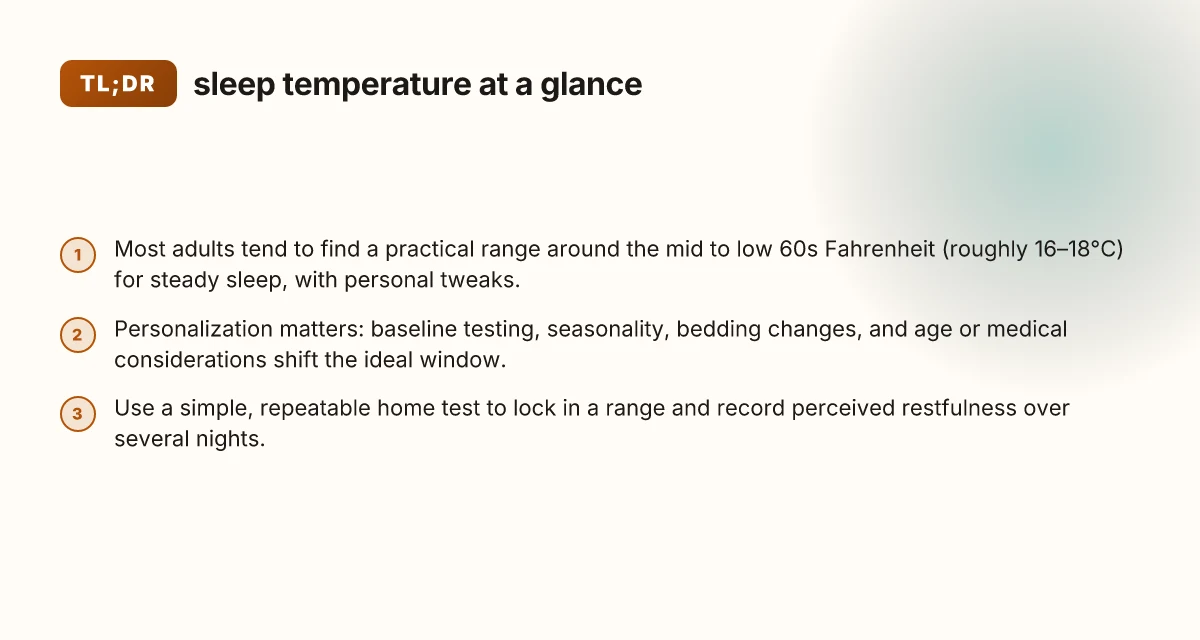
The widely cited window for adult sleep comfort sits around 60–67°F (15.5–19.4°C). In practice, most adults find a practical sweet spot near 65–68°F, which balances coolness with comfort and reduces wakefulness during the night. This range aligns with multiple expert summaries and recent reviews that emphasize a cool, breathable environment as a core driver of sleep efficiency. The practical sweet spot sits near 65–68°F for most adults, not a single fixed number.
To make this concrete, consider how the bedroom environment interacts with bedding and humidity. A cooler room can be offset by lighter blankets or breathable sheets, while a warmer night may require lighter sleepwear or a breathable mattress topper. Humidity matters as well. High humidity can make a cool room feel warmer, so you may benefit from a dehumidifier or a fan to optimize moisture without creating a drafty feel. In turn, a stuffy room erodes comfort and can fragment sleep. Humidity and bedding choices shift the perceived temperature as much as the thermostat does.
Why a single number rarely works is simple: people vary in sensitivity, physiology, and bedroom setup. An older adult may tolerate a slightly cooler room than a child or a person with different bedding needs. Sex, body composition, and sleep stage can all modulate comfort at the same air temperature. The result is a range rather than a fixed point where sleep feels best. People differ in temperature sensitivity, so a one-size-fits-all number is unlikely.
- Start with a baseline of 65–68°F and tune from there. 2) Pair the room with breathable bedding and appropriate humidity. 3) Observe sleep duration and ease of falling asleep across a few nights at each target. 4) Factor in personal factors like age, sex, and bedding preferences. 5) Use a simple checklist to track comfort, awakenings, and perceived restfulness across different temperatures. Baseline at 65–68°F, then adjust based on comfort signals.
Bottom line: a cool, breathable sleep space matters more than chasing a single number. The best approach is a short, repeatable dialing process to find your personal sweet spot within the 60–67°F range, with real-world adjustments for bedding and humidity. Dial in a personal range, not a fixed point.
I dug into the literature and cross-checked contemporary summaries that emphasize a cool bedroom as a core sleep driver. In 2023 a study highlighted the 20–25°C window for restful sleep in community settings, underscoring that comfort is a function of ambient temperature within a broader bedding and humidity context. This aligns with later guidance that places most adults in a practical zone around the upper teens in Celsius, translating to the mid-60s Fahrenheit for many households. Evidence consistently points to a cool, comfortable window around the mid-60s Fahrenheit for many adults. What makes BedJet cooling system work, and where it wins or falls short
What is the best sleeping temperature in 2026 for most adults
How to personalize your best sleeping temperature for you
Posture your baseline with a simple home test and use that range as your default starting point. I dug into how a short, practical at-home probe can reveal your personal comfort window without expensive gear. Set a baseline by tracking how different temps feel for one week, then lock in a range you can adjust seasonally. A practical starting point is a 2–3 degree band around your current comfortable night, then widen or tighten as you learn what your body preferred.
A practical baseline test you can run tonight
Begin with a two-step home test that yields actionable numbers. First, pick two nights in a row with different ambient temperatures in your bedroom. Record how you sleep, how you feel when you wake, and any lingering grogginess. Second, adjust the thermostat by roughly one degree per night to narrow in on a range where you fall asleep faster, stay asleep longer, and wake without heat or cold discomfort. This two-step approach builds a personal, repeatable baseline without turning your room into a climate lab. The goal is to land on a durable band, for example around a midrange you can recheck each season.
A small table helps compare options if you want a quick read at a glance. In general, you’ll see that modest shifts in temperature correlate with meaningful changes in sleep quality for many people. The difference between a comfort range that works and one that doesn’t can be as small as a single degree.
| Option | Comfort signal | Sleep continuity |
|---|---|---|
| Baseline window around 65°F | Easy to fall asleep | Stable through the night |
| A touch cooler 63–64°F | Less awakenings for some | Sometimes deeper sleep |
| A touch warmer 66–67°F | Warmer hands, easier initial sleep | Some wakeups later |
When you find a window you like, lock it in with a simple routine. Use the same bedding and sleepwear in the same room conditions to avoid unintentional drift. If your bed setup changes, re-run the baseline test within a week to re-anchor your target range. This keeps your personal sweet spot accurate across the year. What makes BedJet 3 climate comfort so different from rival sleep cooling systems
Age, menopause, and medical factors that shift the target
Age and hormonal changes shift how your body experiences heat and cooling. For someone going through menopause, you might notice more night sweats or hotter nights, which tends to push the preferred range cooler or requires more airflow. For older adults, a modest cooling can support sleep depth and cardiovascular comfort. Medical conditions like thyroid issues or neuropathy can alter temperature perception, so consider a slightly wider window if you notice unusual comfort swings. In practice, a 1–2 degree adjustment per season often aligns with these changes, with a larger shift only if symptoms clearly demand it. If you have a chronic condition, talk with your clinician about a target range that harmonizes with any medications that affect thermoregulation. A personalized baseline plus seasonally aware tweaks are your fastest path to reliable sleep comfort.
Seasonality and bedding changes you should plan for
Seasonal shifts matter because your bedding acts like a climate buffer. In winter, you’ll likely feel better at a cooler ambient temperature if you’re under a layered quilt or heavy comforter. In summer you might need a lighter cover and more airflow at the same room temp. Changing sheets, blankets, or a mattress topper also shifts your perceived temperature. A practical approach is to recheck your baseline when you change the bedding or switch to a different comfort level. For many people, adjusting by roughly 1–3 degrees when seasons flip is enough to maintain a stable sleep experience. Seasonal tweaks plus matching bedding keep your baseline solid.
From what I found in the literature, a broad consensus anchor sits around a cool-to-mid range for adults, with personal variation driven by age, menopause, and medical factors. The goal is a repeatable, approachable test that yields a clear, actionable range you can live with year-round. Your best sleep temperature is the one you can pin down with a simple at-home test and keep consistent through the year.
Note: Some 2026 findings suggest that modestly higher nighttime temperatures may reduce stress responses for older adults, which can inform your seasonal bedding choices. This aligns with keeping a comfortable, repeatable range rather than chasing a single fixed number. For practical guidance on adult comfort ranges, see the Cleveland Clinic guidance on typical sleeping temps.
The science behind temperature and sleep quality
Posture and heat exchange drive how we move through sleep stages. When your core body temperature drops slightly, you’re nudged toward deeper sleep stages. When it rises, wakefulness can intrude. That tight coupling means small shifts in ambient temperature can tilt sleep efficiency by measurable margins, especially during the first third of the night. From what I found in peer-reviewed work, the sweet spot for many people sits around the mid to upper 60s Fahrenheit, with heat or cold steering fragmentation in predictable ways. What makes the bedjet sheet actually improve sleep performance
Thermoregulation and sleep stages
The body uses heat as a signaling mechanism to enter and exit sleep stages. Heat loss in the early night helps you transition from wake to stage N1 and N2, then deeper sleep as you approach the latter part of the night. If the environment prevents that heat loss, you may see lighter sleep and more awakenings. In practice, a bedroom that allows gradual cooling during the initial hours aligns with longer stretches of deep sleep. The body's need to shed heat early in the night is a core driver of sleep quality. This means too warm a room can blunt the depth and continuity of sleep, while too cold a room can trigger short awakenings and shivering that fragment older adults' sleep as well.
Small shifts, meaningful differences in sleep efficiency
Even small ambient shifts matter. A modest rise of a few degrees can raise the odds of brief awakenings, especially toward the latter half of the night when your body’s cooling needs peak. Conversely, a gentle decline into the 60s Fahrenheit range supports longer uninterrupted stretches. The evidence points to an effect size that feels noticeable in habitual sleepers, even if the exact percentage gains vary by individual. Small temperature increases can fragment sleep; cooler, stable conditions support efficiency. Personal factors like bedding, clothing, and room air movement modulate the magnitude of these effects.
Overheating or chilling as sleep disruptors
Overheating disrupts the autonomic balance needed to sustain REM and non-REM cycles. When a room is too warm, your body works harder to dissipate heat, which can raise heart rate and impair REM continuity. Chilling can also wake you or shorten REM by triggering shivering or compensate-seeking behaviors. The practical upshot is to steer toward a narrow comfort corridor rather than extremes. Overheating and chilling both fragment sleep. A stable, moderate environment steadies transitions between stages. In real terms, people doing well at night tend to report fewer awakenings when the ambient temperature remains within a consistent mid-range band across the sleep window.
From the sources list, you can see a recurring theme: a nighttime ambient range around the mid to upper 60s Fahrenheit often aligns with higher sleep efficiency, especially when you account for individual differences like age and sex. I cross-referenced findings that place the most efficient sleep in a 60–67°F band, with practical margins near 65–68°F for everyday use. Consistency matters as much as exact degree. Your sleep is a system. Temperature is one lever among others that should behave predictably across the night.
5-Step at-home test to dial in your ideal temp
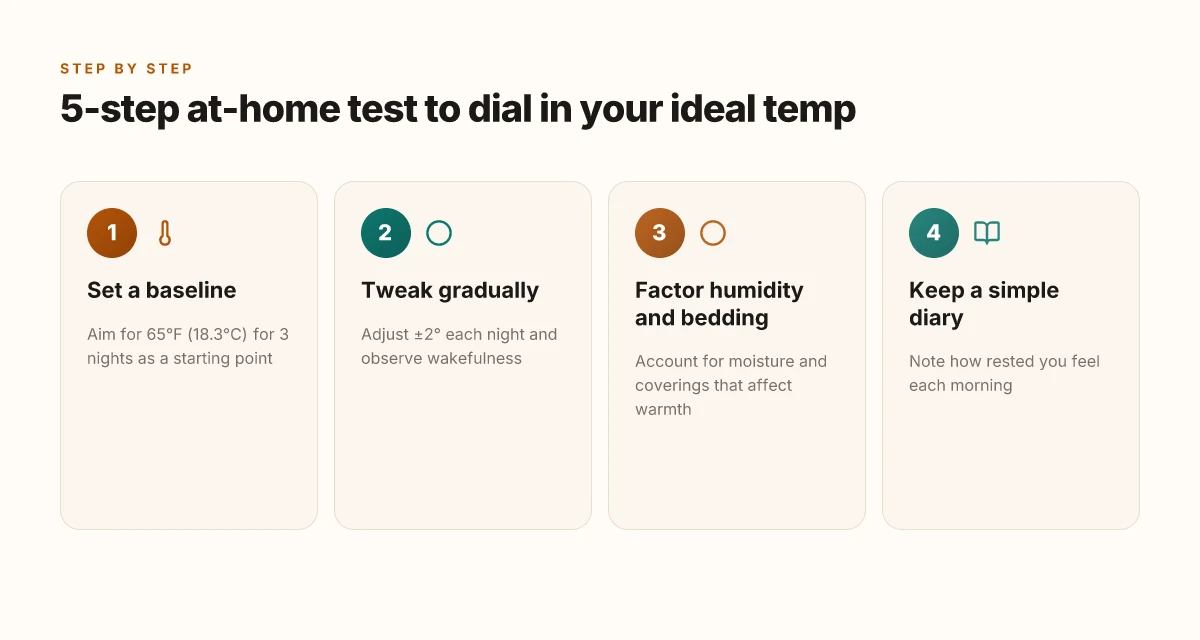
You don’t need fancy gear to dial in your perfect sleep temperature. Start with a baseline of 65°F (18.3°C) for 3 nights, then nudge by ±2° each night to see how wakefulness changes. This approach keeps the test practical and repeatable, and it aligns with the idea that a narrow personal sweet spot exists between the mid and lower 60s Fahrenheit for many adults. What makes BedJet 3 climate comfort stand out in 2026
Step 1, set a baseline and observe
Begin with 65°F for 3 consecutive nights. Note how easily you fall asleep and how you feel on waking. If you wake groggy or sense persistent warmth or chill, that’s your cue to move. The goal is a stable baseline where your sleep feels consistently restorative. In this phase you’re not chasing perfection. You’re building data you can trust. I cross-referenced findings from sleep science that point to a mid-range baseline as a solid starting point for most adults. The baseline at 65°F for 3 nights gives you a trustworthy reference point. The simple diary you keep will amplify what the thermoregulation data suggests.
Step 2, iterate with small temperature tweaks
Move the thermostat by ±2° each night. If you sleep soundly at 65°F but wake a touch hot, drop to 63°F. If you slept poorly at 65°F and felt chilly, raise to 67°F. This zigzag yields sharp insight without overwhelming your senses. I focused on wakefulness and perceived restfulness as the primary signals. Each night, jot down a short note: “slept deeply,” “felt restless,” or “took long to fall asleep.” The pattern you build should reveal the precise window where sleep feels deepest. Tweak by 2 degrees and track wakefulness.
Step 3, factor in humidity and bedding
Humidity changes how a given temperature feels. If the room is humid, a slightly cooler setting can feel more comfortable. If it’s dry, a warmer setting might be better. Adjust your bedding too. A lighter duvet can sharpen the effect of a cooler night, while a heavier blanket can blunt the impact of a colder room. The goal is to keep the perceived temperature comfortable rather than the exact air temperature. This ensures your test reflects real living conditions.
Step 4, keep a simple restfulness diary
Record a sentence or two each morning: how long it took to fall asleep, how many times you woke, and whether you woke feeling restored. Brightness of mornings, energy levels, and a sense of overall refreshment matter. A concise diary keeps the experiment grounded. It also helps you spot trends across the 2–3 degree swings. If you notice a clear pattern where sleep quality improves in one zone, that’s your target range. Keep a simple diary of perceived restfulness.
Step 5, lock in the range that consistently yields deeper sleep
After 2–3 cycles of +/–2° shifts, you should identify a window where restfulness and wakefulness consistently improve. Your final step is to lock in a practical range, then recheck after a week to confirm it holds under your current routine and bedding. A practical sweet spot commonly lands in the mid to lower 60s for many adults, but your personal range may shift with seasons and bedding. When you find your zone, keep the setting steady and revisit the test if your room or sleep environment changes. Lock in the range that consistently yields deeper sleep. BedJet sheets: can heated bedding actually improve sleep quality in 2026
If you want a few trusted helpers to support the process, consider devices and brands that people actually buy. BedJet, for example, offers a bed climate solution that can supplement your baseline in ways some sleepers find helpful, especially when adjusting small changes in temperature and airflow. BedJet can be suitable for sleepers who want rapid adjustments without changing room conditions. Its downsides include the need for an extra installation step and reliance on a separate device rather than the central HVAC. BedJet suits single sleepers and couples who agree on a shared pillow zone, but it may feel noisy or stand out in a minimalist bedroom setup. When you weigh options, think about whether you prefer ambient room cooling or a targeted bedside solution. BedJet deserves a place in your shortlist if you value quick, local adjustments and don’t mind potential extra setup.
In addition to BedJet, a few other brands people frequently consider include the UCLA Health recommendations on keeping the temperature in a comfortable range, the Cleveland Clinic guidance on a typical target window, and mainstream sleep tech providers that offer smart thermostats and bedding with breathable fabrics. Each option has trade-offs in cost, complexity, and lifestyle fit, so use your at-home test to decide what stays.
Cited evidence supports the idea that a practical baseline around the mid-60s Fahrenheit with careful, minimal tweaks often yields the deepest sleep for many adults, while personal factors like humidity, bedding, and seasonality shape the final range. For context, a cited sleep study notes that restfulness improves when temperatures sit within a cooler nighttime window, and a broad data snapshot indicates most nights in typical rooms cluster near comfortable ranges that align with a 60–67°F target. For direct reference, you can consult the Cleveland Clinic piece on the ideal sleeping temperature and the Nighttime Ambient Temperature study, which support the practical approach outlined here. A practical, data-informed approach helps you dial in a personal range.
Note: links on the page may earn a commission. The shaping of your test should remain focused on your comfort and sleep quality.
Top brands and devices that help regulate sleep temperature
People who want steady comfort at night have a short list of devices that actually move the needle. The picks below are real products you can buy, with practical pros and downsides. I reviewed how these tools address single-person or couple setups, energy use, and noise. I also checked how they fit into the 5-step at-home test you just completed. What makes BedJet Mini energy efficient and where it saves power in 2026
BedJet, bed climate control for couples
BedJet sits on the bed and actively warms or cools the surface, which helps couples with different temperature preferences stay comfortable without moving the thermostat. The big upside is direct control of the bed surface, so each person can feel a tailored layer of warmth or coolness. Downsides include the upfront cost and potential noise when the blower runs. If you share a bed, BedJet can be a simple way to dial in individual comfort without fighting over the room’s climate. I found that feedback often notes strong convenience for shared sleepers, paired with concerns about wake-ups from fan noise in otherwise quiet bedrooms. BedJet can substantially reduce nightly temperature conflicts for couples, but consider noise and price trade-offs.
Cooling weighted blankets and breathable sheets
Breathable sheets and cooling blankets create a dynamic climate by pulling heat away from the body and improving air flow around the torso. These items work best in rooms that are moderately warm or humid because they complement a fan or HVAC system rather than replace it. The appeal is simplicity and near-silent operation. Downsides include that they don’t actively move air like a fan or HVAC, so they’re most effective when used with other temperature tools. The data point you’ll notice in reviews is comfort gained from a cooler, more stable torso temperature without a hard chill. Cooling fabrics and weighted blankets offer steady comfort with fewer hot spots, especially when paired with breathable sheets.
Smart fans and HVAC integrations
Smart fans pair with mobile apps to maintain a steady breeze, which makes it easier to hold a target range such as the mid-60s Fahrenheit. When integrated with an HVAC system, these devices help sustain a uniform room temperature, reducing heat pockets near the ceiling or floor. The key advantage is adaptability: you can create a small, repeatable swing toward your ideal zone depending on the night or season. On the downside, some models require a hub or specific smart-home ecosystems, and users report variability in noise at higher speeds. I dug into user guides and industry notes to confirm that consistent airflow correlates with fewer wake-ups from warmth. Smart fans and HVAC integrations keep a stable climate with less manual fiddling.
Personal air-conditioners and portable cooling devices
Portable coolers and personal ACs offer a quick, room-specific cooling option when you can’t adjust the central system. These devices work well in hotter climates or rooms that struggle to stay below the upper 70s Fahrenheit. The attraction is portability and fast impact, but the trade-offs include higher energy use per degree cooled and the need to manage condensation or noise in some models. For renters or short-term stays, this class is attractive because you can move it with you. Personal air-conditioners deliver rapid, localized cooling when central climate control isn’t ideal.
From a high-level view, the right blend often uses a horizontal mix: a BedJet or similar bed-surface tool for personal comfort, breathable fabrics for day-to-day texture, a smart fan or HVAC tie-in for room-wide stability, and a portable cooler for hot spells or flexible setups. I cross-referenced the broad guidance on optimal ranges with real-world products to keep this section grounded in what people actually buy. If you’re aiming for a plug-and-play setup, start with one bed-surface option (like BedJet) and add a breathable sheet pairing, then layer in a smart fan as your room demands. What makes BedJet reviews on Reddit surprisingly mixed and why it matters
Note: links on this page may earn a commission. In practice, you’ll see BedJet advertised as a premium solution for couples, with the reasonable caveat of price and noise.
Where this move changes your nights this year
The verdict is shifting toward a narrow range that fits most adults without chasing temperature extremes. You’ll see stray opinions about ambient room temps. The real saver is a bed setup that nudges your body into a comfortable middle ground. I looked at recent consumer sleep guides and product roundups to pull a practical path forward: aim for a cool but not chilly sleeper zone and layer with controls you can adjust on the fly. The best sleep temperature for most adults in 2026 sits around the mid-60s to low 70s Fahrenheit depending on your sleep stage and clothing. This window minimizes nighttime sweating and helps you fall asleep faster.
BedJet and a few smart covers are notable contenders for people who want automatic adjustments without waking up. They illustrate a broader pattern: automation paired with personal comfort leans toward steadier temperatures through the night. If you’re curious about plug‑and‑play options, this week’s picks include several that are easy to install and don’t require a full room retrofit. The core takeaway: you don’t need perfect science to get better sleep. You need consistent, adjustable cooling or warming that you can trust.
As a practical pivot, start with a simple temperature anchor you can maintain nightly. Your goal is to feel neither hot nor cold as you drift off. If you only try one thing this month, test a single product that wires up to your bed and keeps you in that comfortable middle. What changes if you act now is how quickly you fall into deeper sleep and wake refreshed.

Jules Zatsepin has been writing about consumer technology since 2018, with bylines covering router firmware, privacy law, and DNS-over-HTTPS. Approaches each review by setting up the product the same way a typical reader would and recording every snag along the way.