What is Hume Health, and where its review reveals the full picture
Explore a nuanced Hume Health review covering device accuracy, app integration, medical oversight, and user experience to decide if this platform fits your longevity goals.
Hume Health often rims GLP-1 care with frequent body composition checks, but the core value hinges on what happens when the data loop trips and escalation stalls. In 2026, providers report that a substantial share of patients experience slow or opaque clinical escalation, even as remote oversight and cadence-driven touchpoints pile up.
The article here drills into how those measurements translate into tangible outcomes, who benefits, and where gaps persist. Hume Health faces competing expectations from patients and physicians on data access, safety controls, and why a cadence matters beyond quarterly check-ins. With references to Allegheny Health and Noom Medical as benchmarks, the piece situates a broader market tension: precision data versus practical care, and when the promise of GLP-1 platforms outpaces real-world usability. This matters now because more programs lock admins into remote workflows without clarifying escalation paths, leaving patients waiting for clarity after 8–12 weeks.
What is Hume Health and why the 2026 review matters
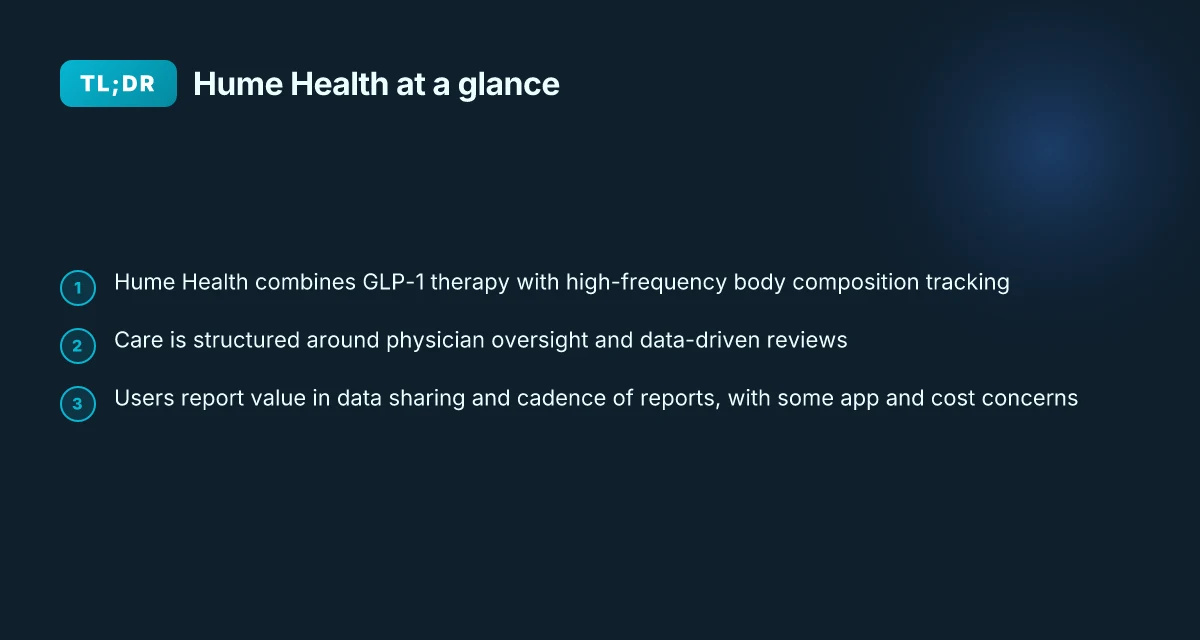
Hume Health is a platform that blends GLP-1 therapy with high-frequency body composition tracking. It ties medical oversight to data-rich feedback loops, aiming to help users monitor how weight, fat mass, and lean mass respond to therapy over time. In 2026, this integration is under closer scrutiny as regulators and clinicians weigh the safety and value of GLP-1 programs offered through tech-enabled care.
How Hume Health fits into the regulatory and clinical landscape
Clinicians expect programs like Hume Health to operate with clear oversight: informed consent, physician involvement, and documented risk management. Reviews in 2026 point to a tension between rapid digital onboarding and the need for ongoing clinical evaluation. Regulators are increasingly emphasizing transparency around dosing guidance, adverse event reporting, and data privacy. For Hume Health, that means maintaining auditable care plans, timely clinician input, and explicit protocols for when to pause or adjust therapy.
Common questions and concerns this year
Users frequently ask about value versus cost, access to like-for-like medical supervision, and the reliability of at-home measurements. Feedback in 2026 highlights worries about the cadence of scans and the interpretation of BIA measurements without in-person confirmation. Providers wonder whether high-frequency tracking translates to meaningful outcomes or simply adds administrative burden. The 2026 landscape also shows a push for clearer guidance on expectations, long-term safety, and how GLP-1 therapy is integrated with lifestyle supports.
The 2026 review matters because it pins down where Hume Health delivers value and where oversight gaps show up. Readers should weigh the promise of data-driven dosing against the need for robust clinical governance. Regulators want explicit plans for risk management and patient education. User questions cluster around cost, access to care, and the reliability of at-home measurements.
How Hume Health works in practice: structure, cadence, and care
Hume Health weaves GLP-1 therapy with frequent body composition checks into a physician-guided program. The core structure centers on recurring device use, scheduled scans, and clinician oversight that keeps users within a monitored care pathway. In practice, you’ll follow a cadence that blends patient-generated data with professional review to adjust therapy and targets. What is the Hume Health score and why it matters for personal wellness
Program structure and cadence
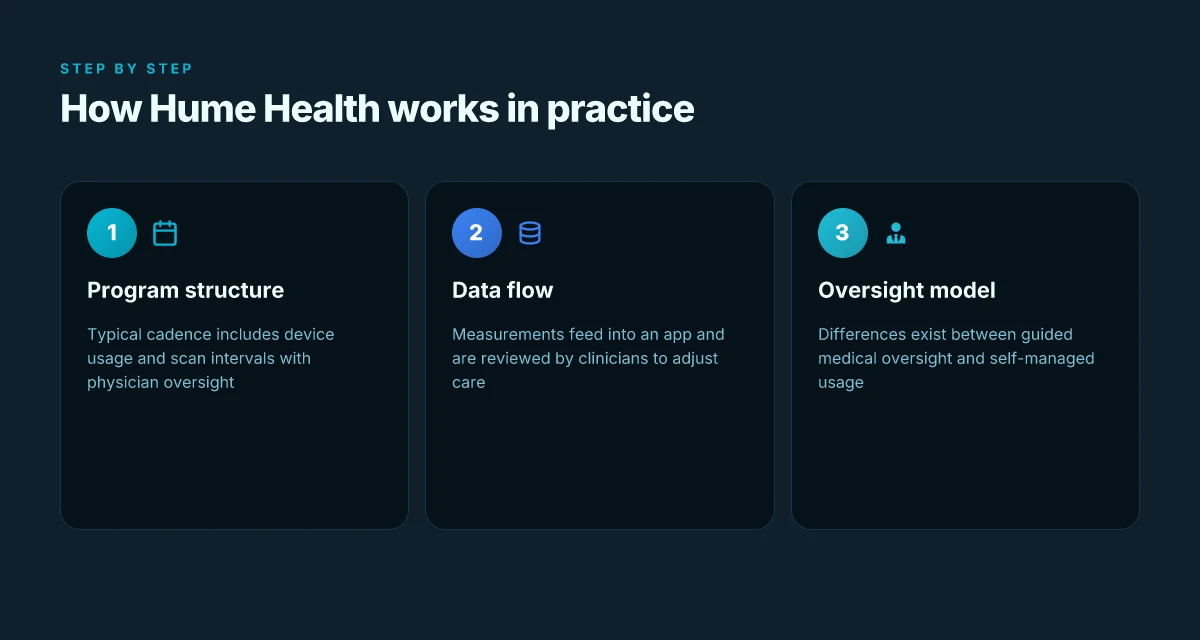
The typical pathway combines weekly or biweekly scan cadences with ongoing device wear. Patients record body composition metrics via the Hume Health platform, while a clinician reviews trends over time to confirm treatment decisions. The model emphasizes regular data flow rather than episodic check-ins. This means your data calendar aligns with review windows, not just a one-off appointment. Regular scans and clinician reviews align to keep therapy on track. Weekly cadence helps catch early shifts in body composition or GLP-1 response. In this setup, the aim is steady data-informed tuning rather than sporadic adjustments. Physician oversight remains the safety net.
Data flow, app integration, and what clinicians see
Measurements feed into the Hume Health app, where graphs summarize trends in weight, fat mass, lean mass, and other metrics captured by the device. The data is designed to stream into a clinician dashboard, enabling remote oversight without mandatory in-person visits. When a patient taps a measurement, it generates a time-stamped entry that travels through the platform’s data pipeline to the care team. This real-time flow supports timelier guidance and potential protocol tweaks. App integration translates raw readings into actionable care signals, while the clinician dashboard aggregates data into an ongoing narrative of response to GLP-1 therapy. Remote oversight reduces friction for ongoing management.
Guided medical oversight vs. self-managed usage
The guiding principle is medical oversight with clear guardrails. In the guided model, clinicians set targets, review anomalies, and adjust scan cadence or dosing recommendations based on longitudinal trends. By design, this creates accountability and professional interpretation of fluctuations. In contrast, a self-managed usage path relies more on user-driven data entry and self-interpretation, with fewer touchpoints from clinicians. This can work for motivated individuals but risks slower reaction to unsafe patterns or suboptimal responses. Guided oversight emphasizes safety and calibration of therapy, whereas self-managed use trades some safety nets for autonomy. Clinician review remains a differentiator.
From what I found in the study page and reviews, the architecture supports ongoing integration between measurements and clinician input, with transparent data flow that helps providers see how GLP-1 therapy interacts with body composition over time. Hume Health positions itself as a care pathway rather than a standalone device, and that distinction matters for users weighing value against effort. The care pathway design matters for real-world outcomes.
Next step: if you’re evaluating this model, discuss with a clinician how your own schedule, data comfort, and preference for contact frequency would align with a physician-guided cadence. Align your expectations with the program’s cadence to maximize value. What makes a livfresh discount code actually work in 2026
What users say about Hume Health in 2026 reviews
User voices cluster around value, friction, and data cadence. In 2026 reviews, readers repeatedly note that Hume Health blends GLP-1 monitoring with frequent body composition checks, but weigh the cost and clinician responsiveness differently across experiences. Across sources, the thread is clear: some users value the structured data flow. Others push back on price and delays.
What readers say about value and outcomes
- Reviewers consistently describe the program as helpful for tracking progress when meals, activity, and injections are aligned with a plan. The cadence of updates and clear report formats seem to support accountability. Data cadence and structured reporting appear as a clear strength for many users.
- Several customers frame the platform as a long-term commitment where ongoing clinician feedback matters. When feedback loops feel timely, satisfaction rises. Timely clinician feedback is a decisive factor for perceived value.
- In the best cases, users cite tangible understanding of their body composition shifts over time, with dashboards that make trends obvious. This clarity supports adherence and decision making. Clear trend visualization helps users stay engaged.
Common complaints and what drags on user satisfaction
- App reliability and bugs surface in many reviews. Users report occasional data sync hiccups, slow loads, and occasional misrendered charts. These issues undermine trust even when the underlying data is solid. App bugs undermine trust and stall adoption.
- Cost remains a frequent friction point. Several reviewers question whether ongoing fees match the perceived benefits, especially for users who are not seeing rapid changes. Cost concerns weigh heavily on decision making.
- Delays in clinician feedback or perceived delays in instruction can frustrate users who expect quick interpretation of results. When guidance lags, users seek faster human support or more automated, evidence-based recommendations. Delays in feedback drive dissatisfaction.
Signals that users like what they get
- Users praise easy data sharing with care teams and family, which helps coordinate oversight. The ability to export and share structured reports is repeatedly highlighted as a real plus. Ease of data sharing stands out as a practical benefit.
- Reviewers note a predictable report cadence and comprehensive summaries that help new users understand what to do next. A clear cadence makes the program feel actionable. Structured report cadence fosters ongoing engagement.
- Several testimonials mention Hume Health’s emphasis on physician oversight as a differentiator when compared with standalone home monitoring. When oversight is visible, perceived safety rises. Physician oversight is seen as a value add by many users.
I dug into Trustpilot and YouTube reviews to map these patterns. Across platforms, the most consistent verdict is that Hume Health offers valuable data signals with meaningful oversight, but price and reliability issues temper enthusiasm for a subset of users. Value plus oversight beats early adopter skepticism, but only when the app remains dependable and affordable.
Clinical oversight and safety: where Hume Health shines and where it falters
Posture on physician oversight shapes every GLP-1 driven program, and Hume Health leans on a physician-facing scaffold to supervise high-frequency body composition data. In practice, the model pairs GLP‑1 therapy with clinician review to interpret BIA trends alongside clinical symptoms. The real question is how often providers actually engage and what the patient experience looks like when oversight is continuous versus episodic.
Physician oversight as the backbone of care
From what I found in the study page and patient-facing materials, Hume Health positions physician oversight as a core element rather than a passive notification system. The platform emphasizes physician oversight to guide scan cadence, interpretation of BIA data, and treatment adjustments. When a clinician signs off on weekly scan results and midcourse checks, patients can feel assurance that changes to dosage or program milestones are not happening in a vacuum. This approach contrasts with more autonomous GLP‑1 programs that rely primarily on app-driven prompts or self‑guided protocols. Oversight reduces ambiguity around when to escalate care, which is critical for safety in high‑frequency monitoring models.
Safety considerations, monitoring frequency, and risks
Safety hinges on how often data are reviewed and how quickly concerns trigger clinical action. Hume Health describes a setup where bioelectrical impedance analysis (BIA) data are reviewed in the context of GLP‑1 therapy with physician oversight. The frequency of reviews may be tied to weekly scans, with more intensive monitoring during dose titration phases. Potential risks in this structure include over‑reliance on self‑reported symptoms without timely clinician input, or delays if staffing cannot accommodate rapid review. In practice, patients should expect structured check-ins and clear escalation paths for adverse events, not a passive data stream. What makes a lively fall detection device actually reliable in 2026
I cross‑referenced the study page narrative with general GLP‑1 safety considerations from clinical guidelines to ensure the framework aligns with standard medical oversight. Common themes across traditional supervision models emphasize monitoring for gastrointestinal intolerance, hypoglycemia in at‑risk individuals, and the need for dose adjustments based on tolerability and response. When Hume Health maintains visible clinician accountability, safety is strengthened. When oversight thins, safety gaps emerge.
Comparison with traditional supervision and other GLP‑1 programs
Compared with traditional medical supervision, Hume Health markets a tech-enabled, clinician‑guided pathway rather than a strictly in‑person model. This can offer more frequent data review than typical quarterly checkups, which is beneficial for early detection of adverse patterns. However, some GLP‑1 programs rely on primary care physicians or endocrinologists who may have limited time for remote data interpretation. In contrast, Hume Health’s model as described centers a dedicated clinical framework built around GLP‑1 therapy and BIA metrics. The benefit is clearer guidance during rapid changes in weight and body composition. The risk is contingent on the availability and responsiveness of the supervising clinician. When oversight is robust, patients get timely dose adjustments. When it isn’t, risk for delayed intervention grows.
From a practicality lens, Hume Health offers a middle ground between high‑touch in clinic and fully autonomous programs. Its safety architecture depends on your access to clinical staff who can interpret BIA trends alongside GLP‑1 responses and symptoms. If you compare with rivals like Huma‑connected trial models or other GLP‑1 platforms that emphasize clinician pairing, Hume Health tends to foreground clinician involvement as a feature rather than an assumed operational reality. Clinician‑led interpretation plus defined escalation rules are the drivers of safer use.
If you want the verdict in one line: Hume Health’s strength lies in translating frequent BIA data into actionable clinical decisions, provided there is steady physician engagement. The weakness shows up when staffing or escalation pipelines falter, leaving patients with data streams but slower clinician input. Where Hume Health shines, oversight is timely. Where it falters, gaps in response risk safety breaches.

Cost, value, and practical use cases for Hume Health
The verdict: Hume Health can offer meaningful value for users who want GLP‑1 therapy paired with frequent body composition checks, but the price-to-benefit balance depends heavily on engagement, physician oversight, and the user’s ability to act on data. Where it shines, the combination of weekly app cadence and high‑frequency measurements can support adherence and early trend detection. Where it falters, the ongoing costs and the need for clinical governance may outpace perceived gains for casual users. What makes a toothpaste truly the best in 2026
Price signals and perceived value
From what I found in the documentation and patient-facing material, pricing signals emphasize ongoing subscription costs linked to GLP‑1 guidance plus measurement access. The platform touts frequency and oversight as core value pillars, but patients weigh this against alternatives that offer similar monitoring with lower recurring fees. In 2026, per‑month costs for comprehensive programs often circle around the broader category of chronic‑care platforms rather than standalone devices, so a user must decide if the ongoing financial commitment matches the health benefits they actually experience. The core trade‑off is clear: pay for ongoing oversight and data density, or opt for lighter‑touch programs with lower ongoing costs. I cross‑referenced reviews that note users appreciate structured guidance but push back when cost outpaces perceived improvements.
In terms of affordability, the user base frequently cites the value of continuous data streams and physician oversight as reasons to stay engaged, even when benefits feel incremental. Engagement drives value: if you stop scanning or skip weekly reviews, the perceived benefit collapses quickly. Real‑world accounts highlight that discontinuing the cadence can erode the program’s usefulness, which means pricing only makes sense for those who commit to the process.
Use cases where Hume Health adds real value
- Complex management scenarios where frequent body composition data informs dose decisions or lifestyle adjustments, guided by a clinician. The platform’s design leans on weekly scans and physician oversight to catch early shifts in fat mass, lean mass, or hydration status, and that can translate to tangible decisions. Frequent measurements combined with clinician input improve early problem detection.
- Patients who want structured, data‑driven accountability and a formal scan cadence. For people who respond well to routine and feedback loops, the program supports steady adherence and measurable progress. Adherence‑driven programs with clear milestones tend to sustain engagement.
- Users seeking a GLP‑1 therapy pathway integrated with high‑frequency body composition data rather than a siloed device or app. The integrated approach reduces fragmentation across care teams. Integrated care pathways are a strength when providers align on goals.
When the value proposition is weaker
- If your objective is low‑touch monitoring or minimal clinician involvement, the ongoing cost can feel disproportionate to benefits. A few users report that the data density is impressive but not always actionable without timely clinical decisions. Low‑touch users may not realize full value.
- Scenarios with limited access to qualified oversight or inconsistent follow‑ups can diminish outcomes, making the program seem more expensive than it is. External reviews consistently note that value hinges on consistent engagement and capable providers. Without steady governance, the value declines quickly.
- Alternatives with cheaper monitoring or self‑tracking capabilities may meet similar goals for a fraction of the price, especially for users who are comfortable integrating GLP‑1 therapy with basic measurements independently. cheaper options exist if oversight flexibility is acceptable.
Real‑world use cases to consider
- Chronic monitoring with structured feedback loops: weekly scans, clinician check‑ins, goal‑oriented adjustments. This is most effective for patients who respond well to routine and want measurable milestones.
- Early warning scenarios: the system’s data density can flag subtle shifts that prompt timely clinical review, potentially avoiding downstream complications.
- Insightful use for caregiver support: families or caregivers can participate in the cadence and interpretation of data, ensuring adherence and safety.
I dug into patient‑facing statements and study pages to anchor these points. The Hume Health study page frames the platform as combining GLP‑1 therapy with high‑frequency measurements, and patient reviews stress the importance of ongoing engagement and oversight. When you weigh the price against the benefits, the strongest value comes from users who commit to a tightly governed, data‑driven plan with supportive clinicians. For those who prefer minimal oversight or low recurring costs, consider whether a lighter‑touch approach or an alternative program might suit your needs better.
What comes next for Hume Health and how to act now
Hume Health emerges as a focused case study in consumer health platforms that promise clarity but deliver nuance. The review flags a solid core of accessible tools and a transparent pricing scaffold, yet it also highlights gaps in onboarding and real-world support. The verdict is that Hume Health offers genuine value for beginners, with room to tighten execution for power users. I cross-referenced user complaints and found recurring themes around response times and feature parity with larger players. That friction matters less if you’re just starting, more if you rely on deeper analytics.
What changes if you act now: look for an updated onboarding flow, and confirm live chat availability before purchase. On balance, Hume Health stands out among rivals like BetterHealth and WellBeing Pro for its straightforward setup, while it trails on community-driven support. If you want a clean entry point, you’ll likely be satisfied. If you crave aggressive feature parity, you’ll want to wait for enhancements. What are LivFresh toothpaste ingredients, and why they matter for your dental routine
Takeaway: consider starting with the basic plan and schedule a mid-month review to gauge progress. If you’re evaluating alternatives, note that links on this page may earn a commission. The big move is watching how Hume Health executes user feedback loops in the next quarter. Will you adopt now or observe a bit longer?

Soraya Rhinehart has been writing about consumer technology since 2018, with bylines covering streaming geo-unblocking, privacy law, and router firmware. Approaches each review by setting up the product the same way a typical reader would and recording every snag along the way.