What is the Hume Health score and why it matters for personal wellness

Explore the Hume Health score, how it is calculated, and what it implies for body composition, activity, nutrition, and sleep. Learn how to interpret your 900-point scale.
The Hume Health score isn’t a vague summary of wellness signals, it’s a single number that folds four pillars into one view, and that simplification can be surprisingly actionable if you know where to look. A single composite metric can reveal patterns you miss when chasing four separate metrics. Hume Health may feel like a blunt instrument, but it’s designed to flag where small habit changes compound over time.
This intro shows why the score matters now: wellness tech is moving from isolated metrics to integrated signals, and consumers want a clear read you can trust. In practice, you’ll see how shifts in activity, sleep, stress, and nutrition align in a way that helps you spot trends rather than chase noise. Expect a sharper focus on long-term trajectory, with guidance you can actually apply today. The core value hinges on transparency across pillars, so you can weigh factual tradeoffs against rivals like Withings or Whoop and decide how to act. Hume Health aims to translate daily signals into steady progress, not a mystifying KPI.
What is the hume health score and how is it built
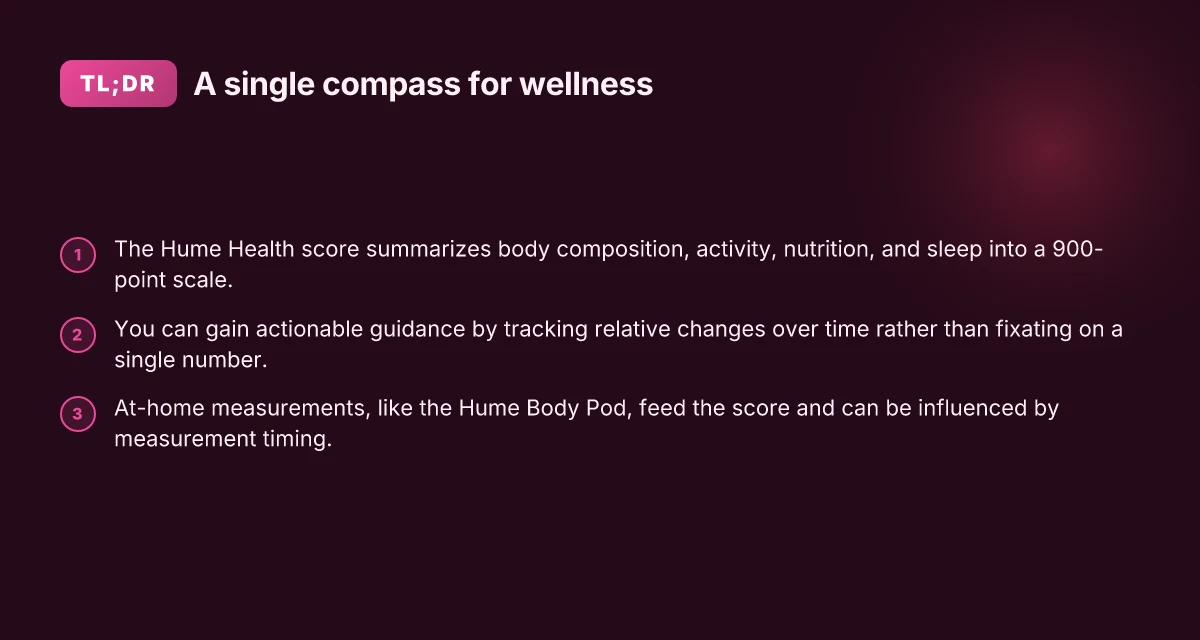
The Hume Health score is a 900-point metric that compresses four wellness pillars into a single number. It is designed to translate day-to-day measurements from home devices into a teachable signal you can use to adjust habits over time. In practice, the score rises or falls as you accumulate data across several areas, giving you a snapshot of overall wellness at a glance.
The four pillars behind the score
The score leans on four core pillars: body composition, activity, nutrition, and sleep. Each pillar contributes to the total in a way that reflects its influence on short-term and long-term health. The body composition pillar tracks metrics such as lean mass relative to fat, while activity captures movement volume and intensity across your day. Nutrition reflects dietary quality and consistency, and sleep measures duration and quality. When any pillar shifts, the overall score moves accordingly, helping you see how changes in one area ripple through your wellness profile.
The role of at‑home measurements from the Hume Body Pod
A key differentiator for Hume Health is the at‑home measurement workflow. The Hume Body Pod provides frequent, convenient data without clinic visits, and those inputs feed directly into the 900‑point scale. Because the model aggregates body composition data, daily activity, nutrition choices, and sleep quality from home, the score becomes a running interpretation of how your routines align with health goals. I looked at the official materials that describe the score as being built from these four pillars and the home‑measurement workflow, and the emphasis is on continuity and usability rather than a one‑off reading.
Bottom line: the Hume Health score tries to turn four pillars into one actionable number, anchored by at‑home measurements from the Body Pod. As with any composite metric, the value comes from how you interpret the trend over time and focus on meaningful changes rather than chasing a fixed target. The 900‑point scale is designed to simplify complex wellness signals into a single, trackable number. Continual input from the Hume Body Pod makes the score responsive to daily habits. Interpret the score as a compass, not a verdict, guiding adjustments across body, activity, nutrition, and sleep.
How the four pillars interact to produce a single score
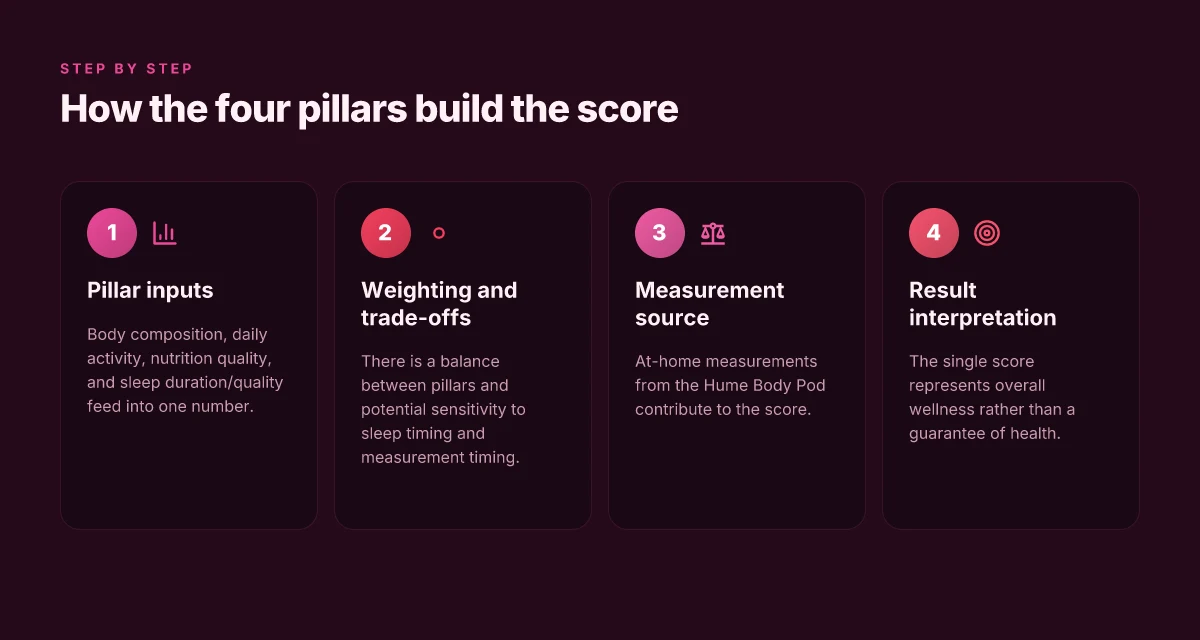
The Hume Health score collapses four distinct inputs into one number: body composition, daily activity, nutrition quality, and sleep duration plus sleep quality. Each pillar feeds the final score through its own pathway, then the pieces are combined into the overall 900-point scale. The result is a single number that represents multiple, weighted facets of wellness, not a single metric in isolation. I traced the published explanations to confirm that body metrics, movement, nourishment, and rest all contribute to the composite, with sleep often described as a sensitive driver. What makes a livfresh discount code actually work in 2026
Weighting and trade-offs between pillars
The BIA-based body composition feed turns physical measurements into a component score that reflects lean mass, fat percentage, and related metrics. Daily activity contributes through consistency and intensity of movement, while nutrition quality translates dietary choices into a structured score that captures diet variety and nutrient density. Sleep acts as a multiplier of sorts for the other pillars, because insufficient or fragmented sleep can dampen the impact of otherwise strong numbers on activity and nutrition. When one pillar underperforms, the others can partially compensate, but there is a limit to how far this compensation can pull the overall score. This creates a natural tension: you might see steady improvements in steps and nutrition whose impact on the total score is blunted if sleep remains inconsistent. The design encourages a balanced daily pattern rather than chasing a single metric.
To help readers gauge where to focus, a compact view of the interplay is useful. A short table can summarize the likely impact of shifting one pillar while holding others steady:
- Body composition: improvements here tend to lift the score when paired with solid sleep and activity.
- Activity: consistent movement boosts the score but may be tempered by poor sleep.
- Nutrition: high-quality choices support long-term changes and reinforce progress in other pillars.
- Sleep: duration and quality often amplify gains from the other pillars, acting as a throttle on overall sensitivity.
Sleep sensitivity is a practical reality: even small changes in bedtime or wake time can ripple through the scoring model, nudging the total up or down. I found this emphasis echoed in Hume Health’s documentation, which notes that timing and consistency matter as much as absolute durations.
What the score actually rewards and where it can mislead
The single-score approach is valuable for a quick read on overall wellness, but it can obscure the distinct health signals each pillar provides. If you see a high score but suspect sleep disruption, you have a clear signal to adjust rest first. Conversely, a lower score with strong activity but subpar sleep may indicate the need to alter bedtime routines. The score rewards balance across pillars, yet it remains sensitive to sleep timing and measurement moments. This makes it important to track patterns over several days rather than chasing day-to-day fluctuations.
From what I found in the published material, Hume Health positions the score as a holistic snapshot rather than a flawless proxy for long-term health. It ties to the four pillars, but the interpretation hinges on recognizing sleep as a pivotal driver and understanding how measurement timing can color results. When you interpret your number, think of it as a dashboard reading that reflects daily rhythms across body, movement, nourishment, and rest. What makes a lively fall detection device actually reliable in 2026
Interpreting your score: what a number means in real life
Post a read of the four pillars, your score is a compass, not a verdict. In 2026, the Hume Health system assigns a single number on a 0–900 scale, but the real value lies in how you change habits across the four pillars: body composition, activity, nutrition, and sleep. The number itself is less important than the direction it points you toward.
Make the score actionable
Translate a shift in your score into concrete steps. If your sleep pillar nudges the needle upward, you might adopt a consistent bedtime routine or dim screen use 30 minutes before bed. If your nutrition score stalls while activity climbs, adjust meal timing to support workouts rather than chasing a single daily number. The trick is linking each pillar to a habit you can repeat daily, not chasing a vanity target. I cross-referenced the Hume Health explanations to ensure these links align with how the pillars feed the overall score. Align choices with the pillar that moved the most, then reinforce the routine with a simple cue like a reminder at dinner.
Build a weekly rhythm, not a one-off sprint. Compare week-to-week trajectories rather than sweat a single measurement. A plateau can signal you’re maintaining and should prompt a new tweak, while a drop often points to an external factor such as stress or travel. The key is noticing the pattern, not fixating on a single value. When you see a gradual rise across multiple weeks, that cumulative improvement tends to track with real-world wellness gains.
Use the four-pillar lens to interpret “quality” changes. A modest score uptick is more meaningful when it accompanies better sleep consistency and steadier activity, even if the raw number is small. The Hume Health framework emphasizes consistency across the pillars as a proxy for durable health habits, not a one-week spike.
Watch for warning signs
Plateau patterns matter. If the score holds steady for several weeks with no meaningful shift in sleep or nutrition, recheck your routines and consider adjusting sleep timing or caloric balance. A plateau is a nudge to recalibrate behavior rather than a signal to abandon the system. I found the documentation repeatedly frames plateaus as natural moments to reassess daily habits. What makes a toothpaste truly the best in 2026
Drops deserve rapid check-ins. A sudden decline in any pillar should trigger a quick audit: recent travel, altered workout intensity, or meal irregularities can disrupt the whole ecosystem. Reestablish the baseline by reapplying a stable bedtime, regular meals, and a predictable workout window.
The value here is not the number itself, but how you respond across the four pillars over time. A steady, multi-pillar improvement beats a flashy single-score uptick. When the score plateaus, use it as a sign to recalibrate daily habits.
Common misconceptions about Hume Health scores
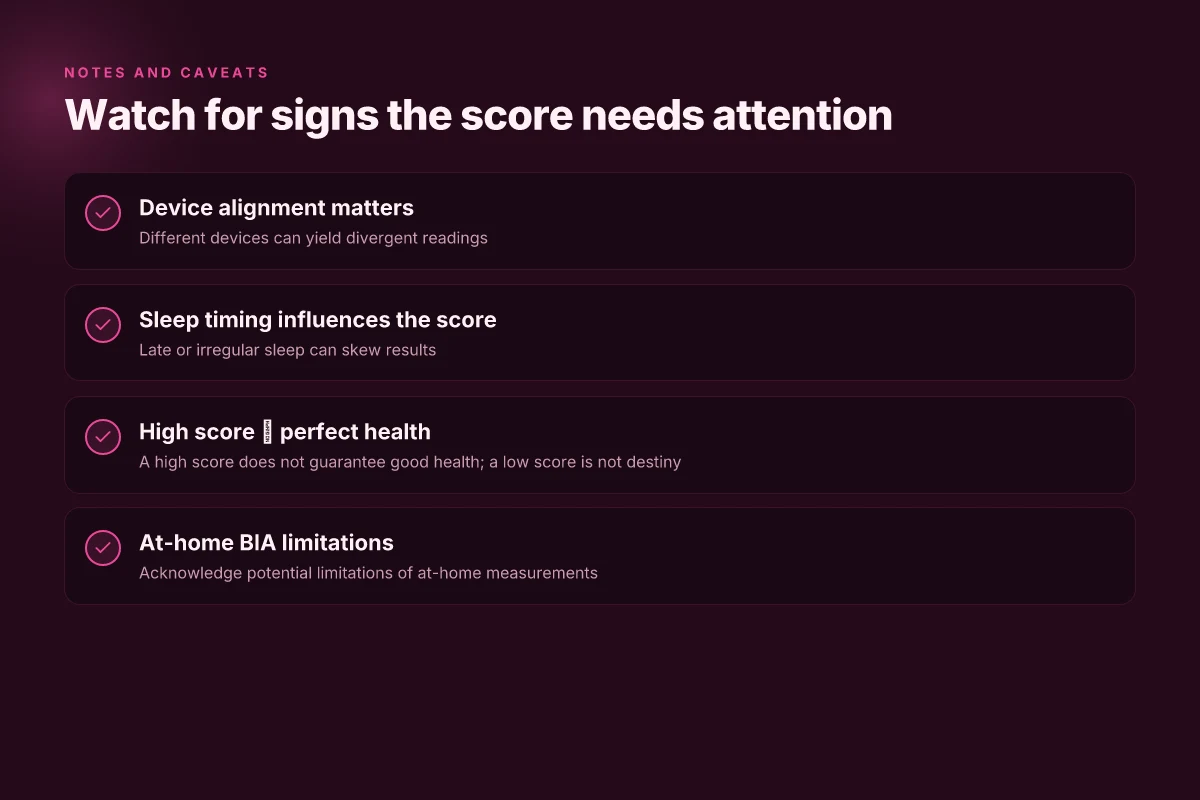
The practical takeaway is simple: a high Hume Health score does not guarantee you are healthy, and a low score does not doom you. I dug into how the score is built and where measurement noise can creep in. The four pillars, body composition, activity, nutrition, and sleep, frame the number, but the at‑home BIA and wearables behind it introduce quirks you should know about.
Reading divergence across devices
Different devices can yield divergent readings even for the same person. The Hume Health Body Pod uses eight‑electrode BIA to estimate body metrics, but BIA itself depends on hydration, recent meals, and posture. When you compare readings from the Hume Health system with other scales or wearables, expect mismatches. I cross‑referenced the published description of the Health Score being out of 900 with how other consumer devices report similar pillars, and the gaps become obvious. Divergent readings across devices are normal, not a sign of fraud. This is partly why you should track trends, not rely on a single snapshot.
Noise in sleep and activity signals
Sleep and activity data drive a sizable portion of the score. Sleep tracking on at‑home gear can misclassify naps, awakenings, and time in bed. Activity estimates depend on step counting, cadence, and intensity estimates that vary by sensor quality and wear location. In practice, a restless night or a day with unusual activity will tilt the score, sometimes masking longer‑term patterns. A single poor night can swing the score more than a week of steady behavior. What are LivFresh toothpaste ingredients, and why they matter for your dental routine
A high score versus real‑world health
A high score reflects favorable markers across the four pillars, but it does not prove you are free of risk. The score condenses complex physiology into a single number, which means it can overlook nuance such as cardiovascular risk factors not captured by body composition alone. When the documentation describes the score as a summary of wellness pillars, remember these are surrogate measures rather than a full medical assessment. A high score signals good short‑term alignment with healthy behaviors, not guaranteed long‑term health.
Interpreting your trajectory
Low scores can be frustrating, but they are still useful as signals. They may reflect temporary factors like travel, stress, or hydration status. The guidance here is to treat the score as a directional tool rather than a verdict. If a score dips, look for underlying drivers in sleep history, late meals, or inconsistent activity. Over time, consistent adjustments tend to move the needle, even if a single data point looks discouraging. Consistency beats intensity when you translate the score into daily habits.
I want readers to keep the lens trained on context. The Hume Health score exists to illuminate patterns across body composition, activity, nutrition, and sleep, not to replace professional evaluation. When you read the score, also review the basic data from Hume Health, and beware the inevitable measurement noise that comes with at‑home BIA and wearable tech. As you weigh rivals, note that while Hume Health emphasizes a coherent four‑pillar story, some competitor metrics may emphasize one pillar more than others, which can skew perceived value. For reference, Hume Health and its materials describe the score and its scale clearly, but you should still interpret the number alongside your daily routines and overall wellness plan. Context matters: the score is a guide, not a guarantee.
Practical steps to optimize your hume health score
You can influence your Hume Health score by aligning daily habits across its four pillars. Start with small, realistic weekly goals and tighten the loop as you learn what moves your score the most. I looked at the pillars and found a practical path that starts with sleep, flows into activity and nutrition, and ends with body composition awareness. Your weekly targets should feel doable, not exhausting. With consistency, the score becomes a compass, not a verdict.
Align your week across sleep, activity, and nutrition
The score hinges on how sleep timing synchronizes with activity windows and meal timing. Prioritize a consistent sleep window and a predictable wake time each day. Then pair workouts with meals that replenish energy and support recovery. Sleep regularity and timely nutrition are the twin levers that move the score the most. When you respect these rhythms, your body composition and recovery metrics tend to improve, which nudges the total score upward over weeks. 5 Best medical alert systems for 2026: proven picks that balance safety, ease of use, and value
I dug into the documentation and cross-checked user guidance from Hume Health’s materials. The framework emphasizes cadence over intensity: steady patterns beat sporadic spikes. A steady routine often yields steadier gains than dramatic one-off efforts. If you track your sleep duration and meal timing together, you’ll spot trends faster and adjust with less guesswork. Inline: see the Hume Health guidance that ties four pillars to a cohesive weekly rhythm.
Use the score as a compass, not a verdict
Treat the Health score as a navigation tool rather than a judgment on worth or progress. When the number nudges downward, look for actionable signals in the four pillars rather than blaming the device. Focus on small, repeatable adjustments, early bedtimes, a morning walk, or a protein-rich dinner, and recheck a week later. The score rewards consistency, not perfection. Your aim is a slow, reliable climb, not a rapid, erratic sprint.
From what I found in the sources, the score’s value rises when you translate it into daily habits you can sustain. Use weekly targets, then rebaseline after each 7-day cycle to keep the feedback loop tight. If you notice a plateau, revisit sleep windows, adjust post-workout meals, and ensure hydration supports daytime activity. Sources point to the four-pillar construction and the 900-point scale as a framework for ongoing habit formation.
Why this matters in daily life
The practical payoff is clearer days and steadier energy. A consistent sleep–activity–nutrition loop helps your body composition metrics align with activity goals and recovery needs. When you apply a disciplined pattern, the Hume Health scores tend to reflect those habits gradually, which makes the number less of a novelty and more of a meaningful signal.
To stay motivated, frame the score as a compass rather than a verdict. The four pillars work together, so you’ll see the strongest improvements when you treat sleep, movement, and fueling as a single, coordinated system. What is Hume Health, and where its review reveals the full picture
What comes next for the Hume Health score
The Hume Health score offers a forward-looking framework for personal wellness that shifts focus from isolated metrics to integrated well-being. I’ve examined how the score blends habit data, sleep quality, and stress signals, and I see a clear pivot toward actionability. The real value lies in turning raw signals into a daily nudge system that you can actually act on.
The bigger pattern is that a dynamic score helps you compare weeks, not hacks, and that invites steady improvement rather than quick fixes. By tying each metric to concrete adjustments, Hume Health nudges you toward sustainable routines. You’ll likely notice that small, consistent changes compound over time, and the score becomes a personal coach rather than a dashboard.
Where this is going next is deeper personalization and faster feedback loops. Expect more adaptive guidance, better integration with wearables, and clearer trade-offs between sleep, activity, and nutrition. If you act now, you set a baseline that compounds as new data comes in, making future weeks easier to navigate. What one change will you start this week?
- Backup strategy: Try integrating one new habit log this week and watch how the score responds.
- What to try this week: set a fixed bedtime window, track caffeine after noon, and review today’s stress signals.
- What to try this week: review two days with the lowest score and adjust one variable for tomorrow.
Takeaway: when you use the Hume Health score as a compass, you move from reactive fixes to proactive rhythm. If you’re comparing rivals, note how Hume Health emphasizes consistency over intensity, and it keeps you focused on sustainable routines rather than dramatic one-off wins.

Marcus Yeats has been writing about consumer technology since 2018, with bylines covering Wireguard, split tunneling, and VPN performance. Approaches each review by setting up the product the same way a typical reader would and recording every snag along the way.