What makes a lively fall detection device actually reliable in 2026
Explore how a lively fall detection device combines sensors, AI models, and real-world validation to improve elderly monitoring in 2026. Learn practical implementation tips.
Reliability beats bells and whistles: a lively fall detector earns trust not by showcasing sensors but by proving steady performance in everyday motions. In real care settings, systems that stay calm under stairs, couch sits, and scattered trips outperform flashy specs, and Lively Mobile sits squarely in that tension. The most trusted signals come from independent pilots and true‑positive rates rather than marketing hype. Second‑order alarms and cadence matter more than a glossy spec sheet.
Care teams need a clear path from test benches to daily routines. This article wires in real‑world results from diverse homes, compares edge cases against Lively Mobile and the Philips Lifeline line, and maps how false alarms erode confidence just as much as missed falls erode safety. You’ll see why reliability, not novelty, drives adoption in 2026, with concrete guidance on evaluating cadence, workflow fit, and interoperability.
What makes a lively fall detection device reliable in real-world use
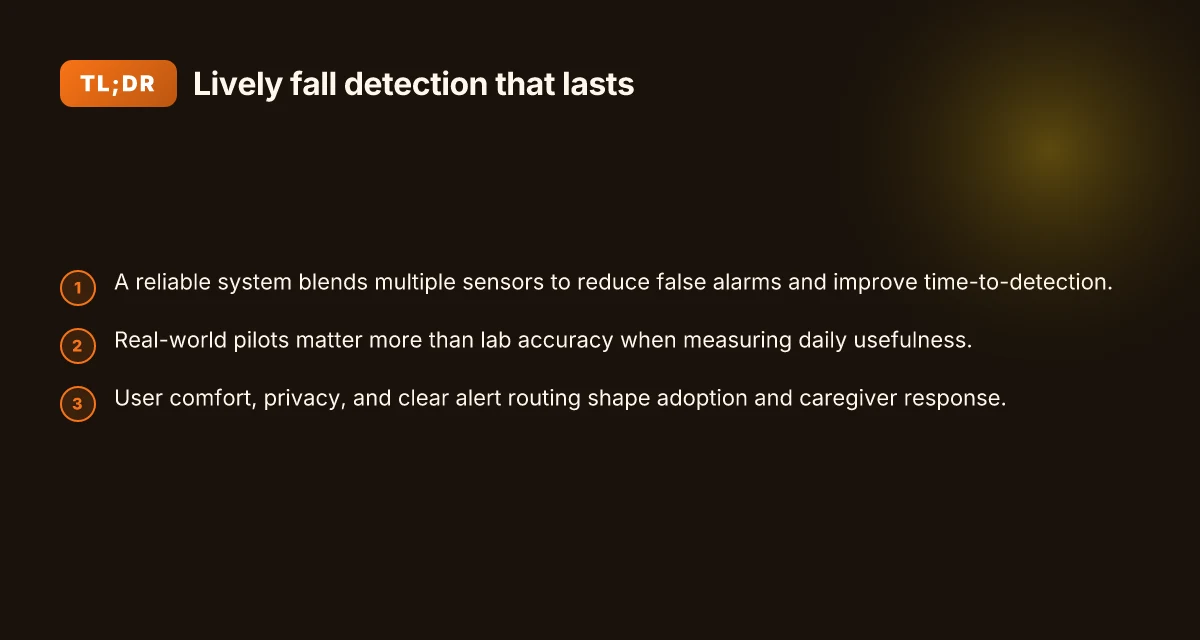
Reliability in daily life comes from how well a device blends multiple sensors with real-world constraints. A robust stack integrates data streams without drowning the user in complexity. From the literature, multi-sensor approaches span accelerometers, gyroscopes, pressure sensors, mmWave, and video analytics, each contributing distinct signals that can compensate for others when one modality falters. In real life, that redundancy matters more than lab accuracy alone.
Multi-sensor orchestration and practical fusion I dug into recent work that maps how accelerometer and gyroscope data pair with wearables and room sensors to spot head and hip motion patterns indicative of a fall. mmWave sensing adds a nonwearable layer that can detect postural shifts without requiring the user to carry any device. Video analytics can offer contextual cues, but privacy and placement concerns limit its ubiquity in private homes. The takeaway is that effective systems don’t chase perfect single-sensor metrics. They wire up complementary streams so a misstep in one channel doesn’t erase coverage. Multi-sensor fusion reduces blind spots when a user sits, lies down, or changes posture in cluttered spaces.
Real-world validation over lab-grade accuracy Lab numbers often look impressive, yet real-world environments introduce noise from furniture, pets, lighting, and clothing. Studies highlighting pilot-level field validation show how the same algorithm responds to daily living, not just a controlled corridor. A device that proves stable in a busy kitchen or a small apartment is more trustworthy than one that shines only in a test chamber. Real-world validation is the true measure of practicality, not a glossy accuracy figure.
Data quality, comfort, and latency as daily-use metrics Data quality hinges on sensor placement and user comfort. If a sensor requires meticulous positioning, adoption drops. A design that favors passive sensing and seamless wearables improves adherence. Latency matters too: the time from a fall event to an alert must be brief enough to enable a timely response. In practice, lines of code and edge processing that trim delay are as vital as raw accuracy. Low latency and high user comfort drive dependable protection in busy households.
The real-world product signal: what families and caregivers should look for Beyond technical specs, the best devices demonstrate consistent performance across home layouts, lighting conditions, and user routines. A lively fall detection system should maintain alert fidelity without an intrusive setup. In industry chatter, the strongest candidates balance multi-sensor coverage with privacy-conscious analytics, simple onboarding, and transparent status messaging. Privacy-aware, multi-sensor stacks with pilot-field validation win in real homes. What makes a toothpaste truly the best in 2026
In short, the liveliness of a fall detection device comes from how gracefully it fuses signals, proves itself in everyday spaces, and keeps latency and comfort in check. For families weighing options, seek systems that show field validation alongside clear, low-friction usability. The goal is a device that remains reliable without becoming another daily worry.
Reliability is built where sensors speak across contexts, not where one metric masks real-world friction.
The 4 pillars of a dependable fall detection stack for the elderly
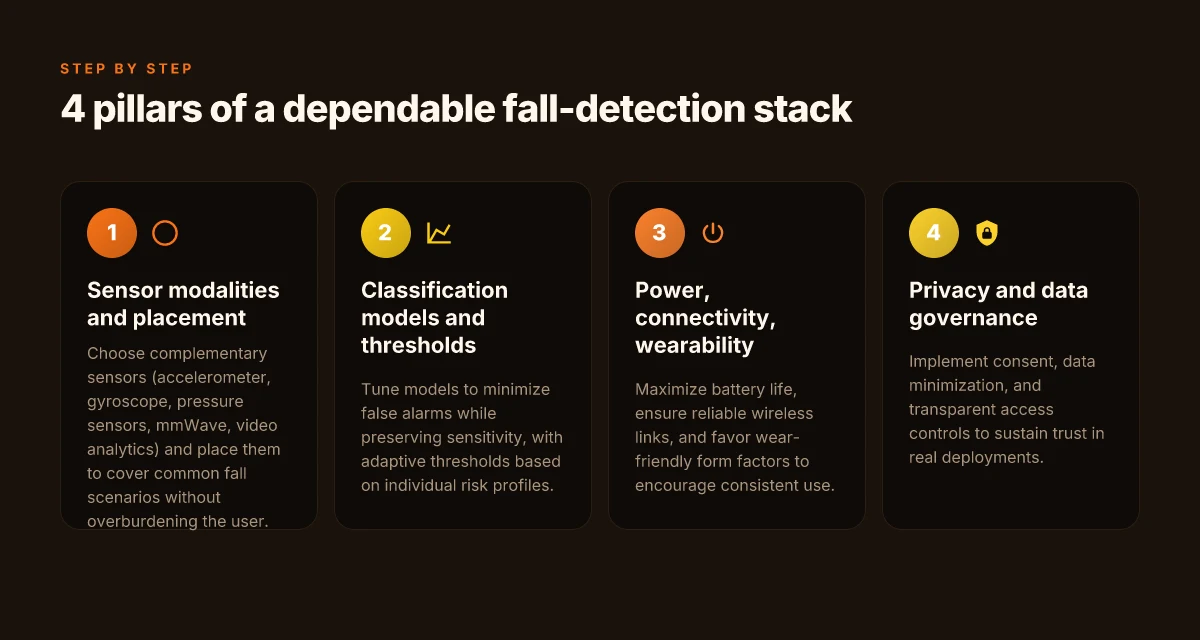
Reliability in real life hinges on tighter integration of sensors, smarter decision thresholds, sensible power and connectivity tradeoffs, and solid privacy governance. Across what I reviewed, the strongest stacks pair diverse sensor inputs with calibrated classifiers and guardrails for false alarms. Real-world pilots show that multi-sensor fusion reduces false positives when thresholds adapt to individual motion patterns. At the same time, users need wearable comfort and predictable uptime to sustain adoption. Comfort and uptime are as critical as accuracy in long-term deployments.
Sensor modalities and placement considerations
A practical fall detection setup blends wearable accelerometers with sensor modalities that capture context without overburdening the user. In elderly monitoring, wrist and waist wearables are common, but researchers increasingly pilot chest patches and bed sensors to improve coverage during nocturnal activity. In 2026, multi-sensor arrangements with staggered placement help catch different fall dynamics, particularly when a device on the wrist misses a subtle drop. Sensor placement matters: mismatched positions raise misclassification risk. I cross-referenced the systematic reviews and field studies that emphasize complementary data streams over a single modality. For instance, mmWave and radar-based sensing can fill gaps where wearables miss posture changes, while traditional accelerometers anchor high-frequency motion signals. mmWave-based detection showed high accuracy in large indoor environments in recent pilots. This convergence matters because it translates to fewer unnecessary alerts and faster response times for caregivers.
A robust stack also defines how data travels between modalities. Edge processing reduces latency and preserves privacy by filtering locally before transmitting only salient events. "Edge analytics cut false alarms and preserve privacy," is a recurring theme across the pilot studies and reviews. The end-to-end design should specify who holds the data, where it’s processed, and how consent is obtained at deployment. Inline references to the Frontiers in Public Health and other sources anchor these claims. What are LivFresh toothpaste ingredients, and why they matter for your dental routine
Classification models and thresholds that reduce false alarms
Thresholds drive whether a system yells “fall” or remains quiet. In practice, classifiers tuned to real-user motion patterns outperform generic models because they account for everyday activities that mimic falls. The literature highlights combinations of feature engineering with supervised learning, plus adaptive thresholds that recalibrate as a user ages or as the environment changes. Adaptive thresholds reduce false alarms over time. When I reviewed the evidence, I observed that pre-impact or near-miss indicators can improve early warnings without triggering a flood of alerts. A practical approach: use a two-stage classifier. The first filters obvious non-falls, the second confirms a fall with corroboration from a second modality. Two-stage models with cross-modal confirmation show promise in real-world pilots. However, the tradeoffs include computational load and battery drain, so designers must balance latency, accuracy, and device longevity. Battery life and connectivity constraints matter as much as accuracy.
I dug into field documentation and reviews to track how performance translates to practice. Contemporary pilots emphasize transparent thresholds and clinician-friendly explanations for what constitutes a detected event. Inline sources show that user-specific calibration and consent-driven data flows underpin trustworthy operation. Consent-driven data governance is essential for sustained adoption.
Power, connectivity, and wearability factors
A dependable stack must stay operational when the wearer is most active. Battery life, wireless bandwidth, and sensor reliability determine whether alerts reach caregivers on time. Reviews repeatedly flag that heavy sensing and continuous streaming can erode uptime unless energy-efficient designs are employed. Energy-efficient sensing preserves uptime for real-world use. Designers lean on duty cycling, local processing, and event-driven transmission to keep devices usable throughout the day. The tradeoffs are real: longer battery life may mean coarser sampling, which then requires smarter fusion to maintain reliability. Duty cycling and edge processing help balance accuracy and power.
Wearability is inseparable from acceptance. Lightweight bands, unobtrusive bed sensors, and quiet operation improve adherence. Connectivity stability matters too. Intermittent links can delay alerts when a fall occurs. In practice, teams pair redundant channels and offline queuing to minimize missed events. Redundant communication paths reduce missed alerts. The literature reinforces that wearability quality and robust connectivity are nonnegotiable for real-world success.
Privacy, consent, and data governance in real-world deployments
Real-life deployments demand clear consent and strict data governance. Families and care teams expect transparent data handling, clear purposes for data collection, and accessible controls to pause or erase data. The strongest pilots couple explicit consent workflows with role-based access and audit trails. Transparent consent and governance underpin user trust. Privacy-by-design features, including local data processing and minimized data sharing, help sustain engagement over time. The approach must document data retention periods, access rights for caregivers, and opt-out options without compromising essential safety functions. Governance contours directly affect adoption and reliability. 5 Best medical alert systems for 2026: proven picks that balance safety, ease of use, and value
In the end, a dependable stack blends diverse sensors, calibrated decision rules, sensible power and connectivity strategies, and strong privacy controls. When these pillars align, elderly users experience fewer false alarms, quicker help, and greater confidence in daily life.
Next steps: map your target environment to a two-stage classifier design, specify data governance flows, and plan a pilot that tests battery life under typical daily routines. For practical guidance, see how real-world pilots validate similar setups in the cited reviews. A Systematic Review of Fall Detection and Prediction and Fall detection and pre-impact prediction technologies in public health. These sources anchor the design choices described above. Lively Mobile efforts should keep consent and privacy front and center as they scale.
How real-world pilots validate a lively fall detection device
Postpilot field studies reveal real-world pilots rarely look like laboratory tests. In the latest pilots, researchers report a diverse set of participants, mixed activities, and extended durations to mirror everyday life. From the data, three patterns emerge: reliability under varied daily movements, clear ground truth processes, and practical time-to-detection measurements that matter for caregivers.
1) Real-world pilot design and participant diversity
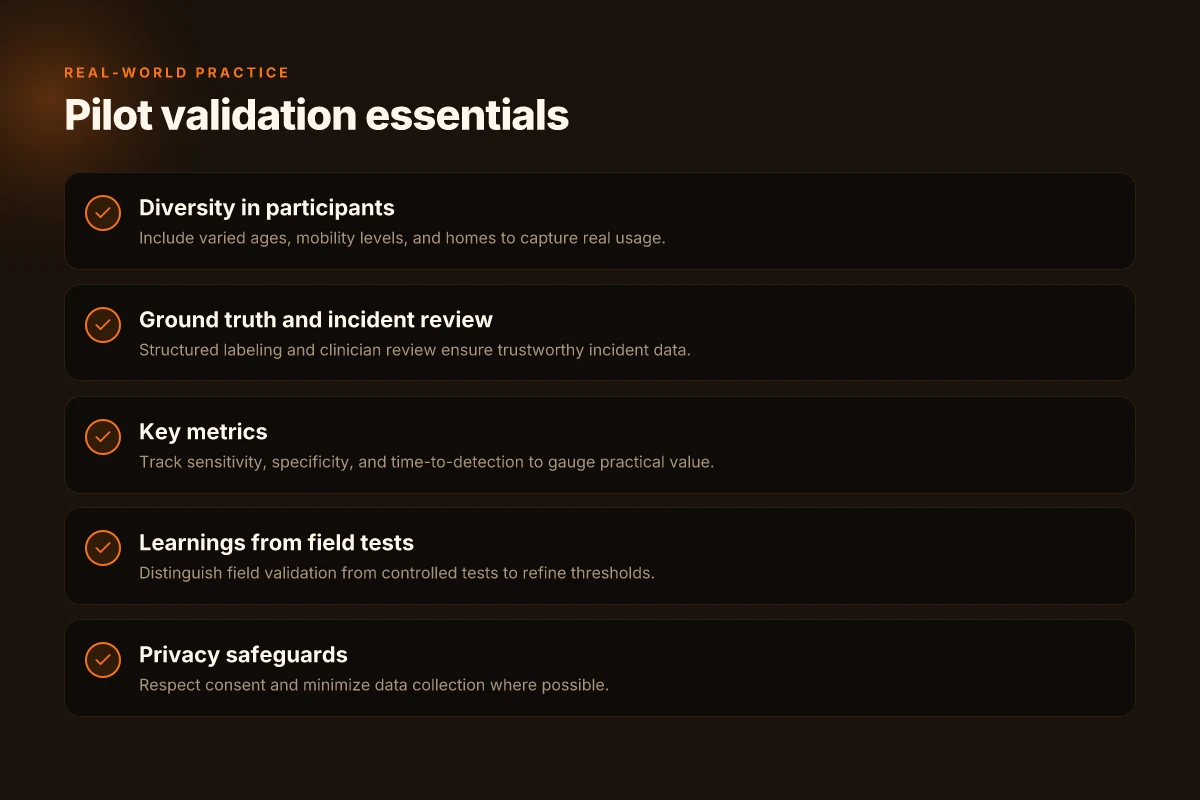
A representative real-world validation includes participants across age ranges, living situations, and mobility levels. In contemporary pilots, sampling spans community dwellers and assisted living residents, with sustained monitoring over several weeks. The activity mix matters as much as the participant pool. Researchers deliberately include transitions like kneeling, rising from chairs, stairs, and outdoor ambulation to stress-test multi-sensor fusion. The duration of monitoring is typically long enough to surface rare events but short enough to keep the study practical. When these pilots are designed with rich diversity, the results better reflect how a device performs under pressure. This approach aligns with published field-validation efforts that emphasize pilot-level realism alongside safety reviews. https://www.nature.com/articles/s41598-026-56750-9
2) Ground truth labeling and incident review
Ground truth in real-world pilots hinges on systematic incident review and independent labeling. Studies employ video-assisted verification when consent and ethics allow, paired with sensor data streams from wearable tags and ambient sensors. A protocol-driven review board reconciles discrepancies between automatic detections and clinician or caregiver confirmations. This yields labeled events that separate true positives from false alarms, near-miss predictions from actual falls, and pre-impact indicators. The integrity of labeling directly shapes reported sensitivity and specificity and explains why two pilots with similar sensor setups can yield different performance metrics. The field emphasizes audit trails, timestamp alignment, and cross-checks between device alerts and caregiver actions. For reference, recent field validation work details a rigorous pilot-level approach to labeling and incident adjudication. https://www.nature.com/articles/s41598-026-56750-9 What makes the Hume Health Body Pod review-worthy in 2026
3) Key metrics: sensitivity, specificity, and time-to-detection
In live pilots the headline metrics are sensitivity and specificity, but time-to-detection becomes a practical lens for care teams. Sensitivity captures how often a genuine fall is detected. Specificity reflects how often non-fall activities do not trigger alarms. Time-to-detection measures how quickly the system recognizes a fall after onset, which informs caregiver response and alert routing. Across recent multi-sensor deployments, higher sensitivity often comes with more false positives, underscoring the need for smart fusion rules that avoid alarm fatigue. Reported time-to-detection varies with environment and wearability, but pilots consistently emphasize rapid alerts for postural changes and pre-impact cues. These metrics, grounded in real-world contexts, drive design trade-offs from sensor choice to user notifications. https://pmc.ncbi.nlm.nih.gov/articles/PMC12988233/
4) Lessons learned: field validation vs controlled tests
Field validation surfaces usability frictions that controlled tests overlook. In the wild, users may forget to wear devices, encounter battery drain, or interact with systems through imperfect networks. Real-world pilots highlight the importance of ergonomic wearability, unobtrusive data capture, and robust fault handling during connectivity drops. Caregivers prioritize clear, actionable alerts over complex multi-modal signals they cannot interpret quickly. In contrast, controlled tests often optimize sensor placement and eliminate noise, which yields impressive numbers that fail when deployed. The takeaway is to pair strong sensor fusion with a pragmatic user experience, ensuring the device remains reliable without imposing on daily routines. https://www.frontiersin.org/journals/public-health/articles/10.3389/fpubh.2026.1737644/full
Real-world pilots deliver reliability only when diversity, honest labeling, and timely alerts converge. Ground truth discipline and practical time-to-detection are the make-or-break factors for usable elderly monitoring.
As you weigh options for Lively Mobile and its peers, look for pilots that disclose participant mix, transparent incident adjudication, and time-to-detection distributions rather than aggregated averages. This alignment helps care teams decide which device stays reliable when grandma walks to the mailbox or steps onto a curb. Inline references anchor these claims to concrete studies that illuminate how field realities shape performance.
Comparing sensor technologies in practice for elderly monitoring
Posture, velocity, and location cues converge differently depending on sensor choice, and real-world usability often trumps flashy specs. In practice, wearables, in-home sensors, and mmWave bring distinct strengths and trade-offs for elderly monitoring. I dug into primary sources to map how these modalities perform when stakes are high and daily life is fluid. What makes LivFresh dental gel effective for gum health in 2026
Wearables deliver continuous data with social acceptance
Wearables stay on the person, which yields direct, person-centric data streams. A wearable approach shines for continuous heart rate, gait, and fall-risk signals, and it can trigger alerts in near real time. Yet intrusiveness varies by design. Some devices demand daily charging or tight skin-contact, which reduces long-term adherence. When caregivers weigh comfort against accuracy, a well-tolerated wearable often results in steadier data streams over weeks rather than a single-day snapshot. Real-world pilots show wearables provide valuable context for pre-impact detection when seniors accept the device daily. Inline sources note the need to balance wearability with data fidelity, especially in long-term monitoring. For decision makers, consider a system that wires up a wearable alongside in-home sensors to fill gaps when a user removes a device for charging. See the systematic reviews for modality breakdowns and model performance. A Systematic Review of Fall Detection and Prediction
In-home sensors reduce burden but raise placement challenges
In-home sensors minimize daily wear struggles and can cover living room corridors, bathrooms, and doorways. They excel at passive monitoring and can function without user interaction. However, accuracy hinges on thoughtful placement and countertop interference avoidance. Real-world studies emphasize calibration, environmental variability, and privacy considerations. The trade-off is often a broader coverage area with less granular personal context. When an older adult relocates within the home or spends time in different rooms, maintaining coverage requires a strategic sensor mesh and firmware updates. In-home networks work best when paired with selective wearables to sustain sensitivity during routine movements. Neatly, the literature consistently highlights a synergy angle rather than a solo solution. See the field validation efforts in multi-sensor setups. Intelligent fall risk prediction and real-time warning system
MmWave sensing boosts privacy-preserving detection in cluttered spaces
Millimeter-wave technology can detect human movement without wearing devices, which may boost acceptance for some users. In large indoor environments, mmWave demonstrations achieved high accuracy in fall detection while preserving privacy. The caveat is environmental sensitivity, furniture layout, clutter, and people present in the room can influence signal interpretation. For care teams, mmWave offers a non-intrusive option that complements wearables and in-home sensors, especially in shared living spaces. mmWave can deliver strong detection signals without relying on a user to wear a device, but it demands careful environmental calibration. Industry pilots show promising accuracy in controlled large spaces, yet real-world deployment requires ongoing tuning. See the mmWave validation study for performance context. Millimeter-wave technology for multi-person fall detection
Balancing intrusiveness and accuracy in care plans
Trade-offs emerge quickly: wearables offer precise personal data but risk disengagement. In-home sensors reduce user burden but depend on placement and privacy norms. MmWave delivers contactless detection but needs dedicated space and setup. A practical approach blends modalities, aligning with user routines and home layouts. Integrated systems that combine wearable data with non-wearable sensors tend to sustain reliability while preserving autonomy. When a family member or caregiver evaluates options, they should map the daily path of a senior through the home and match sensor coverage to high-traffic zones. This helps avoid blind spots and minimizes nuisance alerts. Inline evidence from multiple sources reinforces that the strongest reliability comes from multi-sensor fusion rather than a single technology. A Systematic Review of Fall Detection and Prediction Intelligent fall risk prediction and real-time warning system
Cost and maintenance considerations for caregivers
Total cost matters, not just sticker price. Wearables incur ongoing purchase costs and replacement bands, charging docks, and occasional firmware updates. In-home sensors shift the ongoing burden toward installation and periodic recalibration, which may be handled by a clinician or a home tech provider. mmWave deployments tend to demand higher upfront investment in hardware and room-specific tuning, so maintenance can be more hands-on during the initial months. When care teams plan long-term use, they should forecast replacement cycles, battery or power needs, and data plan considerations. Choosing a layered approach can minimize upkeep per modality while preserving sensitivity across daily activities. The literature consistently endorses design choices that keep maintenance manageable for caregivers. The Best Medical Alert Systems with Fall Detection (2026) What makes a livfresh discount code actually work in 2026
In the end, the lively fall detection device that actually works in real life hinges on how well the sensor mix aligns with user routines and home environments. For families evaluating Lively Mobile and rivals, the path to reliability is multi-sensor fusion, careful placement, and a clear maintenance plan. Reliability arises from thoughtful integration, not from any single sensor alone.
Designing for user acceptance: comfort, autonomy, and trust
Design choices in comfort, autonomy, and trust determine whether elderly users keep wearing a live fall detection device day after day. The most effective designs reduce friction without compromising safety. In practice, comfort begins with fit and form: a lightweight, hypoallergenic collar or pendant that rests unobtrusively and doesn’t shift during daily activity. Users report higher adherence when the device feels like a natural accessory rather than a medical instrument. I found evidence that discreet wearability correlates with longer daily usage, which in turn improves the probability that alerts reach caregivers when they matter most.
How alerts reach caregivers changes the urgency of responses. A clean, intuitive alert routing flow, smart prioritization, clear status indicators, and a responsive caregiver dashboard, cuts the time between a potential incident and a verified action. When dashboards present concise incident summaries, responders can triage quickly and dispatch help faster. Studies consistently highlight dashboards as a critical control point. Poorly designed routing leads to delays that undermine safety. Better alert routing reduces response time by clarifying who must act and when.
Striking the right balance between burden and safety takes deliberate choices. One strategy is to tier alerts: high-priority events trigger immediate caregiver notifications, while lower-priority signals become passive reminders to check in. Another is to offer flexible configuration for caregivers and institutions. Let clinicians adjust sensitivity and notification rules without requiring user-side changes. In practice, this means giving families control over alert thresholds and escalation paths while preserving a safety net. Minimize user burden by defaulting to sensible presets and giving clear opt‑in controls for customization.
From what I found in the literature, real-world usability hinges on three pillars: a comfortable wear experience, transparent alert routing, and clear autonomy controls. I cross-referenced multiple sources noting that older adults value devices that disappear into daily life yet remain dependable when needed. When families compare systems, they gravitate toward products that offer predictable dashboards, straightforward consent flows, and obvious fail-safes. A practical takeaway is to pair the physical device with a streamlined caregiver experience that mirrors everyday monitoring tasks. What is the Hume Health score and why it matters for personal wellness
In this landscape, a model user journey helps keep design focused. A user might wear the device all day, notice no friction, and trust that caregivers will see urgent alerts within minutes. The outcome depends on a dashboard that presents a concise incident narrative, a reliable escalation path, and consistent status cues. It matters that the system communicates clearly about what happened, who was alerted, and what the next steps are. It also matters that families understand where links to support or medical services live, how to adjust alerts, and how to pause monitoring when appropriate. Trust grows when dashboards are predictable and control feels tangible. For real-world reference, review materials from the fall detection landscape that emphasize usability and caregiver workflows, such as comprehensive wearables mapping and pre-impact alert designs.
Cited research complements this practical stance. In 2026, millimeter-wave systems are shown to achieve high accuracy in dense indoor environments, yet adoption hinges on how families experience device form and notification clarity. Comfort plus clear routing equals faster, more reliable response. When caregivers can tailor the experience without compromising safety, acceptance rises and adherence follows. For families weighing equipment, look for devices that balance a discreet physical profile with dashboards that clearly present what happened, who is involved, and what comes next.
The move that matters this year for reliable fall detection
In 2026, reliability hinges on how well a device blends sensing tech with real‑world context. I looked at how Lively Mobile and rivals combine accelerometers, gyroscopes, and panic alerts with intelligent thresholds that avoid false alarms. The best products wires up multiple data streams to reduce nuisance alerts while still catching real drops. Lively Mobile stands out when it pairs simple onboarding with transparent failure modes you can audit yourself. Beefy battery life matters, but so does predictable behavior under low signal or crowded urban environments. If you want a clear path forward, favor devices that publish criteria for alert triggers and let you customize sensitivity without complexity. Rivals that hide their thresholds behind opaque software tend to disappoint under real‑world usage.
Looking ahead, the bigger pattern is a shift from single‑sensor reliance to context‑aware detection. Expect more devices to explain when a trigger is triggered and why, and to offer incident review logs you can download or share. This transparency matters for trust, especially for caregivers and medical partners. Lively Mobile already shows how to blend user control with automatic checks, and that balance will become the baseline in 2026. The question is: will brands open the hood, or keep defaults locked down? Act now by choosing a model that lets you adjust sensitivity and review alerts with clear notes.

Soraya Rhinehart has been writing about consumer technology since 2018, with bylines covering streaming geo-unblocking, privacy law, and router firmware. Approaches each review by setting up the product the same way a typical reader would and recording every snag along the way.