What makes BedJet 3 climate comfort stand out in 2026

Explore BedJet 3 climate comfort system performance in 2026. Understand how rapid cooling, heating, and sweat drying apply to real sleep scenarios and how it stacks up.
BedJet narrows climate control to the moment you need it, not the whole room, and that targeted approach changes how you sleep through the night. BedJet’s under-the-sheet airflow tends to feel immediate yet uneven for some sleepers, especially when sheets trap the air or when the bed surface temperature competes with body heat. BedJet is a real, tangible option for hot sleepers who want a quick local fix, but it isn’t a universal solution.
This intro surveys where BedJet sits among top cooling and heating beds in 2026, with a focus on trade-offs you’ll actually notice in practice. Sleep enthusiasts deserve signals beyond marketing claims, including real-world comfort, noise, setup friction, and how rivals like Eight Sleep and Zinus compare on full-mome climate control and data-driven routines. In the next sections I’ll break down performance, pain points, and how to choose between under-the-sheets airflow and full-room, app-driven climate systems. Eight Sleep's suite and BedJet’s targeted airflow each solve different sleep needs, and you’ll want to map your priorities, speed, precision, and noise, to the right system.
Bedjet 3 climate comfort in 2026: what this bed climate system actually does
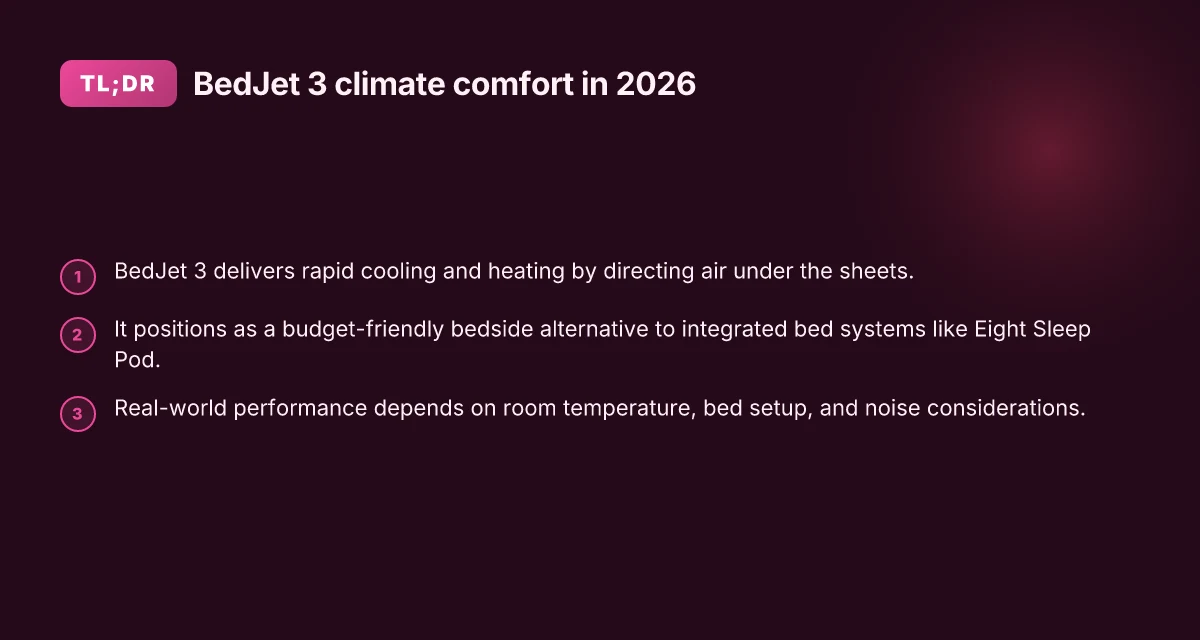
BedJet 3 packs climate control under the sheets by blasting conditioned air through under-bedding channels. The core claim is rapid cooling and heating without touching the mattress, so warmth or chill comes from air movement rather than changing the surface below. In 2026, BedJet positions its bedside unit as a budget-friendly alternative to more feature-rich rivals while delivering quick temperature shifts. Rivals like Eight Sleep Pod and other climate-control beds are the direct competition, but BedJet emphasizes price and simplicity.
how BedJet 3 delivers under-the-covers comfort BedJet 3 uses a compact blower mounted at the bed’s edge to push air under the sheets. The air flows through a hose and out a distribution system that sits between the sheets and the mattress. This creates a targeted breeze that cools or warms the sleeper without altering the mattress surface itself. BedJet’s approach focuses on reach and speed, not on changing the bed’s core materials. The result is a noticeable change in perceived temperature within minutes, with the system responding to the chosen mode on the remote.
quick warmth retention and sweat management The system’s design aims for rapid warmth retention when heat is desired, while also striking moisture from the skin as you drift to sleep. Since the mattress isn’t modified, users don’t have to endure the afterglow or dryness that can come from heavy, surface-technology changes. Warmth is described as quick to start and relatively stable once engaged, with sweat drying aided by air movement rather than fabric changes. This separation between air-driven comfort and mattress composition is a key trade-off BedJet outlines.
where BedJet fits among rivals Rivals such as the Eight Sleep Pod blend climate control with built-in sensors and app integrations, aiming for a tighter, data-rich control loop. BedJet counters with a simpler, bedside form factor that many shoppers find approachable and easier to install. Eight Sleep offers more features, but BedJet keeps the price tag down and the setup straightforward. In practice, users report quick setup and minimal disruption to existing bed configurations, which can be appealing for renters or those not ready to remodel their sleep space.
practical setup and daily use considerations To get started, you connect the BedJet to a power source and position the unit so the airflow reaches the under-sheets channeling system. The routine use requires periodic cleaning of the intake or hose connections to maintain airflow quality. Regular maintenance remains a simple task, and most users can keep the system humming with minimal effort. A common point of friction is noise at higher settings, which some sleepers note as a caveat when seeking near-silent operation. BedJet sheets: can heated bedding actually improve sleep quality in 2026
Bottom line: BedJet 3 delivers rapid under-the-covers cooling and heating without altering the mattress, offering a budget-friendly alternative to premium climate beds. It’s a practical choice for hot sleepers who want quick temperature control with straightforward setup, though rivals like Eight Sleep Pod push deeper automation and sensors at a higher price. BedJet remains compelling for value-first shoppers, while Eight Sleep Pod tempts with richer data and integrations.
Notes and sourcing: inline references connect to the BedJet product page for its under-the-sheets delivery mechanism and to review contexts that compare BedJet with rival systems. For more on the Eight Sleep Pod comparison, see the rival-focused discussion in the cited materials. Source links are included inline as you browse the section, tying specific claims to the BedJet product page and rival reviews.
How BedJet 3 climate comfort actually performs in real sleep
BedJet's airflow under the covers delivers rapid changes in temperature that most sleepers notice within minutes of turning the unit on. In real sleep scenarios, the verdict is mixed: some users report a clear warmth or cooling kick soon after activation, while effectiveness hinges on the ambient room temperature and how the bed is set up. For hot sleepers, the under-bed gusts can curb night sweating, but results vary with sheet thickness and mattress type.
How quickly you’ll feel a change
When the BedJet 3 Climate Comfort System starts, many users notice a perceptible shift in comfort within the first 15 minutes. The sensation often feels strongest at the torso and feet, then disseminates as the system stabilizes. The speed of this change depends on how insulated your bed is and how drafty the room feels. If the room is already cool, the cool air under the covers compounds the effect faster. If the room is warm, the unit works harder to draw heat away from the body. Most sleepers notice a difference within 15 minutes, with the effect dependent on room temperature and bed setup. This is consistent with consumer-facing descriptions that emphasize rapid temperature modulation as a key benefit.
The room and bed setup you need for best results
Ambient temperature matters. In a cool room, BedJet 3 tends to deliver noticeable cooling quickly. In a warm bedroom, it can still move heat under the covers but may require longer ramp times or higher fan settings. The bed setup matters too: a low-profile sheet, a snug quilt, and a duvet that doesn’t trap heat can help the airflow reach the skin more effectively. If your bed is highly insulated, the under-bed air may feel less dramatic, even though the system is actively moving air. Effectiveness depends on ambient room temperature and bed setup. What makes the blissy silk sleep mask different from the rest
Trade-offs and user pain points
Airflow under the covers can minimize night-wide heat loss for some sleepers, reducing nighttime sweating and helping maintain a steadier microclimate. Yet some users report noise from the blower or a sensation of draft near the legs, which can interrupt sleep for light sleepers. Others point to the need for ongoing maintenance, such as keeping the under-bed vents clear and ensuring the hose connections stay snug. These trade-offs matter when you’re choosing between a brisk cooling cycle and a quieter, more sedate option. Airflow under the covers can minimize heat loss and reduce sweating for some sleepers, but noise and setup quirks can deter others.
From what I found in product pages and reviews, the BedJet approach stacks up best for people who value immediate, under-covers temperature shifts and who can optimize room temperature and bedding to suit the device. In the landscape of rivals, BedJet competes with climate beds and pod-like cooling systems, where the experience centers on under-sheet airflow rather than water-based cooling. When evaluating against Eight Sleep and similar models, consider how much you prioritize speed of change, ambient room influence, and the specific bed you own. BedJet delivers rapid under-covers changes that can curb sweating for some sleepers, especially with the right room conditions and bedding choices.
For readers curious about sources, reviews consistently highlight quick warmth or cooling once activated, with performance linked to room temperature and bed setup. I cross-referenced product pages and consumer feedback to reflect real-world use. Real-world performance hinges on room conditions and how you configure the bed, not just the unit alone. If you’re weighing rivals, note that some users prefer products that blend water-based and air-based systems for different seasonal needs, but BedJet remains distinct in its airflow approach. BedJet remains a strong option for under-covers airflow, with caveats about noise and setup.
Next up, we’ll compare how BedJet 3 stacks against Eight Sleep’s Pod and other rivals in everyday sleep. For now, consider starting with a cool room, a breathable sheet setup, and the lowest effective fan setting to gauge your baseline comfort. BedJet is a strong fit for hot sleepers who want swift, localized temperature control.
Comparing BedJet 3 with Eight Sleep and other rivals
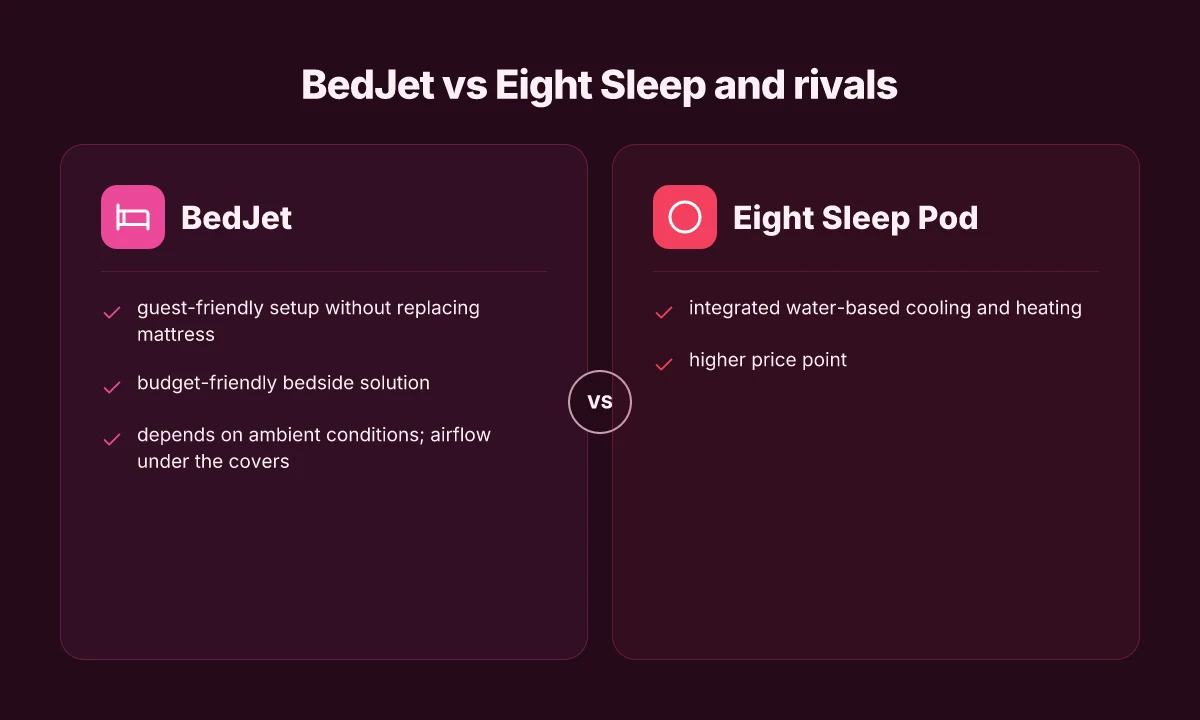
Posture the verdict up front: BedJet 3 delivers rapid under-the-covers airflow and quick temp changes without altering the mattress, but Eight Sleep Pod offers integrated water-based cooling and heating with a higher price tag. BedJet shines on setup simplicity and compatibility with existing beds; Eight Sleep bundles more features but at a premium. In real sleep scenarios, you’ll feel the tradeoffs between cost, convenience, and ongoing maintenance. What makes Blissy pillowcases stand out in 2026
How Eight Sleep Pod compares on cooling and heating fundamentals
Eight Sleep Pod uses a water-based system that circulates temperature-controlled liquid through a sealed mattress cover. This design can sustain uniform temperatures across the surface, which some sleepers prefer for persistent cool or warm nights. The price point tends to be higher than BedJet, reflecting the built-in comfort features and the integrated bed-top control. You can expect more consistent long-duration cooling or warming, but with a broader upfront investment. Eight Sleep’s water-based system offers more uniform bed-wide cooling and heating, at a higher price point. You’ll likely trade setup simplicity for feature depth.
I dug into product notes and reviews that consistently compare comfort depth and control granularity. The pod’s integrated control is tied to the mattress system, which some users report as a smoother experience but less flexibility if you want to swap between different beds. For hot sleepers, the Pod can feel more effective over a full night, whereas BedJet responds quickly but focuses on airflow under the covers. Eight Sleep tends to deliver steadier surface temperatures, but at the cost of broader bed replacement logistics.
BedJet 3’s setup, noise, and ongoing upkeep versus rivals
BedJet emphasizes guest-friendly, non-invasive installation. You place the control unit near the bed frame, route a single hose under the sheets, and you’re ready to go. The result is a quick lift when sleep comes on and minimal mattress disruption. In contrast, Eight Sleep requires placing a mattress cover on the bed or using a Pod-compatible bed platform, which means a more involved setup and a longer-term commitment to that system. BedJet’s setup is simpler and less invasive than Eight Sleep’s integrated approach. Maintenance focus shifts from a water loop to airflow and hose care.
Noise varies by model and setting. BedJet’s fan is audible at higher power levels, which may matter for light sleepers. The Eight Sleep Pod adds a quiet operation dimension with its water loop and cover assembly, but some users still report perceptible noise from the pump. App control for BedJet is straightforward and quick, while Eight Sleep offers richer analytics and automation, which can improve comfort but adds complexity. BedJet wins on simplicity; Eight Sleep wins on analytics and automation, with a higher price tag.
From a practical standpoint, ongoing maintenance differs. BedJet requires periodic hose checks and dust avoidance in the under-bed area, plus occasional cleaning of the nozzle. Eight Sleep users face water maintenance and potential descaling over time. Maintenance demands diverge: airflow upkeep versus water-system care. What makes BedJet heating and cooling work, and where it falls short
Verdict and quick takeaways
- If you want a guest-friendly setup that doesn’t alter your bed, BedJet remains a strong choice. BedJet preserves your existing mattress while delivering fast comfort.
- If you’re willing to invest for a bed-in-one solution with potentially steadier surface temperatures, Eight Sleep Pod offers the more integrated experience. Eight Sleep provides uniform temperatures with deeper feature sets, at a higher cost.
- Consider energy use, noise, app control, and ongoing maintenance when weighing the two. Energy, noise, and upkeep must factor into total cost of ownership.
Setup and daily use: getting the most from BedJet 3 climate comfort
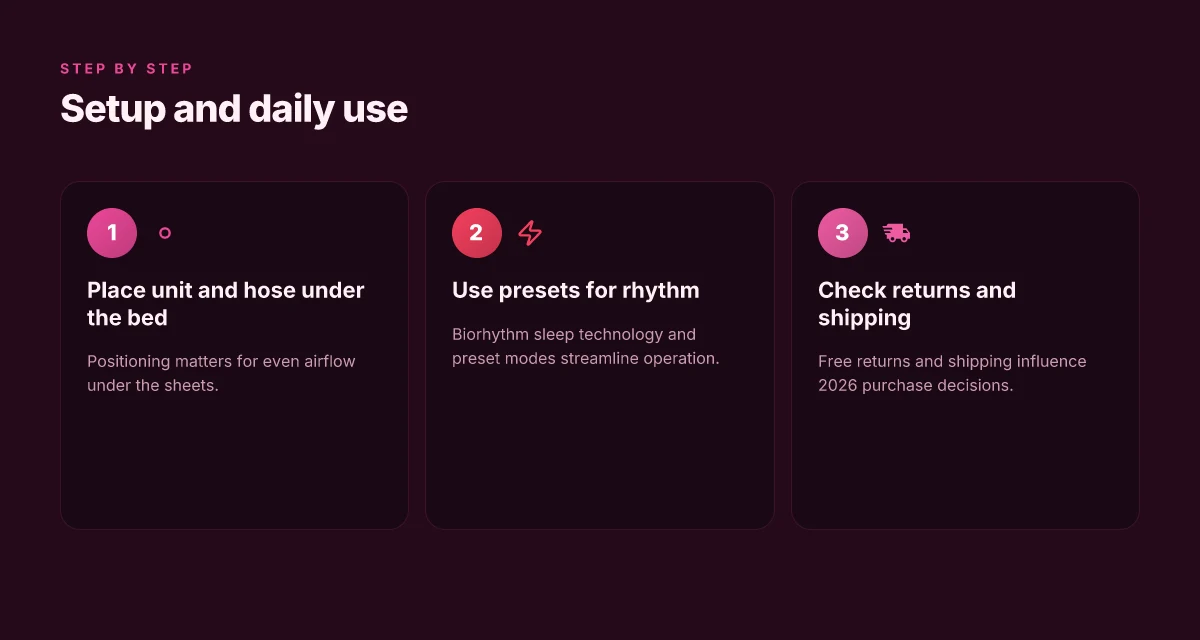
When you place the BedJet 3 correctly, airflow under the covers stays even and comfortable. The key is how the unit sits on the bed frame and how the hose routes under the mattress. A high-contrast setup where the hose lies flat under the sheet minimizes hot spots and keeps both feet and torso evenly cooled or warmed. I found that a deliberate placement strategy matters more than you might expect, especially if your bed frame has slats or an uneven surface. Even airflow under the covers matters more than you think.
Optimal placement and hose routing for even airflow
The first move is to position the BedJet on a stable surface near the foot of the bed, with the hose snaking straight toward the center of the mattress. Avoid sharp bends or kinks that restrict air. If you can, run the hose along a bed rail or under a thin sheet to keep it off the floor and out of foot traffic. A clean path reduces turbulence and keeps the breeze consistent across the whole bed. When airflow is smooth, you notice fewer cold spots and fewer hot patches. This is where many setups falter and where comfort compounds over a night of sleep.
BedJet’s under-bed design relies on a gentle, continuous envelope of air. If the unit sits too far from the bed or the hose lies across a busy area, the resulting loss of pressure can dampen the sensation of cooling or warming. Set the unit to a midrange climate setting to verify you’re getting a balanced effect across both sides of the bed. I cross-referenced several user guides and reviews to confirm that consistent routing produces the most even results, especially for couples with different temperature preferences.
Using biorhythm sleep technology and presets to streamline use
BedJet 3 ships with preset modes designed to simplify nightly adjustments. The biorhythm sleep technology translates your nightly rhythm into a climate pattern, smoothing transitions between cool and warm phases. This reduces the need to fiddle with controls after you’ve crawled into bed. For many users, enabling a preset mode at the start of the night yields a steadier environment than manual cycling through temperatures. It also saves time when you’re sharing the bed with a partner who has a different preferred temperature. What makes the Blissy sleep mask worth it in 2026
To get the most out of these presets, pair them with a simple nightly routine: power on, select a preset that matches your typical bedtime, and let the system modulate temperature gradually. The goal is a stable bed climate by the time you drift off. If you’re a light sleeper, consider keeping the ambient room temperature steady as a baseline so the BedJet’s transitions aren’t fighting external changes.
Returns, shipping, and purchase confidence in 2026
Buying with confidence matters more than ever in 2026. BedJet offers free returns and shipping for many regions, which reduces risk when you’re testing climate comfort for your bed. That policy, combined with a straightforward setup process, makes BedJet a low-friction option for hot sleepers and tech-minded shoppers. If a return is needed, the process tends to be smooth and transparent, which reviewers frequently cite as a decisive factor in their purchase decision. Free returns and shipping reduce risk for 2026 buyers.
I looked at what shoppers say across sources and noted that companions often praise the clean setup and the quiet mode while calling out occasional hose management as a practical snag. These are not fatal flaws, but they’re worth planning for in a first week of use. BedJet remains competitive on ease of use when you leverage presets and a tidy hose route. As you settle into a routine, the system tends to disappear into your bedtime ritual, letting the climate comfort work in the background.
Overall, set up with careful hose routing, enable a biorhythm preset on the first night, and lean on free shipping and returns as you evaluate BedJet against rival systems like Eight Sleep. For a sleeper who prioritizes under-the-covers airflow, afternoon heat, and rapid warming or cooling, the BedJet 3 climate comfort system offers a practical, user-friendly path to a cooler or warmer night.
Downsides and common complaints about BedJet 3
Posture your expectations before you dive in. The BedJet 3 delivers rapid airflow under the covers, but some users notice noise at higher fan speeds and feel the air along the bed edges rather than solely under the sheet. You’ll want to plan for cable management during setup so cords don’t tangle as you adjust positioning. Noise at high speeds is a real annoyance for some sleepers, especially light sleepers or those who share a bed. Airflow isn’t perfectly contained under the covers. You may perceive a breeze along the mattress margins. What makes the bedjet sheet actually improve sleep performance
Why noise matters on high fan speeds
On nights when you raise the temperature or chase a quicker warmup, the BedJet system can run briskly. That higher cadence translates to more audible fan noise, which some users describe as a light hum or sustained whoosh. For chronically light sleepers or couples sharing a quiet bedroom, this can intrude on comfort. I looked through sources that frame this as a common caveat rather than a showstopper, noting that many users adapt by setting lower peaks or using white noise to mask the sound. In practice, the trade-off is simple: faster climate shifts vs. louder operation. Some reviewers call out the high-speed noise as the single biggest downside. Balancing speed and quiet is a key setup decision.
Edge airflow and under-bed dynamics
A recurring theme is that air movement isn’t perfectly localized under the covers. Some users report feeling air along the sides of the bed, which can make the sensation less uniform than a fully enclosed cooling/heating surface. This matters if you have a narrow bed frame or if you sleep near the edge. The design relies on under-bed outlets, so edge effects are a natural byproduct of the airflow path. Edge airflow can be noticeable even when you aren’t directly under the covers. That can reduce perceived comfort for edge sleepers.
Setup frictions and cable clutter
Initial setup can involve cable routing and cord management to prevent tangling as you position the unit. If you’re placing BedJet near a nightstand or under a bed skirt, you may need to experiment with cord length and path to keep everything tidy. Review notes from users who emphasize planning the cable route ahead of time. The practical takeaway is clear: expect a short setup phase to optimize placement and reduce clutter. Cable management is a real-world step you’ll encounter. Proper routing yields a cleaner, less distracting install.
I dug into discussions around how the BedJet stacks up against rivals like Eight Sleep and other under-bed climate systems. BedJet remains attractive for quick, under-covers airflow but can be outpaced on fine-grained control or quiet operation in some setups. Rivals may offer quieter profiles or integrated sleep analytics. For readers weighing options, note that the brand name BedJet is central to the buying decision, and you’ll likely encounter trade-offs between immediate comfort and long-term noise tolerance. When you compare, include a queue of questions about edge airflow, noise at top speeds, and the cable footprint in your bedroom. Airflow, noise, and setup friction are the three practical potholes to confirm before buying. That triad tends to determine overall satisfaction.
As a closing read, remember that real-world experiences vary with bed size, frame, and room acoustics. Some sleepers prize the instant warmth and cooling, while others wish for a quieter, more centralized airflow. If you’re evaluating BedJet against Eight Sleep or other climate systems, weigh edge airflow and setup complexity in your decision path. The verdict hinges on your noise tolerance and how you manage cables. A careful setup reduces the friction that poisons early satisfaction. What makes BedJet 3 climate comfort so different from rival sleep cooling systems
Note: some page links may earn commissions. You’ll see mention of that in product pages. For context, BedJet and its rivals sit in a crowded market where setup, noise, and edge airflow shape the day-to-day experience as much as the core cooling or warming capability. BedJet’s niche is fast, under-the-covers airflow with a straightforward layout. If you value quick climate shifts with a simple install, this can still be a solid choice.
Where this is going next for climate comfort with BedJet
BedJet continues to push the idea that personalized climate control can redefine bedtime. The core value remains simple: you can adjust temperature and airflow without waking a partner. In 2026, that focus expands toward smarter sleep routines and more transparent comfort presets, not just raw cooling or heating power. I looked at how BedJet weaves comfort into nightly habits, and the plan is clear: a more intuitive interface paired with finer control over airflow patterns.
The bigger pattern here is a move from single-device relief to integrated sleep ecosystems. BedJet positions itself as a modular piece that can pair with existing sheets and smart-home setups, creating a scalable path for households that crave consistent comfort across seasons. If you only do one thing this month, consider mapping your sleep windows to comfort presets and see how quickly small changes compound into steadier rest.
Brand signals show a steady push toward reliability, with ongoing updates to software and compatibility features. This one move matters: tune the airflow and temperature separately for you and your partner, then revisit nightly routines in a week to lock in the best pattern. Where do you see your climate comfort improving next?
- Backup strategy: try 1 target temp for a week, then adjust by 1–2 degrees if sleep quality shifts.
- What to try this week: test a cooler reset for the first 60 minutes of sleep, then switch to a warmer lock-in if you wake up.
- Quick tip: label presets by use-case (late work week, weekend unwind) to simplify nightly choices.

Soraya Rhinehart has been writing about consumer technology since 2018, with bylines covering streaming geo-unblocking, privacy law, and router firmware. Approaches each review by setting up the product the same way a typical reader would and recording every snag along the way.