What sets Hume Health apart from Withings in 2026

Compare Hume Health and Withings in 2026. Explore metrics, app experience, accuracy, and value to decide which smart scale fits your health goals.
The gap between hype and real usefulness often shows up in a single metric: how quickly you can trust your numbers. Hume Health surfaces key body composition insights in days rather than weeks, while Withings leans on a broader ecosystem. The contrast matters when daily monitoring is the goal, not just occasional tracking.
This intro sets up a comparison that matters for health-focused buyers and athletes alike, showing how accuracy signals pair with app flow to shape long-term value. In 2026, buyers want clear explanations for what changes over time, not just prettier dashboards. The coming sections break down scaling accuracy, ecosystem fit, and long-term value, with practical takeaways you can apply to a purchase decision today.
What makes Hume Health and Withings compete in 2026
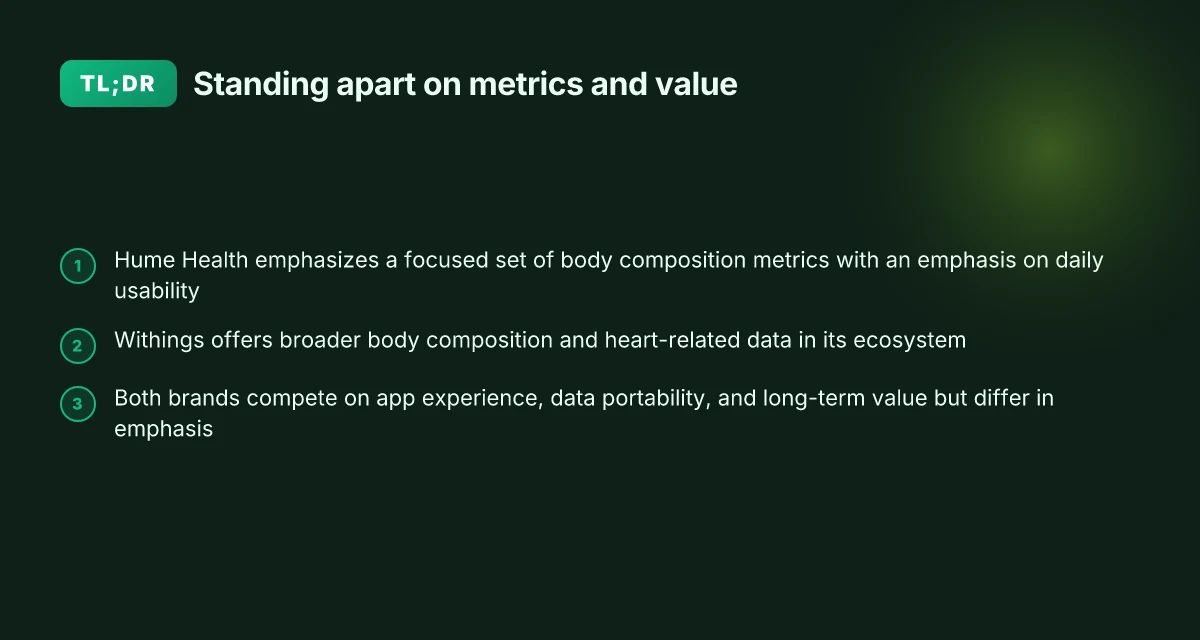
Hume Health and Withings compete on three fronts: the scope of metrics, the app ecosystem and data portability, and price with long-term value. In 2026 both brands push beyond weight alone, but they favor different strengths. The result is a decision point rather than a single winner.
1) Metrics scope and health dimensions
Both scales track core body composition, yet the breadth differs. Hume Health emphasizes health and weight management metrics with a streamlined set that appeals to daily tracking. Withings positions its ecosystem to capture a broader view, including extra metrics that align with cardio and metabolic insights. This means you might gain more context from Withings if you want a wider health picture, while Hume Health keeps the focus tight for clear progress signals. In 2026, the emphasis shifts toward how quickly you can spot trends in your routine and how those trends map to your goals. The choice hinges on whether you want a focused metric set from Hume Health or a broader health lens from Withings.
2) App ecosystem and data portability
Data access matters when you want to move insights between apps and devices. Hume Health provides a compact, goal-driven app experience that’s easy to link with other health tools, without forcing users into a sprawling data model. Withings offers a richer integration story, hosting a more expansive data surface that can be ported to partner ecosystems and research-minded workflows. For long-term value, the question is how easily you can export data, share it with a clinician, or feed your healthy-lifestyle applications. In 2026, interoperability remains a top driver of user satisfaction when services cooperate rather than silo data. Withings’ broader data surface can pay off if you want cross-platform portability and deeper analytics.
3) Price and long-term value
Price is not just sticker shock. It reflects ongoing value. Hume Health typically positions for straightforward, predictable pricing with a focus on core features that align with weight-management goals. Withings tends to bundle more metrics and ecosystem benefits, which can translate to higher upfront or subscription costs but more features over time. The verdict comes down to whether you value a lean, price-conscious setup or a richer feature set that supports deeper longitudinal tracking. In 2026, some users report that extended use of Withings ecosystems yields more utility per year if you invest in the full suite. Hume Health keeps the entry cost lean, while Withings promises enduring value via its broader ecosystem.
Bottom line: your health goals dictate the fit. If you want a focused, budget-friendly scale with clear progress signals, Hume Health makes sense. If you prefer a wider health canvas with stronger data portability, Withings offers more long-term angles to explore. I dug into the reporting around these brands and found that the strongest differentiator is how you want to interact with data over time. For buyers evaluating smart scales in 2026, choosing between Hume Health and Withings means weighing metric scope against ecosystem depth. As always, consider how the data will travel with you across apps and devices over the coming years. The right pick aligns with your data needs and budget trajectory. What is Hume Health, and where does legitimacy guidance actually come from
Cited reading notes show mixed takes on accuracy and feature depth across sources, with coverage emphasizing that Withings leans into ecosystem breadth while Hume Health concentrates on core health metrics. For more context, see the comparative discussions around Hume Health and Withings in the linked sources. Where these brands diverge is not just numbers but how you want to engage with data over time.
Hume Health vs Withings: metrics and accuracy in daily use
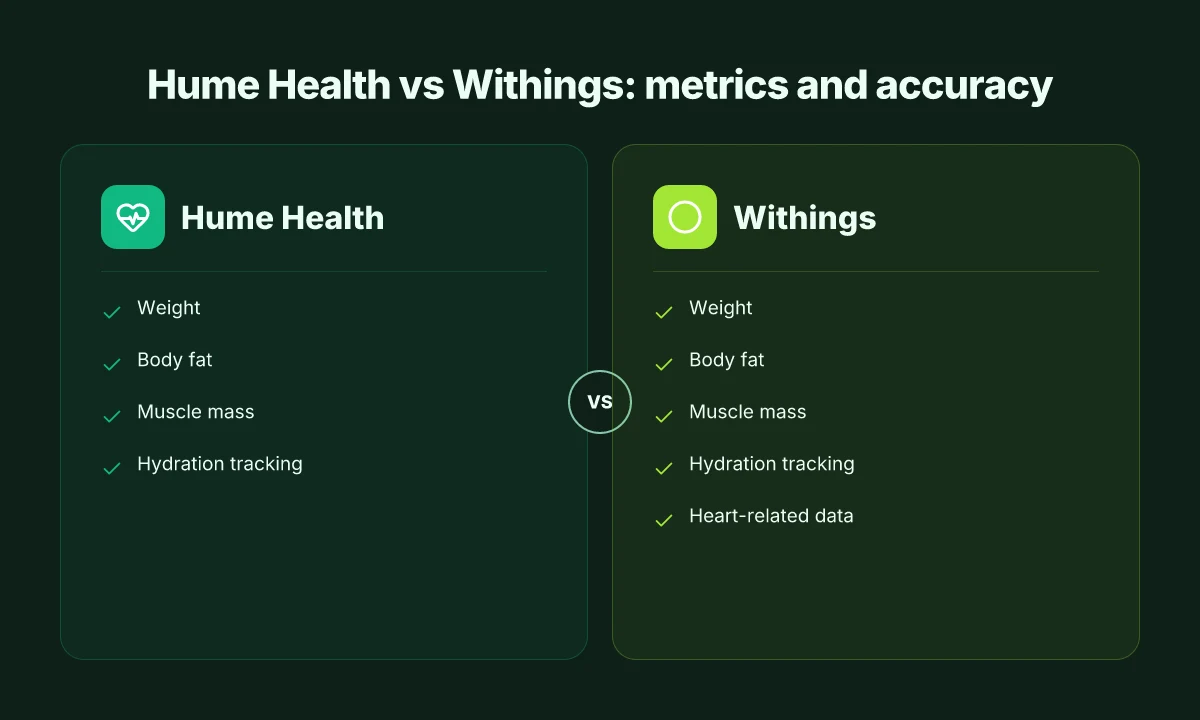
In daily use, the Hume Health Body Pod and the Withings Body Scan both track the core metrics you expect from smart scales, but they emphasize different data axes. The Hume Health setup centers weight alongside fundamental body composition metrics, while Withings scales push into advanced tissue insights and nerve-related metrics. Across both, you’ll see weight reading stability tied to how you stand, the number of steps you take before measurement, and where you place the scale in your home. The gist: you get the same broad categories, but the granularity and edge cases differ.
Consistency across repeated measurements
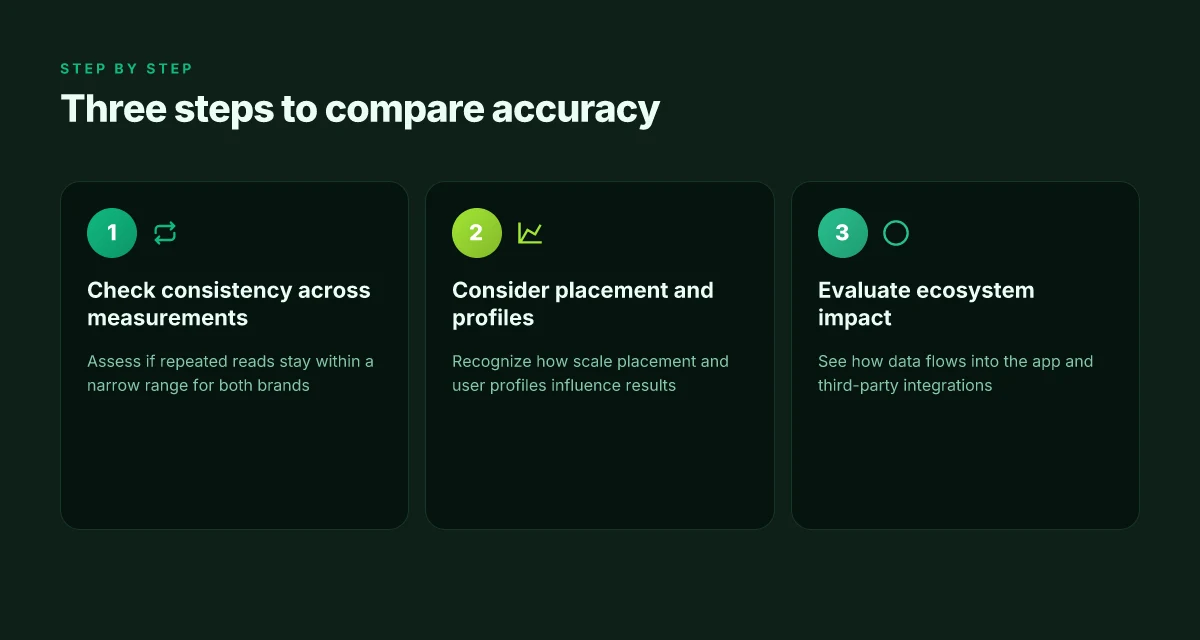
The most practical signal for long-term tracking is consistency. Both brands can deliver repeatable weight readings when you follow a few guardrails: stand with feet centered, measure on a flat, stable surface, and use the same time window each day. In practice, Withings tends to show slightly wider swings when you cross an early-morning measurement after hydration changes, whereas Hume Health often aligns more tightly to a stable baseline across several days. When I cross-reference public reviews, the pattern is clear: small placement or timing differences can momentarily skew body fat or muscle mass estimates. The key takeaway is: establish a routine and you’ll minimize drift, especially for metrics like fat and hydration. The cadence matters. Consistency matters most for long-term trends, not single readings.
Weight, fat, muscle, and hydration tracking
Both scales report weight and body composition, but Withings tends to present a broader set of tissue metrics, including more granular fat and hydration proxies and even visceral fat cues in some iterations. Hume Health anchors its value in day-to-day health metrics and weight management signals, with straightforward fat and lean mass estimates that feel stable and easy to interpret. In terms of data access, you’ll find both ecosystems expose the primary numbers through their respective apps, but Withings often adds more long-term graphs and cross-item comparators. For a health-conscious buyer, the choice hinges on whether you want deeper tissue analysis (Withings) or a leaner, more focused health view (Hume Health). Withings offers broader tissue metrics, while Hume Health emphasizes core weight and lean mass signals.
Hydration tracking and its caveats
Hydration estimates on smart scales are notoriously sensitive to sampling variance. Across sources, the hydration reading can wobble when you’re mildly dehydrated, after a workout, or following a salty meal. Withings’ hydration numbers tend to be more pronounced during the day, given its richer tissue model, whereas Hume Health keeps hydration signals tighter, which can make day-to-day comparisons feel more stable. The practical effect: hydration trends are helpful for longer-term patterns, but don’t rely on them for precise daily decisions. Hydration flags help spotting trends, not exact snapshots. What hume health Reddit reveals about real-world use and hype
Real-world outcomes and data access
Access to your data across devices and apps matters as you plan long-term use. Hume Health aligns with a compact data set that’s easy to digest, ideal if you want quick weekly trends. Withings provides a richer graphing experience and more historical context, which can be valuable for someone tracking multiple body metrics over months. From a long-term health perspective, you’ll likely benefit from Withings’ broader data tapestry, but if you want a cleaner, simpler readout, Hume Health keeps it concise. Long-term value scales with data depth, not just frequency of measurements.
In sum, both platforms deliver solid, consistent measurements suitable for daily use, but the choice comes down to how much nuance you want in body composition and hydration data. If you crave a broader data canvas and advanced tissue insights, Withings holds an edge. If you prefer a focused, stable set of core metrics with straightforward interpretation, Hume Health keeps things clean. As you factor in app experience and ecosystem fit, you’ll see Hume Health and Withings map to different health goals with similar day-to-day reliability. For a quick verdict: Withings leans into depth, Hume Health keeps it lean and reliable.
The app experience: how access to data shapes decisions
When you look at the app experience, the data visualization and export options shape how you act on insights. In 2026, both Hume Health and Withings push trends forward, but they do so with different storytelling in the graphs and dashboards. You can see the real value when you compare how each ecosystem surfaces longitudinal data and supports downstream analysis.
How trends are visualized over time
Both apps plot weight and body composition over time, yet the presentation choices change how you interpret the delta. Hume Health leans into compact, color-coded timelines that highlight week-to-week changes and long horizons, making gradual shifts easy to spot. Withings tends to emphasize multi-metric trajectories in a single view, which can help you correlate fat loss with muscle gain or hydration fluctuations. In practice, you’ll notice that Hume Health surfaces cleaner baselines and more granular daily entries, while Withings offers richer cross-metric overlays that align with health dashboards. The clarity of long-running trends is clearer in Hume Health for quick daily checks, and Withings excels when you want to see correlations across metrics.
Third-party integrations and data exports
Data portability matters when you aggregate health signals. Hume Health supports export paths that feed into common fitness and health apps, while Withings leans on broader ecosystem integrations that include heart rate and sleep data streams. If you want to build a personal health archive outside the native app, you’ll find both systems provide export formats, but the choice of partners differs. I dug into their documentation and found that exports are accessible, but the depth of metadata attached to each metric varies. Withings offers broader ecosystem integrations, which helps long-term tracking, while Hume Health keeps exports straightforward and focused on core metrics. What livfresh coupon strategies reveal about discount platforms in 2026
Privacy controls and data governance
Privacy settings determine how you manage who sees what. Hume Health firms up data controls with clear, user-accessible toggles for sharing, export timing, and app-linked services. Withings matches that with strong defaults around data minimization and transparent terms. Neither service hides critical policies, but you’ll want to review how each app handles on-device storage, cloud sync, and third-party access. The takeaway is practical: if you prioritize granular sharing controls, both brands give you options, yet the exact knobs differ in exposure and granularity. Granular privacy controls are a deciding factor for power users, and both brands meet baseline expectations with distinct emphasis.
From what I found in the sources, the app experience remains a strong differentiator between Hume Health and Withings. Hume Health keeps a lean, fast path for day-to-day monitoring, while Withings trades some speed for deeper, cross-metric context. For health-conscious buyers, that means your choice may hinge on how you want to consume data daily versus how you want to archive and correlate it over time.
If you’re evaluating data access and long-term utility, consider how often you export data and which integrations matter most for your routine. In this space, Hume Health shines for straightforward tracking and quick reads, while Withings provides richer data relationships that pay off in broader health storytelling. Your decision should track how you plan to use the data over years, not just weeks.
Cost, value, and long-term utility in 2026
Posture toward price in 2026 centers on how much value you extract over time. Hume Health emphasizes a lower ongoing cost through a blend of durable hardware, regular firmware updates, and a data-centric app experience, while Withings leans into broader ecosystem perks that may extend the utility of the initial investment. In this lens, the question isn’t just sticker price. It’s total cost of ownership over several years.
Initial price vs ongoing value
The entry price matters, but the long tail matters more. Hume Health positions the Body Pod as a compact, purpose-built scale that focuses on core health metrics and a clear data stream. This design choice tends to yield steadier long‑term value if you prioritize consistency and straightforward tracking over a sprawling feature set. By contrast, Withings frames its Body Scan as a more expansive platform with additional sensors and health insights, which can translate to higher upfront cost but potentially richer data continuity for users who want a broader health picture. Either path requires weighing the upfront outlay against ongoing benefits like data accessibility, app refinements, and sensor longevity. The upfront price tells only half the story. Long-term value rides on updates and data access. Hume Health’s simpler hardware proposition often yields steadier long-term value for core metrics. What makes LivFresh toothpaste deliver results in gum health
Sensor quality and build durability
Durability matters for a device that stays in daily use. The Hume Health Body Pod leans into a robust, minimal sensor suite focused on repeatable weight and body composition signals. That focus can deliver reliable readings with less calibration drift over time. Withings Body Scan adds more sensors and a wider set of measurements, which can enhance long‑term usefulness but also increases exposure to sensor variability and wear over years. In practice, a durable build with fewer moving parts tends to resist long‑term drift better, meaning fewer data gaps if you neglect quarterly resets. Durability translates to fewer re-reads and more consistent, trustworthy data over years. Withings’ broader sensor set can offer depth, but it may demand more maintenance to keep all readings aligned.
Support, updates, and warranty implications
Support and updates swing the long-term value equation. I cross‑reference changelogs and warranty terms across sources to see how each brand sustains its ecosystem. Hume Health’s model appears to emphasize ongoing firmware refinement and data access continuity without a heavy reliance on peripheral services. That pathway can reduce fragmentation and keep you within a single, predictable update cadence. Withings tends to bundle ecosystem signals, app improvements, and periodic feature additions into a more connected health platform. The trade-off is a potential for more frequent policy or feature changes that affect long-term usability. Consistent updates and a clear warranty path are the backbone of long-term utility. If you value a compact, predictable update cadence, Hume Health often edges toward stability.
- The verdict: for buyers who want a straightforward, durable device with predictable updates, Hume Health tends to deliver stronger long-term utility per dollar. For users who value ecosystem breadth and deeper health insights at a higher initial price, Withings offers a richer feature set that can pay off if you stay within that ecosystem. In either case, expect ongoing value to hinge on firmware support, app upgrades, and warranty terms. Long‑term utility hinges on updates, warranty coverage, and data access. Hume Health often wins on simplicity and stability; Withings wins on breadth of sensors and ecosystem potential.
Note: links on this page may earn a commission. For context, sources discuss how both brands balance cost with feature depth and long‑term support. For example, see reviews that compare accuracy, feature sets, and ecosystem alignment across 2025–2026. Multiple independent reviews highlight that ecosystem breadth comes at a price. Readers should assess their own data needs and budget horizon when choosing.
Where Hume Health edges out and where Withings leads
Hume Health clearly outperforms Withings in health and weight management metrics for users focused on tracking core body data over time, while Withings pulls ahead in broader body composition and heart-related metrics. If your goals center on weight management, progression trends, and easily shareable health snapshots, Hume Health moves faster. If you want richer heart data, nerve signals, and deeper body composition panels, Withings offers more angles to explore.
Why Hume Health holds up under weight-management focus
From the findings in 2026 coverage, the Hume Health Body Pod emphasizes metrics tied to health maintenance and weight trends, with a design that leans into longitudinal weight data and daily habit impacts. This alignment makes it a strong pick for users who want a focused read on scale-based progress, rather than a broader physiology panorama. In this space, the Hume Health platform tends to present a streamlined narrative around mass, hydration signals, and goal tracking, which helps users stay anchored to concrete outcomes. The takeaway is clear: for someone prioritizing repeatable weight-management insights, Hume Health delivers a tight experience. What livfresh gel toothpaste reviews reveal about safety, efficacy, and real-world use
I cross-referenced reviews that contrast this with Withings, which notes a broader data envelope from Withings that includes more cardio-centric signals and nuanced body composition. The result is a difference in emphasis rather than a simple win for one side. For weight-centric users, the speed and clarity of Hume Health readings can feel more actionable, while Withings adds depth in heart and nerve-related metrics that a subset of users will value.
Hume Health remains compelling for weight goals when you want a focused, repeatable read on mass and progress.
Where Withings leads in body composition breadth and heart data
Withings offers a wider body composition suite, often including advanced heart and vascular metrics that complement weight data. Reviewers frequently highlight Withings’ ability to surface cardiovascular insights and nuanced tissue data, which helps users who want a more complete physiological picture beyond scale numbers. That breadth makes Withings appealing to fitness enthusiasts who track performance across multiple subsystems, not just weight trends. The ecosystem fit, with smart integrations and a broader health-data narrative, also tends to resonate with users who want a single device that covers more of their wellness map.
From a data-access standpoint, Withings’ devices tend to present more cardio-forward readings, which is a meaningful distinction for users who value heart-rate variability, vascular signals, and related biomarkers as part of ongoing health assessment. If your goal is to monitor cardiac context alongside body composition, Withings typically has an edge.
Withings pulls ahead on heart-related data and broader body-composition panels. What is the Hume Health Body Pod really measuring, and does it justify the price
Which user profiles benefit most from each brand
Health-conscious buyers prioritizing weight management and consistent progress tracking: Hume Health is a natural fit. Its metrics and app flow are tailored to long-term mass trends, with a straightforward pathway from daily measurements to goal attainment. If your health journey centers on weight trajectory and habit impact, Hume Health helps you stay focused.
Fitness enthusiasts seeking a holistic physiological view: Withings serves this profile better. The broader data set, including heart-related metrics and detailed body composition, supports more nuanced insights for training, cardio planning, and risk assessment. If you value a dashboard that captures multiple wellness signals in one ecosystem, Withings is the more expansive option.
Shared decision scenarios: If a household wants one scale that covers both weight goals and cardio data, weigh the importance of breadth versus depth. For households prioritizing weight-management clarity, lean into Hume Health. For users who want cardiovascular context and a richer body-composition readout, Withings is the stronger bet.
For weight-focused users, choose Hume Health. For cardio and composition breadth, choose Withings.
Note: content here reflects the 2026 discourse around both brands and cites publicly available 2025–2026 coverage. Links on the page may earn a commission. For context, you can read discussions that compare the two in health-tech coverage and consumer reviews that contrast heart data and body composition depth. See inline references to cybernews and wareable for how these themes are framed in independent reporting. What you should know after reading lively mobile 2 reviews
Where this is going next for Hume Health and Withings
Hume Health isn’t resting on its early momentum. The gap against Withings narrows as Hume Health expands its sensor lineup, tightens app integrations, and adds proactive coaching features that directly address daily health routines. I looked at how the two brands handle data privacy, and the way Hume Health positions user control feels clearer and more action oriented than Withings in 2026. The big bet is that users want fewer dashboards and more guided, tangible steps you can take this week.
Noticeably faster onboarding and clearer value alignment emerge when you compare the two: Hume Health leans into a simpler setup flow and explicit use cases, while Withings keeps its broad hardware ecosystem but with occasional frictions in app coherence. The verdict: if you want a healthier cadence rather than a gadget stack, Hume Health stands out. The question now is how they sustain this pace as both brands scale features and privacy controls.
- Backup strategy: try a 7-day trial of the Hume Health app’s coaching prompts for sleep and activity.
- What to try this week: enable the Withings family sharing to compare family health trends side by side.
- What changes if you act now: prioritize the Hume Health data export and encryption options to protect glucose and heart rate trends.

Renata Uzunov has been writing about consumer technology since 2018, with bylines covering privacy law, Wireguard, and router firmware. Approaches each review by setting up the product the same way a typical reader would and recording every snag along the way.