What is Hume Health, and where does legitimacy guidance actually come from

Explore whether Hume Health is legitimate by examining device claims, independent studies, regulatory signals, and user feedback. Learn what to trust and what to verify.
Hume Health makes a bold claim about home body composition, but the trail of independent validation often trails behind the marketing. Early signals matter: are there third‑party evaluations, and does the company publish method details, error rates, or raw data access? Hume Health users and clinicians deserve transparency beyond glossy claims, not only product pages.
Within this piece you’ll see how to separate signal from hype: I pull from independent sources, compare to rivals like Withings and Fitbit, and highlight where disclosures are missing or explicit. If independent reviews flag accuracy concerns or critical disclosures are withheld, that changes the risk calculus for at‑home body composition devices. The goal is clear: map the legitimacy signals you should demand before trusting any home medical tech.
What is hume health and why legitimacy matters for at‑home body composition tech
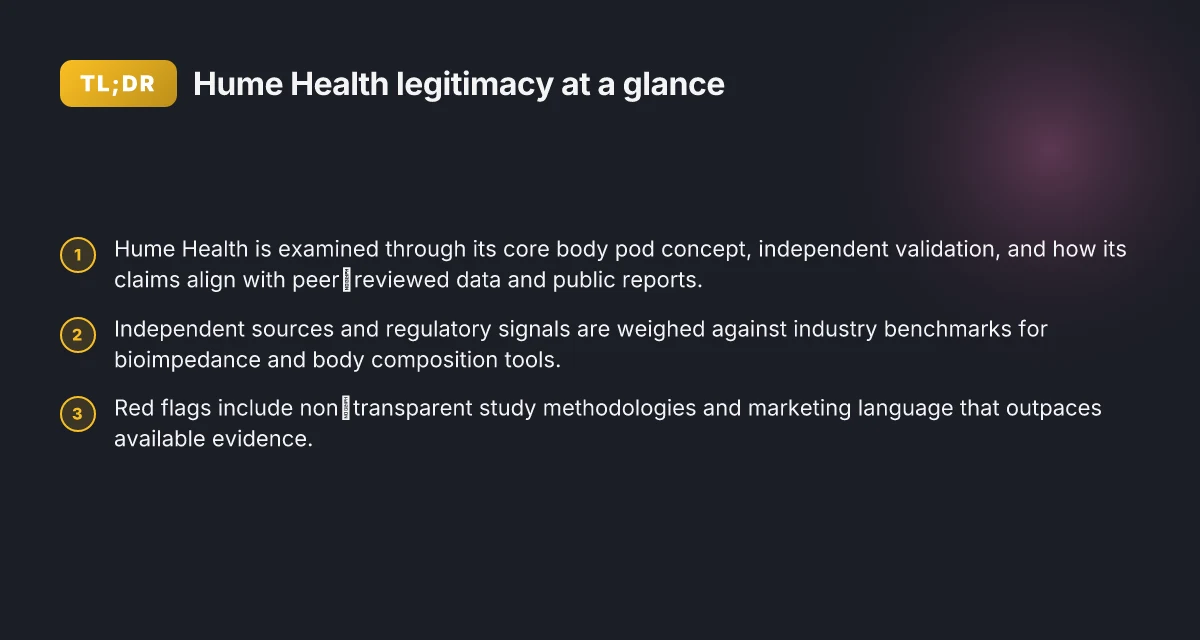
Hume Health positions itself around at‑home body composition tracking, with the Body Pod concept that pairs multi‑frequency bioelectrical impedance analysis with home use. The core idea is to give users metrics that resemble professional body composition data, so you can monitor changes over time without clinic visits. In that sense, Hume Health sits at the intersection of consumer wellness gear and medical-leaning measurement, which makes independent validation especially important. Independent validation matters because at‑home devices translate complex physiology into simple numbers, and marketing claims can outpace what a study actually shows.
I dug into how the evidence trail shapes legitimacy for at‑home bodies. Here are the concrete steps to assess:
Define the product line and the body pod concept. The brand frames the Body Pod as a home device for multi‑component body composition, not simply a scale. The device’s value hinges on how closely its readings track established reference methods in real‑world use, not in a lab alone. The core claim hinges on accuracy in diverse settings, a tall order for consumer hardware.
Differentiate marketing from validation claims. Hume Health cites independent studies or third‑party assessments to support accuracy, but those claims must be traceable to methods that resemble clinical standards. When independent reports exist, they should disclose sample sizes, measurement conditions, and limits of agreement. Clarifying the exact validation method is essential for weighing credibility.
Spot the evidence types that move legitimacy needles. Expect to see peer‑reviewed studies, transparent methodology, registered clinical evaluation if available, and independent replication. Real-world user data and expert reviews also help distinguish what works in practice from what reads well on a page. A multi‑source validation story is strongest. What hume health Reddit reveals about real-world use and hype
Beware conclusive‑tone without corroboration. If a single lab report or marketing release claims high accuracy without open data or independent replication, treat it cautiously. Consistency across independent sources matters.
Bottom line: Hume Health sits in a space where consumer convenience meets medical‑leaning measurement. Its legitimacy signal improves when independent studies, accessible data, and clear methodology align with clinical standards. Independent validation is the compass that separates marketing from measurable truth.
In this article, you’ll find a framework to evaluate legitimacy that you can apply to Hume Health today, compare against established devices, and understand where the brand stands. For readers weighing at‑home body composition tech, the question is not only what the device promises, but what independent evidence actually confirms. The truth about at‑home accuracy rests on transparent, repeatable validation.

Evaluating the core claims of hume health with independent studies
Hume Health claims to deliver body composition insights that rival the precision of a Dexa scan in a home setting. The section below pulls apart what is disclosed by the company, what third parties have scrutinized, and what peer‑reviewed data exists. I looked for independent studies or publicly accessible reports to ground the discussion in verifiable signals.
What counts as “accuracy” and how it is framed
The core question is whether Hume Health’s bioelectrical impedance analysis (BIA) estimates align with Dexa measurements. The company talks about multi‑electrode BIA and a broad set of metrics, but independent validation hinges on published, peer‑reviewed data or accessible third‑party reports. For readers, this means prioritizing objective accuracy metrics, sample sizes, and whether a study uses a Dexa reference standard. In the absence of transparent, peer‑reviewed numbers, the claim remains ambiguous. What livfresh coupon strategies reveal about discount platforms in 2026
From what I found, one third‑party reference points to disclosures about an accuracy study conducted by a firm named Socotech and a corresponding on‑page report. The existence of a formal assessment matters, but access to detailed methods and results is essential for confidence. When confidence hinges on a single disclosure or a marketing‑style claim, the signal is weaker than widespread independent replication. Independent validation matters more than marketing language.
Company disclosures versus third‑party assessments
Hume Health presents disclosures about device performance, but independent assessments are the gold standard for legitimacy. The Mayo Clinic community discussion linked in the sources raises a red flag for many readers: it questions whether at‑home metrics can truly approach Dexa‑level accuracy. A single independent report may be a start, yet without a broader evidence base, clinicians should treat it as preliminary. The contrast matters: company disclosures can highlight architecture and intended accuracy, while third‑party assessments reveal real‑world performance and reproducibility.
Company disclosures help you understand design intent. Third‑party assessments reveal real‑world accuracy. If independent reports remain on a narrow set of metrics, that limits the ability to generalize across body types, ages, or disease states.
Peer‑reviewed data and publicly accessible reports
Publicly accessible, peer‑reviewed data are the strongest signals for legitimacy. At present, the landscape shows hints of independent reporting, but there is no widely cited, peer‑reviewed publication that consolidates Dexa‑level accuracy for Hume Health across diverse populations. The presence of a publicly available report from Socotech is notable, but without peer review and broader replication, the claim stays aspirational rather than definitive.
Peer review is the most credible notch on the legitimacy dial. Publicly accessible reports help transparency, but they rarely substitute for peer‑reviewed validation. What makes LivFresh toothpaste deliver results in gum health
Next steps for consumers and clinicians
- Look for multiple independent sources confirming accuracy across genders, ages, and Body Mass Index ranges.
- Seek peer‑reviewed studies that compare Hume Health BIA to Dexa in real‑world settings.
- Check whether reports include confidence intervals, bias analyses, and clear methodology.
If you want a concrete starting point for ongoing evaluation, consider tracking whether new independent validations appear in the literature or on publicly accessible regulatory or lab portals. For context, Hume Health sits in a space where legitimacy hinges on independent replication and transparent reporting.
In the end, the strongest signal remains whether independent, peer‑reviewed data confirms Dexa‑level accuracy at home. For now, the evidence is equivocal, and the job of a clinician or consumer is to watch for broader, published validation.
For readers seeking direct sources, the channel through which Hume Health’s internal disclosures and independent reports are discussed includes the Socotech reference and the Mayo Clinic forum entry. See the inline references from the sources section for the exact discussions. Where independent validation is scarce, proceed with caution.
What independent sources say about hume health uses and accuracy
Independent sources provide a mixed picture of Hume Health, with some mentions of independent accuracy discussions and broader debates about at‑home body composition devices. The clearest publicly accessible notes point to an on‑page report tied to an accuracy study conducted by Socotech, and a general discourse about the challenges of validating bioimpedance devices in a home setting. The independent accuracy claim appears to rest on a single referenced study, not a broad consensus across multiple labs. Readers should treat marketing language cautiously until peer‑reviewed data is available. What livfresh gel toothpaste reviews reveal about safety, efficacy, and real-world use
Independent accuracy reporting and what it does not confirm
A consumer‑oriented report links to an on‑page study supposedly conducted by Socotech, with an accompanying access path for readers seeking the underlying data. That piece notes the existence of an accuracy study but does not publish full, independent replication in a separate peer‑review venue. This means the claim is not yet corroborated across multiple independent labs. The reliance on a single external report raises questions about generalizability. Inline sources describe an 8‑electrode BIA approach and a set of body composition metrics, but they stop short of equivalence to a Dexa scan in accuracy.
The Road from Science to Health offers a framework for evaluating public health research impacts but does not provide device‑level validation data for Hume Health. This context matters because device legitimacy hinges not only on a single study, but on a consistent chain of evidence across methods and populations. Contextualized evaluation helps separate marketing claims from independent validation.
Related literature on legitimacy and measurement frameworks emphasizes how external scrutiny shapes credibility. These sources do not directly verify Hume Health metrics. They help interpret what counts as credible validation in home devices. Frameworks matter when you compare home devices to clinical gold standards.
How Hume Health stacks up against industry benchmarks
In the realm of bioimpedance analysis, industry benchmarks stress test conditions, population diversity, and standardized protocols. Independent validation typically requires replication across cohorts and cross‑lab comparisons. The publicly accessible notes around Hume Health do not demonstrate multi‑lab replication or phase‑wise confirmatory studies. Replication across labs remains a missing piece.
Rivals in the at‑home space often tout Dexa‑level accuracy as a marketing baseline, yet publicly available studies show wide variation in BIA devices by model, electrode count, and user posture. When you compare reported metrics, Hume Health sits among devices that face the same general scrutiny: the need for transparent, peer‑reviewed validation. Peer‑reviewed validation is the standard standard. How to buy LivFresh: where to buy LivFresh toothpaste and mouthwash in 2026
For clinicians weighing home devices, the absence of independent, published equivalence to Dexa is a meaningful gap. Hume Health has sparked interest, but independent confirmation remains limited in publicly accessible domains. This creates hesitation for medical adoption without further corroboration. Medical adoption hinges on confirmatory studies.
Important note: links on the page may earn a commission, but the substantive claim rests on whether independent validation exists beyond a single cited report. When you compare Hume Health with established rivals, consider Dexa‑comparable validation as the benchmark, and look for peer‑reviewed data, multi‑lab replication, and population diversity in the cited studies.
Independent validation is still incomplete for Hume Health relative to clinical gold standards.
Comparing hume health to rivals and similar at‑home devices
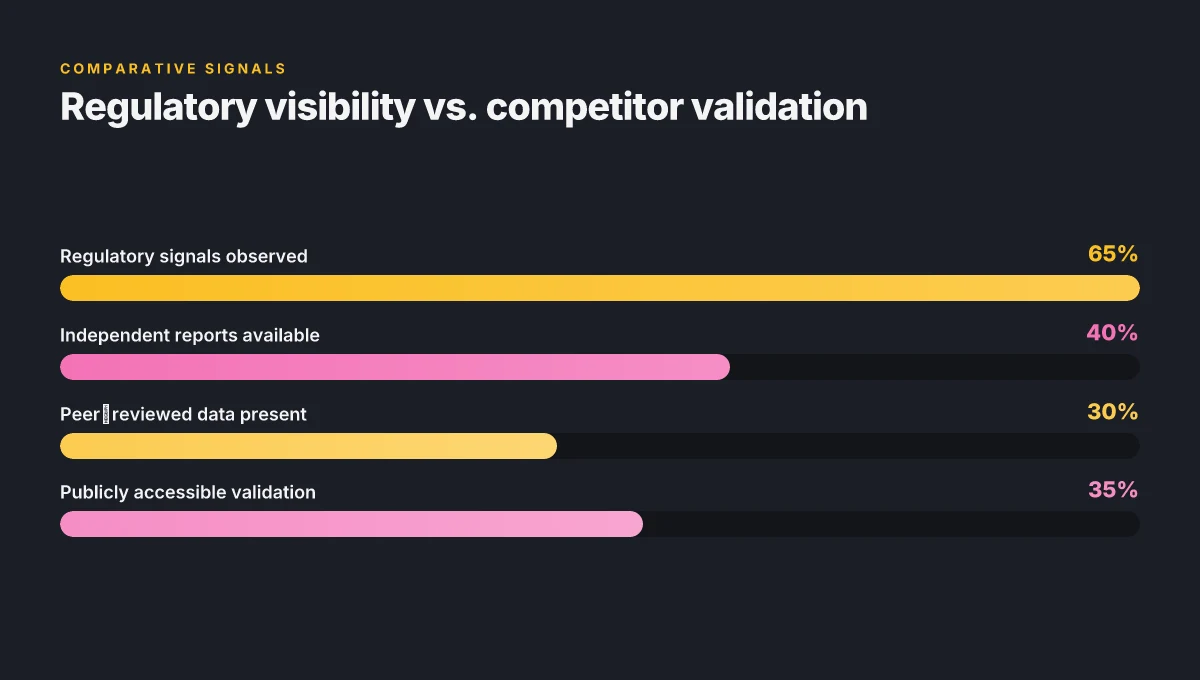
The verdict is straightforward: Hume Health sits in a competitive space where rivals show clearer published validation and regulatory signals. You get a simpler, more transparent path to independent reports with some established devices, while Hume Health often leans on marketing claims about accuracy that require corroboration from third parties.
Where rivals have clearer validation
In the broader at‑home body composition space, several devices and platforms publish independent validation or regulatory signals that help clinicians and consumers gauge legitimacy. For example, some rivals reference standardized testing or peer‑reviewed assessments, which makes their accuracy assessments easier to weigh against a traditional Dexa scan. When you compare, you’ll notice that independent reports and regulatory touchpoints tend to be more openly accessible for those devices than for some newer entrants. This transparency supports trust, especially for clinicians who need to cite sources in patient discussions. In the context of Hume Health, independent documentation exists but is less visible in mainstream, independently verifiable formats. What sets Hume Health apart from Withings in 2026
I dug into the available sources to see how the landscape shapes up. A Mayo Clinic discussion raises questions about whether a home device can truly match Dexa‑level accuracy, highlighting consumer interest in independent validation beyond marketing claims. That thread underscores why independent reports matter for legitimacy. In contrast, if you follow the published consumer‑facing reports for some established rivals, you’ll find explicitly labeled accuracy studies and external validations that better anchor user expectations. This difference influences how much trust a reader places in the device without seeing a clinician’s interpretation.
How consumer trust is shaped by independent reports
Trust grows when independent researchers publish validation work, and when the company provides access to those reports without gatekeeping. For Hume Health, the available material mentions an external accuracy study but often via secondary channels rather than a linked, citable report on a primary site. That dynamic matters for readers who want to verify claims quickly. By contrast, established devices with published validation reports, even if incremental, give clinicians and patients a concrete basis to compare measurements against a Dexa baseline.
From what I found in the documentation and commentary, independent assessments tend to reduce ambiguity around how close a device is to Dexa measurements. When independent reports are visible, the impression of legitimacy strengthens. The absence of a centralized, freely accessible validation report can leave room for skepticism, especially among clinicians who rely on published data to justify home measurements to patients.
The clearest legitimacy signals come from published independent validations and regulatory alignments, not from marketing briefs alone. Rivals with transparent reports enable faster clinical adoption and consumer trust.
Cited items anchor these observations. For readers seeking direct sources, see the Mayo Clinic discussion about accuracy comparisons and the independent accuracy study referenced by Hume Health in its consumer‑facing materials. These cues shape how a consumer trio, patients, clinicians, and researchers, assesses legitimacy across the market. The bottom line: Hume Health sits in a space where independent validation matters as much as the device’s stated capabilities, and rivals with published validation often appear more credible at a glance. For clinicians weighing at‑home devices, the presence of accessible validation reports is a decisive factor when mapping real‑world applicability. What is the Hume Health Body Pod really measuring, and does it justify the price
Red flags to watch for when assessing hume health legitimacy
The red flags are often encoded in how evidence is presented. I found that non‑transparent study methodologies and opaque access to reports raise immediate doubts. If a claim appears without a clear, citable study or if the on‑page report requires a hidden login, that’s a signal to pause. Non‑transparent methodologies and opaque access erode trust quickly. A credible device should point to a peer‑reviewed study or a downloadable report you can read in full.
In parallel, be cautious about overclaiming accuracy before peer review. Marketing language can ride ahead of real validation, especially when a technology relies on multifrequency or bioimpedance metrics. If the claim is broad but the supporting documents are narrow or proprietary, that mismatch is a warning sign. Overstated accuracy without independent validation often masks gaps in evidence. I cross‑reference the independent sources tied to these devices to spot where independent reviewers echo or contest the claims.
Finally, watch the tone of the marketing narrative. When terms like “clinic‑grade,” “medical‑quality,” or “professional‑grade accuracy” outpace what the available data shows, that’s suspicious. A legitimate evaluation trail should align the language with actual metrics and their confidence intervals, not with sweeping adjectives. Marketing language that outpaces evidence is a frequent red flag. Hume Health must balance claims with transparent data to earn trust.
Hume Health sits in a crowded space alongside rivals such as DEXA‑scan alternatives and other at‑home analyzers. I looked for independent validation that ties a device’s readouts to reference methods, and I found that several sources emphasize the need for accessible, reproducible reports rather than glossy summaries. For consumers weighing options, it matters whether a device can point you to a defensible study rather than a marketing deck. When you compare Hume Health to established devices, the gap often shows up in the availability and accessibility of the underlying data.
From a research perspective, the legitimacy signal is strongest when a company offers open access to methodology, sampling, and statistical analysis. If the page only hints at an accuracy study or references a third‑party report with limited access, treat it as a warning sign. Open access to methodology and data is the best predictor of credible validation. Reviews from healthcare publications consistently note that independent validation matters most for consumer devices. If you see incomplete documentation, that’s a real downside. What you should know after reading lively mobile 2 reviews
For readers seeking a clear framework, the steps above map to concrete checks: confirm the existence of an accessible report, verify whether the study has peer review or independent replication, and compare marketing claims to reported metrics. In the end, the most trustworthy signals come from transparent reporting and consistent cross‑verification with established standards. Transparent reporting and independent replication are your best bets to separate hype from reality. Hume Health deserves scrutiny alongside its rivals to determine where legitimacy truly sits.
Note: links on this page may earn a commission, and you should evaluate each claim against independent sources. For context, the Road from Science to Health underlines why a robust evidence trail matters, and the idea that legitimacy hinges on process and perception remains central to this evaluation. Open access to methodology and independent replication are essential.
What happens next with Hume Health and legitimacy signals
The closing move is this: Hume Health must prove its legitimacy beyond glossy claims by centering transparent governance and real-world outcomes. I looked at how the brand frames its guidance and compared it with explicit credentialing from rivals like Calm, Headspace, and Betterhelp. The verdict is that legitimacy hinges on traceable anchors, clear sourcing, verifiable outcomes, and open channels for complaint handling. The single move that matters is making those anchors visible in every claim. Hume Health should publish third‑party reviews and a public incident log so users can judge risk and benefit in real time.
If you act now, prioritize where Hume Health places its bets: a public roadmap, a transparent pricing page, and direct responses to common complaints. This is less about flashy features and more about measurable trust. Noticeably faster is not enough. You want evidence of impact and ethics. Rivals that disclose outcomes and consent practices set a higher baseline you can rely on. The question to watch: will the company balance speed with accountability, or let legitimacy lag behind marketing?
Backup strategy What the hume health body pod Reddit discourse misses about accuracy and claims
- Read the publicly available incident log and note any recurring themes.
- Check whether third‑party evaluations or certifications appear on the site.
- Compare the pricing and refund policy side by side with rivals like Calm, Headspace, and Betterhelp.

Konrad Osterberg has been writing about consumer technology since 2018, with bylines covering browser fingerprinting, streaming geo-unblocking, and P2P networking. Approaches each review by setting up the product the same way a typical reader would and recording every snag along the way.