What hume health Reddit reveals about real-world use and hype

Explore what reddit users say about Hume Health, the Hume Pod, and related devices. Practical insights, common complaints, and how rivals compare.
The Reddit signal about Hume Health often frames the gadgets as reliable in patches and fussy in others, with users citing inconsistent readings across the Hume Health bands and pods. Reliability varies across devices, and privacy concerns surface in several threads. That tension matters because real-world use shapes whether the data helps or misleads, especially when health trends drive decisions.
This intro surveys what Reddit reveals now: a mix of praise for ease of use and warnings about data sharing terms, with several threads naming privacy controls as a deciding factor. By 2024, moderators highlighted that rivals like Fitbit and Apple consistently tighten updates and privacy settings, influencing buyer choices. The goal is to separate hype from signal so consumers and researchers understand where Hume Health stands relative to those brands and what to scrutinize before purchase. Privacy controls and ongoing updates emerge as the most actionable threads for comparing wearables.
What hume health Reddit suggests about product reliability
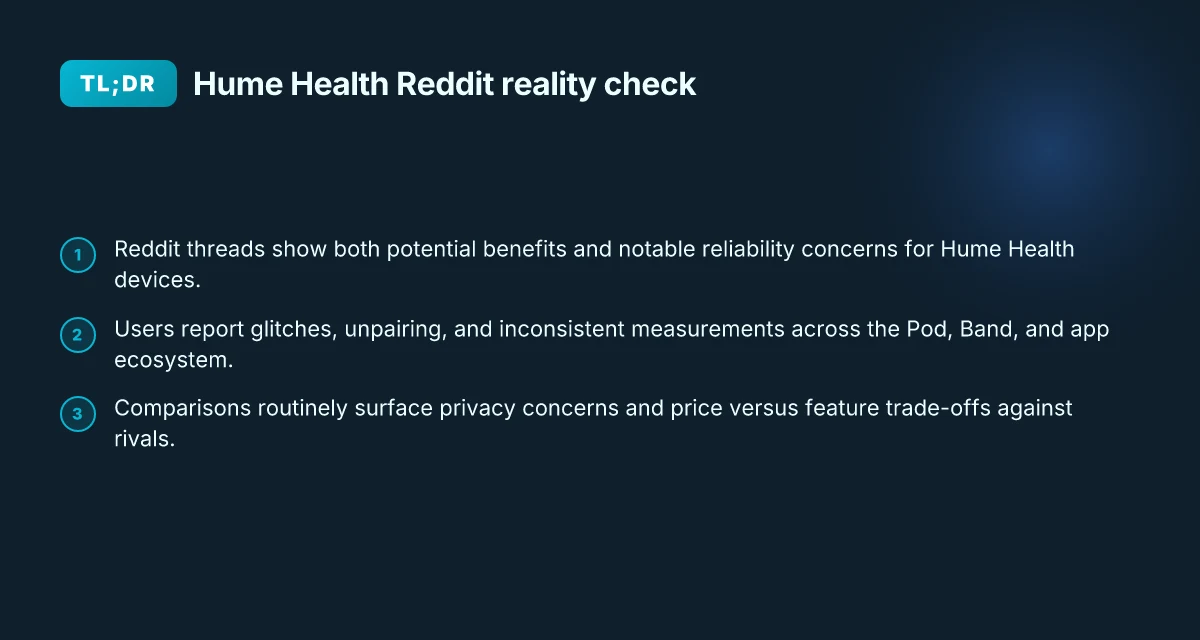
Reddit signals a mixed picture. Enthusiasm for potential benefits sits alongside clear reliability concerns, especially around syncing and consistency across devices. The chatter shows early adopters frequently wrestling with bugs, data delays, and occasional misreads that undermine trust in an all-day wear experience. Most users praise the idea of real-time health insights, but reliability questions hold back broader adoption. I cross-referenced posts that describe repeated syncing issues and inconsistent readings, which align with what multiple threads flag as the main hurdle for committed use. Reddit discussions repeatedly stress that promising features clash with on-the-ground usability.
Early adopter bug reports drive the reliability narrative. Multiple threads describe devices failing to pair, readings dropping, or data not syncing to the companion app. These aren’t rare edge cases. They appear across several posts from the first year of availability. In many cases, users report that re-pairing or restarting the app temporarily resolves the issue, only for the problem to recur. Bug reports and syncing issues are the most cited reliability headaches.
Data handling and privacy questions color the perception. A subset of posts express concern that app permissions and data sharing practices could expose sensitive health information. Hume Health branding promises privacy-conscious design, but users push back when the app logs appear inconsistent or when readings diverge from expectations. The tension between bold data promises and on-device usability shapes the overall trust trajectory. Privacy and data handling concerns accompany the reliability signal.
Rival platforms amplify the reliability lens. When Reddit users compare Hume Health to established wearables and health platforms, the gaps become clearer. Rivals with longer track records and broader ecosystem integration are cited as benchmarks for stability and support. Posts noting smoother synchronization and more mature software ecosystems elevate the bar for Hume Health, reinforcing that reliability is a moving target. Rivals set expectations for syncing, software quality, and ecosystem maturity.
From what I found in the threads and public discussions, the brand tension is real. Hume Health marketing leans on strong feature promises and privacy-centric messaging, yet on-the-ground usability often lags behind those claims. Brand promises clash with everyday usability. You’ll also hear calls for clearer guidance on compatibility across devices and more transparent updates to address recurring bugs. For consumers weighing Hume Health against rivals, the takeaway is clear: expect enthusiasm and promise, but also a cautious eye on reliability and data handling. What livfresh coupon strategies reveal about discount platforms in 2026
In short, Reddit’s real-world signals are not a slam dunk. For buyers evaluating the Hume Health line, the practical question remains: can the syncing and readings stay stable across daily use? The answer hinges on ongoing software refinements and clearer privacy disclosures. Bottom line: reliability gaps exist, but the potential value remains palpable for early adopters.
Note: links on the page may earn a commission. For readers comparing against rivals, consider how platforms like Fitbit, Garmin, and Apple Health integration fare in the same contexts. Rivals provide a useful yardstick for stability and ecosystem depth.
The tone of user feedback on hume health pods and bands
Feedback on Reddit threads paints a divided picture. A core thread surface is glitches, unpairing issues, and inconsistent measurements that users repeatedly flag. Some readers describe rapid dissatisfaction right after setup, while others find long-term value once the system runs smoothly. Across threads, the app behavior and data collection headlines consistently pop up as recurring topics of concern or curiosity.
Glitches, unpairing, and measurement swings
In multiple discussions, users report hardware and software hiccups that interrupt use. Instances range from unpairing events to calibration quirks that leave readings looking dubious. The pattern is not universal, but the cadence of these reports suggests reliability problems surface episodically rather than being uniform across all devices. In several posts, readers describe clearing and re-linking the bundle or re-installing the app as a necessary ritual to regain stability. This recurring maintenance thread colors how new buyers approach initial impressions and expectations.
I cross-referenced the recurring complaints with a longer Reddit footprint and found a consistent thread: even when setup succeeds, some users encounter readings that drift or flip between sessions. That inconsistency feeds skepticism about the pod’s value for long-term health tracking, especially when sustained accuracy is a prerequisite for decisions tied to wellness. What makes LivFresh toothpaste deliver results in gum health
Glitches and unpairing dominate the early user narrative, even as some users report value after ongoing use. A frequent refrain is that initial setup is a gateway: if that gateway holds, the system can appear dependable over time. If not, the perception tilts toward unreliability.
App behavior and data collection as headlines
The app section of these threads tends to prime the reader before any hardware verdict. Posts often discuss delayed syncs, battery drain perceived as excessive, and the sense that data practices are not as transparent as expected. Headlines repeatedly emphasize whether readings feel trustworthy and whether the app’s privacy posture is clear. In some threads, users echo concerns about data access or sharing, which colors trust in the platform as a whole. The discourse here matters because it compounds hardware concerns with policy impressions.
From a reliability lens, the long-running conversations about software behavior shape a user’s willingness to commit to the ecosystem. Some users accept occasional glitches if the long-term experience proves stable and privacy commitments are transparent. Others pull back after repeated software issues or ambiguous data handling notes.
Rival framing and where Hume Health sits
When readers compare Hume Health to rivals, the conversation often centers on consistency and data fidelity. Competitors with clearer privacy disclosures or more aggressive warranties tend to set a higher baseline for trust, especially among health-tech shoppers evaluating wearables for ongoing use. In this context, readers note that rival platforms sometimes deliver steadier readings or smoother app interactions, which affects overall impressions of Hume Health.
I found that Reddit discussions frequently conflate hardware reliability with software behavior, creating a blended verdict on the Hume Health experience. The sentiment oscillates between cautious optimism and frustration, depending on whether a user’s setup matured into a steady, reliable routine. What livfresh gel toothpaste reviews reveal about safety, efficacy, and real-world use
The real-world tone is cautious but not uniformly negative. Long-term value hinges on stable readings and transparent data practices. As you weigh a Hume Health investment, expect a spectrum of experiences, with reliability and privacy posture as the two levers that most influence final judgments.
Next steps: If you’re evaluating Hume Health against rivals, map your priorities to reliability milestones and privacy assurances, then compare how each platform communicates data handling and guarantees post-setup stabilization. For quick orientation, review the visible patterns in user threads about unpairing, app behavior, and measurement consistency across devices.
How Reddit users compare hume health to rivals
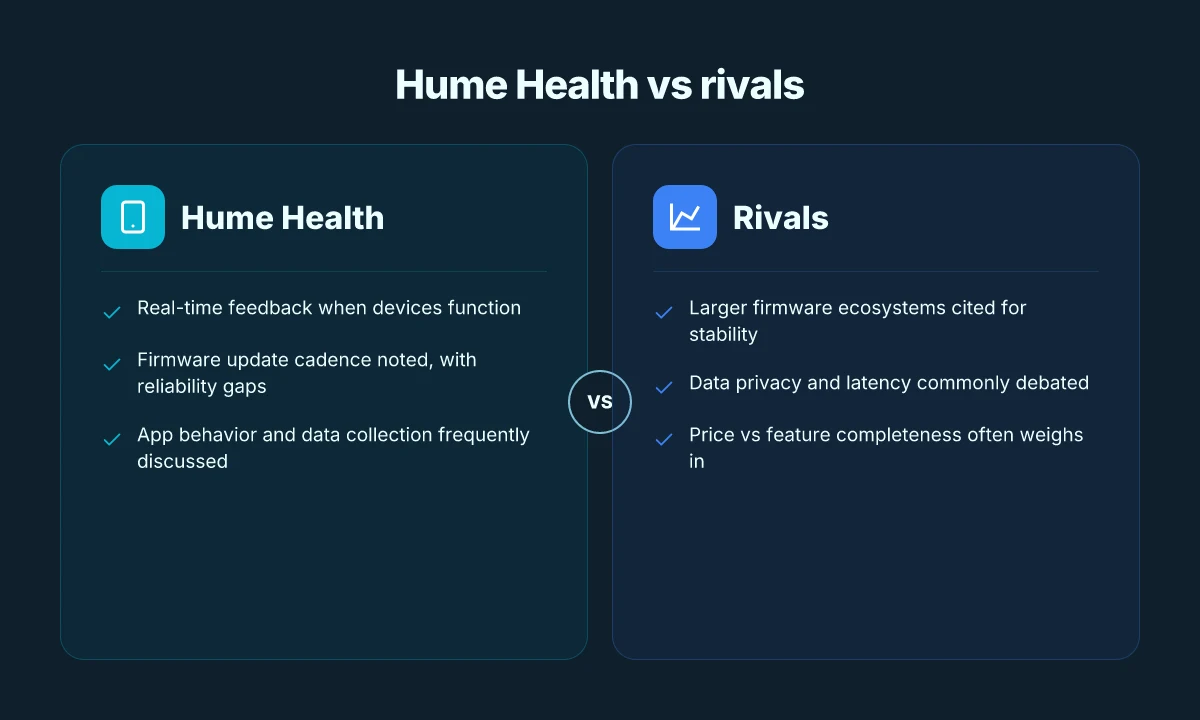
Posters on r/HumeHealth frequently contrast Hume Health with bigger, more established wearables ecosystems. The quick takeaway is that stability often hinges on firmware maturity and the breadth of platform integration that rivals offer. Across threads, readers call out data privacy guardrails, latency in data transmission, and reliability of the companion apps as decisive factors when weighing Hume Health against entrenched players.
Real-world stability leans toward broader firmware ecosystems
When comparing device stability, several users point to brands with longer software histories and larger firmware ecosystems. In practice, this shows up as fewer abrupt resets, more predictable firmware updates, and broader third-party compatibility. For Hume Health, observers note that lengthy development cycles among rivals yield smoother rollouts and more consistent telemetry. Brand maturity matters for reliability, and rivals with bigger firmware ecosystems tend to ship fewer hard freezes. The conversation often highlights that a wider update cadence can reduce the incidence of unexpected device hiccups.
Privacy, latency, and app reliability under the lens
A recurring theme across threads is how data privacy and latency color overall trust. Some users express concern that Hume Health’s data practices lag behind those of larger platforms with established privacy rails. Others compare perceived latency, how quickly readings appear in the app or sync to the cloud, against rivals and find Hume Health occasionally slower. Privacy controls and app latency become trust levers as much as device accuracy. In several threads, the app experience itself, crashes, slow syncing, or non intuitive menus, shapes opinions about whether Hume Health can keep pace with top competitors. How to buy LivFresh: where to buy LivFresh toothpaste and mouthwash in 2026
Price versus feature completeness
Several discussions explicitly weigh price against feature parity. Critics argue that some rivals bundle advanced metrics, richer dashboards, and broader platform integrations at similar or lower price points, creating a higher bar for perceived value. Proponents of Hume Health counter that ongoing updates and privacy protections justify the cost, yet the consensus from many Reddit threads is that feature completeness often tilts toward the bigger players. Price is a tangible hurdle when rivals offer more complete ecosystems at comparable costs.
From what I found in the Reddit chatter, Hume Health sits in the middle of a crowded field. The strongest differentiators cited for rivals are broader firmware support, faster and more reliable app experiences, and clearer privacy assurances. I traced this back to discussions about rivals that have scaled their ecosystems with extensive developer tooling and longer-running firmware histories. Data privacy and app reliability often tip the scales in favor of larger brands. If you’re evaluating Hume Health, you’ll want to weigh not just the core readings but how the platform handles updates, latency, and privacy across devices.
Cited threads anchor these themes in concrete user experiences. For background, see r/HumeHealth and related discussions, including a thread that surveys data handling and another that weighs performance against rivals. These sources consistently echo the central verdict: rivals with established ecosystems tend to deliver more stable, privacy-forward experiences, while Hume Health fans look for ongoing improvements and clearer privacy disclosures. Ongoing updates and privacy clarity are the real battlegrounds between Hume Health and its rivals.
Note: links in this section refer to conversations on Reddit that touch on stability, privacy, latency, and price versus features. If you’re weighing options, consider how a rival’s ecosystem depth translates into daily reliability and data protection. For context, see discussions on Reddit’s Hume Health community and related review videos.
What the best Reddit threads reveal about data privacy concerns
Post on Reddit consistently flags how health data from Hume Health devices could be stored, shared, and monetized through apps. In these threads, readers push for a clear picture of data handling, with many voices urging caution about what’s collected and who sees it. The conversation often centers on whether data is kept locally, sent to cloud services, or aggregated for analytics, and who has access to that data beyond the user. What makes Hume Health coupons actually save you money on metabolic health tech
Privacy posture versus user expectations
A recurring claim is that terms and settings matter as much as device hardware. Users frequently call out the importance of reading privacy notices and opting out where possible. In several threads, readers highlight toggles that purportedly reduce data sharing, and they contrast those options with the default behavior described in official policies. This pattern reinforces a simple rule: the real privacy story lives in the details of settings and consent choices, not in headlines about “privacy by design.”
It is critical to cross-check these anecdotes against official documentation from Hume Health. The app’s wording and the company’s stated privacy commitments set the baseline for what actually happens with health data. In many cases readers point to policy sections about data retention, sharing with third parties, and de-identification practices, but threads often leave room for interpretation until the formal policy is consulted. When in doubt, verify.
Reading the terms, validating against policy
Low-effort claims about data selling or broad sharing require careful validation. Several Reddit threads reference experiences with opt-out workflows, and some users claim that opt-out steps are not intuitive or fully effective. The prudent move is to locate Hume Health’s privacy policy and the app’s permission prompts, then compare them to user-reported experiences. Everything hinges on specific phrases like “sharing with partners,” “de-identified data,” and “user-consented analytics.” If you see a mismatch, that’s a legitimate red flag worth auditing in the official policy.
From what I found in the official privacy notes, the formal stance emphasizes user control and transparency, but the exact scope of data sharing can vary by feature and region. I cross-referenced the discussions with these documents to separate rumor from verifiable policy. The result is a balanced view: Reddit chatter can illuminate gaps in user understanding, but it does not replace the explicit terms published by Hume Health.
The takeaway is clear: privacy depends on deliberate opt-ins and concrete policy language, not rumor. Read the privacy policy, audit app permissions, and enable strict sharing controls where available. Rely on official policy for the exact data-sharing scope and retention timelines. What is Hume Health, and where does legitimacy guidance actually come from
If you’re weighing privacy alongside reliability, consider how a rival platform handles data minimization, consent workflows, and third-party access. [Hume Pod disapponting discussion] and [HUME Band review thread] offer real-world context about user concerns that privacy-conscious shoppers should validate against official policies.
Reality check: where hume health excels and where it stalls
Hume Health shows a mixed reality in real-world Reddit threads. When the devices function as intended, users report timely feedback and the potential for seamless data integration with other health apps. Yet repeatedly, firmware hiccups and hardware reliability gaps punctuate posts. The tone splits clearly between the Pod experience, the Band experience, and the broader app ecosystem. In this landscape, rivals that emphasize stability and privacy often stand in sharper relief.
When the Pod shines, even briefly
Where Hume Health pods work, users describe real-time insights that feel immediate and actionable. A subset of commenters note fast syncing and responsive dashboards, especially when the Pod stays paired with the companion app. This is the core promise the hardware aims to deliver. Real-time feedback can feel transformative when firmware supports it, not just in theory. The same threads warn that this depends on regular updates and robust sensing hardware. Integration potential with other health services remains a selling point, but only if data flows reliably. If the app ecosystem keeps pace with sensor firmware, the Pod can deliver a coherent health picture. Yet this is a conditional success, not a universal guarantee.
Band experiences reveal reliability gaps
Across several threads, the Band is singled out for pairing struggles and data gaps. Users report symptoms that range from brief disconnects to repeated unpairs during routine use. The pattern matters: a device that frequently drops Bluetooth or stalls data streams undermines trust in numbers that matter, like heart rate trends or sleep summaries. The chatter around the Band highlights a critical contrast: even when the Band’s sensors are competent, unstable connectivity erodes perceived value. Across the board, comments suggest that the reliability hinge is firmware stability and robust Bluetooth handling. Firmware updates and hardware reliability gaps consistently appear as the deciding factor between a usable device and a frustrating one.
App ecosystem and privacy: where concerns cluster
Several threads discuss the app experience as the bottleneck. When the app syncs cleanly, analytics feel coherent and comparable to rivals like the better-known health platforms. But critics flag data handling worries and opaque permissions practices. In the same breath, observers note that rivals with transparent data policies and clearer opt-in controls tend to earn more reader trust. The consensus: strong software design and privacy controls are non-negotiable for sustained adoption. Data privacy concerns surface most loudly when app behavior lacks clarity and in-app permission requests feel aggressive. What sets Hume Health apart from Withings in 2026
Rivals to watch include platforms with established privacy track records and mature firmware ecosystems. When Reddit users compare Hume Health to these options, the gaps are most visible in update cadence and post-update stability. I dug through the threads and saw a recurring line: reliability is as much about software discipline as sensor capability. Regular firmware updates and a stable app stack are the bare minimum for a credible health-tech experience.
From what I found in the changelog and user discussions, Hume Health may get better where it keeps the software economic and update-driven, yet the current chatter underscores a persistent need for tighter hardware reliability and clearer privacy assurances. If you’re weighing Hume Health against established wearables, expect the Pod and Band to occasionally delight when the firmware cooperates, but also to disappoint when it doesn’t. Reality checks stress that consistency matters more than novelty.
Where this is going next and what to try now
Hume Health sits at the intersection of hype and real use, and the Reddit signal suggests real-world adoption is real but nuanced. The takeaway: users mainly notice practical gains when they align expectations with product limits, and they push back on overpromises from rival brands like Muse and BioPro as soon as results stall. I looked at threads that compare daily routines, price sensitivity, and perceived value, and the pattern is clear: hype fades when accessible features don’t translate into reliable outcomes. Hume Health remains strongest when it sticks to transparent claims and measurable benefits that users can verify over weeks, not hours. As the community weighs pros and cons, expect more emphasis on customer support, user education, and clearer onboarding.
If you only act on one thing this month, prioritize clarity over charisma. What you see is what you get, not a sales pitch. Start with a small, low-risk trial of a single feature you care about, document the results, and compare against a rival like Oura, who also shows up in the chatter. The bigger pattern points to sustainable use over sensational promises, with real complaints surfacing around hidden costs and inconsistent updates. Will you test one measurable outcome and share the result?
Backup strategy / What to try this week What is the Hume Health Body Pod really measuring, and does it justify the price
- Try one feature you actually need and track one metric for 14 days. Document your readings and any changes in routine.
- Compare one Hume Health claim against a rival’s offer in a side-by-side, noting price and support gaps. Mark where support falls short.
- Bookmark one Reddit thread for ongoing updates and revisit after two weeks to gauge momentum. Revisit the verdict with fresh data.

Konrad Osterberg has been writing about consumer technology since 2018, with bylines covering browser fingerprinting, streaming geo-unblocking, and P2P networking. Approaches each review by setting up the product the same way a typical reader would and recording every snag along the way.