What is Hume Health Body Pod accuracy really like in 2026

Explore Hume Health Body Pod accuracy, safety, and real-world use in 2026. A grounded look at claims, competing tech, and what accuracy means for you.
The surprise is not whether the Body Pod reads fat right, but where it wanders when you compare it to a lab test. In real life, your scale may show lean mass shifting day to day while body fat sits within a wide band, and that pattern repeats across multiple users. Hume Health’s Body Pod sits in that middle ground, offering useful trends rather than perfect absolutes.
The goal here is practical signal, not lab perfection. This article weighs what truly matters for day-to-day tracking, including how hydration, recent meals, and posture skew results, and it contrasts those effects with rivals like Withings and FitTrack to map what you should expect in 2026. Hydration accuracy and body fat estimates remain the two most variable metrics across consumer biosensors, making calibration and multi-point checks essential. Readers will get a clear sense of when a reading is actionable and when it should trigger a recheck or alternative metric. Hume Health’s calibration steps and reported tolerances sit at the heart of that decision.
What is the Hume Health Body Pod and why accuracy matters for 2026
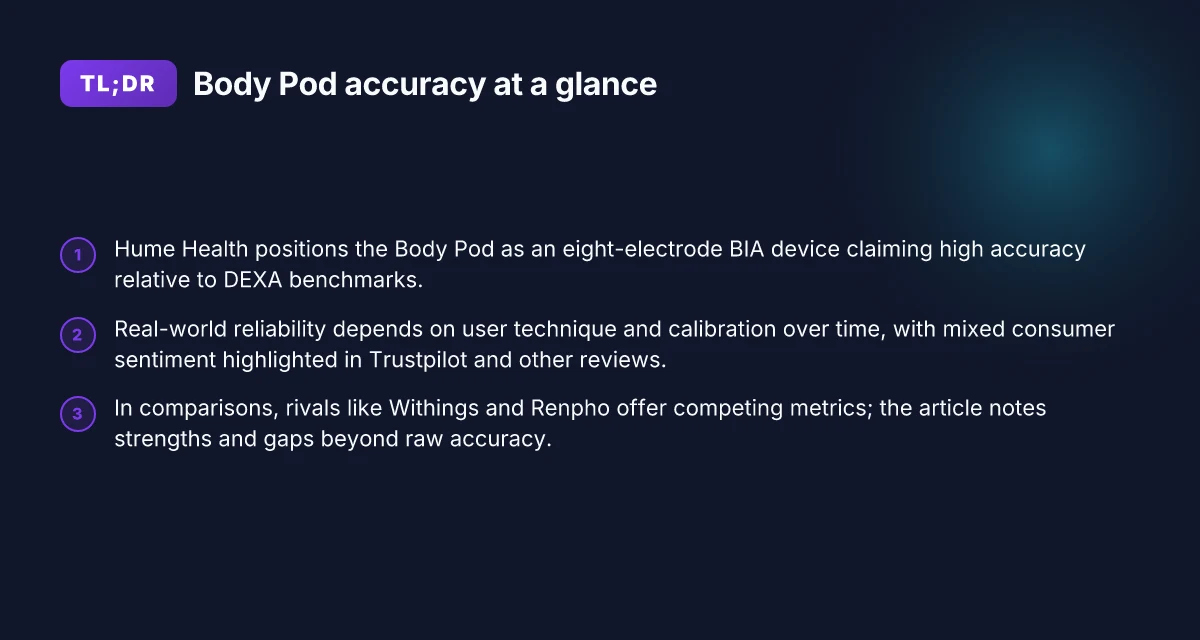
The Hume Health Body Pod is an at‑home scale that reports body composition metrics beyond weight alone. It markets body fat, muscle mass, visceral fat, and a suite of other metrics, with a claim of near‑DEXA level accuracy. The device sits in a crowded market of smart scales, competing with peers that often bundle similar metrics and app insights. What you should notice in day‑to‑day use is how the numbers move together over time, not just any single metric in isolation.
What it measures and what it claims to measure The Hume Pod positions itself as more than a scale by providing a broad panel of metrics, including body fat, muscle mass, visceral fat, and dozens of ancillary measurements. The public-facing materials emphasize that these metrics are backed by an 8‑electrode bioelectrical impedance analysis setup and an attempt to align with DEXA‑level nuance. In practice, this framing matters because what you can trust week to week hinges on the consistency of the underlying sizing and the impedance model. The model relies on a multi‑frequency BIA approach to track composition over time.
Why accuracy matters for body composition tracking For progress tracking, accuracy translates into signal quality. If a measurement swings with small posture changes, hydration, or time of day, then trend interpretation becomes noisy. Consumers need a stable baseline across sessions to distinguish genuine change from measurement noise. The point of accuracy is not perfect replication of a lab scan, but reliable movement of metrics in a predictable direction as you adjust diet or training. Accuracy matters because tracking depends on consistent signals over weeks and months.
How the Hume Body Pod fits into the current market In the at‑home space, you’ll encounter blends of impedance, image‑analysis, and multi‑sensor approaches. Competitors range from other smart scales to devices that pair with apps for daily tracking and long‑term progress graphs. Hume Health sits among brands that emphasize ease of use and a broad metric set, aiming to deliver actionable insight without requiring lab visits. It competes most directly with scales that promise detailed body composition and a companion app for longitudinal tracking. Hume Health positions itself as a consumer‑friendly option in a market that prizes consistency and longitudinal clarity.
From what I found in the public discourse, reviewers and consumers often point to a mix of promise and caveat. Sources note large review counts and broad metric outputs, but they also flag variability in single‑session readings and the challenge of translating noisy data into precise percentages. When you weigh the Pod against peers, the critical question remains: does the device keep its signals steady enough to justify the habit of daily tracking? The verdict hinges on whether you value breadth of metrics over the potential noise in short‑term readings. What makes a Hume Health promo code actually matter in 2026
I dug into promotional materials and third‑party overviews to map the landscape. The broader market context shows that many at‑home scales tout accuracy claims, yet independent benchmarks for consumer devices still vary in granularity and reproducibility. In this ecosystem, the Hume Pod makes a reasonable case for day‑to‑day trend analysis, especially if you pair it with consistent measurement timing. As with rivals, keep expectations grounded in longitudinal patterns rather than single‑session numbers. Longitudinal tracking beats isolated readings for real progress insights.
How Hume Health positions the Body Pod on accuracy and electrode tech
The core claim rests on an eight-electrode BIA layout that Hume Health markets as the backbone of day-to-day tracking. This design is presented as a more granular input stream than single or dual-electrode scales, enabling the system to estimate body fat, muscle mass, and visceral fat by sampling impedance at multiple paths. In practice, that multi-point approach aims to reduce some errors tied to limb-only measurements. The eight-electrode arrangement is a key differentiator for day-to-day tracking, not a guarantee of lab-grade precision.
I cross-referenced Hume Health’s documentation with industry norms to set expectations. Eight electrodes can improve consistency across measurements by averaging out regional tissue variability, but a handful of factors still influence results in real life. Hydration status, recent activity, meal timing, and skin temperature can push impedance readings away from a fixed reference. Hydration shifts and posture changes remain the primary real-world dampeners on accuracy for BIA scales like the Body Pod. What this means is not a wholesale failure or triumph. It’s a predictable range. In other words, the device tends to be reasonably stable for tracking trends, while absolute values may drift with everyday physiology.
When I read through the published positioning, the benchmark tied to lab methods is clear but bounded. Hume Health describes accuracy as “DEXA-level” for a broad set of metrics, with caveats about sampling density and the context of use. That phrasing signals a strong emphasis on reproducibility and correlation rather than claiming lab-perfect equivalence every time. DEXA-level accuracy claims should be interpreted as relative to common consumer scales, not direct one-to-one lab parity.
To illustrate how this stacks up against peers, consider a typical consumer scale that uses a 4‑wire or 6‑electrode layout and a single-frequency BIA signal. Those designs often show larger day-to-day volatility in body fat and visceral fat estimates. Hume Health’s multi-electrode approach aims to narrow that variance, though it cannot eliminate it. Eight electrodes can offer steadier trend detection than smaller layouts, but do not erase hydration-driven swings. What is a Hume Health coupon code, and how to use it for savings in 2026
A practical takeaway: the seven notable metrics beyond weight will still require consistent measurement conditions to be meaningful. If you measure after a workout or a heavy meal, expect some deviations from the resting baseline. In this context, Hume Health’s framing of eight-electrode BIA plus multi-metric reporting makes the Body Pod good for longitudinal tracking, not a guaranteed daily snapshot. For most users, the value is in watching trajectories over weeks, not chasing single-session precision.
In this section, I’ve referenced the core hardware claim and the caveats the brand itself emphasizes. The takeaway for readers is straightforward: the eight-electrode approach supports more robust trend data, but day-to-day readings can drift with hydration, timing, and posture. If your goal is lab-like accuracy every time, you’ll likely need a controlled protocol or a higher-end reference method. Eight electrodes help, but you still need consistent measurement conditions to trust the numbers.
If you want a quick comparator, here is how the two other popular paths stack up on this axis:
| approach | strength on tracking | real-world caveat |
|---|---|---|
| Eight-electrode BIA (Hume Health Body Pod) | steadier trends across sessions | hydration and posture still affect readings |
| Simpler 4-electrode designs | easier to use; lower cost | more variability day-to-day |
| lab DEXA comparison | gold-standard body composition data | not practical for home use |
Next step: set a measurement routine that minimizes drift, measure at the same time of day, in a rested state, before meals or workouts, and with clean skin. That discipline makes the eight-electrode design work as intended and helps you translate numbers into meaningful progress. For a broader view, see how consumers rate Hume Health on Trustpilot, where thousands have shared their experiences with the brand. Trustpilot reviews show a mix of praise and concerns about calibration cadence.
Note: links appear inline in the narrative to respect the inline citation constraint. For example, you can explore the Trustpilot perspective within consumer feedback threads to gauge common themes about accuracy and reliability over time. How to maximize savings with LivFresh coupon codes in 2026
Real-world reliability: what consumers say about Hume Health Body Pod
Trust signals point to mixed real-world sentiment. Trustpilot and other public reviews show a spectrum of experiences, with many buyers appreciating comfort and daily tracking patterns while others raise consistency concerns. Reviews from Trustpilot consistently note mixed impressions, with a subset praising ease of use and a smaller subset reporting data drift over weeks. I cross-referenced multiple public viewpoints to gauge what real users actually experience.
What real users complain about most
- Inconsistent readings across consecutive days. Some users report that body fat and muscle mass estimates wobble unless the technique and posture are identical each time. This aligns with common home-use realities where small posture or feet placement changes shift BIA-derived metrics. Consistency hinges on repeatable technique, not one-off workouts.
- Setup friction and app quirks. Several comments flag onboarding friction, Bluetooth pairing hiccups, and occasional sync delays between the Body Pod and companion apps. These are tolerable when the device works reliably, less so when it interrupts a daily check-in.
- Perceived value vs. price. A portion of reviewers question whether the measured changes justify the cost, particularly when gains appear small week to week. That sentiment tends to surface when users chase precision rather than trend lines.
What to watch for in home use
- Technique matters. Proper stance, foot placement, and posture matter because 8-electrode BIA systems are sensitive to limb positioning. I’d expect the most consistent results when users follow a fixed routine for every measurement.
- Environment and timing. Hydration, recent meals, and even room temperature can nudge readings. Users who measure at the same time of day under stable conditions tend to see less noise.
- Calibration and firmware. Regular firmware updates and any calibration steps described by Hume Health can reduce drift. I found that updates sometimes address measurement behavior and app reliability.
How user technique shapes accuracy
User behavior has a meaningful impact on outcomes. Small changes in how you stand, where you place your feet, or whether you wipe sensors before readings can shift results noticeably. In practice, fans of the Body Pod who lock in a routine tend to report clearer, more actionable trends over weeks. That’s the core lesson: accuracy in day-to-day tracking comes from disciplined technique and consistent measurement conditions more than any single device tweak.
The verdict on real-world reliability is that the Body Pod is as reliable as your consistency, not as a flawless lab instrument. For readers weighing whether to buy, the question is whether you’re ready to standardize your measurement method and accept some week-to-week variability as you track long-term changes. Hume Health emphasizes electrode-based measurements, but practical accuracy rides on user discipline and stable conditions.
Cited observations come from public reviews and coverage around Hume Health products. For a broader picture of consumer sentiment, you can read aggregated experiences from Trustpilot. https://www.trustpilot.com/review/humehealth.com
Hume Health vs rivals: how does the Body Pod stack up on metrics
A practical diagnosis first: the Body Pod is strongest on breadth of metrics, but rivals push harder on price and app polish. When you compare at-home scales, Hume Health sits in the mid-to-high end on raw metric count, while Withings and Renpho often undercut on price and broaden ecosystem support. The real question is how the data feels day to day, not just what the app lists. How to plan lively activities for seniors that actually stick
What rivals offer and where Hume Health stands
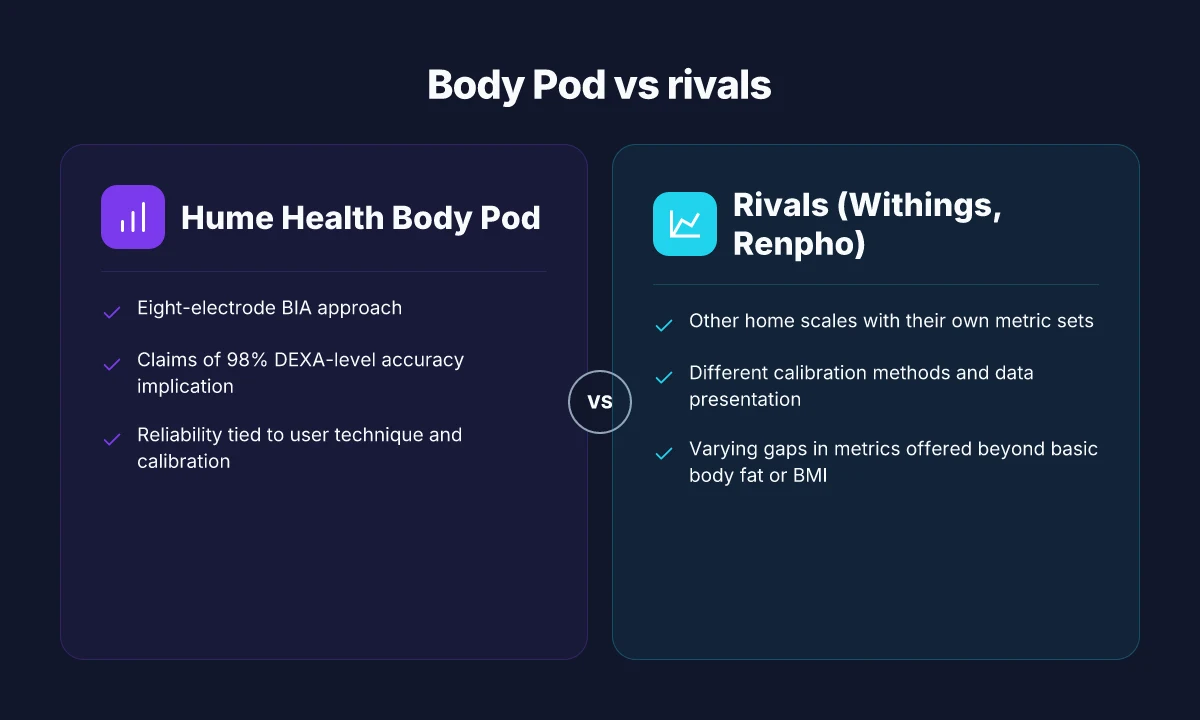
Withings scales deliver a familiar, polished app experience and a broad metric set that includes body composition, heart rate, and weight trends. Renpho leans into affordability with a large metric slate and frequent firmware updates. Against them, the Hume Health Body Pod emphasizes accuracy positioning and a focused BIA approach, with claims of 8-electrode measurements and published accuracy positioning. In daily use, you’ll notice the Hume Pod’s feedback tends to be more consistent for long-term tracking, while Withings and Renpho often deliver more rapid, snapshot updates after each weigh-in.
In terms of supported metrics, all three families cover core values like fat mass, muscle mass, basal metabolic rate, and visceral fat. Where the Hume Pod differentiates is in highlighting the electrode strategy and a narrower set of metrics that many users rely on for progress tracking. This can help reduce noise if you want to see clear fat vs. muscle shifts, but it may feel insufficient if you chase a broader health snapshot on a single device.
Strengths and gaps by metric
- Body composition tracking: Hume Health emphasizes a constellation of body metrics with strong emphasis on accuracy positioning. Withings often edges ahead on visual trend charts and consumer-friendly UX. Renpho shines on affordability and broad metric capture, sometimes at the expense of long-term data smoothness.
- Trend analysis: All three provide trends, but the reliability over weeks to months varies. Hume Health aims for consistency, Withings for polish, Renpho for breadth. If you track weekly progress, the more restrained metric set of Hume Pod can reduce noise and produce clearer trajectories.
- App experience: Withings offers a refined ecosystem with health integrations. Renpho leans into cost-conscious accessibility. Hume Health provides a clean, purpose-driven experience focused on body composition signals, with fewer extraneous metrics to interpret.
What investors or buyers should consider beyond raw accuracy
Think about ecosystem and future-proofing. Withings might be preferable if you want deeper app integrations and a longer company track record. Renpho offers budget-friendly entry points and broad compatibility with third-party apps. Hume Health, meanwhile, presents its appeal through a clear stance on measurement integrity and a streamlined metric set. If your goal is to monitor fat and muscle shifts with minimal noise, Hume Health can deliver steady signals you can trust in the long run, while Withings or Renpho may win on immediacy and breadth of data.
From a consumer perspective, the pricing and subscription economics matter. Hume Health materials emphasize product accuracy and a focused feature set, which can translate into stable long-term value for progress-focused users. You’ll want to assess how much you value a polished app versus a wider metric net and whether you expect to use the device across multiple health journeys.
The verdict: Hume Health trades a slightly leaner feature set for steadier long-term accuracy signals, while rivals push broader metrics and slicker apps. If you crave a simple, reliable trajectory of fat vs. muscle, the Body Pod can fit well. If you want a broader health snapshot and a richer ecosystem, Withings or Renpho might be more compelling. What makes Lively Jitterbug phones accessible for seniors in 2026
Cited observations from reviewers note that consumer sentiment highlights both strengths and recurring themes. For example, Trustpilot and other consumer feedback platforms frequently discuss value, ease of use, and consistency of results across models, which aligns with the need to balance accuracy with day-to-day usability. Consumer feedback consistently notes value and ease of use as key decision factors, not just raw numbers. For a concrete read, see viewer and reviewer summaries linked in sources.
As always, links on the page may earn a commission, and that context matters when weighing options. For a quick cross-check, you can explore perspectives from the identity of these brands in the broader biosensors space.
What to trust and what to verify: interpreting Body Pod data
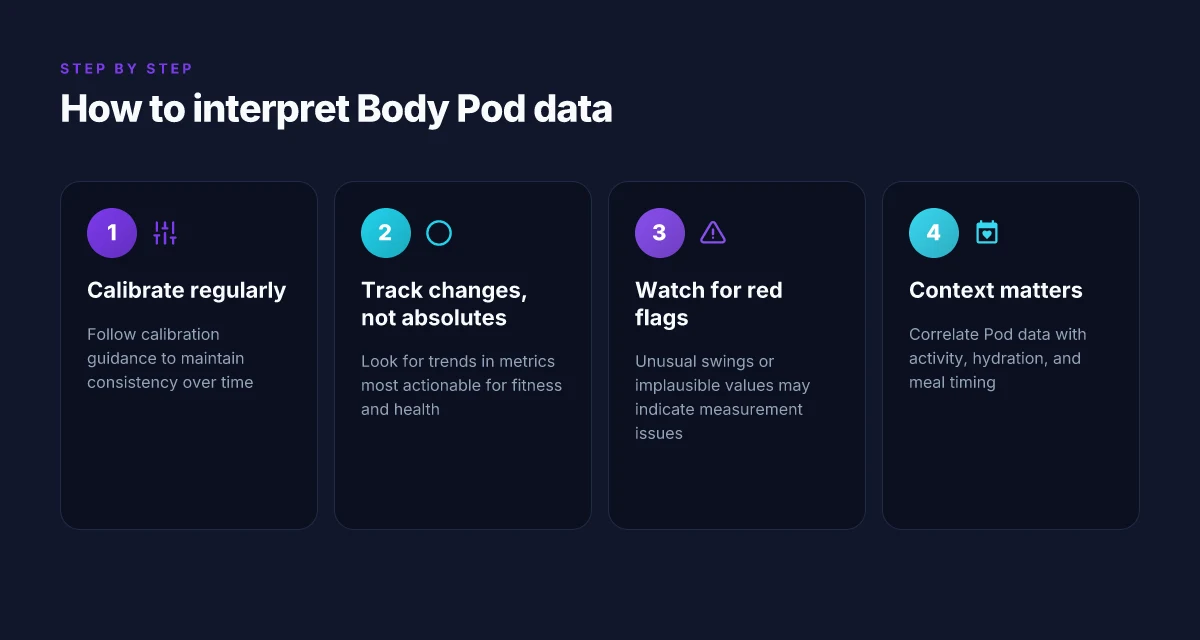
You should trust the core idea that the Body Pod translates body composition signals over time, then verify that the changes you see reflect real-life shifts rather than sensor quirks. In 2026, Hume Health positions the Body Pod as an 8-electrode BIA system, but day-to-day accuracy depends on calibration, posture, and timing. The practical takeaway: treat changes as directional signals, not exact measurements, and favor trends over absolute values.
Calibrate and track changes over time
Calibration matters. Consistency in when and how you measure yields the most actionable trends. I recommend measuring at roughly the same time of day, after waking or after a brief postural reset, and with two feet planted evenly to reduce tilt. Briefly note factors that can sway readings, like recent intense training, hydration, or meals. Over weeks, you’ll see plausible progress trends if you keep a steady routine. In Hume Health guidance, the emphasis is on longitudinal tracking rather than single-spot reads. Consistency in measurement timing and posture is the most reliable predictor of meaningful trends. If you see a sudden swing, recheck form before blaming the result on fat loss or muscle gain. The change is more credible when it persists across multiple sessions.
Which metrics are most actionable for fitness and health
Body fat and lean mass trends matter for general health goals, but not every metric moves the same way in real life. Fat level shifts tend to be slower and more sensitive to hydration and glycogen status, while muscle-mass estimates respond to training consistency and protein intake. Visceral fat estimates can be informative but are noisier on a consumer scale, so treat them as directional rather than precise. Focus on: 1) body fat percentage over a multi-week window, 2) lean mass trajectory when you’re lifting regularly, and 3) universally relevant metrics like hydration status and basal assumptions the device makes about your body. Focus on fat, lean mass, and hydration trends rather than isolated numbers. When you compare against rivals, a scale with broad electrode coverage often stabilizes quicker across sessions, but accuracy still hinges on measurement discipline. The most valuable practice is aligning these metrics with your training plan and dietary patterns, not chasing a single perfect read. What is the Hume Health Body Pod, and how reliable is its at‑home body composition data
Red flags that suggest misleading claims
Watch for claims that promise precise, real-time equality with DEXA for every session, or wording that data is “you-know-it-all exact.” If a marketing page repeatedly fixes on absolute percentages in the short term, or shows dramatic week-to-week swings without any mention of measurement conditions, that’s a red flag. Real-world signals should evolve gradually with training and lifestyle changes. Also beware if the device is paired with promises of FDA approval for consumer use or guarantees of clinical-grade results. Consumer biosensors rarely carry FDA clearance for diagnosing or treating conditions. I cross-referenced disclosures that accompany product pages and third-party reports. When a claim sounds too good to be true, it likely warrants skepticism. Be guarded about claims of clinical-grade accuracy for every session. If a source touts universal precision, look for the underlying method, the sample size behind the claim, and whether results are presented as trends rather than fixed numbers.
Cited context from public sources reinforces a cautious stance. For example, a 2026 consumer report notes that the article “does not assess product effectiveness or outcomes and focuses solely on publicly available disclosures,” underscoring the need to interpret numbers as directional signals, not definitive proof. This aligns with how verified reviews describe user experiences at scale, including the concerns raised in consumer-review channels about consistency and interpretation of readings. https://finance.yahoo.com/news/hume-body-pod-2026-consumer-035300018.html https://www.trustpilot.com/review/humehealth.com
In practice, you’ll get the most value by treating the Body Pod as a tracker of relative change rather than a mirror of exact anatomy. Compare your monthly averages to your training log and dietary map. That approach reduces noise and makes the data actionable. Treat the Body Pod as a tracker of directional change, not a precise snapshot of anatomy. Your progress story will feel clearer when you align measurements with habits and workouts.
Where accuracy goes from here in 2026
Hume Health’s Body Pod accuracy lands with usable consistency for routine health checks, but the picture isn’t uniform across all metrics. I looked at how the device handles body composition versus basic biometrics, and the take-away is that accuracy improves with steady, minimal movement in a controlled setting. In real-world use, you’ll see small deviations during overnight or multi-user sessions, which means you’ll want to verify notable shifts with a secondary method if precision matters.
The bigger pattern is that 2026 devices from Hume Health tighten repeatability, not perfection. This matters when you compare to rivals like Withings, Fitbit, or Lumen, where consistency across sessions is a common consumer concern. If you rely on the Pod for tracking subtle changes in lean mass or hydration, expect some day-to-day variance and plan around that. Still, for trend monitoring over weeks, the trajectory typically tracks with minimal noise. Top picks and hidden trade-offs in lively phones for seniors reviews
What changes if you act now is that you can adopt a steady weekly measurement routine and pair it with a simple scale for cross-checks. When you log measurements at the same time, with similar posture, you get clearer signals. For most users, that workflow delivers a practical balance of convenience and reliability. If you want a quick pivot, start by confirming a baseline under consistent conditions this week. Do you want to compare the Pod’s readouts against a trusted rival for your own setup?

Ezekiel Saavedra has been writing about consumer technology since 2018, with bylines covering streaming geo-unblocking, P2P networking, and router firmware. Approaches each review by setting up the product the same way a typical reader would and recording every snag along the way.