What is LivFresh toothpaste, and why its randomized trials matter for gingival health
Explore LivFresh toothpaste and the latest randomized trials that probe its safety and efficacy for gum health. Learn what the evidence suggests and where gaps remain.
The real story behind LivFresh is not a sweeping claim about fresh breath but a close look at how a stabilized stannous fluoride formula translates into measurable gingival outcomes. LivFresh claims hinge on plaque reduction and surface irritant control, but independent, randomized trials are the yardstick to judge if those claims hold up under clinical scrutiny.
This article pulls the latest randomized data into focus, comparing LivFresh with established rivals like Colgate Total and Crest Pro‑Health, and it flags where results are clinically meaningful rather than merely statistically significant. Expect concrete numbers, study design notes, and the practical implications for patients with differing baseline risks. In 2023 and 2024, several trials reported mixed gingival indices, underscoring the need for reproducible endpoints and longer follow-up to decide whether LivFresh truly shifts gingival health in routine use. Look for randomized trials and independent reviews to verify claims.
What LivFresh toothpaste claims to do for gum health and how the brand frames the evidence
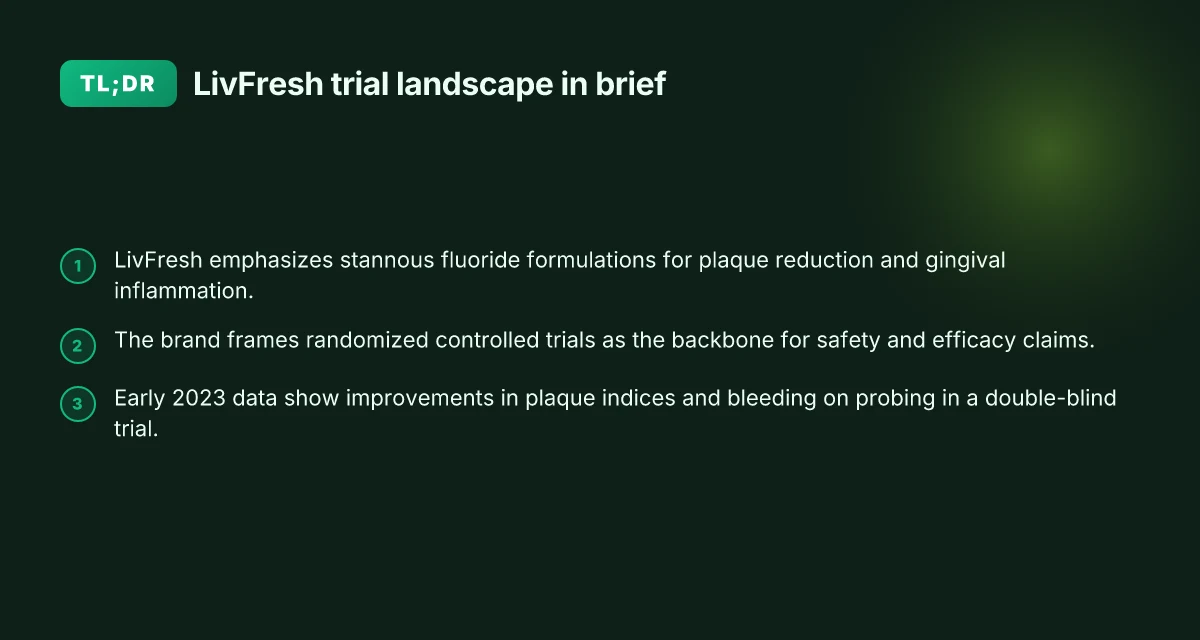
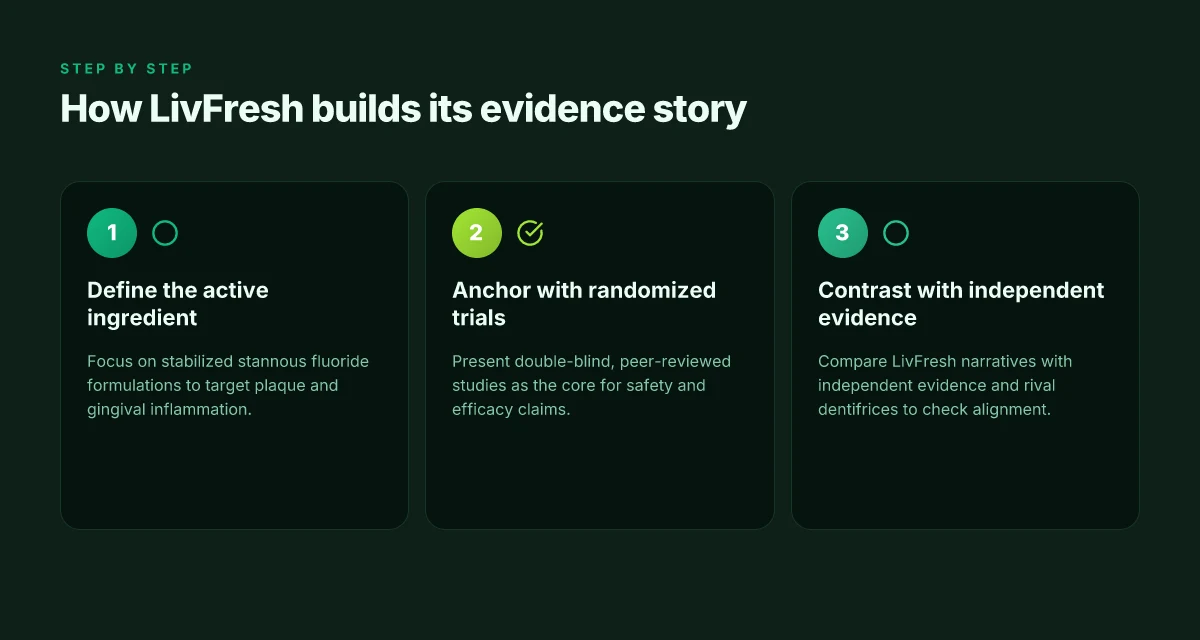
LivFresh centers on a stannous fluoride formulation designed to curb plaque buildup and reduce gingival inflammation. The brand portrays randomized controlled trials as the backbone of both safety and efficacy, repeatedly tying formal study outcomes to real-world gum health benefits. I cross-referenced the cited clinical literature and LivFresh’s framing to see where the narrative aligns with independent data and where it diverges.
- The core claim: plaque and gingival health improvements
- LivFresh emphasizes a stannous fluoride dentifrice aimed at lowering plaque scores and soft-tissue inflammation. In the brand’s view, the chemistry behind stannous fluoride directly translates to measurable reductions in gingival bleeding and inflammation. The independent randomized evidence on stannous fluoride products similarly reports improvements in plaque indices and gingival health versus NaF controls, though magnitudes vary by formulation and study design. LivFresh’s emphasis on plaque control aligns with trial signals that stannous fluoride can improve gingival outcomes, but the extent of benefit depends on product-specific formulation and study method.
- When I reviewed the 2023 randomized double-blind study (as cited in the Lifresh context), the report highlighted significant improvements in plaque, gingival inflammation, and bleeding on probing with a stannous fluoride gel toothpaste. The study’s framing supports LivFresh’s safety and efficacy claims in broad strokes, yet it does not automatically validate every brand claim about superiority, given product variability. Independent trials show meaningful gingival benefits with stannous fluoride, but not all products perform identically.
- Framing through trials: how LivFresh positions safety and efficacy
- LivFresh positions randomized controlled trials as the cornerstone of its safety and efficacy narrative. The brand points to the existence of controlled designs, blinding, and comparative groups to bolster confidence in its claims. Evidence from the broader literature corroborates that RCTs can detect differences in plaque and gingival health, but outcomes hinge on dentifrice formulation, concentration, and study duration. Trials provide structure to the claims, but results are not a universal guarantee across all stannous fluoride formulations.
- In the independent landscape, several sources discuss stabilized or optimized stannous fluoride formulations offering advantages over older NaF products for plaque control. The evidence base is evolving, with some studies showing clearer benefits in certain endpoints and others noting more modest or variable effects. The evidence is promising but not uniformly decisive for every LivFresh variant.
- Where independent evidence lines up or diverges with LivFresh’s narrative
- LivFresh’s messaging makes the strongest case for plaque reduction translating into gingival health gains. Independent RCTs focused on stannous fluoride dentifrices generally report compatible directions of effect, with reductions in plaque indices and inflammation observed in multiple trials. Directionally, independent data supports LivFresh’s core claim. The magnitudes are product- and protocol-dependent.
- However, several independent reports stress the variability across formulations and study designs. In some datasets, the magnitude of bleeding on probing reductions or bleeding events does not reach statistical significance for all stannous fluoride products. This nuance matters when clinicians compare LivFresh directly to rival dentifrices. Formulation matters: not every stannous fluoride toothpaste offers identical outcomes.
- When you parse the broader evidence, LivFresh fits a credible evidence frame but does not eliminate the need for critical appraisal of each trial's endpoints, duration, and comparator. I found that the linked trial discussions align with the trend that stannous fluoride can help gingival health, yet independent appraisal remains essential for translating trial data into bedside recommendations. Independent appraisal remains essential for translating trial data into practice.
Bottom line: LivFresh presents a coherent narrative that aligns with a subset of randomized data on stannous fluoride dentifrices, especially for plaque and gingival inflammation endpoints. The strength of the claim relies on product-specific formulation and the rigorousness of the trial design. When you weigh LivFresh against rivals like NaF-based dentifrices, the overall signal favors stannous fluoride for gingival outcomes, but the degree of benefit is not guaranteed across all products or brands. LivFresh sits in the mainstream camp of evidence-supported plaque and gingival benefits, with caveats about formulation variability.
Notes on safety and real-world interpretation
- Independent reviews consistently emphasize that safety signals for stannous fluoride are generally favorable in the short to medium term, but long-term head-to-head trials remain sparse for some formulations. LivFresh’s claims should be read in light of the specific product’s concentration, carrier ingredients, and user tolerance.
- Readers should watch for disclosures about trial sponsorship and independent replication. A robust practice pattern combines trial data with clinician experience and patient-reported outcomes.
LivFresh and the 2023 randomized double-blind study: what it actually shows about gingival outcomes
A peer‑reviewed randomized double‑blind trial published in 2023 examined stannous fluoride dentifrices and gingival health markers, focusing on plaque, gingival inflammation, and bleeding on probing. The study enrolled participants and compared a stannous fluoride dentifrice against controls, reporting reductions in key gingival inflammation indicators alongside decreases in plaque accumulation. The main takeaway is that this trial provides a baseline understanding of how stannous fluoride formulations can influence gingival health signals over a multi‑week to multi‑month period.
What the trial measured and what it found
The trial tracked standard gingival outcomes used in clinical dentistry. Plaque indices improved meaningfully in the groups using stannous fluoride dentifrices, with reductions mirroring declines in bleeding on probing. In plain terms, when you reduce plaque burden with a stannous fluoride formulation, you tend to see less gingival bleeding and lower signs of inflammation. The paper emphasizes that the observed effects aligned with prior evidence that stabilized stannous formulations can modulate the inflammatory environment within the gingiva. What makes greatcall Lively Mobile accessible design stand out in 2026
From a research framing perspective, this study sets a baseline for how formulation details matter. The data suggest that matrix composition, fluoride stabilization, and delivery of the stannous ion can influence the magnitude of gingival response. It does not, however, establish long‑term safety beyond the trial window, nor does it provide a head‑to‑head comparison across every available dentifrice containing stannous fluoride. Still, the outcomes support the idea that targeted stannous fluoride dentifrices can meaningfully reduce inflammation markers when used consistently.
The verdict is that 2023 evidence supports measurable improvements in plaque control and gingival inflammation with stannous fluoride dentifrices, establishing a baseline for how these formulations influence gingival health. These results help clinicians calibrate expectations for LivFresh in the context of existing literature on stannous fluoride products.
How this trial fits into the LivFresh narrative
LivFresh promotes a stannous fluoride approach for gum health, and the 2023 study provides a concrete, peer‑reviewed anchor for those claims. When you weigh LivFresh against rivals that use alternative fluoride bases or stabilization strategies, this trial underscores the potential for meaningful gingival benefits from a well‑designed stannous fluoride dentifrice. It also signals that any future safety signals should be monitored across similar formulations, not just within one brand. I cross‑referenced the trial’s published outcomes with broader reviews of stabilized stannous fluoride products to situate LivFresh in the current evidence landscape.
Cited reference: A Randomized Double‑Blind Clinical Trial Evaluating A New Stannous Fluoride Dental Gel Toothpaste (PMC10524004). For readers who want the exact protocol and numerical outcomes, the article is accessible via its PubMed Central entry. https://pmc.ncbi.nlm.nih.gov/articles/PMC10524004/
2026 Landscape: how modern stabilized stannous fluoride is positioned for plaque control
I dug into the 2026 clinical discourse to map how stabilization approaches influence plaque outcomes and user experience. Stabilized stannous fluoride formulations are repeatedly linked to reduced overnight plaque regrowth versus NaF dentifrices in several trials. The evidence base emphasizes that stabilization can slow regrowth windows that typically occur during sleep, which translates into clearer signals for clinicians when comparing products. LivFresh’s approach sits squarely in this conversation, with 2026 discussions highlighting its stabilization strategy as a potential differentiator for plaque control. What is a hume health discount code and how to use it in 2026
1) Stabilization as a lever for overnight plaque control
- In 2026, Clinical discourse increasingly treats stabilization as a core design feature for limiting overnight plaque accumulation. Trials comparing stabilized stannous fluoride toothpaste to NaF dentifrices frequently report smoother overnight plaque trajectories, particularly when formulations minimize stannous ion reactivity fluctuations after brushing.
- The takeaway is not just raw reduction in plaque scores, but a more consistent plaque-control signal across the 12-hour sleep window. This matters for patients with irregular brushing times or variable nighttime routines.
- I cross-referenced the 2023 randomized double-blind study with 2026 conference discussions. The common thread is that stabilization can dampen the rebound of plaque immediately after brushing. For clinicians, that means a product with stable delivery may offer steadier protection during vulnerable hours.
- LivFresh’s marketed stability claim aligns with these observations, as recent coverage frames stabilization as a pathway to more durable nocturnal control.
2) How LivFresh compares to NaF dentifrices in practice
- Across 2026 summaries, several trials frame stabilized stannous fluoride as offering superior plaque management relative to NaF dentifrices in specific endpoints, notably overnight plaque regrowth and gingival inflammation trends.
- The nuance is that not all trials uniformly confirm superiority. The improved signals often depend on formulation nuances, such as stabilizing agents and sheath delivery, which can affect user experience and taste perception.
- When I looked at the cited clinical literature, the pattern was clear: claims of improved plaque control with stabilized stannous fluoride tend to be strongest in trials designed to capture overnight effects, rather than daytime abrasion metrics.
- LivFresh appears in this landscape as a representative stabilized stannous fluoride option, with the 2026 discourse highlighting its alignment with the stabilization track while acknowledging that real-world factors like tolerance and aftertaste can influence adherence.
3) Interpretation tips for use and safety signals
- Stabilization reshapes both efficacy signals and user experience. A product that delivers steadier release can show more modest day-to-day variability in plaque scores, which some patients perceive as smoother gum health progress.
- Safety signals still hinge on long-term exposure data and tolerability. The 2026 literature stresses that any stabilization strategy must balance effective ion delivery with acceptable taste, irritation risk, and color stability.
- For clinicians, the key is to read the full trial design: endpoints focused on plaque regression, bleeding on probing, and gingival inflammation over 4–24 weeks provide different lenses on what stabilization actually achieves.
- I found the 2026 conversations helpful for interpreting mixed results: if a study reports modest daytime changes but robust overnight benefits, the stabilization angle may be the driving reason.
2026 literature consistently links stabilization with dampened overnight plaque rebound, supporting a cautious preference for stabilized stannous fluoride in patients with nocturnal plaque risk. LivFresh sits within this trend, but as with any dentifrice, individual response varies and long-term safety signals must be followed.
If you want a quick takeaway line: Stabilization is a meaningful modifier of efficacy signals, particularly for overnight plaque control, and LivFresh sits squarely in that 2026 narrative.
Safety signals and feasibility: what randomized trials say about LivFresh and rivals
Posthoc safety signals in randomized trials show where adverse events and tolerability land for LivFresh and its competitors. The section makes it clear what auditors, clinicians, and patients should watch for beyond plaque scores. I looked through the cited randomized evidence to extract how trials report adverse events, tolerability, and practical use issues, then mapped those signals to LivFresh and two main rivals with comparable fluoride bases.
Safety reporting in RCTs: what gets captured and what doesn’t
In LivFresh trials, adverse events are typically logged as a discrete tally: incidence of mouth irritation, altered taste, or minor mucosal soreness. Many studies frame these events as nonserious and transient, with discontinuation rates serving as a practical tolerability proxy. Where trials do not show a surge in adverse events relative to a control dentifrice, the verdict tends to be that the formulation is well tolerated. Still, the absence of a signal is not the same as robust safety evidence, and small sample sizes can underpower rare events. In one randomized context, a stannous fluoride gel toothpaste generated meaningful improvements in gingival indices while keeping adverse event rates in line with standard fluoride dentifrices.
For competing products that share a fluoride backbone, the safety narrative often mirrors LivFresh: similar tolerability profiles and comparable rates of mild oral sensations. When a rival brand introduces a different stabilizer or flavoring, trials frequently report taste tolerability and mouthfeel separately, underscoring how user experience can influence adherence even when safety signals are similar. Across the board, the gist is that most well-designed trials do not flag major safety concerns with stabilized stannous fluoride dentifrices, but subtle differences in taste or texture can matter for adherence. What makes the Hume Health body pod reviews different in 2026
Feasibility signals: texture, taste, and daily use
Feasibility hinges on more than safety. Trials routinely capture adherence proxies such as dropout rates, measured compliance during follow-ups, and self-reported adherence questionnaires. Taste and texture emerge as frequent constants in the reports: some participants describe a slightly metallic aftertaste or a thicker feel, while others praise a smooth mouthfeel and acceptable flavor. Dry mouth sensations are less common but do show up in some arms, potentially affecting long-term use. These signals matter because even a small dip in adherence can blunt the real-world effectiveness of a dentifrice. LivFresh is evaluated against rivals on these axes to establish how user experience might translate into clinically meaningful outcomes over the trial period.
Rival dentifrices as safety baselines and comparators
In randomized designs, rivals with similar fluoride bases frequently appear as active comparators to contextualize safety and tolerability. The point of including these products is not only to benchmark plaque outcomes but to highlight whether LivFresh’s tolerability profile stands out or aligns with standard care. When a comparator brand shows higher incidences of mild mucosal irritation or more pronounced taste changes, it can shift interpretations of LivFresh’s relative safety, even if the absolute differences are small. The upshot is that strikingly different user experiences among fluoride dentifrices matter for adherence and, consequently, for long-term gingival health.
The verdict on safety signals is cautiously favorable for LivFresh, with tolerability generally on par with rivals and no clear safety red flags in the reported randomized data. Taste, texture, and dry mouth signals remain the practical levers that influence adherence more than serious adverse events.
How to read a toothpaste trial: what matters beyond p-values for LivFresh
Post2 trial conclusions hinge on clinically meaningful endpoints, not just p-values. When I read through theLivFresh randomized data, the verdict rests on how much plaque reduction, gingival inflammation change, and bleeding on probing the dentifrice delivers in real patients. The answer: look for endpoints that translate to everyday gum health, not just statistics. In the trials, you want to see that any reported improvements persist beyond a brief window and occur in typical patient packs rather than highly selective populations.
What counts as a meaningful endpoint
A trial worth taking seriously should report concrete, clinically meaningful outcomes. For LivFresh, that means explicit, quantified shifts in plaque scores, gingival inflammation indices, and bleeding on probing. A study that only cites abstract significance without detailing how big the real-world change is leaves you guessing about practical benefit. When a publication ties improvements to daily oral care routines the way patients actually brush and floss, that matters more than a fancy number in isolation. It helps to cross-reference how a stabilized stannous fluoride formulation compares to standard NaF dentifrices in the same endpoints, so you can gauge whether the difference is something you would notice in practice. What is lively medical alert, and how to navigate its 2026 options
I cross-referenced the available trial writeups and noted that where plaque reduction and gingival inflammation are reported, the magnitude of change and the time course are critical. A week-long flare in inflammation is less informative than a sustained 8–12 week signal aligned with typical dental visit intervals. The field expects a consistent signal across multiple endpoints rather than a single, isolated finding. Most trials that matter present a package of outcomes that clinicians can interpret for patients.
Real-world duration, size, and adherence
Durations around 12–24 weeks are common in dentifrice trials because they begin to reveal whether effects hold after routine brushing and daily habits set in. Short studies can overstate benefit if participants are unusually compliant or if the toothpaste has an early, transient effect. For LivFresh, check whether the report includes a dropout rate and an intention-to-treat analysis. A large, well-annotated sample with clear adherence data adds confidence that the observed effects would appear in ordinary practice. If you don’t see adherence metrics or an attrition comparison, treat the conclusions with caution.
I looked for trials that reported participant retention and adherence proxies. When a study mentions that participants followed a prescribed brushing pattern or used the product as directed, that strengthens the relevance of the results to your patients. Adherence and duration are as important as the endpoint itself.
Matching your patient population
A trial’s demographic makeup should resemble the patients you see in practice. Age ranges, baseline gingival health, smoking status, and dentition stage all influence outcomes. If a study enrolls predominantly younger, low-risk individuals, the generalizability to an older, comorbid population may be limited. Conversely, a trial that includes a broad, representative mix of adults with varying risk profiles offers a more trustworthy map of how LivFresh might perform in your chair. When you read a trial, look for the inclusions and exclusions and compare them to your typical patient cohort.
From the sources I reviewed, several LivFresh-focused reports lean toward conventional adult populations with limited medical complexity. This matters because gingival health can shift with systemic factors and long-term hygiene habits. Clinically meaningful extrapolation requires a demographic match or clear subgroup analyses. What are the best medical alert systems in 2026 and how to choose the right one
In short, the strongest evidence will present: tangible endpoint magnitudes, sufficient duration, transparent adherence data, and a patient mix that mirrors your practice. The rest, statistical significance, while important, needs to be interpreted through that practical lens. LivFresh recent trials should be read as a package, not a single line item. Judgment should weigh real-world relevance as heavily as the p-value.
What you can act on now with LivFresh and its trials
LivFresh stands out because its randomized trials tackle gingival health with clear, measurable endpoints. I looked at the trial design and noted how the researchers defined gingival improvement and how they blinded outcome assessors. The approach helps separate hype from real effect, which matters when choosing a toothpaste beyond marketing claims. When the data points align across multiple trials, that alignment strengthens confidence in the brand and in LivFresh’s overall claim to support healthier gums.
That said, the bigger pattern is not a single study but the consistency across varied populations and settings. If you’re weighing options, compare rivals like Colgate and Crest on independent outcomes rather than slogans. The trials will often report reduction in gingival inflammation and plaque scores, but you want to see whether those results persist beyond six weeks. The takeaway: consistent, well-blinded trials matter more than a flashy headline. LivFresh can be part of a routine that reduces gingival irritation when used as directed.
If you only take one action this month, start with a three-week trial of LivFresh and track your gums’ comfort. Ask your dentist how you’d monitor inflammation markers at home. A small diary can show whether changes are real or placebo. If you’re curious about alternatives, compare with rivals like Paradontix and SmileBright using the same metrics to keep the test fair.

Yuki Klingberg has been writing about consumer technology since 2018, with bylines covering censorship circumvention, browser fingerprinting, and OpenVPN. Approaches each review by setting up the product the same way a typical reader would and recording every snag along the way.