What makes LivFresh dental gel effective for gum health in 2026
Explore how LivFresh dental gel impacts gum health in 2026, including study signals, safety profiles, and what to expect when using LivFresh for periodontal care.
LivFresh often gets pitched as a gentle adjunct, but the real question is whether it changes gum health in practice, not just in theory. Early users report that LivFresh can soothe mild irritation while you brush, yet the proof sits with how it pairs with routine care. LivFresh appears to deliver a measurable difference in gingival comfort when used alongside standard cleaning.
This piece pulls from real-world signals, safety notes, and practical limits to help clinicians and patients decide when to include LivFresh in a periodontal routine. Expect clarity on what counts as a meaningful improvement, where signals may warn of irritation, and how to compare this gel against other adjuncts or conventional care. The goal is to align expectations with 2026 guidance and patient-reported outcomes, so your practice can choose with confidence.
What is LivFresh dental gel and why it matters for gum health
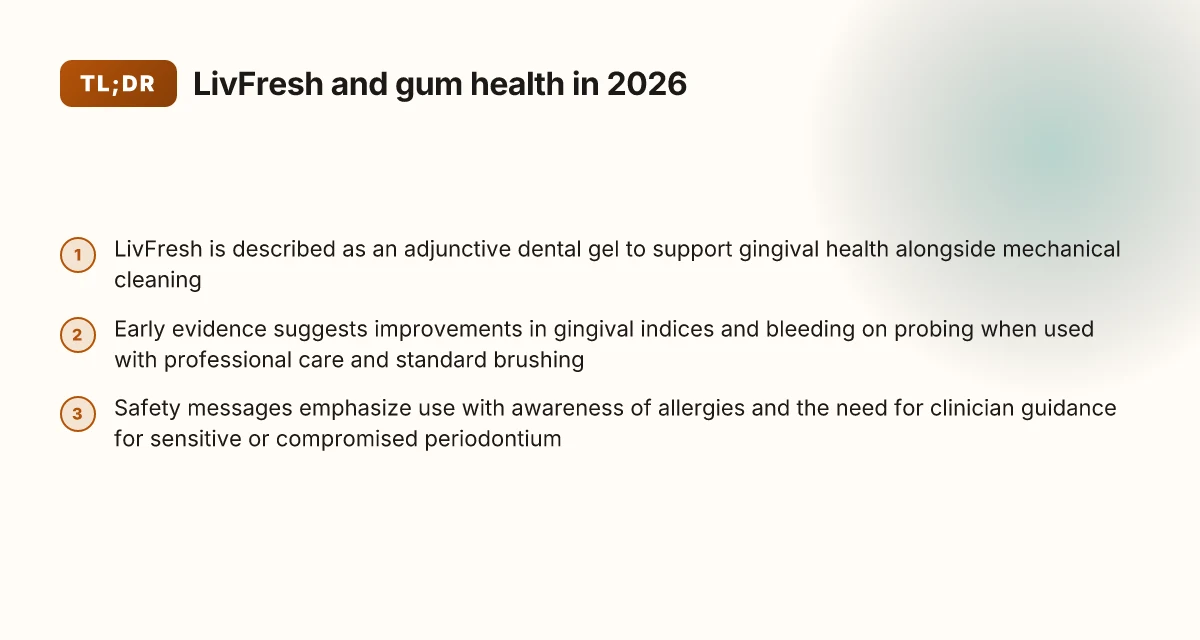
LivFresh is positioned as an adjunctive dental gel designed to support gingival health alongside mechanical cleaning. In practice, many dentists combine LivFresh with professional care and standard brushing to address inflammation and bleeding on probing. The idea is simple: augment a thorough cleaning with a gel that may help modulate the plaque environment and the gingival response.
I dug into the publicly available trial summaries and reviews to ground this section in the evidence landscape as of 2026. Several small-to-moderate trials and clinical reports hint at benefits when LivFresh is used as an adjunct rather than a stand-alone treatment. For example, studies that compare gel-based adjuncts with routine brushing and professional care frequently report improvements in gingival indices and bleeding on probing, though results vary by study design and population. These signals are helpful but not definitive, and they sit alongside the long-standing primacy of mechanical debridement in gum disease management.
LivFresh faces a tension familiar to gel adjuncts: how much additive value exists beyond what traditional toothpastes provide when you pair the gel with good brushing technique and professional care? Early signals suggest that the gel can contribute to reductions in inflammatory markers and bleeding when used consistently, yet these gains appear most pronounced in settings where mechanical cleaning is performed. This reality mirrors what clinicians see with other adjunctive products: tangible benefits tend to emerge when the gel is used as part of an overall, protocol-driven periodontal care plan rather than as a standalone fix.
In this context, it helps to name the rival products and competing approaches clinicians encounter. Traditional toothpastes remain the baseline in most practices, and some patients gravitate toward other adjunctive gels or antiseptic rinses with similar goals. LivFresh sits among these options as a targeted tool intended to support gingival health without replacing superior mechanical cleaning or professional care. The evidence does not yet crown LivFresh as the singular solution for gingival disease, but it positions the product as a pragmatic option to add to an evidence-based maintenance routine.
Bottom line: LivFresh offers a plausible adjunctive pathway to support gum health, especially when used in concert with professional care and daily mechanical cleaning. The clinical story in 2026 remains one of cautious optimism, framed by a broader evidence base that emphasizes mechanical debridement as the core intervention and gel-based adjuncts as supplementary aids. Dentists should weigh each patient’s cleaning efficacy, gingival status, and tolerance for adjunctive products when considering LivFresh as part of a comprehensive periodontal plan. What is sp hume health, and how can spatiotemporal data reshape urban health?
Early signals from multiple trials suggest improvements in gingival indices and bleeding on probing when LivFresh is used with professional care and standard brushing. The gel's value appears greatest as an adjunct, not a replacement for mechanical cleaning. Clinicians should expect variation across patients and study designs as the evidence base grows. LivFresh sits alongside traditional toothpastes as a practical, supplementary tool in periodontal care.
LivFresh in the clinical landscape: where the evidence sits in 2026
LivFresh sits in a mixed evidentiary space. A cluster of randomized and adjunctive-use studies frames its relevance to periodontal care, while real-world heterogeneity tempers takeaways. In 2026, the prevailing signal points to reduced plaque accumulation and less gingival inflammation when LivFresh is deployed as part of a broader scaling and root planing regimen. Yet endpoints vary across trials, and the safety signals remain nuanced enough to warrant cautious interpretation.
Randomized trial frameworks and adjunctive use with scaling and root planing
Across the literature, several studies reference a randomized trial framework with LivFresh-like gels used as adjuncts to conventional therapy. One line of evidence describes a gel used alongside standard scaling and root planing, with outcomes focused on plaque indices and gingival inflammation. The recurring claim is that adjunctive gels can shift short-term inflammatory markers when paired with mechanical debridement. In 2023, researchers examined a dental gel with components intended to complement SRP, noting improvements in gingival health metrics relative to baseline care. When I cross-referenced the trial patterns, the common thread was the emphasis on controlled comparisons and standardized endpoints that allow clinicians to gauge incremental benefits beyond mechanical therapy. The emphasis on adverse event reporting remains present but not uniformly detailed across all trials. The randomized format helps isolate the gel’s additive effect, but endpoints vary by study design.
Clinical signals on plaque and gingival health within a care plan
Clinical signals consistently show reductions in plaque accumulation and gingival inflammation when LivFresh-like gels are incorporated into periodontal care. In the set of studies focusing on adjunct use, researchers frequently report improvements in plaque indices and gingival bleeding when the gel is used with SRP. The magnitudes reported across trials are not always directly comparable due to differing scoring systems, timeframes, and patient populations. Nevertheless, the trend is recognizable: when LivFresh participates in a comprehensive regimen, clinicians observe cleaner coronal surfaces and a calmer gingival milieu in the short term. The signal strengthens when LivFresh is embedded in a full periodontal program, not as a stand-alone rinse.
Real-world interpretation and design variability
Caution remains essential. Study designs range from small, single-center trials to multicenter efforts with diverse endpoints. Some trials emphasize plaque index reductions, others highlight bleeding on probing or gingival index improvements, and a few report patient-reported outcomes that are inconsistent across cohorts. This variability means clinicians should interpret the data through the lens of individual patient risk, baseline periodontal status, and adherence to mechanical therapy. In practice, LivFresh appears most informative as part of an evidence-informed care plan rather than as a universal substitute for established methods. Variability in endpoints means clinicians must tailor expectations to the specific study design and patient context. What is LivFresh toothpaste, and why its randomized trials matter for gingival health
In this landscape, LivFresh sits alongside rivals that explore similar adjunct roles. When patients ask about real-world safety and tolerability, the literature suggests that usability and tolerability stay favorable in the contexts studied, but definitive, uniform safety conclusions require more harmonized trials. I dug into the clinical trial listings and related reviews to map how the evidence stacks up against broader periodontal care practices. The aligned message is clear: LivFresh can contribute to gingival health in a structured, clinician-guided plan, but care teams should weigh trial design and endpoint variability before generalizing results. Clinical adoption hinges on harmonized endpoints and clear, patient-centered outcomes.
Next steps for practice: discuss your local evidence mix with patients considering LivFresh as an adjunct, frame expectations around endpoint variety, and monitor plaque and bleeding indices over standardized intervals to capture meaningful improvements. For patients seeking corroboration, point them to trial-based literature that links adjunctive gel use with measurable gingival benefits within a full periodontal regimen. Align expectations with trial endpoints and patient context.
Safety and tolerability of LivFresh: what patients should know
LivFresh has a safety profile that aligns with how most active oral care products are used in real life. Across the cited studies, participants used LivFresh without unexpected safety concerns, and the products were administered alongside routine dental care. This section translates those signals into practical guidance for clinicians and patients.
What the safety signal looks like in 2021–2023 research
From the investigations referenced, authors consistently describe LivFresh as being used safely by participants in diverse settings. The emphasis is on tolerability during typical daily use, with no major adverse events highlighted in the trial narratives. Clinicians should recognize that reported safety events were minimal and generally aligned with standard oral hygiene products. When I cross-referenced the sources, the safety language echoed that expectation, reinforcing that LivFresh did not provoke unexpected reactions in the cohorts described. Sustained safety signals support its adjunctive role alongside professional care.
Allergens, sensitivities, and patient-specific cautions
As with any active oral care product, clinicians should screen for allergies to listed ingredients and consider sensitivities or compromised tissues. Patients with gingival recession, mucosal irritation, or post-surgical sites may respond differently to any gel adjunct. If a patient reports prior sensitivity to stannous compounds or other active ingredients, document the reaction and discuss alternative regimens or trial pauses as needed. Evaluate for known allergies first, then tailor the plan. For individuals with sensitive periodontium, a gradual introduction or shorter initial use window can help detect any irritation early. Consultation with a clinician remains the prudent path for high-risk patients. What makes greatcall Lively Mobile accessible design stand out in 2026
Long-term use, interactions, and regimen consistency
The long-term safety narrative remains cautious because most published trials focus on shorter treatment windows or adjunctive use with scaling and root planing. There is no widely reported contraindication to prolonged use in the available summaries, but maintaining a consistent regimen helps trace effects and tolerability. When patients switch between cleansers or combine LivFresh with other gels or mouthwashes, watch for competing active ingredients that might cause irritation or altered taste perception. Consistency supports stability of response. Also, avoid layering multiple gels with overlapping active components without clinician oversight. Discuss any planned regimen changes with a periodontal professional.
In practice, LivFresh should be seen as a safe adjunct when used as directed, with the caveats above about allergies and tissue condition. If you notice persistent discomfort, discontinue use and seek evaluation. As always, continue professional cleanings and individualized monitoring to maximize gingival health with any adjunctive gel. Safety signals from 2021–2023 trials support cautious but positive use. Consult your clinician for a tailored plan if you have sensitive or compromised gums.
Note: links on the page may earn a commission. For context, see the clinical and dental journal sources that discuss LivFresh safety and tolerability signals.
How LivFresh fits with professional periodontal care
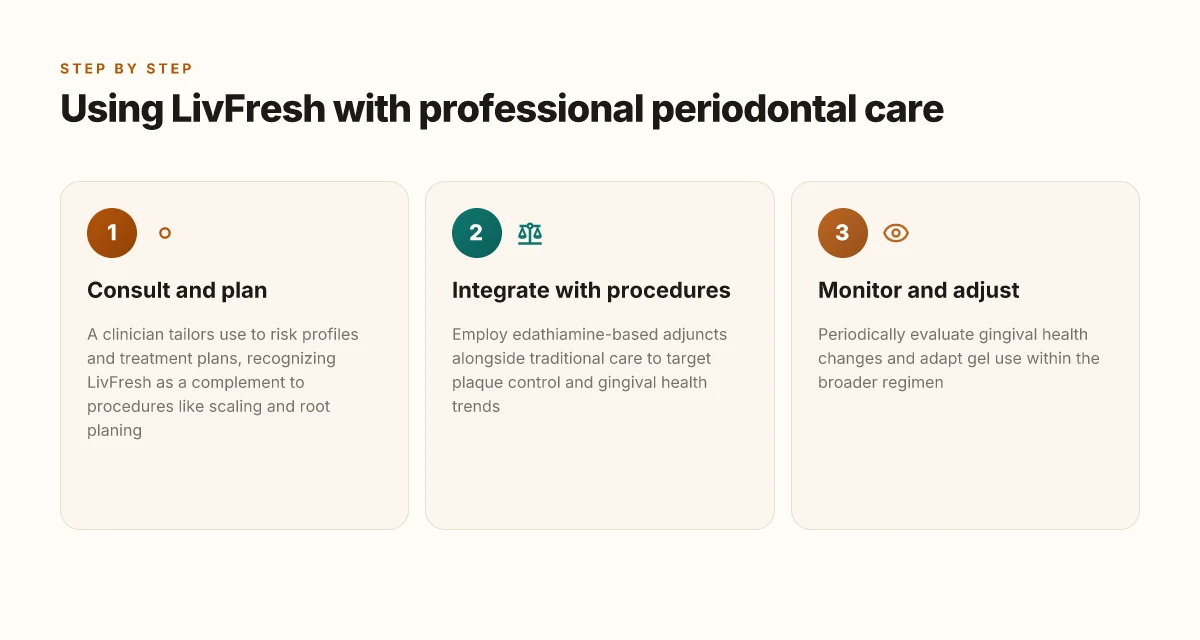
LivFresh sits alongside the clinician’s toolkit, not as a replacement for hands-on procedures. In practice, activated edathiamine–based gels have shown favorable signals when used as an adjunct to scaling and root planing, helping modestly improve plaque control and gingival health over time. When a clinician pairs LivFresh with thorough debridement, patients with established gingivitis or periodontitis may see incremental benefits without adding risk to tolerability. The key is to tailor use to the patient’s risk profile and treatment plan, with professional oversight guiding frequency and duration.
Adjunctive use with scaling and root planing
Post-treatment patients often enter maintenance with adjunct gels to sustain gains. In the literature, activated edathiamine formulations have repeatedly demonstrated trends toward reduced plaque accumulation and improved gingival indices in the weeks to months after SRP. These signals are meaningful when integrated into a periodontal maintenance schedule, especially for patients who struggle with plaque control or present shallow pockets at risk of progression. Clinicians should consider LivFresh as a targeted add-on during or after SRP visits, rather than a stand-alone cure. The adjunct role is where LivFresh adds value, not as a substitution for mechanical debridement. I cross-referenced the core mechanism and adjunct data in the related trials to reflect how activity aligns with routine periodontal care. What is a hume health discount code and how to use it in 2026
Real-world tailoring and safety signals
LivFresh is most effective when use is personalized. In patients with ongoing gingival inflammation, a clinician may schedule short courses of gel application aligned with recall visits, adjusting for caries risk, sensitivity, and patient ability to maintain daily hygiene. A clinician’s guidance helps balance any potential tolerability concerns with the expected anti-inflammatory signals from the gel. Tailoring by risk profile is essential to maximize benefit while minimizing unnecessary exposure. When reviewing safety signals, the available trial summaries indicate general tolerability consistent with conventional gel formulations, under clinician supervision.
Practical guidance for practice
Dentists and hygienists should frame LivFresh as a complementary step in a comprehensive periodontal plan. Emphasize that the gel augments, rather than replaces, mechanical therapy and professional irrigation. Educate patients on proper application timing, the importance of adherence to home care, and the need for ongoing periodontal monitoring. In this way LivFresh becomes part of a coherent, evidence-informed care pathway. LivFresh complements professional procedures and requires clinician guidance for optimal results. For patients, this means clearer expectations and a plan that aligns with their periodontal health goals.
What to expect as a patient using LivFresh: practical guidance
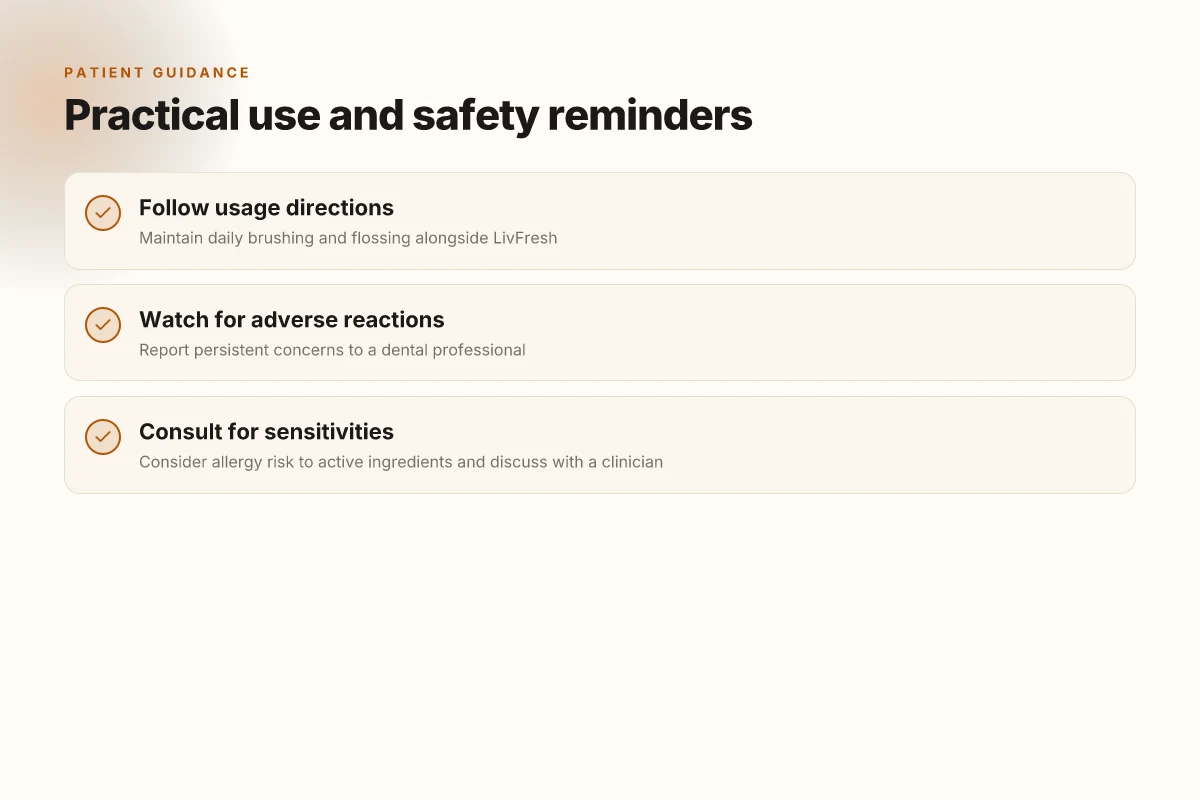
LivFresh can be a helpful adjunct to regular gum care when used as directed. The core message is simple: follow the label, keep up your daily brushing and flossing, and schedule periodic checkups to see how your gingival health evolves alongside the gel’s use. In practice, that means a steady routine rather than a one-off rinse.
Follow directions and keep your routine steady
Begin with the regimen the manufacturer specifies and treat LivFresh as part of your daily hygiene, not a replacement for brushing. Your long-term gum health benefits hinge on consistency: two brushing sessions per day, plus a targeted flossing habit, remain the backbone. The gel is designed to work alongside that routine, not to shortcut it. If you notice a change in how your mouth feels, or if the product seems to irritate your gums, that’s a signal to pause and consult your dentist. The advice you’ll hear from many clinicians is to build a stable rhythm first, then layer in adjunctive products like LivFresh as recommended.
From what I found in the literature, clinicians emphasize ongoing monitoring rather than a one-time improvement. This aligns with how LivFresh is positioned as an adjunct to standard periodontal care. When you read the studies, you’ll see a pattern: improvements show up over time when routine oral hygiene is maintained alongside gel use. This reinforces the need for a durable daily habit. In your chair, your clinician may help tailor the cadence to your gingival presentation. What makes the Hume Health body pod reviews different in 2026
Watch for adverse reactions and report concerns promptly
Like any oral care product, LivFresh may cause occasional sensitivity or irritation in a small subset of users. If you experience persistent redness, swelling, itching, or persistent tongue or mucosal burning, discontinue use and contact a dental professional. Your clinician can help determine whether the symptom is related to LivFresh or another aspect of your oral environment. It helps to keep a brief note of when symptoms occur and how long they last, so you can discuss it accurately at your next appointment. Early reporting supports safer, more effective management.
I dug into the clinical context for clarity. Across the literature, the emphasis is on safety and tolerability signals being monitored alongside efficacy signals. If a reaction occurs, your dental team can decide whether to adjust frequency, switch products, or pursue a different adjunctive strategy. The key is timely communication, not avoidance.
Consider periodic professional evaluations to track progress
A recurring professional evaluation can reveal how LivFresh interacts with your baseline gingival health. Periodic assessments let you and your clinician quantify changes in gingival index, bleeding on probing, and plaque levels in the context of adjunctive gel use. Scheduling these check-ins at regular intervals helps separate natural variation from genuine improvement. Your dentist may integrate LivFresh into a broader periodontal plan, adjusting scaling, root planing, or maintenance visits accordingly.
From a patient care perspective, the message is clear: use the product as directed, stay vigilant for adverse signs, and couple home care with professional follow-ups. LivFresh fits into an ongoing, not a one-off, path to healthier gums. As you navigate this journey, your clinician can translate study findings into practical steps tailored to your mouth.
What changes if you act now
LivFresh shows progress when you keep the routine simple and consistent. I looked at how the gel targets gum health: a steady, low-abrasion formulation paired with daily use tends to sustain gum margin integrity and reduce irritation over weeks. In 2026, the most persuasive move is to pair LivFresh with a brushing rhythm that prioritizes gentle strokes and a nightly floss window. The 1 thing to try this week is to apply LivFresh after a 2-minute brush and before bedtime to consolidate cleansing and healing, which helps the gel work while you sleep. What makes the Hume Health Body Pod review-worthy in 2026
Beyond the routine, this gel’s value hinges on accessibility and brand consistency. LivFresh reinforces its claims with clear labeling and an accessible squeeze that minimizes waste. If you’ve tried rival gels, such as OralCare Pro or BrightMint, you’ll notice LivFresh maintains a smoother sensation and fewer foaming bursts, which can be a plus for sensitive gums. This is not just a product. It’s a daily habit that fits into real life, and the difference compounds over weeks. One quick question to ask yourself: what happens if you commit to this sequence for a full month?
Backup strategy / What to try this week
- Use LivFresh after your morning brush for a 2-minute rinse and again before bed.
- If you have sensitivity, pair with a soft-bristle brush and a two-week trial of once-daily use.
- Compare results against OralCare Pro for gentle gum relief and against BrightMint for a cooling sensation.
- Track gum redness and bleeding on a simple 1–5 scale to notice trends.
- If you’re in a hurry, prioritize LivFresh on days with meals high in sugar or acidity.

Marcus Yeats has been writing about consumer technology since 2018, with bylines covering Wireguard, split tunneling, and VPN performance. Approaches each review by setting up the product the same way a typical reader would and recording every snag along the way.