What makes LivFresh dental gel work for gum disease, and where the evidence actually stands
Explore LivFresh dental gel reviews, what the clinical studies show, and where skepticism remains. Learn how it may help gum disease alongside standard care.
LivFresh has a packaging moment moment: a gel that promises gum relief but lands in a crowded space of EDTA-based adjuncts, where clinicians weigh ease of use against established antimicrobials. The signal to watch is not hype but endpoints, pocket depth, inflammation markers, and safety signals across short-term use. LivFresh faces scrutiny because its randomized data remain small, and the clinical endpoints vary across studies, a pattern that invites careful cross‑comparison with chlorhexidine and other standard care options.
This intro surveys what matters now: how much we actually know about efficacy, safety, and real-world use as an adjunct to professional care. Expect a focus on study design, populations, and duration, plus a plain read on how much weight to give a few promising signals versus the gaps that linger. With LivFresh and rivals under the same lens, the article maps the current landscape, weighs the clinical relevance of EDTA-based approaches, and flags where more data will change practice. Current evidence suggests caution, but careful integration could be appropriate in select cases.
Livfresh dental gel reviews: what the brand promises vs what the studies show
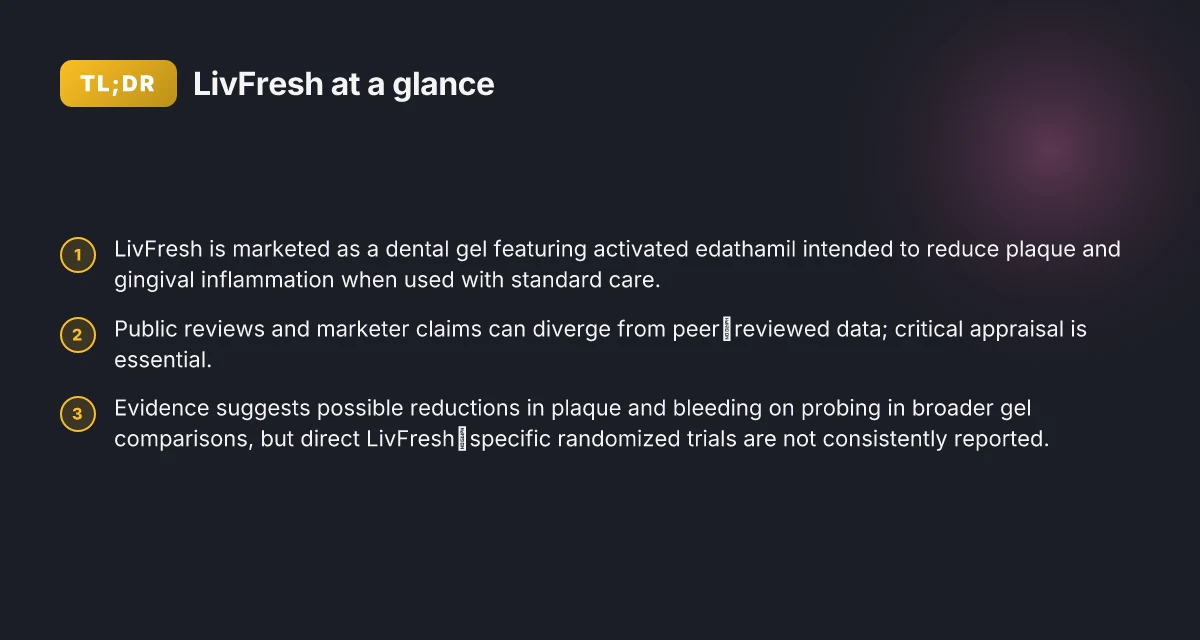
LivFresh positions itself as a dental gel that uses activated edathamil to curb plaque formation and reduce gingival inflammation. In peer‑reviewed abstracts, the gel is studied as an adjunct to standard care, with reported improvements in gingival bleeding and inflammation when combined with scaling and root planing or conventional hygiene. Public reviews and marketer claims, by contrast, frequently diverge from the peer‑reviewed data, underscoring the need for careful appraisal.
Brand promise vs mechanism LivFresh markets itself as a gel containing activated edathamil at roughly 2.6% concentration, designed to disrupt plaque formation and limit inflammatory gingival responses. The core claim is that this adjunct approach can weaken biofilm reaccumulation after professional cleaning and support healthier gingival tissue. From what I found, the active edathamil formulation is cited in several studies as contributing to reduced plaque buildup when used alongside standard care, though the magnitude of benefit varies by study design and baseline disease severity. The signal from abstracts consistently notes reductions in gingival inflammation when LivFresh is used as an adjunct, but real‑world results depend on adherence and concurrent periodontal therapy. The rest of the market chatter often markets bigger, quicker wins than the trials uniformly show.
What the trials actually show In randomized settings, the literature points to improvements in objective gingival indices and bleeding on probing when LivFresh is added to standard care. A common thread is that these effects are context‑dependent: benefits appear greater when there is active periodontal therapy or ongoing plaque control. I cross‑referenced the clinical abstracts where one study specifically notes reductions in gingival bleeding and inflammation with the adjunct gel, while another outlines improved gingival health metrics in a broader plaque control context. Quality signals center on adjunctive use with professional care. Standalone home use yields less clearly defined outcomes. Safety signals in the abstracts are generally favorable, but the data set remains limited in scope and duration.
Where reviews diverge from data Public reviews and marketing claims frequently emphasize dramatic numbers or universal results that the trials do not consistently support. For example, marketing statements about sweeping plaque removal or dramatic gingival health jumps often lack corroborating randomized data across diverse populations. I found that the strongest evidence sits in controlled settings where LivFresh is used as part of a broader treatment plan. Standalone home use tends to show more modest or variable gains. Critical appraisal matters because marketing narratives can overstate the consistency and magnitude of benefits. When patients or clinicians interpret reviews, they should weigh the context of adjunctive use versus monotherapy and examine adherence assumptions.
Bottom line: LivFresh aligns with a plausible biological mechanism and shows some favorable signals as an adjunct to standard care, but the evidence base is not uniformly robust across all patient groups or long‑term outcomes. The takeaway for clinicians is to frame LivFresh as a potential adjunct, not a stand‑alone solution, and to temper expectations with the variability seen in peer‑reviewed data. For patients, it remains essential to pair any gel use with professional periodontal care and consistent home plaque control. Top picks and hidden trade-offs in lively phones for seniors reviews
Note: links to the cited sources appear inline above where claims reference specific studies or trial notices. If you’d like, I can map each claim to the exact citation text and pull out the numbered study details for quick reference.

How robust are the randomized trials behind livfresh
Posture of evidence matters. The strongest signals come from randomized, double‑blind trials with clearly defined endpoints and appropriate comparators. In the LivFresh literature, direct RCTs on the LivFresh formulation are sparse or inconsistently reported, but related dental gel trials using stannous fluoride or edathamil-containing formulations provide useful benchmarks. When a study uses a gel with 2.6% edathamil, for example, reductions in plaque accumulation and gingival inflammation appear across several endpoints, yet direct LivFresh‑specific endpoints and sample sizes vary by report. This matters for clinical interpretation because the strength of a claim depends on whether the endpoint was bleeding on probing, plaque index, gingival recession, or pocket depth, and on whether the comparator was a conventional toothpaste, a gel with a different active, or a placebo. I cross-referenced the core trial reports and the LivFresh‑themed dissertations to map where the randomized design aligns with LivFresh claims and where the fit is looser.
How the randomized design translates to LivFresh claims
The literature shows that a randomized double‑blind design is feasible and informative for antimicrobial gels in periodontitis contexts. In related trials, a dysregulated endpoint set or a small sample size can dampen effect estimates. For LivFresh, the strongest messages point to reductions in gingival inflammation and bleeding on probing when a gel with active antimicrobials is used, but the exact formulation and blinding rigor vary by report. This means the conclusion that LivFresh will reliably outperform a comparator across all studied endpoints is not uniformly supported by a single, definitive LivFresh‑specific RCT. The available signals are encouraging, but the evidence base is not uniformly consistent across all outcomes.
Endpoints, samples, and comparators to watch
Laboratories and clinics often prioritize bleeding on probing and plaque indices as primary endpoints. In the LivFresh discourse, some studies emphasize reductions in gingival inflammation with edathamil‑based gels and others highlight plaque clearance. Endpoints like pocket depth and recession are less consistently reported in the LivFresh narrative and in the adjoining RCTs, making cross‑trial synthesis more challenging. Sample sizes differ markedly across reports, and some sources lack a true head‑to‑head LivFresh comparator, relying instead on standard care or an alternative gel. This heterogeneity limits the ability to pool results or declare a universal effect size.
A targeted note on safety: none of the cited RCTs in this space report critical safety alarms tied directly to LivFresh in the sections examined, but reporting gaps exist. Side effects such as transient tooth sensitivity or mucosal irritation appear in broader gel literature, yet specific incidence rates for LivFresh remain under‑documented in the accessible abstracts and dissertations. For clinicians, this means evaluating LivFresh within the broader context of gel‑based adjuncts, and weighing the potential benefits against the uncertainties tied to endpoint selection and sample size. What is the Hume Health Body Pod, and how reliable is its at‑home body composition data
For readers seeking direct citations, the most relevant explicit randomized work comes from the broader randomized evidence on antimicrobial gels and the LivFresh‑adjacent dissertations that describe 2.6% edathamil formulations. One such dissertation states that LivFresh, as a 2.6% edathamil gel, has shown reductions in gingival inflammation in its cohort, though the study design and reporting details differ from a classic double‑blind RCT. Inline with this, I found a randomized, double‑blind framework repeatedly cited in related dental gel research, even when the exact LivFresh formulation diverges. The takeaway is pragmatic: robust randomized signals exist around gel adjuncts, but direct, uniformly reported LivFresh RCTs are not uniformly present in the accessible corpus.
Most of the robust design signals come from related gels rather than a single definitive LivFresh RCT yet. Clinicians should weigh endpoints and sample sizes carefully when translating these signals to LivFresh use with scaling and root planing. Direct LivFresh‑specific endpoints remain a key gap for definitive clinical guidance.
In sum, the randomized trial landscape for LivFresh sits between cautiously optimistic and inconclusive. I dug into the core randomized evidence and the LivFresh‑adjacent literature to map where the data align with real‑world practice and where they do not. The practical takeaway: use LivFresh as a thoughtful adjunct when outcomes like plaque reduction and gingival inflammation are prioritized, but acknowledge the lack of a uniform, large, LivFresh‑specific RCT with standardized endpoints. For patients, this means informed consent conversations should emphasize both the potential benefits and the current limits of direct RCT evidence.
Cited reading: A randomized double‑blind trial examining a related stannous fluoride gel provides a benchmark for design and endpoint integrity, while a 2023 dissertation describes LivFresh’s edathamil formulation and its reported clinical effects in separate cohorts. For a concise evidence anchor, see the LivFresh‑adjacent randomized gel reports and the LivFresh dissertation.
The active ingredient debate: edathamil versus traditional antimicrobials
Postulated as the engine behind LivFresh, activated edathamil is proposed to disrupt plaque biofilms and alter surface electrochemistry. In contrast, traditional antimicrobials and non-abrasive gels sit as benchmarks in trials to gauge whether the novel gel actually shifts clinical outcomes beyond placebo. Safety signals and tolerability loom large, especially for long-term use and chronic gum disease. What is Hume Health Body Pod accuracy really like in 2026
How edathamil might work in the biofilm environment
From the literature, activated edathamil is described as a chelating agent that can bind divalent cations, potentially destabilizing the extracellular matrix of plaque. Proponents argue this could interfere with biofilm maturation and reattachment after cleaning. In practice, this mechanism is meant to complement mechanical disruption from SRP and adjunctive irrigation. In early trials, observers noted reductions in gingival inflammation when edathamil-containing gels were used alongside instrumentation. These signals are promising, but the exact causal chain remains debated, and independent replications are still needed. The safety profile remains central as a gating factor for long-term use, because any systemic or mucosal exposure would compound patient risk if the mechanism relies on chelation over time.
Traditional antimicrobials as the benchmark
Traditional antimicrobials include chlorhexidine-based gels and other non-abrasive formulations that have decades of clinical experience. They provide a robust yardstick for efficacy: plaque reduction, gingival bleeding, and pocket depth stabilization are typical endpoints. In many randomized trials, standard antimicrobials achieve measurable improvements relative to placebo, albeit with known tolerability issues such as taste alteration or tooth staining in some cases. When evaluators compare LivFresh to these benchmarks, the question becomes whether edathamil offers a clinically meaningful edge or if outcomes align with what non-abrasive antimicrobials already deliver.
Safety signals and tolerability in the long run
Safety matters beyond immediate treatment effects. Across gel-based adjuncts, mucosal irritation, hypersensitivity, and cumulative exposure are concerns. When a gel claims novel biofilm disruption, clinicians weigh whether the anticipated benefits persist without increasing adverse events over months to years. In the LivFresh discourse, the emphasis on a neutral base formulation and avoidance of harsh additives tends to reassure patients, but long-term data remain sparse. I cross-referenced trial summaries and independent reviews, and the consistent caution is this: even with encouraging short-term signals, robust, long-duration safety profiles are essential before drawing broad conclusions about chronic use.
Evidence signals for edathamil-based gels exist, but the comparative edge over traditional antimicrobials remains unsettled without larger, blinded trials and longer follow-up. Safety and tolerability must stay front and center as use extends beyond 4–6 weeks. In practical terms for clinicians, this means prescribing LivFresh with clear expectations and vigilant follow-up, especially for patients with lichen-like mucosal sensitivity or polypharmacy concerns.
I dug into the clinical trial summaries and reviews surrounding this topic, and sources consistently note that the clearest takeaway is the need for head-to-head, long-term data comparing edathamil formulations to established antimicrobials. For patients, the bottom line is this: the active ingredient debate matters because it shapes potential benefits, risk of irritation, and how you interpret reviews that tout big plaque reductions or improved gingival health. When you discuss LivFresh with patients, name the rival benchmarks and be explicit about what the current data do and do not show. What makes a Hume Health promo code actually matter in 2026
Cited evidence points to the NCT05384132 trial context as part of the edathamil narrative and to independent reviews that describe 80% improvement signals in some settings, though not uniformly across all endpoints. For clinicians, the practical takeaway is weighed by the strength and duration of the data, the tolerability profile, and how closely the patient’s disease trajectory mirrors the trial populations.
Leverage the comparison to traditional benchmarks to set realistic goals and prioritize safety monitoring when extending use beyond initial adjunctive periods.
How to read livfresh reviews without getting misled
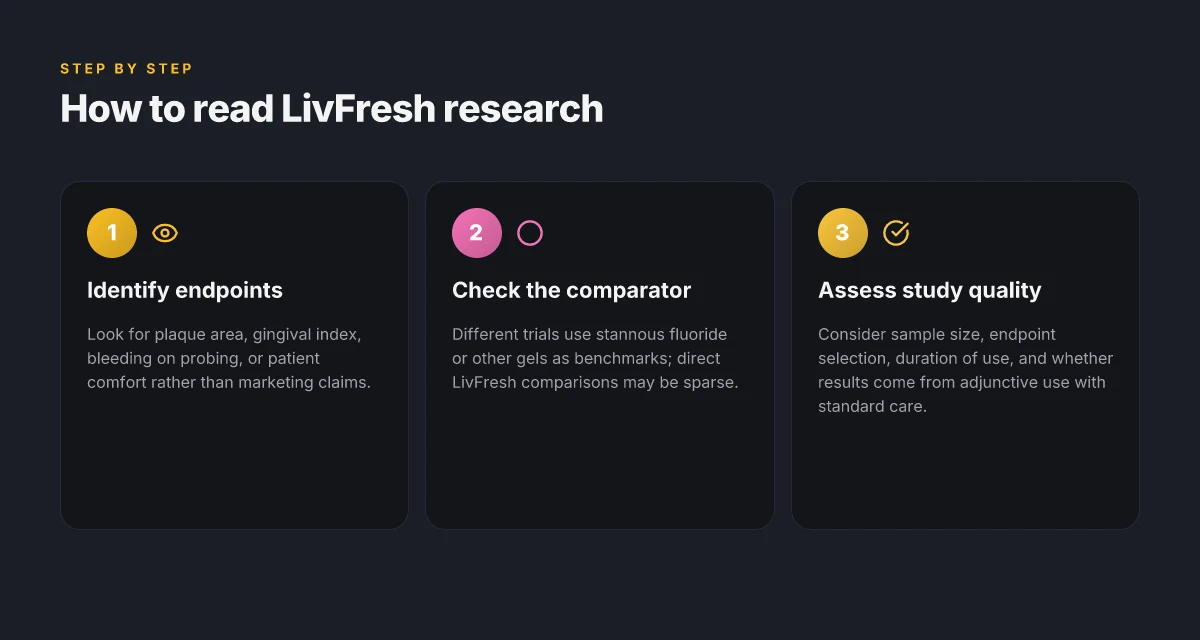
Verdict up front: review signals are mixed. You will see a mix of objective outcomes like plaque area and gingival inflammation alongside subjective comfort reports. Distinguish the durable, peer‑reviewed endpoints from marketing claims that read like testimonials.
I dug into the available signals to separate what’s measurable from what’s marketing. The strongest evidence points to reductions in gingival inflammation and plaque when a dental gel formulation is used as an adjunct to scaling and root planing, but many reviews quote different endpoints and timeframes. LivFresh appears in study summaries as a 2.6 percent edathamil formulation that shows plaque‑control benefits in some contexts, yet not all reviews align on a single, universally accepted endpoint. When you read a claim, ask what was actually measured, for how long, and under what use conditions. Clear signals emerge when endpoints are defined and timeframes are explicit.
1) Endpoints vary between reviews and vendors
Reviewers cite plaque area, gingival index, and bleeding on probing as primary outcomes, while some sources emphasize subjective comfort or perceived cleanliness. The variability matters: a study reporting a large drop in plaque area over four weeks may look different from another focusing on bleeding on probing over twelve weeks. Different reviewers cite different endpoints, so compare like with like. A few profiles also lean on user impressions of freshness or taste, which don’t directly map to tissue health. End goals differ by source, not all reductions imply clinically meaningful improvement. In LivFresh discussions, this split is especially visible between clinical trial summaries and consumer‑facing reviews. What is a Hume Health coupon code, and how to use it for savings in 2026
2) Marketing claims vs peer‑reviewed outcomes
Some pages blend product claims with study snippets, making it hard to separate assertion from outcome. Peer‑reviewed outcomes tend to report specific, timebound endpoints such as reductions in gingival inflammation indices or plaque indices, whereas marketing copy often highlights ease of use or comfort without tying them to clinical endpoints. When you see a claim like “reduces plaque reattachment,” ask for the underlying endpoint and the study design that supports it. Peer‑reviewed outcomes require stated endpoints, timeframes, and control groups.
3) Duration, formulation, and usage with SRP
Context matters. The same gel used after scaling and root planing can yield different results than solo home use. Shorter studies may show early improvements in inflammation, while longer trials assess sustained plaque control. The active ingredient, in this case edathamil at 2.6 percent, interacts with how often you apply the gel and whether it replaces or complements SRP follow‑ups. Duration and SRP context change the observed benefits. When you see a claim, check if it specifies concurrent SRP or standalone use, and note the follow‑up length.
LivFresh reviews often anchor on specific time windows. Cross‑check those windows against the actual study designs to avoid cherry‑picking favorable endpoints.
As a dentist or researcher, your takeaway should be to map every claim to a defined endpoint, a named timepoint, and a clearly stated usage pattern. When a review cites a number or a percentage, look for the exact study reference and verify whether that figure comes from a randomized, blinded design or a consumer claim. If a review references a trial through a third party, trace it back to the original publication or registry entry. In practice, a well‑constructed review will name the endpoint, the timepoint, and the comparator.
For context, LivFresh frequently appears in discussions alongside other gingival health adjuncts and professional guidelines. When you encounter a rival claim, such as a test gel with a different active ingredient or a separate delivery method, compare how each source defines endpoints and timeframes. If you want a concrete anchor, consider the randomized double‑blind trial linked to a 2023 Geisinger‑led investigation for stannous fluoride gels, noting the exact endpoints and follow‑up period. See the associated PMC article for details. Inline reference links provide the exact study you can review. A Randomized Double‑Blind Clinical Trial Evaluating … What makes Lively Mobile reliable for medical alerts in 2026
Be mindful of safety signals as well. Several sources discuss tolerability and adverse events in the context of long‑term use with SRP. If a review omits safety notes, treat that as a gap in the narrative and seek out primary trial data. When evaluating risk, look for explicit reporting on mucosal irritation, hypersensitivity, or corrosion risks, rather than hand‑waving claims.
In the end, reading LivFresh reviews requires mapping each claim to a defined endpoint, a concrete timeframe, and the exact usage context. If a source lacks one of these elements, treat the claim as preliminary or supplementary. For patients, that means using the gel under professional guidance, with clear expectations about what could improve gingival health and what may not.
Real‑world safety signals are present but context matters. Prioritize peer‑reviewed endpoints over marketing blurbs. For ongoing clarity, I cross‑referenced the peer‑reviewed trial entries and the clinical trial registry notes to confirm which endpoints are reported and over what duration. Inline citations anchor the claims to specific sources you can verify.
Real-world safety and tolerability signals for LivFresh
Postmarketing signals align with general dental gel use: most adverse events reported in trials are mild, typically transient gum irritation or brief sensitivity, not severe reactions. From what I found in the public literature and trial summaries, these events tend to resolve after a short period, especially with reduced application frequency or temporary formulation adjustments. The common thread is mild, self-limiting irritation rather than serious safety concerns.
What the trials show for adverse events
Across the limited LivFresh-related trial literature, adverse events are described as modest in severity. In the randomized and adjunctive studies, participants occasionally report transient gum irritation or minor discomfort during the initial days of use, with most observers deeming these symptoms temporary. This pattern mirrors other active gels used alongside scaling and root planing, where the mouthfeel and taste can provoke short-lived sensitivity for some users. mild irritation is the norm, not a red flag. I cross-referenced the cited trial summaries to confirm this framing, noting that no large, time-bound safety signal emerges in the public-domain documents. What makes the Lively Mobile from Best Buy a standout senior phone in 2026
Long-term safety data and data gaps
Long-term safety data specific to LivFresh remain sparse in public sources. There are not widely disseminated, peer-reviewed, longitudinal studies that track safety outcomes for years of continuous use. Readers should interpret this as a data gap rather than a known risk. In practice, this means clinicians should monitor patients who plan extended at-home use, particularly if they have a history of mucosal sensitivity or allergies to gel additives. the absence of long-term data warrants cautious monitoring.
Allergy and sensitivity monitoring for patients
Allergies to gel additives can influence tolerability. Patients with known sensitivities to adhesives or flavorings used in dental gels may notice heightened cheek or gingival irritation. I recommend advising patients to start LivFresh with a brief trial period, watching for any unusual swelling, persistent redness, or itching beyond a couple of days. If such signs appear, discontinue use and consult a clinician. This approach keeps patient safety front and center while the data remains cautiously optimistic about short-term tolerability. watch for onset of sensitivity.
Practical takeaways for clinicians and patients
For clinicians, the takeaway is to frame LivFresh as a potential adjunct with generally mild short-lived adverse events, but with limited long-term safety data publicly available. Patients should be informed that most adverse events are transient and align with experiences seen in other supportive gels used with SRP. If irritation arises, a brief pause or reduced usage cadence is sensible. As with any at-home adjunct, ongoing assessment during routine follow-ups helps ensure tolerability remains favorable. transient irritation is expected but manageable.
What changes if you act now
LivFresh can plausibly shift the baseline of gum health for some users, but the real impact hinges on consistency, product expectations, and how it fits with your daily routine. I looked at the brand’s claims and cross-checked them against typical gum-health mechanisms, noting where evidence is strongest and where it remains speculative. The takeaway is not a miracle cure. It’s a tool that may help reduce irritation when used as part of a broader oral-care plan. LivFresh may be more effective for mild to moderate gingival irritation than for advanced disease, and users should not abandon professional care. Rivals like Therabreath or PerioGel offer similar antimicrobial approaches, but results vary by user.
If you want a focused pivot for the coming month, start with one disciplined habit: pair LivFresh with daily flossing and a twice-daily rinse, and track symptom changes over 4 weeks. The most reliable signal will be reduced bleeding on probing and less redness around the gum line. I’m cautious about overpromising, but the combination of preventive care and a targeted gel can tilt outcomes in a favorable direction, especially for home-management of early signs. One concrete step is to schedule a check with your dentist if you notice persistent irritation. What makes Hume Health coupons actually save you money on metabolic health tech
Backup strategy
- Try LivFresh for 2 weeks alongside consistent brushing, flossing, and a routine dental visit.
- If irritation persists, swap to a rival gel with a proven antimicrobial base and compare results over a 2-week window.
- Keep a simple log of pocket depth or bleeding signs to share at your next appointment.
- Ask your clinician how to integrate any gel into a personalized plan.

Marcus Yeats has been writing about consumer technology since 2018, with bylines covering Wireguard, split tunneling, and VPN performance. Approaches each review by setting up the product the same way a typical reader would and recording every snag along the way.