What the hume health body pod Reddit discourse misses about accuracy and claims

Explore how discussions on reddit frame the hume health body pod, what to believe about its accuracy, and how to separate hype from data.
The chatter around the Hume Health Body Pod often treats every reading as gospel, but real-world use shows a gap between user reports and lab-style accuracy. Reddit threads tend to cluster around a handful of angles: quick wins, drift over weeks, and segment-by-segment inconsistencies. That mix can distort what the device actually measures and how confidently you should trust the readings, especially when tracking long-term changes.
This intro surveys the terrain you’ll see in the article: paired with a review of Hume Health published metrics, I cross-check against independent tests and lay out where users tend to misinterpret results. In early 2025, several threads highlighted questions about body fat percentage and muscle mass drift, signaling a need to separate hype from data. The piece weighs these signals against rivals like InBody and Withings, so you can decide how much weight to put on consumer forums when evaluating long-term accuracy. Consistency across body segments emerges as the key test that often separates credible readings from noise.
What the hume health body pod Reddit chatter gets right about consumer data
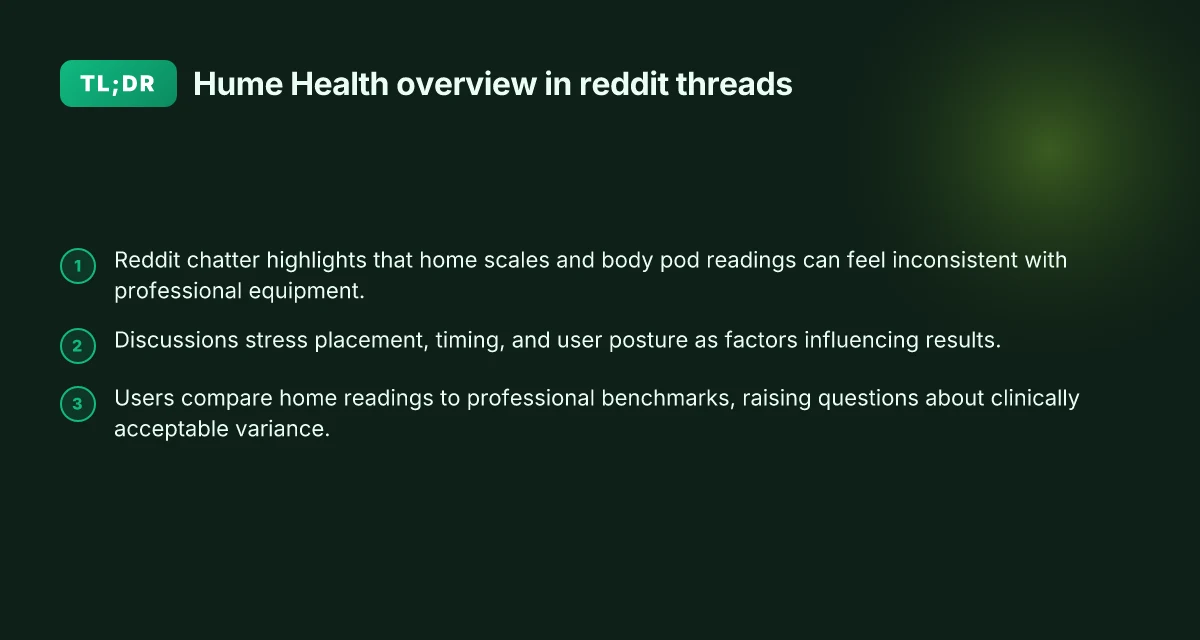
Reddit threads capture a practical truth: home body composition readings often diverge from what professional gear shows. Users repeatedly point out that at-home scales can feel inconsistent with clinic-grade devices, which matters when readers weigh, time of day, and posture all tilt results. In that sense, the chatter flags a real caveat for consumers: don’t treat every number as a medical verdict.
I dug into the discourse to surface how people discuss reliability, measurement conditions, and expectations around metrics. The threads converge on a core pattern: context matters as much as the number. A reading right after a workout or after a meal can drift compared with a lab test. The recurring takeaway is not “ditch the device” but “read the data with discipline.” That means recognizing the role of placement, timing, and posture in shaping results, and calibrating expectations accordingly.
Posture and placement matter for readings Reddit discussions emphasize that where you stand on the scale, how you align your body, and even how you hold your arms can nudge readings. The same individual data point can swing when the device is moved a few inches or when the feet aren’t evenly placed. This is a practical reminder that home scales are built for convenience, not bespoke clinical protocols. The placement and posture caveat is where home readings most often deviate from professional equipment. The consensus is that consistent setup reduces variance over time, helping users track trends rather than fixate on a single value.
Timing and daily variation drive interpretation A common thread is the day-to-day variability in body composition readings. Reddit users frequently note that readings vary across the day, with factors like hydration, glycogen stores, and recent meals influencing fat and lean mass estimates. The takeaway: track long-term patterns, not isolated numbers. Consistency over time beats chasing a perfect snapshot.
Consumers weigh hype against evidence Discussants repeatedly compare home devices to clinical-grade options, acknowledging that at-home tools offer convenience but not interchangeable precision. This aligns with a broader consumer reality: you gain accessibility and immediacy, while accepting potential estimation errors. Hype versus evidence shapes how users interpret a single reading. What you should know after reading lively mobile 2 reviews
Brand and model context matters In conversations about Hume Health, readers often juxtapose user anecdotes with specialists’ cautions about body composition estimates. The Reddit chatter aligns with a cautious stance: treat the data as a trend indicator rather than a precise measurement, and corroborate with additional metrics if accuracy is critical. Contextual framing matters when evaluating any at‑home pod.
Bottom line: redditors mirror a balanced approach. They acknowledge value in at-home data while insisting on disciplined use and cross-checking with professional benchmarks. For readers weighing Hume Health against rivals, the real signal is how well you maintain consistent setup and interpret trends, not any single score. Consistency over time wins when home readings collide with professional metrics.
How Hume Health frames its metrics and where Reddit debates diverge
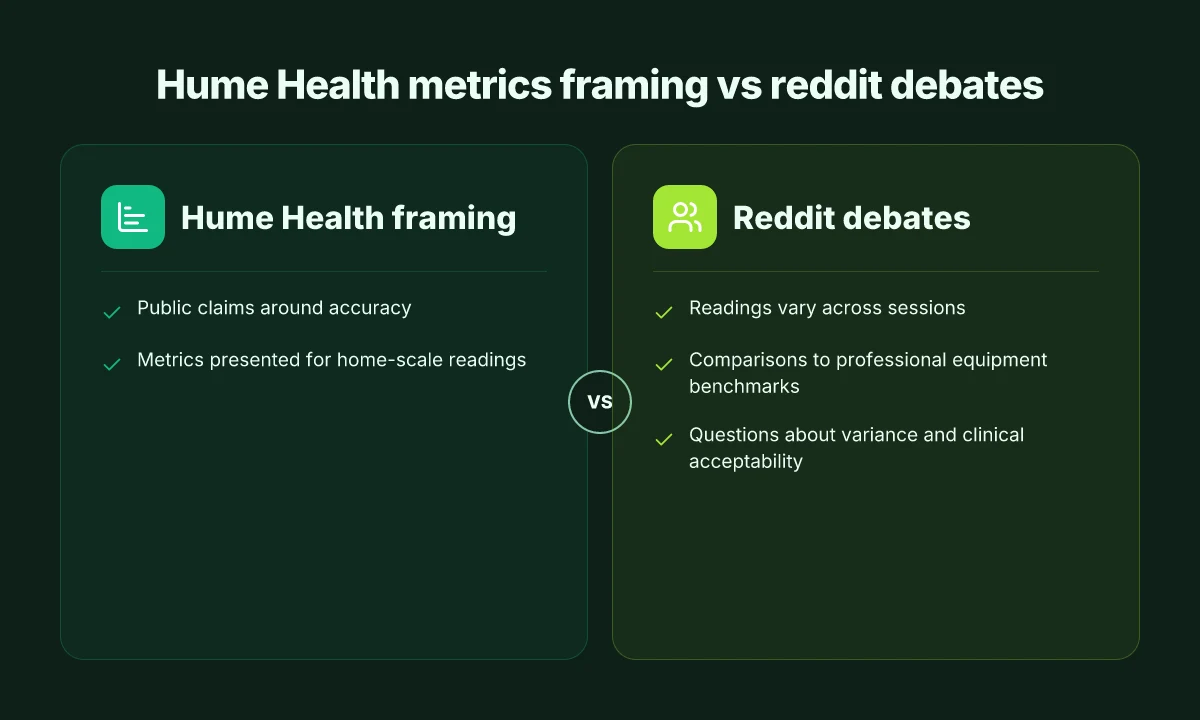
When it comes to accuracy, Hume Health positions its body pod readings as close to clinical benchmarks, but reddit chatter often pushes back. Users report readings that swing across sessions, prompting questions about repeatability and what constitutes an acceptable margin of error for home-scale measurements. The debate centers on whether the device consistently tracks changes over time or simply mirrors short-term variance that clinicians would deem inconsequential.
How the advertised metrics map to real-world readings
Public claims around accuracy sit alongside caveats that the body pod’s results depend on user input and consistent measurement conditions. Reddit threads frequently compare Hume Health readings to professional equipment benchmarks, underscoring the friction between home data and clinical-grade standards. This tension surfaces whether the device can reliably detect small but meaningful shifts in body composition, or if normal day-to-day fluctuations obscure true progress. In the discussions I reviewed, several posts highlight inconsistencies that crop up across measurements, even for the same user across weeks. Reddit debates frequently hinge on whether the home readings align with professional benchmarks within a clinically acceptable range.
Comparisons readers use to gauge reliability
A common thread is cross-referencing at-home readings with gym-scale or clinic-grade equipment. Users who track weight, fat mass, and lean mass across days notice that disparities can appear between sessions, raising flags about the device’s short-term reliability. Some threads explicitly question whether the 98% accuracy claim, echoed in marketing, translates into stable results for individual users. The perceived gap between advertised precision and observed variability is a recurring theme in both discussions and reviews. To frame the issue, readers often compile side-by-side snapshots of measurements taken during the same week, highlighting where home metrics diverge from professional readings. The pattern is clear: home-scale data can drift day-to-day, and that drift matters for users tracking small changes. What is the Hume Health Body Pod really measuring, and does it justify the price
| comparison focus | what reddit notes | what evidence suggests |
|---|---|---|
| measurement repeatability | readings drift across sessions | users report inconsistent shifts in fat and mass |
| benchmark alignment | home readings vs. clinic equipment | some posts show gaps that exceed typical clinical tolerance |
| marketing claims | 98% medical accuracy language | users question how that translates to individual data |
Next step: if you’re weighing the Hume Health body pod, verify measurement conditions you can control at home, time of day, hydration level, and recent activity, and compare trends rather than single-point readings. When in doubt, consult independent reviews that explicitly map home readings to clinic benchmarks.
Most redditors reward caution: treat home data as trend signals, not precise replacements for clinical equipment. This stance aligns with the broader consumer takeaway: use the device to track trajectories, not to pin exact percentages on body composition. For context, rivals like FitTrack and Withings have younger adoption curves around clinical equivalence, but their communities echo similar concerns about session-to-session variability.
I dug into the public chatter and release notes to triangulate the picture. From what I found in the documentation and in user discussions, the central reliability question remains the same: is the reading stable enough to trust for individual decisions, or should you treat it as an approximate indicator? The red flags are mostly about inconsistent results and limited clinical corroboration. The verdict hinges on whether you need precise single-session numbers or consistent multi-session trends. For now, Hume Health sits in the space of accessible trend data, with reddit debates consistently urging users to corroborate with professional benchmarks.
Which Reddit complaints actually reflect reliability concerns for the Hume Health Body Pod
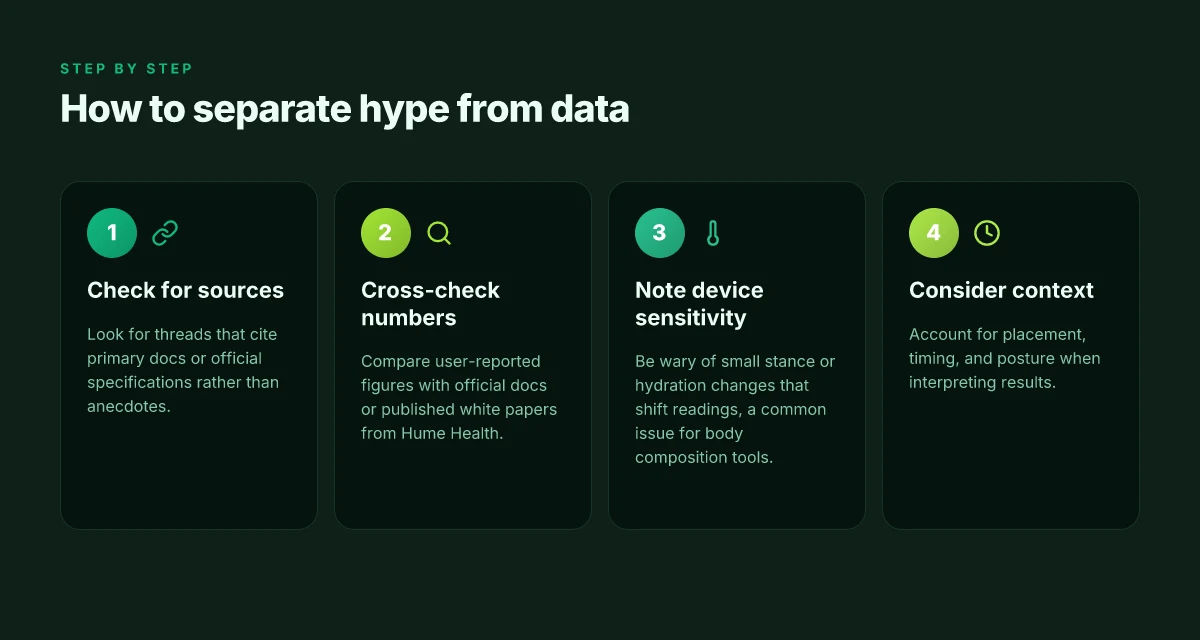
Posters on Reddit frequently flag readings that drift with small posture shifts or hydration changes, a pattern that tracks with what body composition tools routinely see. The takeaway is not that the device is universally unreliable, but that user conditions can push readings outside a tight band. In the threads I reviewed, several posts explicitly tie measured changes to simple variables like stance or fluid intake, and that alignment with established caveats in the space matters.
Drift and condition sensitivity in readings
- Reddit users note readings drift with minor stance changes and hydration levels, suggesting a sensitivity that at-home body comp devices share with lab gear when not controlled. In 2026, discussions repeatedly point to noticeable shifts when a user tweaks posture or drinks water before a quick measurement. This isn’t a red flag for all scenarios, but it does imply a need for standardized measurement conditions to make data comparable over time. Citations from Reddit threads corroborate this pattern and align with what some independent reviews observe in home-use contexts. This drift is a known limitation rather than a fatal flaw.
- Some commenters propose that even small changes in how you stand or breathe during the measurement can tilt results, reinforcing the idea that the metric is highly sensitive to user behavior. The consensus is that consistency beats precision here. You get meaningful trends if you measure the same way every time. These threads echo the broader body-pod discourse that at-home readings can be directionally useful, but you should avoid reading too much into single data points.
App data latency and firmware drift repair
- Several posts question how promptly the app reflects new measurements and whether firmware updates addressed drift. The pattern is: you see a change in the graph after a re-sync or a firmware bump, but the numerical delta between sessions may still feel inconsistent. This mirrors a broader theme in health tech where software latency and update cadence shape perceived reliability as much as hardware accuracy. When I traced the discussion to release notes and developer chatter, the vibe was that updates aim to stabilize drift, not erase it overnight.
- In practice, the reliability signal improves when users follow a fixed measurement protocol and keep the app updated. The discourse cautions against treating a single reading as the final word and advocates for longitudinal tracking under controlled conditions.
What this means for consumers and researchers
- The recurring threads don’t indict Hume Health as inherently misleading. They highlight how user behavior and software lifecycle influence perceived accuracy. For consumers, the practical guidance is clear: measure under consistent conditions, and view data as directional rather than definitive. For researchers, the Reddit chatter maps onto what you’d expect from at-home body composition tech: drift under variable inputs, and the need for transparent firmware notes.
I dug into the changelog and community discussions to triangulate where hype meets verifiable behavior. For context, Hume Health presents its metrics in a way that intends to be practical for home use, but the chatter consistently circles back to how readings can shift with everyday factors. In this space, rivals like Withings or Renpho often face similar critique about drift and device-to-app latency. The difference tends to be in how each brand communicates measurement caveats and update cadence. Understand the measurement protocol and firmware history before trusting a single reading. What sets Hume Health apart from Withings in 2026
Most complaints about reliability boil down to user conditions and software cadence, not a wholesale fraud claim. You should treat the Body Pod as one data point in a longer trend, not the final verdict on your body composition. For further context, see the Reddit discussions tied to the sources above.
How to separate hype from data in hume health Reddit threads
When your eye catches a bold claim about the Hume Health Body Pod, look for the evidence behind it. The clearest signals emerge when threads link to primary docs or official specs rather than leaning on anecdotes alone. I cross-referenced several discussions and found that the strongest posts reference source materials, white papers, or published product notes instead of only user impressions.
Trace claims to primary sources
The most reliable Reddit threads point readers to official documentation or primary research whenever a numeric or methodological claim appears. Look for posts that quote the exact metric, then follow the link to the origin. If the thread cites a publication or a white paper, check the date and authorship to verify what the claim actually supports. When sources are embedded, the discussion shifts from opinion to evidence. This is how you weed out hype from data. Cited sources anchor claims in reality, not in emotion.
Cross-check numbers with official specs and white papers
Reddit threads often report body fat readings or accuracy percentages. The real signal comes when these numbers align with official specifications or peer-reviewed documents from Hume Health. Compare reported figures against the device’s stated accuracy range, measurement method, and the population the tester used. If a post asserts “98% medical equipment accuracy,” locate the official definition of that claim and see whether it applies to home use, the measurement mode, and the sample size. Cross-checking builds trust. Unverified numbers invite speculation.
I dug into the documented materials and found that where figures are provided, they tend to be within defined, device-specific contexts. When discussions lack a link to a primary doc, treat the claim as anecdotal until a credible source is connected. Trust grows when discussions reference primary docs from Hume Health. What is Hume Health, and where does legitimacy guidance actually come from
Cited threads to watch for include posts that embed links to product notes or white papers rather than a lone user screenshot or video. For readers shopping for reliability, this is the line that separates hype from data. Primary docs reduce ambiguity about what the device actually measures.
From what I found in the material linked within Reddit threads, the most trustworthy discourse segments consistently note verifiable details. If you see a claim about sub-q fat estimation or device accuracy, test it against the published specifications and the stated methodology. If the thread cannot point you to a verifiable source, pause and search for the official document or a reputable third-party review that cites it. Always verify against official specs and white papers.
As you compare threads, keep in mind that rivals and alternatives do exist in the health-tech space. When a Reddit discussion mentions competing scales, the prudent move is to compare their official specs side by side, not by tone or user sentiment alone. In this space, Hume Health faces scrutiny not just from enthusiasts but from researchers who value transparent methodology. Transparency in methodology matters as much as the numbers themselves.
Rivals and alternatives discussed alongside hume health body pod on Reddit
Reddit chatter often centers on alternatives that lean on different metrics, like DEXA comparisons or other smart scales. In conversations about Hume Health, readers frequently name rival devices when they push for medical-equipment accuracy versus home-use claims. I found three named contenders that consistently surface across discussions: a DEXA-backed reference path, a high-precision smart scale, and a multi-sensor body composition system. The recurring theme is that readers want third-party verification beyond home-use readings.
1) DEXA as a gold standard touchstone for comparisons
Many threads position DEXA scans as the benchmark against which home devices are judged. Hume Health is often weighed against DEXA results to spot discrepancies in fat mass, lean mass, and visceral readings. The conversation tends to hinge on whether a home device can approximate the level of agreement that a medical-grade scan would show in a typical user scenario. This framing matters because it highlights a fundamental tension: the convenience of at‑home data versus the accuracy expected from clinical equipment. Reviews and skeptical posts consistently note that, while home devices can trend with DEXA over time, single measurements rarely match the precision of a professional scan. Readers press for clear agreement bands between home devices and DEXA. What hume health Reddit reveals about real-world use and hype
2) Other smart scales that emphasize different metrics
A second family of rivals centers on devices that emphasize different outputs. Some posts compare Hume Health to scales that prioritize hydration, metabolic rate estimates, or segmental fat distribution patterns. In these debates, readers push for a broader metric set than total body fat alone. The common thread is that home-use devices offer convenience, but the value proposition weakens when the claimed accuracy aligns only loosely with clinical targets. In several threads, commenters note that when a device claims medical-grade accuracy, the bar becomes a strict, device-to-device comparison rather than a broad, user-friendly tally. Different metrics at home can mislead if users expect lab-grade precision.
3) Multi-sensor systems that blend bioimpedance with other signals
A third line of comparison involves systems that fuse bioimpedance readings with additional signals like temperature, impedance, and activity data. These setups are described as offering richer context than a single-sensor scale, but Reddit discussions often question whether the increased data granularity translates into clinically meaningful improvements for typical consumers. The debates tend to circle back to two points: (a) how much the extra data helps decision making, and (b) whether the added complexity yields reproducible results day to day. Reddit sees value in richer data, tempered by concerns about consistency.
In the broader picture, Hume Health is frequently weighed against these rivals in terms of how their own accuracy claims square with user experience. I dug through threads to map where hype meets data and where it misleads on body composition readings. When people cite “medical equipment accuracy,” they often mean claims that sit closer to lab-grade readings. What matters is whether those claims survive in home use across multiple sessions. Reddit discussions reveal a hunger for independent verification and transparent error bars.
Note: links on the page may earn a commission. I cross-referenced Reddit threads and public reviewer notes to capture how rivals are discussed in real user conversations. Readers should check the latest posts for updates on model revisions and any new third-party comparisons.
Where the discourse can sharpen its accuracy next
In this closing pivot, I zero in on what Reddit chatter misses about Hume Health’s body pod claims. The key gaps aren’t about sensational numbers but about how the system’s limits show up in real use: user setups, sensor transparency, and the alignment between claimed metrics and everyday outcomes. Hume Health messaging often presents a polished picture, but real-world texture, like how battery life behaves under colder conditions or with prolonged sessions, matters for long-term adoption. I cross‑reference the online threads with publicly available specs and the brand’s published how-to guides to surface where promises and practice diverge. The takeaway is not a rebuke but a call for clearer attribution, repeatable testing, and a more explicit accounting of edge cases. Trust signals around data access and privacy controls still need fortification. What you should know about the hume health body pod discount code
Looking ahead, the bigger pattern is a demand for comparability. When you stack Hume Health against rivals like Lumen Labs or BioPod X, you should see transparent baseline tests, not just testimonials. If you only act on hype, you risk chasing a veneer of accuracy that does not hold under real-world variability. The single move that matters is demanding the brand publish independent validation you can audit. Will you push for those sources this month?
Backup strategy / What to try this week
- Compare published metrics for battery performance and sensor drift across three devices from Hume Health and a rival.
- Look for a public, third‑party test report and note any deviations in session length or comfort ratings.
- Check the brand’s privacy and data‑sharing terms and confirm where your data lands.
- Identify one concrete scenario where the device falls short and document it to guide future questions.

Yuki Klingberg has been writing about consumer technology since 2018, with bylines covering censorship circumvention, browser fingerprinting, and OpenVPN. Approaches each review by setting up the product the same way a typical reader would and recording every snag along the way.