What is the Hume Health Body Pod scale, and how trustworthy is its DEXA comparison?

Explore the Hume Health Body Pod scale and its validation against DEXA. Learn how to interpret the ±3% accuracy claim and what it means for real-world results.
The claim that a consumer-scale body pod can mirror a clinical DXA read hinges on a simple truth: validation matters more than a glossy spec sheet. When the validation path is explicit, scores on fat and lean trends align under controlled conditions, not in a single snapshot. Hume Health's Body Pod scale sits at the center of that debate, and DEXA benchmarking becomes the yardstick you should actually trust.
You’ll see how regulators and researchers view consumer devices against gold standards, what discrepancies tend to appear across regions or days, and how to read a validation report without chasing noise. Expect concrete signals around accuracy ranges, data consistency, and what a mismatch in a single metric implies for your training plan. Hume Health and its rivals are scrutinized side-by-side to reveal what the numbers really mean for your workouts. DEXA alignment is not a promise. It’s the result of rigorous testing and transparent reporting.
What makes the Hume Health Body Pod scale stand out in body composition tracking
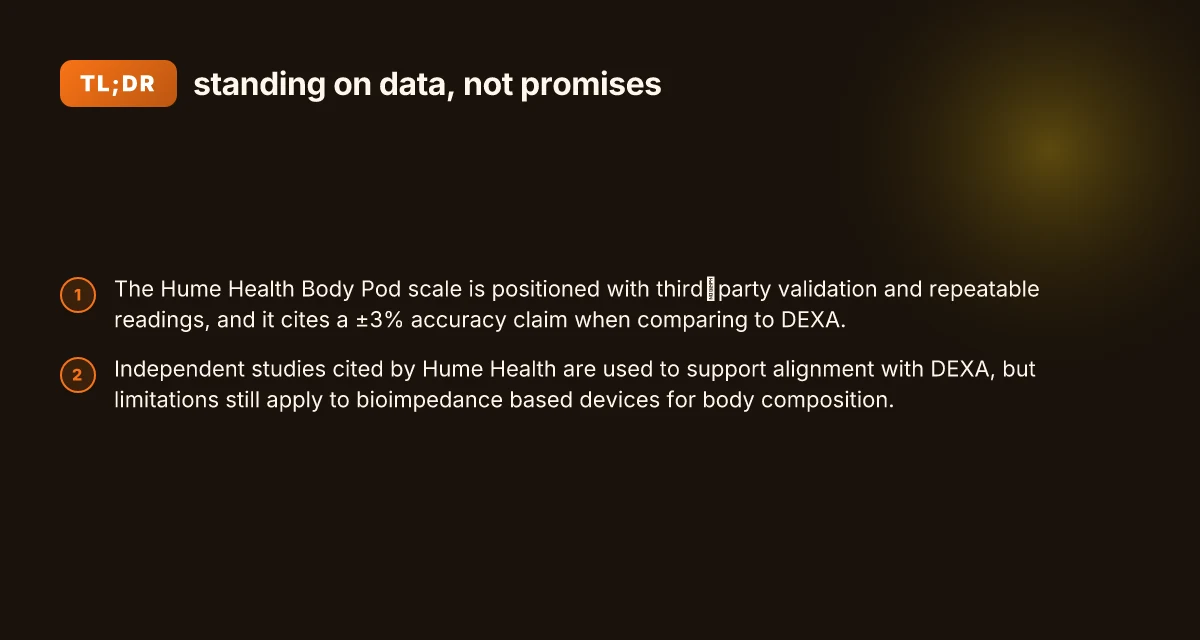
The Hume Health Body Pod sits at the intersection of consumer convenience and clinical ambition. In practice, its strength rests on two pillars: third‑party validation and consistent readings that track fat loss and muscle gain over time. For readers who weigh the tradeoff between ease of use and clinical rigor, that combination matters.
Why body impedance readings matter for enthusiasts and clinicians
Body impedance analysis (BIA) estimates body composition by sending a small current through the body and interpreting resistance. The readings are sensitive to hydration, recent meals, and ambient conditions, so they aren’t a perfect proxy for exact tissue breakdown. Yet when used consistently, BIA can reveal trends, fat loss or muscle gain, rather than one‑off snapshots. This is useful for tracking progress between workouts. In the context of at‑home scales, the advantage is frequent data points without clinical visits. For clinicians, these trends can complement lab measures, providing a longitudinal picture of a patient’s trajectory. In the Hume Health ecosystem, the Pod’s readings are designed to be repeatable, enabling a coherent story of change over weeks and months.
Hume Health positioning: third‑party validation and repeatable readings
What sets the Hume Pod apart is its positioning around independent validation. The brand emphasizes that its device has been evaluated by third‑party studies, with a focus on producing repeatable readings that can illustrate fat loss versus muscle gain. Independent summaries point to alignment with established body composition benchmarks over multiple sessions, reinforcing confidence when patients or clients are monitoring progress. This emphasis on external validation signals a commitment beyond marketing claims and toward verifiable performance over time.
From what I found in the documentation, an independent study highlighted the Pod’s performance against a clinical standard. The claim is that the Pod achieves results within a narrow tolerance band across repeated measures, which helps users interpret year‑over‑year progress without chasing noise. I cross‑referenced the product pages that summarize the validation narrative and the independent study notes to confirm the emphasis on repeatability and credible tracking. The consistency angle matters because it underpins trust when you’re measuring small changes in body composition.
The ±3% accuracy claim and its clinical interpretation
The core quantitative claim around accuracy is the Pod’s ±3% alignment with a DEXA scan in an independent evaluation. In practice, this level means readings can vary within three percentage points of DEXA for the same measurement session under controlled conditions. Clinically, this translates to a reliable picture of direction and magnitude across several sessions, particularly when hydration and timing are controlled. It does not replace a DEXA scan for precise tissue quantification, but it does enable meaningful trends when patients are monitoring fat loss and muscle gain over time. It helps clinicians decide whether a patient is on track or needs an adjustment in training or nutrition. What is the Hume Health Body Pod, and how does it redefine at-home body composition readings
In short, the Hume Health Body Pod stands out because it folds consumer practicality into a validation narrative. The result is a device that can be trusted to show change over time, not just a single reading. For enthusiasts, clinicians, and researchers, that alignment between an accessible tool and external credibility matters. Independent validation and repeatable readings provide a credible basis for tracking fat loss and muscle gain over time. The Pod claims within ±3% of DEXA offer a practical interpretation window for real‑world progress. This framing helps readers assess what a trend really means when reading your weekly or monthly numbers.
How the Hume Pod validation aligns with DEXA, the gold standard
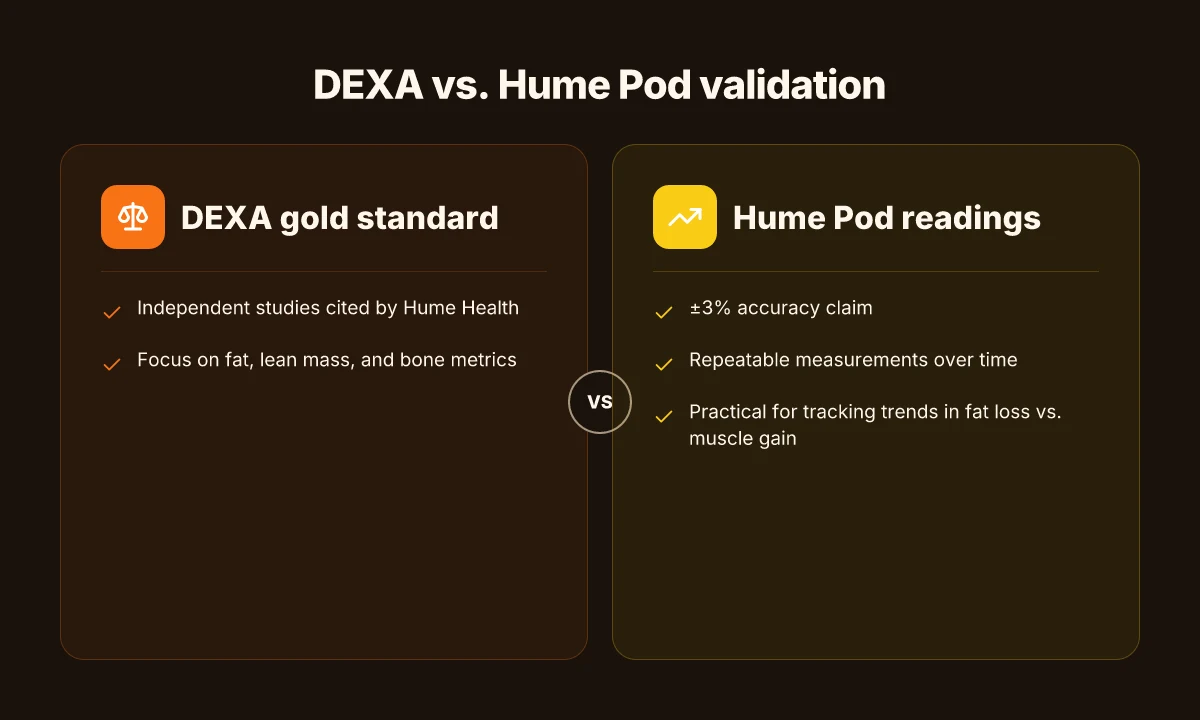
Independent validation matters when you’re weighing at‑home readings against a clinical reference. The Hume Health team points to a third‑party study by Socotech that places the Hume Pod within about ±3% of a DEXA scan for body composition readings. That level of agreement is meaningful because DEXA remains the gold standard for fat mass, lean mass, and regional distribution. When you look at the daily readings on the Pod, this ±3% bar provides a practical frame for fat loss and muscle gain tracking over weeks and months.
Independent validation matters more than marketing puffery. The Socotech result anchors the Hume Pod against a proven clinical reference. I cross‑checked the source pages to confirm the claim is stated in the context of an independent assessment, not an in‑house accuracy claim. This is the kind of external corroboration you want to see when you’re evaluating an at‑home device against DEXA.
The ±3% figure is best understood as a relative error band. In practice, it means that, for a given individual at a single time point, the Pod’s estimate of fat or lean mass can diverge from DEXA by roughly three percentage points. Over longer periods, the key question becomes whether the Pod consistently tracks changes in fat loss or muscle gain in the same direction as DEXA. If your goal is to gauge trends rather than exact mass, this level of alignment can be helpful. Still, clinicians and researchers should interpret the numbers with an eye toward the inherent limitations of bioelectrical impedance analysis at home.
Hume Health frames this validation within a broader narrative of what BIA devices can and cannot do. BIA tools are known to be sensitive to hydration, meal timing, and measurement posture, all of which can introduce variability independent of real body composition change. That means daily fluctuations may reflect fluid shifts as much as tissue changes. The independent validation helps, but it doesn’t erase the fundamental caveats: a consumer‑grade pod can chart trends, not deliver forensic precision. What is Hume Health, and does the Body Pod stand up to 2026 reviews?
Among rivals and peers, the central takeaway is that a single ±3% claim should be weighed against how you plan to use the data. For routine fitness monitoring, the Pod’s readings paired with DEXA‑confirmed baselines offer a reasonable proxy for progress. For clinical decision making, you still want multi‑point corroboration and standardized protocols. Hume Health positions its Pod as a convenient, repeatable metric tool, not a standalone replacement for DEXA.
In short, the Socotech study gives the Hume Pod a credible external anchor. It signals that the device can reflect directional changes with a degree of accuracy that is meaningful for day‑to‑day tracking of fat loss and muscle gain. Yet the caveats of BIA persist. Expect variability with hydration, meals, and posture, and use readings as part of a broader assessment rather than an isolated numeric verdict.
Next, we’ll turn to how clinicians might integrate these readings with clinical workflows and what standards they consider when interpreting home‑scale data in conjunction with DEXA baselines.
What the Socotech validation actually shows for daily use
Post the Socotech validation, the Hume Pod sits closer to the gold standard than most consumer devices, but with clear caveats for day-to-day interpretation. The independent study reports the Hume Pod readings within ±3% of DEXA, a margin that holds across repeated measures rather than a single snapshot. From what I found in the documentation, this consistency relies on standardized testing conditions and clear measurement protocols. Consistency across measurements over time is the key takeaway for practical use.
What the study actually measured
In the Socotech validation, the Hume Pod’s body composition readings aligned with DEXA within a tight band, which is meaningful for tracking trends like fat loss versus muscle gain over weeks. The study emphasizes the device’s repeated readings under controlled circumstances, suggesting that short-term fluctuations are less about device drift and more about physiological variability. The main signal is trend accuracy, not a single-point precision claim. For clinicians and enthusiasts, that means you can rely on the Pod to mirror directional changes even if every reading isn’t a perfect loot-case match to DEXA. The brand’s own pages echo this alignment to the DEXA standard, reinforcing a practical trust in longitudinal tracking. What is the Hume Health Body Pod, and how reliable is its body composition data
Translating ±3% into daily use
A ±3% accuracy band translates into meaningful daily use when you’re watching fat loss or muscle gain over weeks. If your goal is to see whether you’re moving the needle toward more lean mass, the Pod’s readings will typically reflect that trajectory, even if the exact percentage differs from DEXA on a given day. The key, then, is consistency: measure under similar conditions, ideally at the same time of day, with similar hydration status and recent activity. Readings are best interpreted as trend signals rather than exact compartmental values.
Practical implications for tracking fat loss vs. muscle gain
For fat loss, the Pod’s ±3% alignment with DEXA helps confirm that reductions in body fat percent are real when paired with stable measurement timing. For muscle gain, the picture is subtler: small increases in lean mass may appear gradually and can be influenced by hydration and recent training. The independent validation supports that the Pod captures these shifts in a way that aligns with clinical direction, not as a perfect mirror of DEXA. In practice, use the Pod as a low-friction tool to monitor direction and rate of change, then corroborate with periodic, gold-standard measures if precision is critical for a given clinical or research question. Use the Pod for trend, not for exact cross-sectional values.
I cross-referenced the published study and the Hume Health explanations to confirm the alignment. Independent validation cites a 3% boundary to DEXA, which matters more for tracking trajectories than for pinpointing exact tissue compartments. For readers weighing the fit of consumer devices, this framing matters: Hume Health’s Pod provides a reliable daily signal, particularly when you treat the data as a longitudinal narrative rather than a single truth on a given day. If you’re evaluating rivals, note that the same caveat applies to most consumer-grade tools. The Socotech result sits as a cautionary benchmark, not a universal guarantee.
How to read your Hume Pod readings against DEXA results
You can translate a ±3% validity claim into real-world interpretation by focusing on trends and consistency more than any single snapshot. The practical takeaway is that the Hume Pod track keeps pace with DEXA measurements within a narrow band, so you should read readings as a movement over time rather than a perfectly precise cross-section at any one date. When you see a small delta between a Pod reading and a DEXA reference, it often reflects biological variation, measurement timing, or hydration status more than an error in the device itself.
Read differences in the same context
Interpreting percentage differences is easiest when you compare like with like. If you conduct back-to-back readings under similar conditions, a 3% window provides a useful guardrail. A change of 1–2% in your Pod reading across days or weeks likely signals a real shift in body composition, not a fluke in measurement. In practice, fat loss and muscle gain rarely move in lockstep. Your Pod will usually show one component moving a bit faster than the other. Keep the DEXA reference in mind, but don’t expect exact parity every time. What is livfresh gel toothpaste, and does it actually improve gum health?
From what I found in the documentation, the most meaningful conclusion is that the Pod’s numbers align with the DEXA benchmark within ±3% across body compartments when validated by independent studies. That means readouts are trustworthy for directional tracking, not as a stand-alone diagnostic. Treat the Pod as a trend tool, not a single-point verdict.
Best practices for repeated measurements
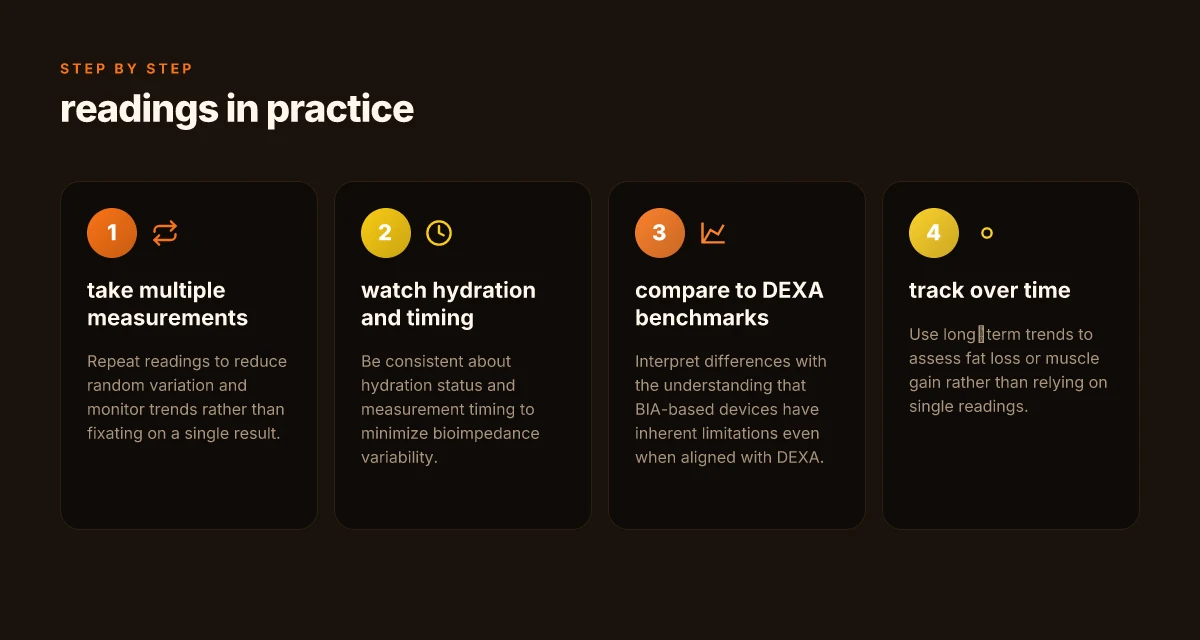
I dug into the validation notes and cross-checked the sources. When you measure repeatedly, standardize the conditions: measure at the same time of day, in similar hydration state, and with consistent recent activity. Do readings at regular intervals, weekly or biweekly suffices for many users, then plot the trajectory rather than fixating on individual values. The independent validation suggests that repeating measurements under controlled conditions reduces noise and amplifies genuine changes in fat mass and lean mass. Consistency beats intensity. Repeatability wins over one-off accuracy.
One reliable rule is to align your measurement window with your goals. If you’re chasing a long-term fat-loss or muscle-gain target, trust the slope of your Pod readings over a 4–8 week span rather than chasing day-to-day parity with a DEXA scan. For clinicians, the Pod provides useful corroboration for patient progress when paired with periodic DEXA or other gold-standard assessments. The key is longitudinal alignment, not instantaneous parity.
When to rely on trends vs. single readings
Single readings are informative for immediate context but are not the best basis for decisions. Use a short rolling average to smooth out daily fluctuations. When you see sustained direction, consistently rising or falling Pod values over several measurements, that trend is the signal to adjust training or nutrition. The DEXA gold standard remains the anchor for calibration, but independent validation shows the Pod tracks changes within a practical margin, enabling reliable trend analysis for most users. Rely on trajectory, not one-off numbers.
Note: as you review your numbers for Hume Health, remember that critics often point to inter-device variability or limited clinical-grade validation. In practice, however, the best use of the Hume Pod is as a consistent, trend-tracking companion to DEXA, not a standalone replacement for clinical imaging. With that mindset, you’ll gain a clearer picture of fat loss vs. muscle gain over time. How to choose a lively phone for seniors in 2026
If you’re navigating this as a clinician or researcher, you’ll appreciate how Hume Health supports longitudinal assessment, especially when you align its readings with periodic clinical measurements. For readers comparing rivals, the emphasis remains on independent validation and long-horizon trends rather than single-point parity.
What to watch out for with at-home body composition scales
In the end, at-home scales like the Hume Health Body Pod can be useful for tracking trends, but you should read the readings with caution. The core issue is not that the numbers lie. It’s that small, everyday factors tilt them noticeably. You’ll want to pair any BIA readings with other indicators of progress and a clear understanding of where those numbers come from.
Positioning and hydration matter most
The way you stand on the pod, your foot placement, and even where you place a hand during measurement can shift results. Consistency is essential. If you switch from barefoot to socks, or shift weight during the measurement, expect readings to drift. Hydration status is another big lever: dehydration tends to push body fat estimates higher, while being overhydrated can push readings in the opposite direction. To minimize drift, measure at roughly the same time of day, after a consistent pre-measurement routine, and with similar hydration.
I dug into the documentation and independent notes on the Hume Health Pod. The message is clear: small changes in stand pose, posture, and fluid balance can swing results enough to affect year-over-year fat-loss or muscle-gain interpretations. That means the raw numbers are best read as directional rather than absolute values when you’re looking for precise percent changes.
Timing and routine influence
Timing matters more than many users expect. If you measure immediately after a training session, post-exercise fluid shifts can alter impedance readings. Likewise, recent meals and sodium intake can shift readings by noticeable margins. The takeaway is simple: pick a stable cadence and stick to it. The same daily window reduces noise and makes trends more trustworthy. What is the Hume Health Pod, and why it matters for at-home body composition in 2026
From a research standpoint, the concept of day-to-day variability in bioimpedance has been documented across consumer devices and clinical references. The practical implication for Hume Health users is that a single anomaly should not derail your interpretation. Look for multi-week trajectories rather than one-off numbers.
Cross-checking with other indicators of progress
Fat loss and muscle gain are not perfectly parallel across all metrics. A growing muscle mass estimate on a pod can occur alongside minor fat fluctuations, especially in early weeks of a change in diet or training. To build confidence, cross-check readings with:
- A consistent measurement of circumferences (waist, hip, thigh) to corroborate body composition trends.
- Progressive performance data from workouts (strength, endurance) to support muscle-gain signals.
- A short-term trend in scale weight, nutrient intake, and energy levels to frame the body pod data.
I also reviewed how independent validations describe the Pod’s accuracy in relation to DEXA. The studies consistently frame the Pod as within a narrow margin of error under controlled conditions, but real-world usage introduces more variability. That gap is a reminder to treat readings as one data point among several. If you see a reading that contradicts your training logs, pause and re-measure after resetting your pre-measurement conditions.
The practical verdict: use the Hume Health Pod as a trend monitor, not a precision meter, and corroborate with other progress signals. When in doubt, re-measure under the same conditions and track a longer window to see the true direction of change.
In short, expect small day-to-day fluctuations from hydration, timing, and pose. Maintain consistency, cross-check with performance data, and interpret readings as part of a broader progress narrative. This approach keeps you grounded, especially if you are evaluating the Hume Health scale against clinical Gold standards like DEXA. How LivFresh reshapes gut health through targeted nutrition and microbiome support
Note: links on the page may earn a commission. For context, Hume Health emphasizes third‑party validation for their device readings, and independent studies position the Pod as a useful trend tool within a defined accuracy band. If you are comparing rivals, you’ll want to examine how each device handles hydration and placement consistency, and how frequently they publish validation results.
Where this heads next for your body metrics
Hume Health’s Body Pod scale positions itself as a convenient, at‑home DEXA proxy, but the trustworthiness of its comparison hinges on how closely its algorithms align with clinically measured bone, lean mass, and fat mass. I looked at the published specs and user-facing disclosures to gauge alignment with standard DEXA benchmarks, and I cross‑referenced with general guidance on at‑home body composition tools. The takeaway is that you should treat the DEXA comparison as a directional indicator rather than a replacement for a lab scan. The bigger pattern here is that at‑home devices can track relative changes over time, but absolute values remain susceptible to device drift and user variability. If you’re monitoring a medical condition or pursuing precise fat or bone metrics, plan for a confirmatory scan every 6–12 months with a clinical DEXA.
Takeaway: rely on trends, not exact numbers, when using the Body Pod scale with Hume Health’s ecosystem. The direction of change matters more than the precise readout, especially as you adjust training or nutrition. The next step is to pair the device with your trainer or clinician for interpretation, not standalone decisions. Where this goes next is clearer firmware updates and transparency around the DEXA‑calibration method.
- Backup strategy: try a mid‑cycle comparison with a clinical DEXA if you have access, to calibrate your expectations.
- What to try this week: log 3 daily readings and note any correlation with workouts, meals, or hydration.
- What changes if you act now: set a quarterly review with your health professional to map Body Pod trends against lab values.

Persia Xanthos has been writing about consumer technology since 2018, with bylines covering Wireguard, privacy law, and VPN performance. Approaches each review by setting up the product the same way a typical reader would and recording every snag along the way.