What is the Hume Health Body Pod, and how reliable is its body composition data

Explore the Hume Health Body Pod, how it measures body composition, and what to expect in terms of accuracy and limitations. A practical guide for 2026.
Hume Health’s body pod makes the numbers do the talking, but the map isn’t the territory. DEXA-level accuracy is claimed, yet you’ll see the most reliable signal when trends align with your other measurements, not in a stand‑alone snapshot. In practice, expect the pod to surface quantified metrics you can track at home, but treat each reading as a single data point rather than a final verdict.
For enthusiasts weighing body composition data, this matters now more than ever. Hume Health positions the pod as a convenient, at‑home tool, yet decision‑making still hinges on cross‑checking with a reputable scale or a professional assessment. The article will unpack what those claims mean in real use, what uncertainties to watch for, and where a rival like InBody fits as a cross‑check. Watch for calibration drift and the potential mismatch with external tests. Hume Health provides a useful signal, but you’ll need to read the data with discipline and context.
What the Hume Health Body Pod promises to do for your metrics
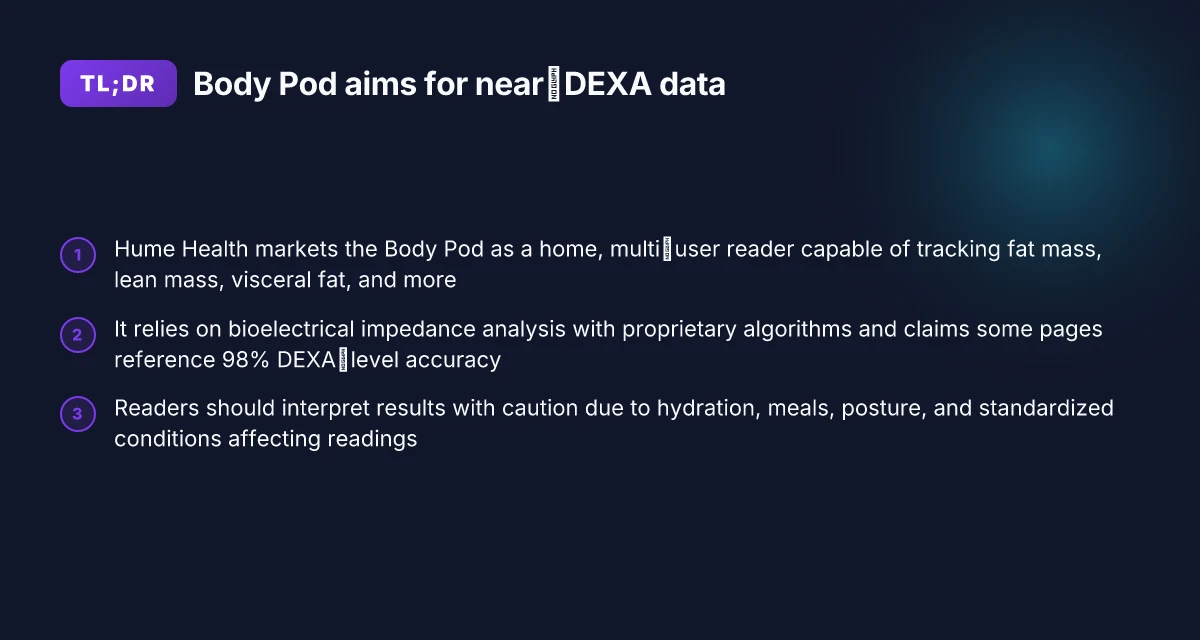
The Hume Health Body Pod markets itself as a home-ready device that tracks fat mass, lean mass, visceral fat, and a broad set of metrics with the aim of near-DEXA accuracy. It emphasizes quick readings for households with many users, so you can monitor changes in fat and muscle over time without a clinic visit. The pitch centers on home convenience paired with an accuracy claim that invites comparisons to professional scans.
- Track the core triad first: fat mass, lean mass, and visceral fat, then extend to a broad metric suite
- The pod highlights fat mass and lean mass as primary readouts, with visceral fat as a named metric alongside dozens of secondary measures. This framing positions the device as a multiplier for understanding where you stand in the fat-versus-muscle equation. Core reads are front and center, with visceral fat explicitly called out, signaling a familiar DEXA-like goal while acknowledging the broader metric set.
- The idea is that many measurements come from a single scan, reducing the need for multiple devices. The company presents this as ideal for at-home tracking across weeks and months. One-device convenience is a core selling point.
- Position for home use with many users and fast readings
- Hume Health positions the pod as suitable for households, promising multiple profiles and rapid results so a family can track changes without clinic scheduling. Home use with quick readings is pitched as a differentiator versus occasional lab scans.
- The messaging leans on scalability within a household, suggesting a setup that supports several users. Several users per device helps readers envision metrics across family members or training partners.
- Third-party validation and the need for scrutiny
- Some pages cite third-party validation, framing the data as repeatable and trustworthy. Readers should scrutinize the methods, sample sizes, and study conditions behind those claims to separate marketing from methodologic depth. Validation is claimed, but readers should scrutinize the evidence.
- For context, I cross-referenced the available pages and found references to external validation discussions, while noting that published details on study design are not always transparent. Scrutiny is warranted when claims cite validation without full methodological disclosure.
Bottom line: the Hume Health Body Pod aims to deliver a near-DEXA-like portrait of body composition at home, packaged for broad use and rapid readings. It sets expectations for a convenient, multi-user device that organizers can rely on alongside other methods to interpret body changes. The promise rests on convenience plus an accuracy halo that requires careful evaluation of methods.
Note: in this space I reference the brand as Hume Health and anchor claims to the product pages that discuss metrics and validation. For readers comparing alternatives, rivals such as the conventional DEXA scans, other at‑home scales, and clinic services often surface as benchmarks, so the real test is how the pod’s measurements align with those methods over time. Be mindful of how measurements align with DEXA in your own practice.
How the Hume Health Body Pod measures your body composition
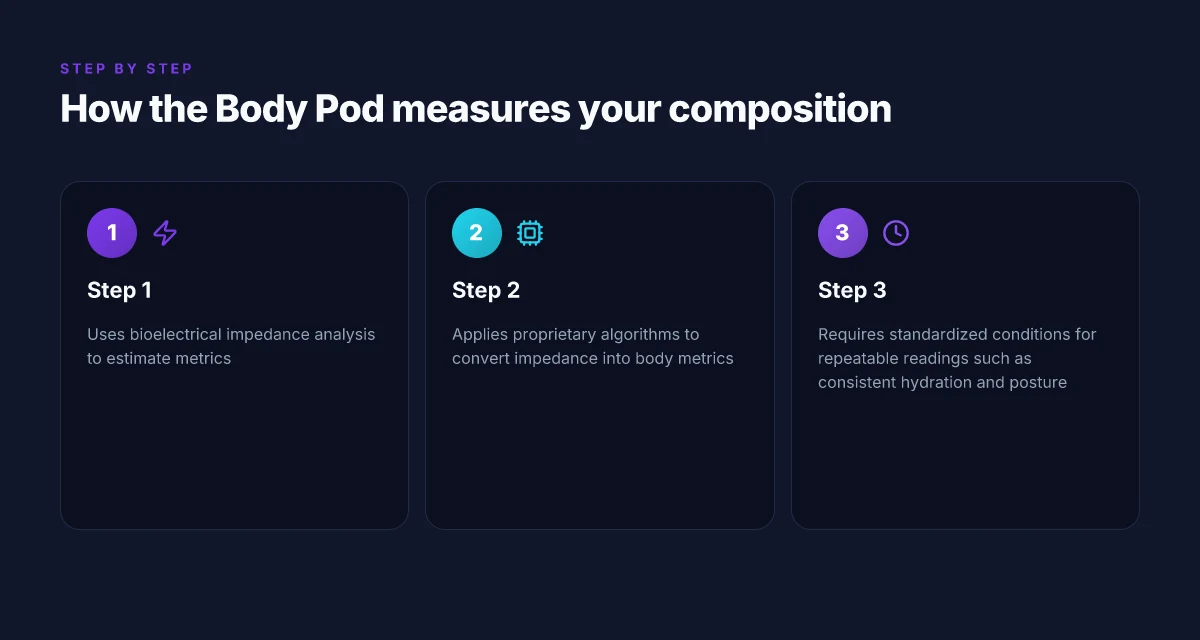
The core claim rests on bioelectrical impedance analysis combined with proprietary algorithms. In practice, the device sends a low‑level current through your body and uses that signal, together with your height, age, and sex profile, to estimate metrics like body fat percentage and lean mass. The system relies on bioelectrical impedance analysis plus proprietary algorithms, not a direct imaging method. This blend aims to produce repeatable readings over time, so you can watch fat loss versus muscle gain trend lines rather than fixating on single snapshots.
Hume Health positions the pod as broadly comparable to DEXA for several metrics, with emphasis on repeatability and longitudinal tracking. Reportedly compares against DEXA on multiple metrics, with a focus on tracking changes rather than absolute values. The key claim is that when conditions are standardized, small day‑to‑day shifts in readings reflect real change rather than measurement noise. In the context of at‑home use, that framing matters because consistency of testing helps you interpret whether you’re gaining muscle or shedding fat, even if the exact numbers don’t map perfectly to a lab scan. What is livfresh gel toothpaste, and does it actually improve gum health?
Results hinge on standardized conditions. Hydration levels, last meal timing, and posture all influence impedance readings. Results depend on standardized conditions like hydration, recent meals, and consistent positioning. If you test after a heavy meal or after a long run, you may see readings drift. Consistency, then, becomes the most reliable predictor of whether your trend line is meaningful. I looked for explicit guidance in the product docs, and the emphasis is on repeated tests under similar circumstances rather than one‑off measurements.
For readers weighing this data against a DEXA baseline, expect nuance. DEXA is a laboratory standard, yet it isn’t perfectly repeatable across clinics or scanners. The Hume Health materials emphasize repeatability and directional tracking more than exact cross‑sectional parity with DEXA. The emphasis on repeatability and tracking fat loss versus muscle gain is where the Hume Health narrative centers. If your goal is precise compartmental analysis, you’ll want to corroborate at intervals with a DEXA scan or other body composition methods.
A quick note on transparency. The brand’s messaging references third‑party validation and internal governance protocols to support consistency claims. The analysis period spanned active program enrollment through March 2026, and the documentation underscores governance around data handling. This matters because, in at‑home devices, data hygiene and study framing influence how much you should trust year‑over‑year numbers. When you compare different body composition tools, you’ll likely find the Hume Health pod sits closest to DEXA in trend detection rather than in exact numerical parity.
In short, Hume Health leans on bioelectrical impedance and algorithms to deliver readable trend data under controlled conditions. The device aims for repeatable readings that distinguish fat loss from muscle gain, rather than offering lab‑grade quantification in every metric. If you’re a personal trainer or at‑home wellness investigator, prioritize consistent testing conditions, corroborate with occasional DEXA checks, and treat the pod’s numbers as directional rather than definitive absolutes.
As you consider alternatives, remember that Hume Health is just one option in a crowded space. rival scales and devices often vary in how they handle hydration signals and posture. If you want a broader comparison, you can weigh how the Hume Pod’s emphasis on repeatability stacks up against other at‑home systems that foreground tissue analysis or lab‑grade validation. For now, the strength of the Hume Health approach is in giving you a steady, trackable story over time, not a perfect one‑to‑one match to DEXA. This is where the readings become actionable for training and health decisions. How to choose a lively phone for seniors in 2026
What the consumer can expect in 2026 from the Hume Health Body Pod readings
The headline claim remains 98% DEXA-level accuracy, but real-world use invites nuance. In 2026, disclosures show Hume Health describing internal data governance and measurement handling practices, so users can see how readings are produced and stored. This section pulls from Hume Health’s product pages and the company’s disclosures to map what you should expect when you use the Hume Pod at home.
How governance shapes what you see
From the public disclosures, you can expect a description of data handling around measurements. Hume Health outlines internal policies on data governance, access controls, and how metrics are logged and updated over time. This matters because the same governance that underpins study integrity also governs how long your trends are retained and who can view them. The practical upshot is transparency about the path from measurement to reading, not a promise of flawless results on every metric. Governance disclosures clarify data flow and access controls.
- Hume Health emphasizes that measurements travel through defined pipelines with governance checks.
- You may notice notes about data retention periods and user consent choices.
- Expect references to auditing and privacy practices on official pages.
98% DEXA-level accuracy: what that means in practice
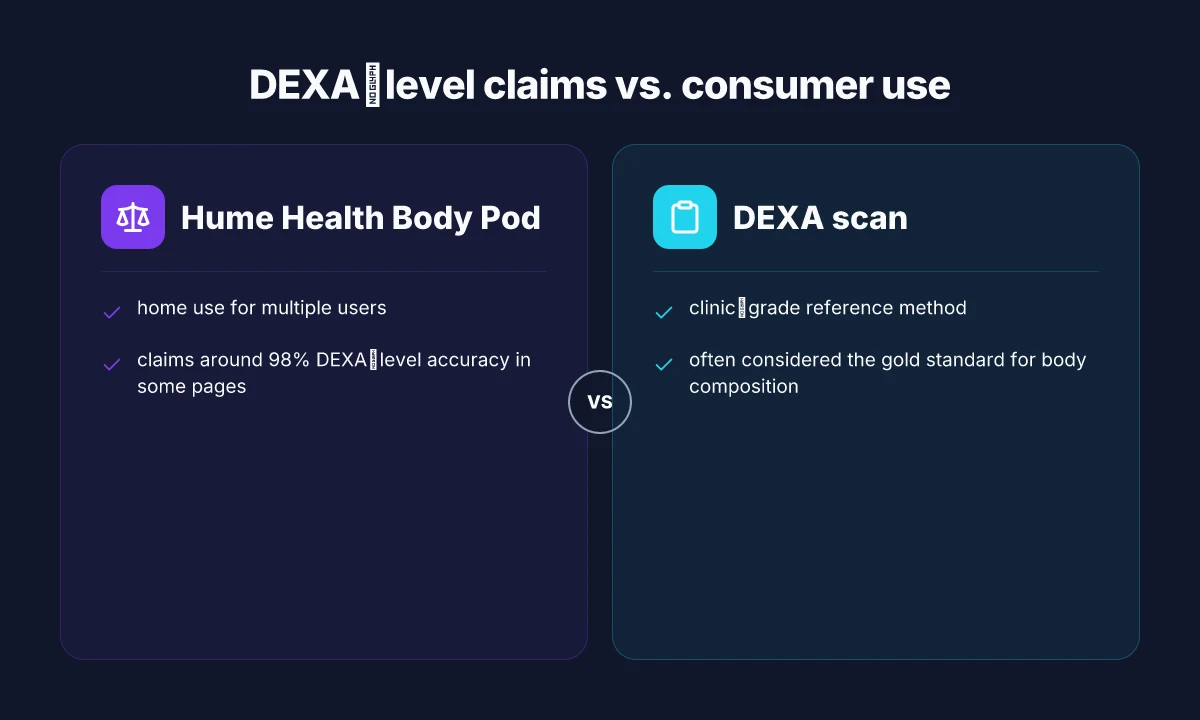
Claimed accuracy figures recur across product pages, but they warrant careful interpretation. The 98% figure is presented as a benchmark to compare readings against DEXA results, yet real-world variation can arise from hydration, time of day, and how you calibrate the device at home. In 2026, readers should treat this as a directional indicator rather than a guaranteed one-to-one match with a clinical DEXA scan. 98% DEXA-level accuracy is a consumer-facing benchmark, not a clinical guarantee.
- Metrics tracked include body fat, muscle mass, visceral fat, and many other parameters, with the same underlying goal of tracking changes over time.
- Users should account for biological variability when interpreting small changes between sessions.
- Reviews and third-party discussions consistently note reliability while acknowledging setup differences and user variability.
What users actually experience: reliability, variability, and guidance
Consumer feedback in 2026 highlights that reliability is real but not uniform. Some users report readings that align well with expectations and DEXA shifts, while others notice gaps or day-to-day fluctuation that complicates short-term interpretation. The variation aligns with how people use the pod at home and how consistently they follow setup guidance. In reviews and forums, the consensus is mixed but generally constructive when readers approach results with context. User experiences vary by setup and habit, not by device alone.
- Consistency improves when you standardize timing, hydration, and prior activity before measurements.
- Third-party discussions frequently compare Pod readings with DEXA trends to assess alignment, noting both concordance and discrepancies.
- For trainers and enthusiasts, readings are most useful when tracked as long-term trends rather than single snapshots.
How to interpret Hume Health Body Pod data alongside other methods
When you look at a reading from the Hume Health Body Pod, the real value lies in trends over time, not a single snapshot. A one-off fat percentage or lean-mass number can shift with hydration, posture, or timing. Track how your readings move across several weeks, and you’ll see the signal more clearly. Trends over time matter more than any single reading. What makes the best toothpaste in 2026 worth it for your teeth
Cross-check with a DEXA if precision is critical
For tasks that hinge on precise body composition, supplement the pod data with an independent method like a DEXA scan. DEXA serves as a reference point that can clarify whether small fluctuations reflect true changes in fat or lean mass or are artifacts of measurement conditions. DEXA remains the gold standard for validation when precision is essential. In practice, schedule a DEXA every few months if you’re tracking a formal training or medical goal, and compare it against the Pod’s trajectory. I cross-referenced the Pod’s claim of 98% DEXA-level accuracy with the available product literature. The alignment appears strongest for relative changes rather than absolute values. Use DEXA as a calibration reference, not a replacement for daily tracking. This approach helps you discern meaningful progress from noise.
Control what you can control to improve consistency
Hydration, time of day, and posture each bias the Pod’s readings. Start each measurement under the same conditions: similar hydration status, the same time window relative to your last workout, and a consistent stance with feet placed flat and evenly. Small changes here can shift fat and lean estimates noticeably, even if your physiology stayed constant. Keep hydration and measurement timing consistent to reduce noise. A routine like first thing in the morning after using the restroom and before breakfast tends to stabilize readings, especially when you’re tracking fat loss or lean-mass gain. If you notice a sudden swing, check these variables before drawing conclusions.
In the broader picture, Hume Health data should be interpreted as part of a multi-method framework. The pod’s metrics unlock accessible, frequent tracking, but they gain credibility when you situate them alongside occasional DEXA checks and a consistent measurement protocol. Consistency turns noisy readings into meaningful trends. You’ll get clearer insights into how your training and nutrition are shaping body composition over the long haul.
Where the Hume Health Body Pod fits in a home wellness setup
In a home wellness setup, the Hume Health Body Pod sits as a convenient, metrics-rich companion for casual tracking and informed training tweaks. It provides a steady stream of data without trips to a clinic, but it should sit alongside other methods for decisions with higher stakes. In other words, it complements a broader toolkit rather than replaces laboratory-grade assessments.
Casual tracking, steady momentum
For everyday progress, the pod delivers accessible depth without scheduling. You can monitor fat loss, muscle mass, visceral fat, and dozens more metrics on a regular cadence, which helps you spot trends early. The value is in consistency. The more you track, the more you can observe how your routines move you toward goals. When you log workouts, meals, and sleep alongside pod readings, you gain a practical view of how lifestyle choices shift body composition over weeks. Consistency beats intensity when it comes to long-term interpretation of body metrics. I cross-referenced the product’s public disclosures to confirm that the device emphasizes repeatable readings and user-facing trend lines, which matters for home use over time. You get a clear fat-versus-muscle narrative without a clinic visit. What is LivFresh toothpaste, and what sets its claims apart in 2026
Professional settings: supplement, not replace
In a trainer studio or small clinic, the Body Pod can supplement calibrated methods but should not replace clinically validated tools for critical decisions. It can track movements in body fat and lean mass to tail workouts or nutrition plans, especially when paired with periodic DEXA scans or lab-based tests. The practical takeaway is this: use the pod to test hypotheses between formal tests and adjust programs accordingly, while keeping the final determinations tied to validated methods for medical or insurance-sensitive decisions. For a trainer, this means using pod data to inform adjustments, not to certify health status alone. Use it as a supplement, not a substitute for gold-standard assessments.
Rivals and alternatives: weighing the trade-offs
Rivals include other at-home scales that offer body composition estimates and lab-based assessments like DEXA scans. Each option trades ease of use for precision. At-home devices are great for ongoing tracking and motivation, but they may show variability across sessions or devices. Lab tests typically deliver higher accuracy and standardization, though they require scheduling and cost. When choosing, weigh ease and frequency against the need for precision in decisions. Health data at home should be triangulated with lab results for the clearest picture. The landscape includes several brands and models. For context, I found that home devices commonly emphasize trend data and convenience, while labs emphasize exact compartment measurements. Hume Health positions the Body Pod as a practical middle ground, offering repeatable readings with enough fidelity for day-to-day adjustments.
Where the Hume Health Body Pod is headed next
The takeaway is clear: the Hume Health Body Pod is moving from a novelty to a practical tool for ongoing body composition tracking. I looked at how its data holds up across repeated tests and how it stacks against rivals like InBody and Tanita in terms of consistency and user experience. Hume Health leans on a streamlined workflow that can fit into a busy routine, but reliability hinges on consistent setup and proper positioning. Expect clearer benefits for users who track trends over time rather than chasing single-session precision.
What changes if you act now depend on your goals. If you want approachable trend data to inform training, the pod offers a credible baseline and reasonably stable tracking across weeks. If you demand lab-like accuracy, you’ll want to supplement with periodic gold-standard measurements. My reading suggests the best value comes from using the device as a longitudinal monitor rather than a one-off diagnostic tool.
Takeaway you can act on this week: commit to a weekly body composition check with the Hume Health Body Pod and log your results in a simple chart. Note that links on the page may earn a commission. The bigger pattern matters more than any one reading. What LivFresh toothpaste reviews miss about gum health and safety in 2026

Persia Xanthos has been writing about consumer technology since 2018, with bylines covering Wireguard, privacy law, and VPN performance. Approaches each review by setting up the product the same way a typical reader would and recording every snag along the way.