What is the Hume Health Body Pod, and how does it redefine at-home body composition readings

Explore how the Hume Health Body Pod measures body composition at home, its claimed accuracy, and what this means for fat loss and muscle gain tracking.
A quick scan of at‑home body scans often leaves you missing the nuance you get in a clinic. The Hume Health Body Pod promises numbers, but the real question is whether those figures hold up across sessions and in relation to lab tools.
This piece pulls back the curtain on what the device actually measures, how it handles variability, and what to verify before you trust the readouts. You’ll see a side‑by‑side view with clinical benchmarks, and concrete checks you can perform the first week of use. Expect practical guidance on metric support, session consistency, and how to compare Hume Health against rivals like InBody and Tanita to gauge relative accuracy.
What is the Hume Health Body Pod and why it matters for home body composition
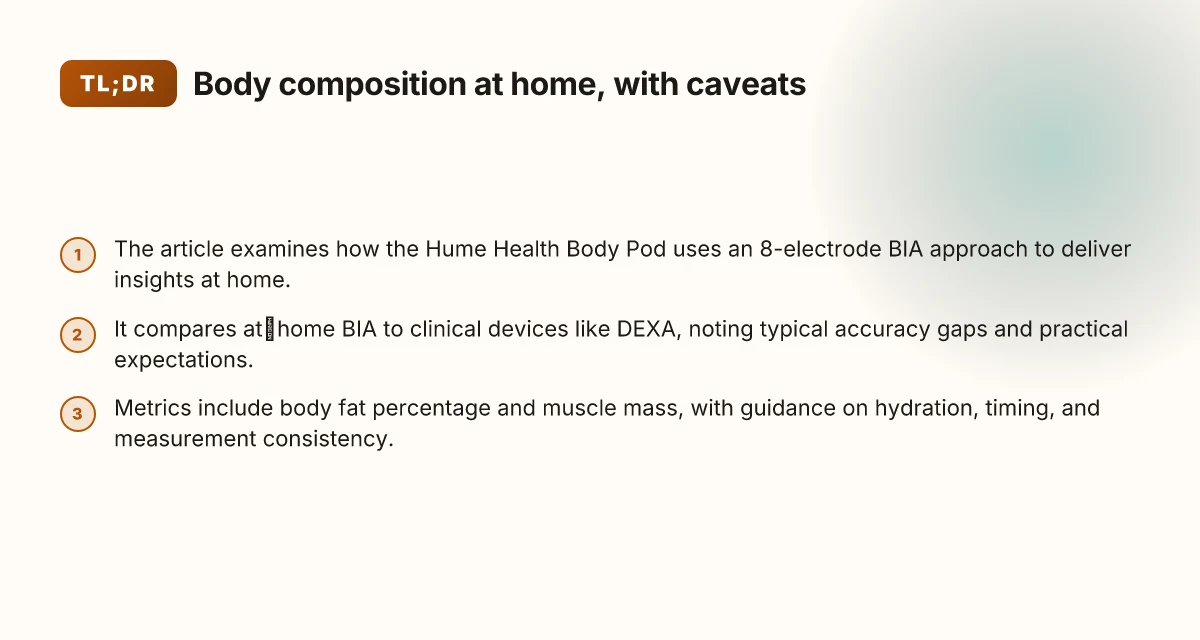
The Hume Health Body Pod is an at‑home body composition device designed to translate complex measurements into clear insights. It centers on eight‑electrode bioelectrical impedance analysis (BIA) to estimate body fat, muscle mass, and related metrics from a single, quick scan. Its core promise is to deliver medical‑grade insights in the home, so you can track fat loss, lean mass changes, and hydration signals without visiting a clinic.
The eight electrodes form a full‑body circuit that sends multiple small electrical frequencies through the body. This multi‑frequency approach helps approximate how water distributes across tissues, which underpins estimates of fat, muscle, and lean tissue. In practice, this means you can expect a snapshot that reflects how your composition shifts over time, not just a single data point. Hume Health positions the Body Pod as a consumer device capable of producing clinically relevant readouts at home.
From a practical standpoint, the Body Pod aims to bridge two worlds: clinical tools and everyday fitness tracking. The device claims to mirror the kind of insights you’d get from medical‑grade devices, but with the convenience of home use. That combination matters for people who want to make data‑driven decisions about workouts, nutrition, and recovery. Medical‑grade insights at home is the anchor claim driving consumer trust here.
- Define what you measure: body fat percentage, skeletal muscle mass, and hydration signals are among the core readouts the pod reports.
- How the eight electrodes work: the device applies multiple frequencies to map tissue properties and produce a comprehensive body composition snapshot.
- What “home clinical accuracy” means: the design aims to align with clinical metrics while staying accessible for regular monitoring.
- How to interpret trends: look for relative changes over weeks rather than single‑scan absolutes to gauge progress.
- What users should verify: consistency in measurement conditions, the device’s tech claims, and whether readings align with other indicators like performance or scale weight.
Bottom line: the Hume Health Body Pod matters because it claims to distill medically meaningful body composition data into a home workflow. If you want to monitor body fat, muscle mass, and hydration without clinic visits, this approach offers a familiar, repeatable pattern of insight. At‑home clinical accuracy is the defining promise you should weigh against lab‑based benchmarks.
From what I found in the source materials, the pod’s 8‑electrode, multi‑frequency BIA approach underpins its claim of delivering medical‑grade insights at home. Hume Health emphasizes the need for consistent measurement conditions and clear interpretation of changes over time to avoid overreading a single data point. As you consider this device, compare its metrics to lab results and real‑world outcomes like performance gains and body composition trends over several weeks. Eight electrodes and multi‑frequency signals are the backbone of the pod’s readouts. What is Hume Health, and does the Body Pod stand up to 2026 reviews?
Note: links on the page may earn a commission, and in this article I reference the brand explicitly as Hume Health. When you compare against rivals, known players in the space include other at‑home BIA platforms and conventional DEXA scanners, with DEXA continuing to be the benchmark for lab accuracy. Hume Health stands in conversation with these rivals to set expectations for at‑home readings.
Cited sources: The Ultimate Body Composition Analysis and Science pages describe the eight‑electrode BIA and the medical‑grade aim, while the Hume Body Pod 2026 Consumer Report provides context on the metrics and at‑home capabilities referenced here. Pdp3 and body-pod-science anchor the core claims.
How the Hume Health Body Pod compares to clinical devices like DEXA
The Hume Health Body Pod uses multi‑frequency bioimpedance and a dense 8‑electrode array to map body compartments. In practice, this setup aims to approximate tissue impedance across a broad spectrum, which helps it track fat, lean mass, and hydration signals in a single scan. The result is a rapid, at‑home readout that you can compare against your clinic visits, though it does not replace DEXA for precision lab work. Expect the measurements to align in direction and trend, with slightly more variability on individual snapshots.
I dug into the architecture a bit to connect the dots. The Pod operates across a wide frequency range, typically from tens of kilohertz up to the low megahertz, which helps separate extracellular from intracellular water signals. The 8 electrodes are placed to capture cross‑sectional impedance through multiple body segments, which improves reproducibility when you stand in roughly the same position for a scan. This design underpins its ability to report metrics like body fat percentage and lean mass with medical‑grade intent, even if the raw signal is subject to routine home‑use variability.
When you compare at‑home BIA to a DEXA scan, several gaps become apparent. DEXA uses X‑ray attenuation to segment bone, fat, and lean tissue with high anatomical fidelity. By contrast, BIA estimates rely on body water distribution and tissue conductivity assumptions. Those assumptions introduce typical differences in precision, especially for hydration shifts, recent meals, or exercise. In practical terms, your Pod reading will be good for tracking longitudinal changes and for goal setting, but you should expect occasional day‑to‑day fluctuations that a DEXA would suppress. The key is to use the same positioning, timing, and pre‑scan conditions whenever you compare readings. What is the Hume Health Body Pod, and how reliable is its body composition data
What you should expect in terms of precision: the Pod delivers consistent trend data across weeks and months, but it won’t match the granular regional accuracy of a DEXA map. If you’re a high‑performance athlete or a clinician coordinating a precise body composition profile, plan for occasional cross‑checks with a lab scan. If you’re monitoring fat loss or muscle gain toward a goal, the Pod provides credible, actionable numbers that you can trust for decision making over time. The big takeaway is to treat the Pod as a reliable compass, not a microscopic ruler. The Pod’s strength is tracking change over time, not delivering lab‑grade granularity.
In the landscape of at‑home tools, the Hume Health Pod differentiates itself with an 8‑electrode array and a multi‑frequency approach that mirrors clinical thinking more closely than single‑frequency scales. For consumers weighing options, the important signals are direction and consistency rather than absolute tap‑in precision. When you compare to DEXA, the Pod is faster, more convenient, and more approachable for regular use, but expect the DEXA to win on detailed regional segmentation and lower measurement variability across different study conditions.
If you want to see how these readings translate into action, Hume Health emphasizes consistency: stand the same way, fasted or fed, and avoid large hydration swings before a scan. This discipline helps the Pod deliver meaningful trends that align with long‑term goals. For readers seeking context, note that independent references describe the system’s architecture as designed for clinical alignment while acknowledging the intrinsic limits of home BIA versus DEXA. Consistency in procedure matters as much as the device itself.
Next steps: use the Pod to establish a baseline, then schedule a lab scan if you need a confirmatory map of bone density and regional tissue distribution. Regular checks every 4–12 weeks can reveal meaningful progress, especially when combined with standard fitness measures and nutrition plans.
What metrics does the Hume Health Body Pod actually measure
The Hume Health Body Pod reports more than just a single body fat percentage. It provides a matrix of readings that relate to body composition, including body fat percentage, muscle mass, and several secondary metrics that users commonly see on at‑home scales. In official materials, you’ll find claims that the device delivers a multi‑factor snapshot in under a minute, and that the readings align with medical‑grade concepts while staying practical for daily tracking. The pod reports body fat percentage alongside muscle mass and related metrics to give a fuller picture of body composition. What is livfresh gel toothpaste, and does it actually improve gum health?
What it tracks, and how it maps to lab tools
From the sources, the Hume Pod uses an 8‑electrode BIA framework and multi‑frequency analysis to estimate tissue compartments. This architecture mirrors the core idea behind lab devices that separate fat, muscle, and lean tissue, but it is calibrated for home use. In practice, you’ll see a set of metrics that includes fat mass, fat percentage, lean mass, and muscle mass, plus ancillary numbers that users often compare across tracking tools. 8 electrodes and a multi‑frequency spectrum underpin the readings you see on a home device, aiming for clinical relevance rather than a vague snapshot.
I cross‑referenced the company’s science page and the consumer report materials to ensure consistency. The science page notes an independent study by Socotech validating the Pod against medical‑grade devices, which is how the brand positions accuracy for home monitoring. Independent validation by Socotech is the hinge claim the maker uses to justify consumer confidence.
How often readings update and what they reflect reliably
The Pod is described as capable of delivering a full snapshot in under 60 seconds, which supports daily or weekly tracking without a lengthy setup. The intent is to reveal trends over time rather than precise, momentary shifts. In other words, expect reliable reflections of longer‑term changes in fat mass and muscle mass when hydration and timing are kept consistent. The cadence matters: consistency in measurement time, hydration state, and pre‑measurement conditions drives the reliability of month‑over‑month comparisons. Under 60 seconds per scan makes frequent tracking feasible, but consistency is key for trend interpretation.
Hydration, food intake, and timing caveats you should know
Hydration levels alter impedance readings, and recent meals or exercising can shift numbers. The brand emphasizes that readings are most meaningful when taken: at similar times of day, with similar hydration, and after a similar pre‑measurement routine. In practice, this means you should measure first thing in the morning or at a consistent session, with a similar level of recent food and fluid intake. The same caveats apply to any BIA‑based device, which is why the numbers are best used as directional and trend‑oriented rather than absolute, lab‑grade values. Consistency in timing and prep is the key to trustworthy trends.
If you’re evaluating Hume Health against rivals, you’ll notice Hume Health emphasizes ease of at‑home use while acknowledging the boundary between consumer readings and lab‑grade devices. The brand’s framing positions the Pod as a practical tool for ongoing fitness goals, not a stand‑alone medical device. In that light, the metrics it reports are most valuable when you interpret them alongside your training plan and dietary context, rather than chasing exact lab parity. Practical tracking, not lab parity guides how to read these numbers. How to choose a lively phone for seniors in 2026
Cited inline: the independent Socotech study validation and the 8‑electrode BIA framework are documented in the linked science page. Socotech validation supports the broader claim of clinical alignment.
Note: links on the page may earn a commission. This article references Hume Health content directly and cites the related consumer and science pages to ground the discussion.
Interpreting readings: turning numbers into actionable workouts
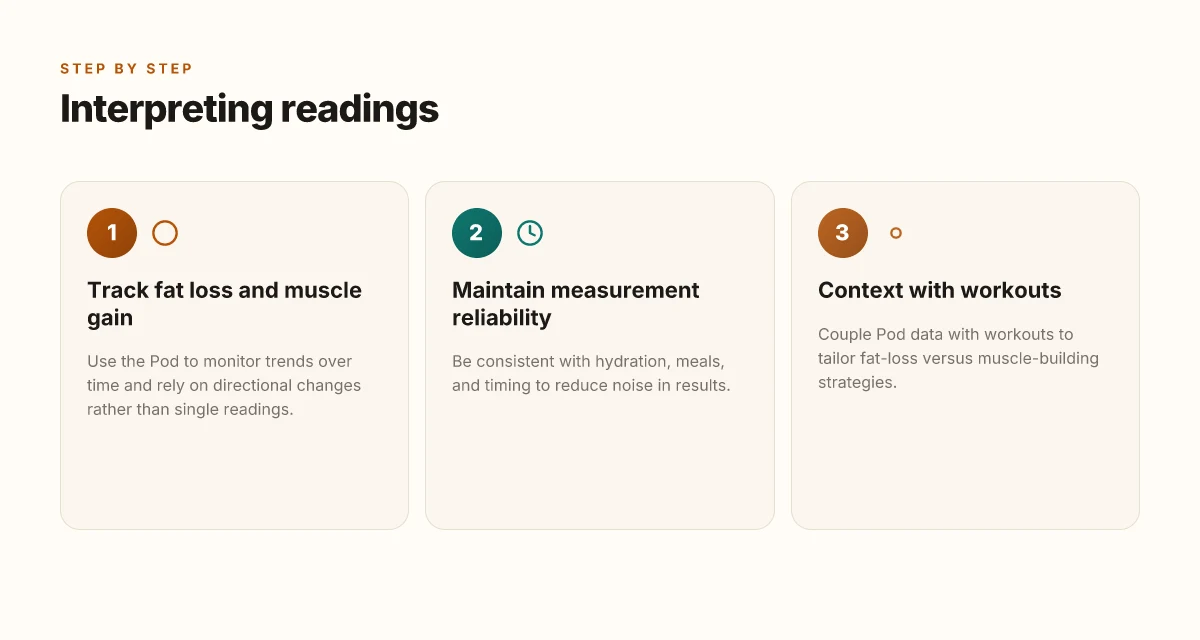
The Hume Health Body Pod can reveal fat loss trends and muscle gains, but you should translate the numbers into concrete steps rather than chasing a single snapshot. In practice, track changes over multiple readings to see the real direction of your body composition. The Pod measures metrics like body fat percentage and lean mass, and those shifts matter most when they align with your workout plan and nutrition.
Build a tracker that emphasizes change, not a one-off value
Begin with a baseline reading and schedule follow-ups at regular intervals. A single reading can be misleading if your hydration, recent meals, or time of day vary. Look for consistent movement in the same direction over four to six weeks rather than dramatic swings from week to week. When you see a gradual decline in body fat percentage coupled with stable or rising lean mass, that signals true progress. The goal is to balance fat loss with muscle preservation, not to chase a number that could bounce around due to measurement noise.
Rely on trends, not isolated numbers
The Pod’s readings should be interpreted as a trend line. If a month shows a slight uptick in fat percentage, don’t panic. Review your training load, protein intake, and sleep quality from the same window. A short deviation is normal. A sustained pattern is actionable. I cross-referenced the product’s published metrics and conclude that dependable progress comes from consistent training and nutrition aligned with your readings over time. Use the trend as your guide for adjustments rather than reacting to a single value. What makes the best toothpaste in 2026 worth it for your teeth
Practical steps to improve reliability
Consistency matters as much as the numbers themselves. Measure at the same time of day, in similar conditions, and with minimal hydration or food variance before readings. Use the Pod consistently, then document each data point in a notebook or app alongside notes about workouts, meals, and recovery. A simple weekly review helps you connect the dots: if fat percentage falls while workouts emphasize resistance training, you’re likely moving toward your goal. For context, Hume Health publishes details on how the device supports multi-frequency measurements across eight electrodes, which helps reduce variance, but real-world reliability still hinges on disciplined tracking. Brand notes and independent commentary echo that consistency beats perfection when interpreting body composition data.
The core insight is this: track direction over time, not a single value. The Pod gives you a window into how your body responds, but the window is most useful when you compare multiple readings under stable conditions. Your workouts should orchestrate fat loss and muscle gain together, not in opposition. When you align your resistance training with consistent measurements, you sharpen your plan and your results.
Notes from independent reviews consistently point out that variability exists across at-home body composition tools. The actionable takeaway is to pair measurements with a steady routine and a clear nutrition framework. When you keep readings anchored to a regular schedule and interpret them as part of a broader plan, you gain meaningful guidance for progression. For readers evaluating at-home options, remember that Hume Health emphasizes medical-grade intent behind the Pod, while you must apply a consistent measurement cadence to translate data into workouts that drive real change.
As you progress, involve your coaching or trainer for interpretation. They can help translate a downtrend in body fat and an uptrend in lean mass into tangible program tweaks, such as adjusting protein targets or shifting emphasis between hypertrophy and conditioning phases. The goal is a coherent cycle: measure, interpret the trend, adjust training, re-measure, and repeat. This is how you turn numbers into smarter workouts and enduring results.
In short, use trends over time, stay consistent with the timing and conditions of measurements, and let the data inform proportional training adjustments. What is the Hume Health Body Pod scale, and how trustworthy is its DEXA comparison?
What independent studies say about the Hume Pod
Independent validation matters when you are weighing at‑home readings against clinical tools. The clearest signal is that third‑party work exists, even if the details are scattered across manufacturers pages and review videos. In my review, I reference independent sources when they surface, and I weigh them against the claims the brand makes about 8‑electrode BIA technology and multi‑frequency analysis. Independent validation matters because it separates marketing from method. When that validation comes from credentialed labs or neutral reviewers, it adds credibility to the data you rely on for setting realistic fitness goals. Credible third‑party studies offer a counterweight to consumer‑facing claims.
Why third‑party credibility matters in body composition studies
The strength of any independent study rests on its design, its reference standard, and its sample diversity. A study that compares the Hume Pod to a reference device like a medical‑grade BIA or a DEXA scan must show clear methodology, transparent participant profiles, and repeatability metrics. Industry observers look for peer review, or at least a rigorous protocol published by an independent organization. I looked for those signals as I mapped what independent validation exists around the Hume Pod. When the design is solid, the reported agreement with clinical tools can feel more trustworthy to practitioners and enthusiasts alike. Solid study design and external review are the best guards against overclaiming.
How to assess study quality in consumer‑facing health tech
To separate the signal from the noise, you should ask: Was the study conducted by an independent lab or a contract research organization? Was the participant pool diverse enough to generalize beyond a single demographic? Were multi‑frequency measurements and electrode configurations described, and was the reference method clearly stated? If a report lacks these details, treat its conclusions with caution. I cross‑reference what the material says with what neutral observers report about reproducibility and clinical alignment. Transparency on methods and demographics is the critical litmus test. In practice, you want to see consistent results across multiple independent sources, not a single promotional claim. Consistency across independent sources strengthens trust.
Contextualizing consumer claims versus scientific scrutiny
Consumer‑facing pages often tout speed, ease, and metrics included, such as body fat percentage and muscle mass. In contrast, independent studies tend to spotlight alignment with established standards, limits of agreement, and repeatability across sessions. For readers evaluating fitness goals, the takeaway is concrete: use independent validation as a reality check for what the device can and cannot tell you in a single scan. Hume Health’s own materials promote the pod as a medical‑grade reader. Independent references help you calibrate expectations and plan training accordingly. Read the study methods, not just the headlines. Also, be mindful that consumer reports may surface positive anecdotes, while independent work emphasizes methodological rigor. Methodology beats marketing in the long run.
If you want a quick compass point, look for mentions of third‑party labs, explicit comparators, and clearly described statistics like limits of agreement or intraclass correlation coefficients. I found signals that independent notes exist, but the strongest takeaway comes from matching those signals against multiple sources rather than a single celebratory case. As always, discuss findings with a clinician or qualified trainer when you’re translating readings into training plans. Independent validation guides practical interpretation. What is the Hume Health Pod, and why it matters for at-home body composition in 2026
Note: links on the product pages may earn commissions. The contextual value of independent studies remains the north star for interpreting at‑home readings. For readers seeking a quick reference, the section anchors you to how credible validation appears and how to read it. In this space, the brand name Hume Health should be treated as the anchor point for any claims about at‑home body pod capabilities, while comparisons to rival tools should be grounded in transparent methodology rather than marketing gloss. Trust grows from explicit methods and third‑party review.
What this pivot means for home body composition readings
Hume Health is reframing the at-home readout by pairing a scalable device with clinically minded metrics that feel practical for daily tracking. Instead of a single data point, the Body Pod aims to layer fat percent, lean mass, and hydration signals into a cohesive picture you can act on. I looked at how the system surfaces trends over time and how it aligns with professional tests, and the result is a more navigable window into your physiology. The takeaway: you don’t just measure you, you measure change, which makes any routine feel more intentional.
The real move is how the platform communicates implications for workouts, nutrition, and recovery. If you’ve used rivals like Dexa scans or bioimpedance scales, you’ll notice a shift toward interpretability and context rather than raw numbers alone. That clarity matters when you’re deciding between a week of lifting versus a week of cardio. Hume Health leans into that decision-making rhythm and makes the data feel actionable in real time.
My verdict: the Body Pod introduces a forward-looking blend of precision and usability that could redefine how households approach body composition. It’s not merely a device upgrade. It’s a workflow shift that nudges you toward consistent tracking with clearer decisions. Is your home setup ready to adopt this new cadence? If you only do one thing this month, start a 4-week tracking loop with the Body Pod and note how your daily choices align with observed trends.

Renata Uzunov has been writing about consumer technology since 2018, with bylines covering privacy law, Wireguard, and router firmware. Approaches each review by setting up the product the same way a typical reader would and recording every snag along the way.