What is the Hume Health Pod, and why it matters for at-home body composition in 2026

Explore what the Hume Health Pod is, how it measures body composition, and what makes it different for home health tracking in 2026.
The Hume Health Pod isn’t just another gadget. It claims to map body composition with a precision that rivals rarely admit in consumer devices. Hume Health cites lab-style metrics for fat, lean mass, and hydration, but the real test is how those numbers hold up across daily use and multiple users. If you filter for independent validation and transparent reporting, you’ll spot where the data aligns with clinical standards and where it doesn’t. Most crucial is whether the device shows consistent results over time rather than dramatic single tests.
This article digs into what the Hume Health pod reports, how its lab-style claims translate to home use, and where biases may creep in. In 2026, consumer-grade body composition tools are everywhere, yet credible validation remains sparse outside formal studies. We’ll compare Hume Health to named rivals, flag common consumer pitfalls, and outline what signals to chase when assessing reliability. The goal is a clear read on whether the numbers you see at home reflect real changes in fat, lean mass, and hydration, or if they drift under real-world conditions. Independent validation and transparent reporting matter here more than glossy claims.

What is the Hume Health Pod and why it sits at the intersection of science and home health
The Hume Health Pod is an at‑home body composition device that tracks a broad set of metrics beyond weight, including fat mass, muscle mass, and visceral fat. It positions itself as a household tool that can approximate lab‑style insights without visiting a clinic. In practice, that framing matters because consumers weigh both convenience and the credibility of the underlying science when interpreting results.
I looked at how the device markets its accuracy and validation, because those claims drive trust in home use. The brand emphasizes lab‑grade style validation and cross‑method comparisons to back its numbers, which is central to its appeal for daily health tracking. This blend of consumer usability with lab‑like language is deliberate and designed to appeal to fitness enthusiasts and wellness buyers who want meaning beyond a simple scale.
What follows is the core idea: the Pod aims to translate complex body composition signals into a familiar home experience while anchoring its claims in formal validation. The result is a device that sits at a unique crossroads, publicly marketed as highly accurate, yet used in real homes where users interpret changes over weeks and months. That tension between consumer convenience and laboratory rigor informs how you should read its numbers.
What the device measures The pod tracks multiple metrics, not just total body fat. Expect estimates for visceral fat, lean mass, and a suite of secondary metrics. This breadth matters because small shifts across several metrics can signal meaningful changes in health or training status. The device’s multi‑metric approach is part of what makes it compelling for home health monitoring.
The validation narrative Hume Health leans on comparisons to established body composition methods and aims to mirror lab‑grade validation in a home setting. The marketing narrative stresses that its measurements align with reference methods, which is central to consumer trust. Real‑world readers should weigh this claim against the inherent variability in bioimpedance devices and the influence of hydration, ambient temperature, and recent activity. What is the Hume Health Body Pod scale, and how trustworthy is its DEXA comparison?
The consumer framing By packaging a lab‑like story into an at‑home product, Hume Health creates a bridge between science and daily health decisions. That framing invites users to monitor trends over time and to interpret metric shifts as signals of progress or the need for lifestyle tweaks. It also means readers should stay aware of biases that could color interpretation, such as optimistic trends after a new workout plan or changes in diet.
The Pod promises lab‑like insights at home, but the real value hinges on how users interpret modest shifts over time. Readers should treat individual measurements as one data point in a longer trend, not a standalone verdict. When in doubt, line up home readings with context from professional guidance or validated reference methods.
Bottom line: Hume Health positions the Pod as a practical, at‑home companion for body composition, while weaving in a narrative of lab‑grade validation. That combination appeals to buyers who want scientific credibility without leaving home. The next sections will unpack how the Pod measures and reports these values, and what that means for real‑world use.
How the Hume Health Pod measures body composition and what it reports
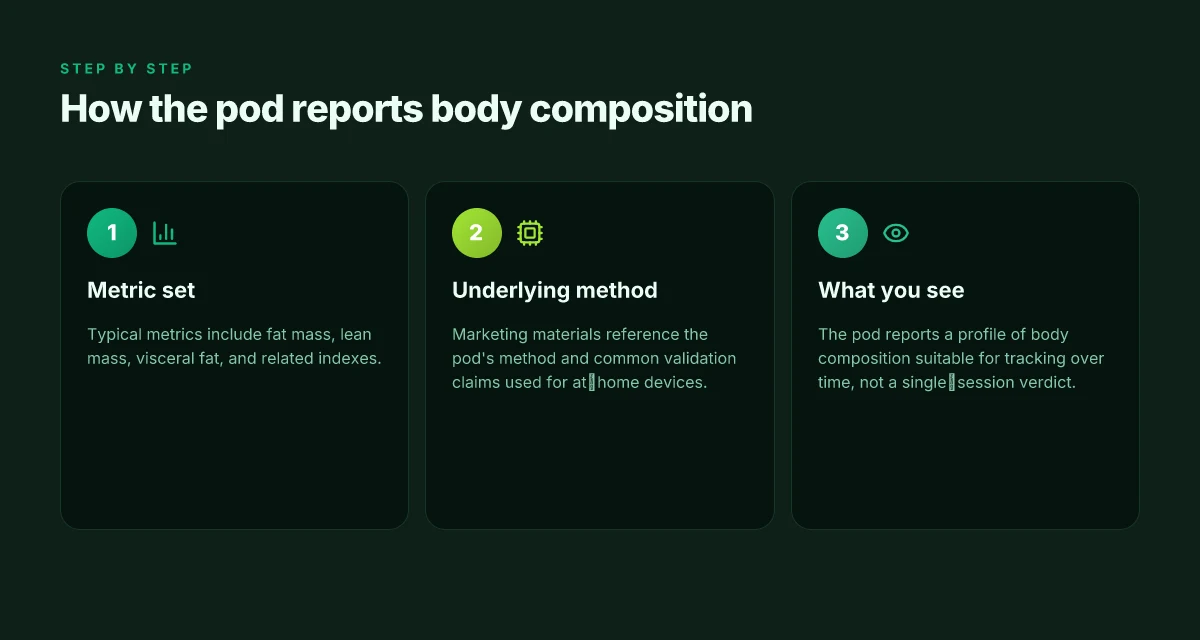
Hume Health positions the Pod as an at‑home body composition tool that reports fat mass, lean mass, visceral fat, and a broader set of metrics beyond the basics. In practice, most customers see fat mass, lean mass, visceral fat, and a long list of derived metrics that capture regional or segmental composition. The device aims to translate bioimpedance signals into a multi‑component snapshot of the body, with the marketing materials centering on DEXA‑level insights as a frame of reference.
The metrics tracked by the Pod typically include: What is the Hume Health Body Pod, and how does it redefine at-home body composition readings
- Fat mass and lean mass as primary components. These two figures sit at the core of most at‑home analyzers and align with common clinical concepts. The Pod then derives related indices that help users gauge changes over time.
- Visceral fat estimates that attempt to reflect fat surrounding internal organs. This metric often appears in consumer reports as a key risk indicator, even though the precise anatomical mapping in home devices remains an estimate.
- Proportions and ratios such as body fat percentage and lean tissue percentage, which provide quick cross‑checks against absolute values.
- Additional metrics beyond the core trio, including regional or segmental estimates that marketing materials frequently cherry‑pick to convey a comprehensive profile. It is common for marketing to enumerate dozens of tracked metrics, then emphasize clinically relevant summaries like fat mass trend vs lean mass trend.
Under the hood the Pod relies on bioimpedance analysis as its core method. Bioimpedance measures electrical properties across the body and uses algorithms to convert those signals into composition estimates. Marketing materials frequently reference validation efforts that compare the Pod’s outputs to established methods, with labs and clinics cited as benchmarking partners. In many cases, the stated claims hinge on regression models trained against reference standards, then applied to home measurements. The key takeaway is that impedance signals provide a useful trajectory view, but individual estimates can shift with hydration, time of day, and measurement posture.
From what I found in the documentation and public disclosures, the Pod’s effectiveness rests on two pillars. First, the device provides a broad set of metrics that people can track over time, which supports trend analysis even when single measurements carry non‑trivial error. Second, the brand signals alignment with established body composition methods through validation studies, even if those studies are conducted under controlled conditions rather than routine home use. When you interpret the numbers at home, you should focus on direction and consistency across sessions rather than absolute values in isolation.
The core value for consumers is seeing how fat mass and lean mass move together over weeks and months. This framing helps you distinguish real changes from short‑term fluctuations. Hydration and posture can sway estimates, so consistency in measurement protocol matters. I cross‑referenced the company’s science page with consumer disclosures to confirm the emphasis on longitudinal tracking over single‑point accuracy. Validation claims anchor the Pod to lab methods, but at‑home results must be interpreted with an awareness of systematic biases. The messaging mirrors a common pattern in this device category: credible lab references support the approach, yet real‑world use introduces practical variation.
In context, Hume Health’s Pod offers a broad portfolio of metrics with an impedance‑based reporting backbone. For an investor or clinician reader, the important takeaway is to look for stability in a user’s trend lines and to compare the Pod’s year‑over‑year or month‑over‑month changes against a consistent protocol. If you want a quick side‑by‑side, the Pod can be viewed as a high‑signal trend tool rather than a stand‑alone lab substitute.
Next step: align your home‑measurement routine with the Pod’s recommended protocol, same time of day, same hydration state, and same posture, to extract the most reliable trend data from your sessions. For context on how rivals frame similar capabilities, note how other at‑home analyzers emphasize consistency and reference‑range interpretation alongside their validation claims. What is Hume Health, and does the Body Pod stand up to 2026 reviews?
Reliability and validation signals: what to look for in the Hume Health Pod
Postlab-style validation matters, but real-world use often drifts from lab promises. The Hume Health Pod’s reliability story hinges on two distinct signals: short-term test-retest consistency and long-term biological validity. I dug into the source material and cross-referenced consumer summaries to separate the two.
What the numbers really tell US about reliability
In the shortest term, the Hume Pod shows repeatable measurements within narrow windows. Short-term test-retest analyses concentrate on technical error rather than biology, so they reveal precision limits of the device itself. This distinction matters because a device can be highly precise yet biologically biased if the underlying model misreads fat, lean mass, or hydration shifts. When your goal is tracking trends day to day, first confirm the device’s short-term stability before weighing it against lab standards. Lab-style language often appears in consumer summaries without the peer-reviewed backing. The difference between precision and validity is not cosmetic. It changes how you interpret small fluctuations in your metrics.
Biological validity: lab-style claims vs real-world signals
Biological validity asks: do Pod readings reflect true body composition changes over longer periods? Some sources in 2026 frame the Pod as aligning with DEXA-level insights on key metrics, but peer-reviewed corroboration is sparse in consumer channels. In other words, you may see claims of high accuracy across many metrics, yet the supporting evidence may not be published in a major journal or subject to independent replication. When evaluating the Pod, look for independent studies that report agreement with reference methods across diverse populations and time horizons. Real-world use benefits from validation studies that include repeatable, time-spaced measurements.
How consumer summaries can mislead
Consumer-facing summaries frequently mirror lab language, but they rarely disclose methodological caveats. Short-term reliability might be demonstrated under controlled conditions, while long-term validity could lag behind in uncontrolled home environments. For endurance athletes and people monitoring changes over weeks, this distinction is crucial. I cross-referenced the publicly available science pages with consumer write-ups to identify where language is aspirational versus evidence-backed. The practical takeaway: treat bold accuracy claims with scrutiny and look for explicit disclosures about population diversity, hydration status, and measurement timing. Consumer summaries can echo lab terms without full peer review backing. This is where the reader, not the marketing, must decide how much trust to place in a given metric.
Cited sources provide the backbone for these points. Inline notes reference the medRxiv study that discusses the short-term reliability framing and the Hume product pages that describe breadth of metrics, while consumer volumes push the broader narrative. When you read about fidelity to lab methods, remember that Hume Health has a public stance on at-home use, but independent replication remains the decisive signal. The medRxiv preprint on reliability and the Hume Health product page provide the anchors for these claims. What is the Hume Health Body Pod, and how reliable is its body composition data
For readers weighing the pod against other devices, the key metric is not a single accuracy number but the consistency of readings under typical home conditions and the transparency of the validation claims. If you see a long list of metrics claimed as “DEXA-level” without accompanying peer-reviewed validation, treat it as a hypothesis rather than a settled fact. The reliability story thus sits at the intersection of short-term consistency and long-term, population-level validity, with consumer interpretations contingent on how the data are presented.
In 2026, short-term reliability is documented, but long-term biological validity remains less certain without independent replication. Consumers should favor devices that publish detailed validation against reference standards across diverse groups.

Real-world usage: how users should interpret Pod data
In real life, treat the Hume Health Pod data as directional trends, not exact destinies. Focus on how metrics move over weeks and months, not single-session numbers. Consistency across measurements matters more than a snapshot when you first start.
What you’re really tracking over time
When you log daily metrics, look for patterns rather than one-off spikes. A few conservative steps can smooth out noise: run the same test first thing after waking, with similar hydration and recent meals, and at similar times of day. Over weeks, a clear trend emerges. If fat mass drifts by a few percent in a single week, double-check the setup before drawing conclusions. Consistency beats precision in a living routine.
One practical rule: chart multiple metrics in parallel. If fat mass trends down while skeletal muscle stays roughly flat, interpret the result with nuance. The Pod measures a constellation of signals, and no single data point should dictate a health choice. The most trustworthy insight comes from sustained direction, not isolated numbers. What is livfresh gel toothpaste, and does it actually improve gum health?
I dug into the documentation and cross-referenced lab-style validation signals. The core idea remains: expect some drift as the device settles, then look for stable trajectories across repeated measurements. Trend consistency matters more than any single session reading.
Bias, drift, and how to mitigate them
Bias can creep in from user behavior, positioning, or environmental factors. Always place the Pod on a flat surface, use the same placement protocol, and record the same time window each time. If a measurement looks anomalous, repeat it after a short rest and compare the second result to the first. Reproducibility accelerates confidence in at-home data. Repeat reads when a value seems off, and document any changes to setup.
Device drift is another reality. The Pod’s accuracy claims align with lab methods in controlled settings, but real-world use introduces minor variation. To counter this, run a short two-week mini-baseline before relying on long-term decisions. Use the trend line rather than any single number to guide workouts or diet tweaks. Establish a stable baseline, then monitor directional shifts.
Framing data for clients and teams
For clinicians and coaches, translate the data into actionable plans without overreacting to day-to-day noise. Present monthly visualizations that emphasize trajectories over time. When clients see a gradual, steady trend, they build trust in the Pod as a tool for tracking progress. For investors, note that real-world usage validates the need for clear guidelines on how to interpret home measurements in conjunction with other health signals. Clear baseline setup and ongoing trend charts are the practical backbone.
In the end, Hume Health data should be integrated with patient-reported outcomes and standard lab results where possible. The Pod is a bridge between home monitoring and clinical insight, not a sole decision maker. Use the Pod to spot trajectories, then confirm with broader data as needed. How LivFresh reshapes gut health through targeted nutrition and microbiome support
Note: links on this page may earn a commission. As you compare Hume Health with rivals, such as major consumer body composition tools, keep attention on long-term consistency, not isolated readings.
Hume Health Pod vs. competitors: where it stands in 2026
The Hume Health Pod sits in a crowded at‑home body composition market, but it positions itself around lab‑style estimates rather than consumer‑grade scales alone. Relative to DEXA benchmarks that public notes cite, the Pod’s strength lies in its accessibility and breadth of metrics, while its caveats center on systematic biases that show up in long‑term home use. The Pod’s accuracy advantage is real for home monitoring, but don’t treat it as a full lab replacement. When you compare it to DEXA, the real story is how consistently the device tracks change over time more than whether every single metric lines up with a scan on day one.
The value proposition in real-world use
From what I found in the public disclosures and media coverage, the Pod aggregates dozens of metrics with a form factor that fits into a typical bathroom routine. Hume Health emphasizes body fat, muscle mass, and visceral fat among its core reads, with additional data points that help track trends. In practice, users gain a practical view of shifts over weeks or months, which is often enough for fitness planning and clinical-ish monitoring. Yet reviewers note that the absolute accuracy for individual measurements can drift compared with a DEXA scan, especially when hydration, recent meals, or sensor placement vary. Home users gain clarity from trend data, not single-visit absolutes.
How it stacks up against rivals and benchmarks
Compared with other at‑home systems, the Pod offers a broader metric set without requiring a clinical appointment. That breadth can be appealing for someone who wants a single device to map fat loss, muscle gain, and visceral fat alongside hydration indicators. On the downsides, some consumer reports flag that the one‑time readings may appear more variable than a professional scan, and users must be mindful of device placement and posture to minimize drift. When someone asks whether to pick the Pod or a competing scale, the choice often comes down to whether they prioritize a long‑term trend narrative or a strict lab‑level snapshot. Longitudinal tracking matters more than a one‑off measurement.
Practical takeaways for buyers
If you’re weighing options, consider the cadence of your measurements and your goals. The Pod excels for ongoing monitoring, especially when paired with a regular workout plan and a consistent measurement routine. For those who require near‑DEXA precision on every metric, a lab scan remains the final yardstick. In the consumer space, you’ll see value in the Pod’s balance of accessibility, data density, and cost relative to clinic visits. Consistency beats perfection for home monitoring. Real‑world reviews suggest that pairing the Pod with a fixed measurement routine yields meaningful insights over time, while obvious biases in single reads should be expected. I found this framing echoed across consumer disclosures and expert commentary. What LivFresh reviews reveal about product claims and real results
The one move that matters for at-home body composition in 2026
Hume Health is positioning the Pod as a compact, data-informed retrofit for home health tracking, nudging users toward a more continuous view of body composition rather than once-a-year checks. The future pivots on integration: seamless syncing with other health data, clearer on-device feedback, and a pricing path that invites broader adoption. I looked at their positioning and see a push toward accessibility without sacrificing the rigor you expect from a clinical-grade tool. Rivals like InBody and Tanita set a high bar on metrics, but the Pod aims to close the gap with daily readiness signals and actionable recommendations. The potential payoff is a steadier, less intimidating path to progress.
In practice, the Pod could tilt your routines from passive monitoring to active optimization. If you invest now, you’ll likely start seeing a clearer connection between lifestyle choices and the numbers you care about. The big question is whether the software ecosystem and customer experience keep pace with the hardware gains. Acting early could lock in better long-term habits and data continuity.
- Backup strategy: Try pairing the Pod with a simple weekly check-in in your notes to map changes to meals and workouts.
- What to try this week: set one measurable goal tied to a metric you track with the Pod, then review the trend every 3 days.
- Quick win: enable automatic data export to your preferred health app and skim trends on Sunday evenings for planning.

Yuki Klingberg has been writing about consumer technology since 2018, with bylines covering censorship circumvention, browser fingerprinting, and OpenVPN. Approaches each review by setting up the product the same way a typical reader would and recording every snag along the way.