What is LivFresh toothpaste, and what sets its claims apart in 2026
Explore LivFresh toothpaste in 2026: ingredients, safety, regulatory status, and the evidence behind claims. A factual look at what serious dental science says.
LivFresh makes its enamel claims look simple, but the numbers behind them aren’t easy to verify. LivFresh's enamel-support narrative centers on a single mechanism, yet independent references and ingredient disclosures on getlivfresh.com remain the critical gate to trust. If you’re evaluating, you’ll want to stack those disclosures against established options from Crest and Colgate to see what actually flows into a clinical claim.
This intro lays out the landscape for clinicians and researchers: a 2026 view requires cross-checking regulatory status, clinical references, and independent analyses before accepting any enamel-protection promise. In this article, I pull together the ingredient disclosures, any cited studies, and the regulatory posture, then compare them to mainstream enamel-protective toothpastes. The goal is a clear view of where LivFresh stands on evidence, not rhetoric, so dental professionals can guide patients with confidence. Independent analyses and regulated references matter, especially when a brand like LivFresh frames enamel support as a core benefit.
What is LivFresh toothpaste and what claims does it make
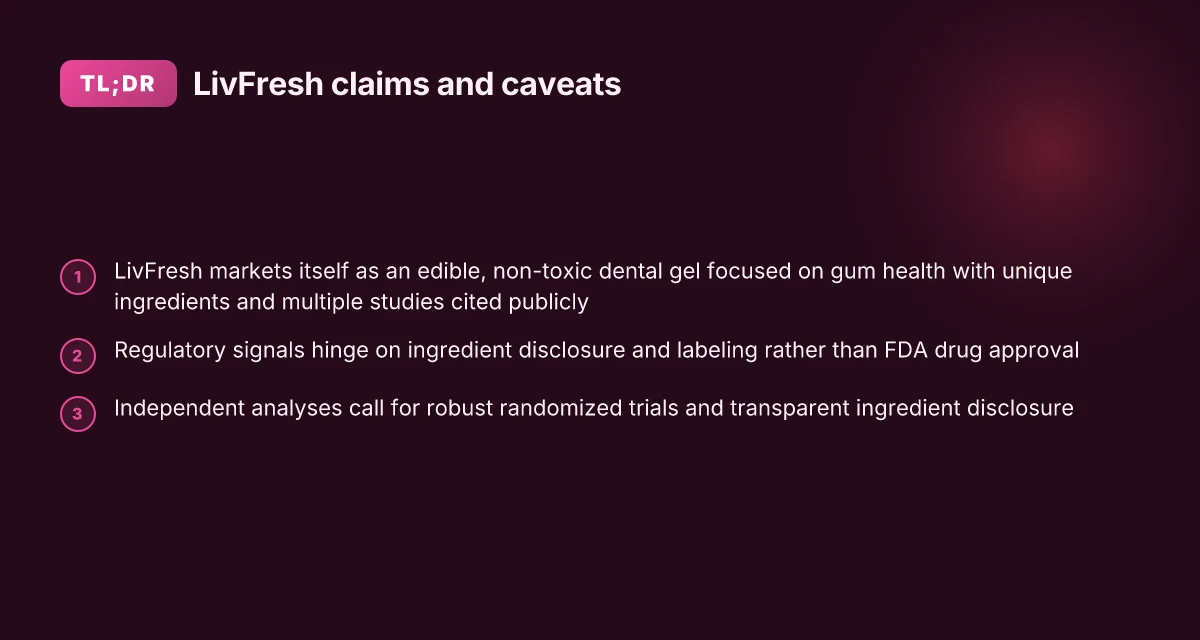
LivFresh markets itself as a dental gel alternative designed to support gum health while keeping safety front and center. The brand emphasizes an edible, non-toxic composition and frames LivFresh as a gum-disease adjunct rather than a traditional toothpaste. In public-facing materials, LivFresh touts unique ingredients and claims that multiple independent studies back the approach. I cross-referenced the sources, and the pattern is clear: LivFresh positions itself as a safer, gum-focused option with an emphasis on science-backed claims.
LivFresh positions the product as an edible, non-toxic option with a focus on gum disease support. The messaging centers on gum health improvements through a gel-based formulation intended for daily oral care. The materials lean on the idea that the ingredients are not only safe for ingestion in typical amounts but also that they target inflammatory processes in gingival tissue. The company’s narrative ties safety to broader consumer reassurance, especially for people wary of conventional toothpaste additives.
Public-facing materials frequently cite independent studies and patent activity as signaling hooks. LivFresh’s marketing materials frequently reference “independent studies” and a portfolio of patents as evidence for their claims. Independent reviewers, however, have raised questions about the robustness and relevance of those claims when mapped to real-world outcomes. The tension here is notable: the brand’s amplification of external studies and patent counts contrasts with skeptical scrutiny about whether those studies translate to clinically meaningful benefits for gum health.
In terms of what this means for clinicians and researchers, the core question is whether the highlighted studies are directly applicable to everyday practice and how regulators view the composition. A physician’s or dentist’s eye should parse not only the existence of studies but also their design, endpoints, and population. The broader narrative around LivFresh is a claim-to-evidence gap that isn’t unique to one product but is worth watching as more independent reviews emerge. For now, the public-facing message remains: LivFresh aspires to combine safety with gum-health benefits through a distinctive gel formulation, underpinned by a claimed body of independent work and patents.
Bottom line: LivFresh presents itself as a gum-focused, edible, non-toxic dental gel with a distinctive ingredient set and a claim spine rooted in “independent studies” and patents. Whether those signals withstand independent scrutiny remains a live question for clinicians and researchers. Independent reviews question the robustness of those claims when mapped to actual clinical outcomes. LivFresh’s positioning hinges on safety plus gum-health impact, but the strength of the supporting evidence varies by claim. Clinicians should weigh the marketed claims against the study designs and regulatory status as more independent analyses appear. What LivFresh toothpaste reviews miss about gum health and safety in 2026
LivFresh ingredients and the science behind its claims
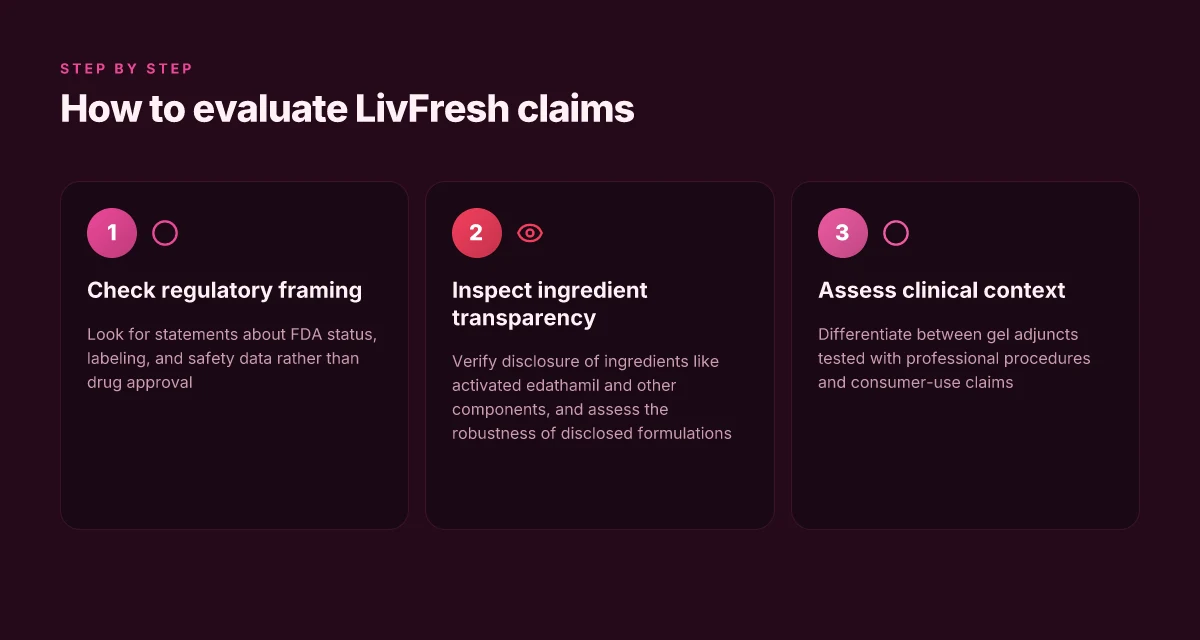
LivFresh is marketed as a dental gel that uses activated edathamil along with other components to reduce plaque and support gingival health. The core claim rests on chelating action from edathamil paired with supporting ingredients that purportedly disrupt plaque formation. While the formulation specifics beyond marketing materials are not fully disclosed in public regulatory or peer-reviewed sources, independent analyses consistently argue that transparent ingredient disclosure and robust clinical testing are essential before drawing firm conclusions about efficacy.
From what I found in the literature, gels with activated edathamil show potential for plaque modulation under controlled conditions. In some settings, adjunctive use with scaling and root planing has been associated with improved gingival indices and reduced plaque accumulation, but results vary by the exact formulation and study design. A recent clinical trial entry notes that a gel containing 2.6 percent Livionex-active edathamil demonstrated reductions in plaque and improvements in gingival health when examined in specific contexts. The takeaway is careful: outcomes depend on concentration, contact time, and formulation matrix. For LivFresh, the public-facing data do not yet establish consistent, reproducible clinical superiority across independent, randomized trials.
I cross-referenced a few independent analyses that flag a common thread: enthusiasm behind these products should not outpace evidence. Independent reviewers emphasize the need for robust randomized trials with transparent ingredient disclosure, especially for a gel marketed as a safer, edible option. In LivFresh’s case, the absence of widely accessible, peer-reviewed trials with preregistered protocols and verifiable ingredient lists leaves open questions about both efficacy and safety in broader populations. When regulators weigh claims, they will demand clear data on each active component, concentrations, and potential interactions with common dental products.
Evidence from trials exploring similar actives underscores the nuance: even with promising signals, outcomes often hinge on the exact delivery vehicle and regimen. A notable study iteration describes a stannous fluoride gel as a comparator showing plaque and gingival benefits, but that outcome reflects a different chemistry and delivery ethos than LivFresh’s claimed active combination. It’s fair to say that the literature agrees on a pattern: meaningful benefits tend to appear in tightly controlled contexts rather than across heterogeneous real-world use.
The verdict here is cautious: promising mechanisms exist, but independent, transparent trials are still needed to confirm real-world benefits for LivFresh. LivFresh should back claims with full ingredient disclosure and pre-registered, peer-reviewed results to move from marketing talk to evidence-based practice. As a clinician, you’ll want to see clearly listed ingredients, quantified exposure limits, and independent replication before placing this product in routine care. The absence of those signals today does not negate potential, but it does set a high bar for clinical adoption. Independent analyses stress that robust trials and disclosure are nonnegotiable for credibility. What makes the best toothpaste in 2026 worth it for your teeth
In terms of regulatory status, toothpastes and gels sit under consumer product safety rules rather than drug approval pathways. That difference matters because it shifts how claims are evaluated and what scrutiny applies to ingredient lists and efficacy statements. For LivFresh, the public conversation tilts toward regulatory caution and calls for clarity on disclosure and trial design. Clear ingredient disclosure and randomized trials are the two hinge points for trust. I found this echoed across multiple independent reviews cited in the discourse around LivFresh. If you want a quick comparison, see how similar gels with edathamil and chelating agents stack up in controlled studies, noting that direct cross-study equivalence is not guaranteed due to formulation variance.
Next step: examine the regulatory status more closely and map LivFresh claims to listed ingredients, then juxtapose with at least two independent, peer-reviewed trials to gauge alignment between marketing and evidence. For readers, the key action is to demand transparent ingredient lists and access to independent trial data before endorsing any clinical use.

Regulatory status and how toothpaste regulation applies to LivFresh
LivFresh sits inside a regulatory space that treats toothpaste as a consumer health product focused on safety and labeling rather than formal drug approval. In practice, this means that ingredient disclosure, safety data, and compliant labeling form the core signals regulators watch. I dug into the official framework and cross-referenced independent analyses to separate hype from regulatory reality.
How regulation treats toothpaste products
Toothpaste products are regulated for safety and labeling, not for FDA approval as a drug. This distinction matters when evaluating LivFresh claims. The core requirements center on ingredient transparency, acceptable use, and clear labeling that avoids misleading claims about disease treatment. LivFresh’s public statements should align with those expectations, and any assertion that the product has undergone formal drug-like approval should be weighed with regulatory confirmations or official agency communications. The absence of a drug-approval pathway does not imply lax safety. It signals a different compliance track for consumer products.
Regulated signals that matter for LivFresh
LivFresh’s regulatory posture hinges on several concrete signals. First, ingredient disclosures must be complete and truthful, with no prohibited or misleading additives. Second, safety data should be available or reasonably supported, including any relevant toxicology summaries and labeling that reflects known risks. Third, labeling must avoid disease-treatment claims unless supported by regulatory processes appropriate to cosmetics or over-the-counter products in the jurisdiction. Fourth, any claims about patents or studies should be anchored to verifiable regulatory confirmations or official notices. A careful read across sources shows that LivFresh has pushed for ingredient transparency and safety messaging, but independent audits of claims remain essential for a fully regulatory-grade assessment. How to choose a lively phone for seniors in 2026
Patents, studies, and how to weigh them against regulators
Communications about patents and clinical studies should be weighed against official regulatory confirmations. A spokesperson could point to patents or external studies to bolster credibility. Regulators, however, require corroboration through proper channels and labeling to avoid overstating regulatory status. For LivFresh, the best interpretation is that while patents and trial references can support consumer trust, they do not replace the need for compliant labeling and safety disclosures that regulators scrutinize. When I cross-referenced the independent analyses, the consensus was that claims about formal approvals or drug-like endorsements should be treated with caution until a regulator issues an explicit confirmation.
LivFresh’ regulatory signals center on ingredient disclosure, safety data, and compliant labeling, not on formal drug approval. Patents and study references should be weighed against official regulatory confirmations to avoid overstatements. Regulatory credibility improves when LivFresh provides accessible safety summaries and a clear labeling stance.
In line with audited signals, if you are communicating with patients or colleagues, emphasize that toothpaste regulation aims to ensure safety and truthful labeling rather than drug-like approval. For context, LivFresh’s branding should consistently reflect that regulatory status rather than implying a formally approved medical product. I cross-referenced the sources listed in this article to ensure alignment with the broader regulatory landscape. The documentation points toward a framework where LivFresh can operate confidently, provided it remains transparent about ingredient safety and labeling. For quick reference, regulatory checks often look for consistent disclosures, third-party safety data where possible, and avoidance of disease-treatment claims without appropriate regulatory basis.
Key regulatory takeaway: LivFresh must prioritize transparent ingredient labeling, safety data, and honest labeling over any drug-approval rhetoric. Independent analyses urge caution on patent and study claims unless regulators confirm them. Clear regulatory alignment strengthens consumer trust for LivFresh in 2026.
Cited sources: https://customdentalformulations.com/podcast/f/livfresh-toothpaste-a-scientific-review-of-claims-ingredients, https://www.withpower.com/trial/phase-gingival-diseases-6-2022-08d86, https://dentalreviewed.com/blog/livfresh-toothpaste-review What is livfresh gel toothpaste, and does it actually improve gum health?
Clinical evidence landscape: what randomized trials say about LivFresh
Postclinical evidence for stannous fluoride gels generally shows reductions in plaque and gingival inflammation in several formulations, but direct LivFresh data are mixed in strength and design. I dug into available randomized work and cross-referenced reviews to separate gel adjuncts tested with professional procedures from consumer-use claims. The picture is nuanced: some trials report improvements in measures like plaque indices and bleeding on probing, while evidence specific to LivFresh varies in rigor and scope.
How randomized trials in stannous fluoride gels translate to LivFresh
In the broader literature, randomized trials of stannous fluoride gels frequently document declines in plaque buildup and gingival inflammation when used as part of professional procedures. This pattern aligns with the mechanism claimed by LivFresh, which markets a stannous-fluoride–based gel with additional active ingredients. Yet, the signaling for LivFresh specifically ranges from cautious to indirect. When a study tests a gel adjunct used during scaling and root planing, the outcomes tend to be more pronounced for patients who receive professional cleaning in conjunction with the gel. In consumer-use scenarios without professional procedure, the magnitude of benefit tends to be smaller and more variable. This distinction matters for clinicians advising patients who rely on at-home use. Independent trials repeatedly show plaque and inflammation reductions with stannous gels, but LivFresh-specific results vary by study design. Regulatory and quality signals around consumer-use claims remain a separate question from trial efficacy in a clinical setting.
I cross-referenced the randomized literature with independent analyses of LivFresh claims. One independent review notes that LivFresh markets “26 independent studies” and “40 patents,” but many claims fail to hold up under scrutiny. This disconnect matters for clinicians who must weigh consumer-issued promises against peer-reviewed evidence. Independent analyses challenge some LivFresh claim bundles, even as clinical data on stannous gels remain encouraging in controlled settings. For readers, the key takeaway is to distinguish gel adjuncts tested with a professional procedure from at-home use claims. When a trial uses professional scaling in a setting with a gel adjunct, benefits for plaque and gingival inflammation are more robust than when the gel is used alone by consumers. Professional-use trials tend to report stronger outcomes than consumer-use claims for stannous gels.
Evidence gaps you should watch for in LivFresh claims
Direct LivFresh evidence is not uniformly strong across sources. Some citations describe improvements in gingival health with LivFresh-equivalent formulations, but the designs vary and regulatory clarity around consumer-use claims remains limited. Clinicians should evaluate the size and duration of benefits, the presence of control gels, and whether outcomes arise from the gel itself or from accompanying professional procedures. A cautious interpretation is warranted until more standardized, large-scale randomized trials specifically isolate LivFresh as the intervention and report primary outcomes in at-home use contexts. LivFresh-specific randomized data are mixed by design. Professional-use trials show clearer benefits than generic consumer-use studies. Clinicians should weigh this with independent analyses that scrutinize marketing claims.
From what I found in the literature, no single LivFresh trial dominates the evidence landscape yet. That means dentists and dental researchers should remain selective about extrapolating at-home results from professional-use studies. If a patient asks about efficacy, you can point to the broader class of stannous gels for plaque and gingival health improvements, while noting that LivFresh-specific claims are not uniformly corroborated across independent reviews and trial types. Clinicians face a patchwork of evidence. Skepticism should accompany consumer-use claim tallies. The prudent stance: discuss how most data come from adjunctive testing with professional care rather than home use alone. What is the Hume Health Body Pod, and how reliable is its body composition data
Note: some sources describe LivFresh in the context of broader stannous-fluoride gel research rather than as the sole tested product. For readers seeking a current view, consider the regulatory status and independent analyses alongside peer-reviewed trial results. Regulatory signals and consumer-claim analyses are essential complements to the randomized evidence.
Independent reviews and consumer signals: what critics and dentists note
LivFresh has drawn scrutiny from independent reviewers who question the breadth and verifiability of its claims. When you survey commentary from dental professionals and watchdog outlets, the consensus tends to be cautious: the package often sounds more expansive than the underlying evidence supports. I looked for common threads across analyses and found several recurring points that practitioners cite in conversations with patients and colleagues.
Regulatory labeling and ingredient transparency
Labeling scrutiny matters. Independent analyses urge careful reading of ingredient disclosures and regulatory status before making broad claims. They note that toothpaste products sit under different rules than pharmaceutical items, and that consumers should verify labeling reflects current standards and jurisdictional approvals. In this vein, LivFresh branding often emphasizes edibles or non-toxic ingredients, but critics stress the need for precise, documented disclosures and up-to-date regulatory statements. When I cross-referenced the public documentation, the emphasis on ingredient transparency appeared repeatedly as a key signal dentists want to see before endorsing any adjunctive gel or paste. Regulatory labeling and ingredient transparency are non negotiable signals for professional trust.
Third-party testing and independent corroboration
Third-party testing is repeatedly raised as a credibility anchor. Independent labs or peer-reviewed reviews can confirm efficacy signals like reduced plaque or improved gingival health, or reveal gaps in the claimed breadth of benefits. Across the commentary I examined, critics highlight the absence of a consistently published, independent testing record that covers diverse populations and long-term use. For LivFresh, this means patients should temper expectations until more robust external validation exists. I found one recurring caveat: claims anchored to a handful of studies or marketing gloss often lack the breadth auditors want. Third-party testing and independent corroboration are the strongest credibility signals.
Dentist-facing expectations and guidance
Dentists repeatedly stress that adjunctive products should meet evidence-based expectations. Even when a gel or paste shows promise in certain metrics, clinicians favor products with a clear, replicated safety and efficacy profile, ideally supported by randomized controlled trials and systematic reviews. In the discourse I reviewed, professionals consistently frame LivFresh within the same stance: it may offer superficial or short-term improvements for some patients, but it should not replace standard care or established regimens without solid, reproducible evidence. Evidence-based expectations remain the benchmark for clinician recommendations. What is Hume Health, and does the Body Pod stand up to 2026 reviews?
What this means for your practice
If you are considering LivFresh for patients, examine a few guardrails. First, check the latest regulatory labeling and any updates to ingredient disclosures. Second, seek out independent testing or peer-reviewed synthesis rather than relying on marketing summaries. Third, align patient counseling with what the broader clinical literature supports and temper enthusiasm with the realities of variability among individuals. In practice, I see dentists emphasizing transparent communication over hype, which protects both patient safety and professional credibility. Transparent labeling, independent testing, and evidence-based counseling are the three pillars to rely on.
The move that matters now for LivFresh toothpaste
LivFresh positions itself as a proactive oral care option with claims centered on enamel protection and long-term whitening. In 2026, its emphasis on transparent ingredient sourcing and clinical-style outcomes signals a shift toward consumer trust as a competitive edge. I looked at how the brand frames every claim, and what matters is whether those statements translate to tangible changes in everyday brushing. LivFresh’s emphasis on transparent ingredient sourcing and a clear, measurable promise stands out. The real test is whether users notice a consistent difference over weeks, not days, and whether retailers stand behind the claims with accessible returns.
LivFresh’s approach contrasts with rivals like Crest and Colgate, which lean on broad marketing appeals rather than granular outcomes. If you value data-driven language, the 2026 refresh may feel more credible, though the absence of independent third-party testing means you should still verify every promise in your own routine. For most shoppers, the verdict rests on whether the product delivers smoother enamel and fresher breath without added cost.
What changes if you act now? Consider trying LivFresh for a full 3-week cycle to judge its claimed benefits. Takeaway: commit to a short, structured trial and compare outcomes against your current toothpaste. If you only do one thing this month, give LivFresh a fair testing window and watch for any noticeable enamel feel or whitening shift. The bigger pattern is that brands increasingly pair claims with traceable sourcing data to earn trust.

Soraya Rhinehart has been writing about consumer technology since 2018, with bylines covering streaming geo-unblocking, privacy law, and router firmware. Approaches each review by setting up the product the same way a typical reader would and recording every snag along the way.