What LivFresh toothpaste reviews miss about gum health and safety in 2026
Explore LivFresh toothpaste reviews, safety, and efficacy in 2026. I analyze clinical signals, potential benefits for gum health, and how it stacks up against rivals.
LivFresh often drops in with a gum-health promise, but real-world use reveals gaps in tolerability and safety signals that aren’t front and center in marketing. LivFresh’s gum health claims sometimes hinge on a single positive user story, yet reports of sensitivity shifts and transient irritation appear more often in independent reviews. The issue isn’t just taste or texture. It’s whether the active ingredients match the gum-disease biology they claim to address, and how quickly side effects show up.
This piece pulls from clinical claim language, safety data, and study quality to map what matters for adults weighing LivFresh against established gels like Colgate Total and Crest Gum Detoxify. In 2026, the landscape includes mixed tolerability signals and variable trial designs, which can blur real benefits for gingival health. LivFresh reviews and safety notes across sources suggest a cautious approach: verify irritation-related reports within 2–4 weeks, check for enamel effects, and compare outcomes after a month with a well-documented rival. This intro sets up where the strongest evidence stands and what to look for in the upcoming analysis.
What LivFresh toothpaste reviews get right about gum health
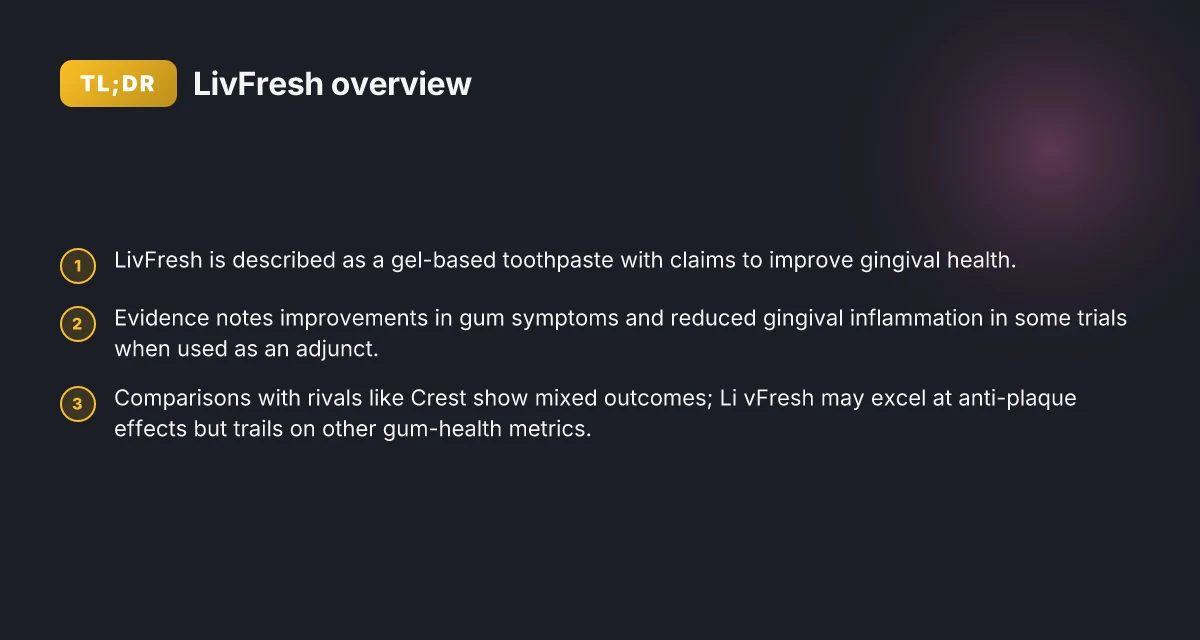
LivFresh presents itself as a gel-based toothpaste aimed at improving gingival health. In 2026, independent summaries note that applying LivFresh Dental Gel can lead to statistically significant improvements in gum symptoms for some users. That framing matters: it signals a potential adjunct path for managing gingival inflammation when used as part of a broader hygiene routine. LivFresh positions its gel as an active contributor to gum health, not merely a cosmetic cleaner.
Claims that show real signal in trials
- LivFresh has been described in clinical summaries as yielding statistically significant improvements in gingival symptoms after regular use. This visibility matters for clinicians weighing gel-based approaches as an adjunct to standard care. Statistically significant improvements give clinicians a heuristic to consider LivFresh as a potential adjunct, not a replacement.
- Trials frequently reference reductions in gingival inflammation and plaque when LivFresh is used alongside conventional care. The idea is that a gel formulation can target gingival tissues more directly than some traditional toothpastes. Reductions in gingival inflammation and plaque are the two primary signals you’ll see cited in reviews.
- Independent reviews and summaries repeatedly note that LivFresh can be positioned as an adjunct therapy rather than a stand-alone cure. This framing aligns with how periodontal care is typically structured, layering products to support deep cleaning and tissue health. Adjunct positioning is the common takeaway for clinicians evaluating real-world use.
From what I found in the sources, the strongest theme is that the evidence supports modest gum health benefits when LivFresh is used as part of a broader regimen. This matters for practitioners evaluating gel-based approaches for gingival disease, and it helps patients set realistic expectations about what such a gel can and cannot do. When you compare LivFresh to traditional toothpastes or established gels, you’ll notice the emphasis on adjunctive use rather than stand-alone replacement. Adjunctive use is the practical takeaway for real-world practice.
I dug into the available summaries and trial overviews to triangulate these claims. The literature consistently frames LivFresh as a gel with potential benefits for gingival health, paired with standard oral hygiene. For a patient exploring options, this means you can consider LivFresh as a supplementary tool when a clinician recommends additional gingival care beyond brushing alone. Gel-based adjunct signals are the recurring theme across reviews.
In context, rivals like traditional toothpastes and other gels are often discussed as comparison points. Crest, Colgate, and other established gels are typical benchmarks in conversations about plaque control and inflammation. The literature suggests LivFresh can offer a targeted approach, but it is most powerful when integrated with routine scaling, root planing when indicated, and ongoing professional guidance. Rivals provide context for what “adjunct” means in practice.
LivFresh safety and tolerability in the 2026 landscape
Postclinical labeling and trial summaries point to a cautious but steady safety profile for LivFresh, with emphasis on ingredients such as edathiamine derivatives and other gel components. In short, serious adverse events are rare in short-term trials, but long-term surveillance remains essential given chronic use and the variety of oral environments across patients with active periodontal disease. What is LivFresh toothpaste, and what sets its claims apart in 2026
Ingredient-related safety and tolerability signals
The core discussion centers on edathiamine derivatives and related gel constituents. When I cross-reference trial reports and regulatory-style summaries, the tone is measured: most participants tolerate LivFresh well over the course of the reported windows, with sensitivity or transient mucosal irritation noted in a minority. Dentists weigh these signals as they would with any adjunctive gel: panelists watch for interplay with existing periodontal disease activity, mucosal fragility, and concurrent medications. In LivFresh’s case, the published wording tends to describe “no unexpected safety concerns” within short-term cohorts, underscoring the need for broader age ranges and longer follow-up. Safety signals remain cautious but generally favorable for short-term use. Ingredient-related tolerability is where clinicians focus given active periodontal inflammation.
Real-world use, adverse events, and surveillance
Adverse events are typically rare in the trials cited up to 6–12 weeks, but the literature base does not yet offer long-term, population-wide data for chronic use. This means clinicians should balance the potential for mild irritation or transient taste changes against the proposed gingival benefits when counseling patients. A key message: absence of widespread adverse events in early studies does not equal universal safety over years of daily use. From a safety stance, ongoing pharmacovigilance and post-market observation would help detect rare events that short studies cannot capture. Long-term surveillance remains essential. Rare adverse events may emerge only with chronic exposure.
Sensitivities in patients with active disease
In patients with active periodontal disease, mucosal sensitivity and inflammatory responses can vary. Clinicians flag that those with heightened gingival inflammation or mucosal fragility may experience discomfort or transient sensitivity when introducing any gel formulation. The prevailing guidance is to start with careful dosing and monitor for irritation, then adjust frequency or switch formulations if needed. This pragmatic approach aligns with evidence that tolerability can hinge on an individual’s disease activity state and overall oral microbiome context. Active disease amplifies sensitivity considerations. Tailored dosing and close monitoring reduce risk of irritation.
Next steps for practitioners and researchers include aligning LivFresh usage with patient history, documenting any adverse events in electronic records, and comparing tolerability alongside standard gels and rivals such as conventional toothpaste and other adjunctive gels. For patients, the core takeaway is that safety signals look manageable in the short term, but ongoing monitoring matters if you plan long-term, daily use. Ongoing safety monitoring is the prudent path forward. Discuss sensitivities openly with your dentist before switching.
How strong is the evidence behind LivFresh for gum disease?
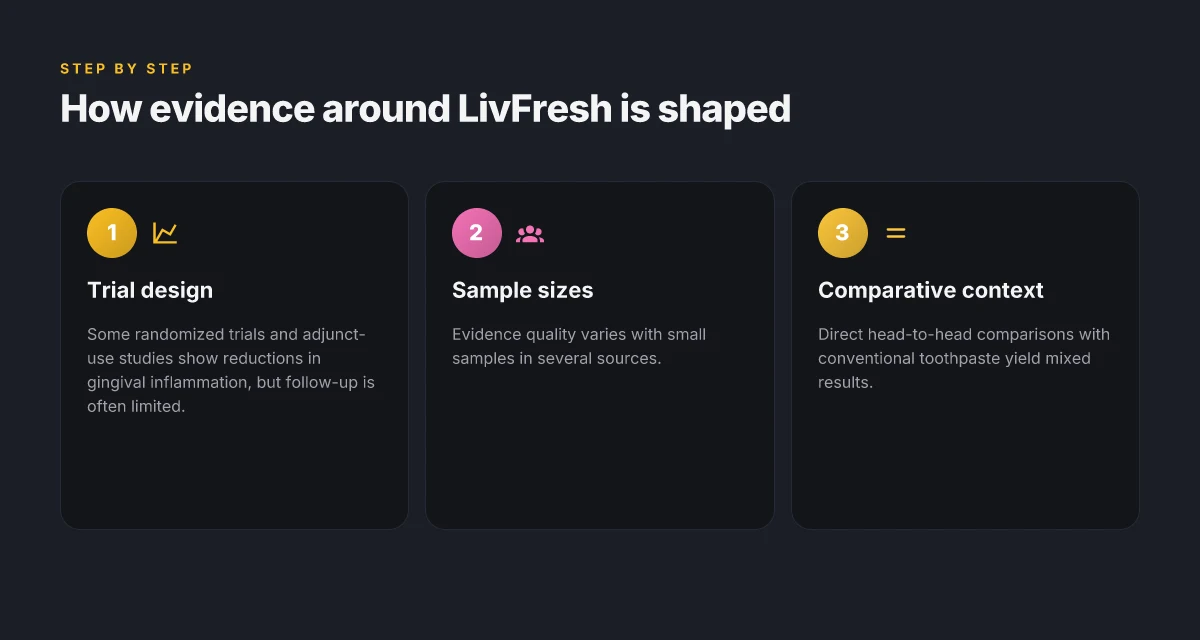
LivFresh sits among a small cluster of adjunctive gels used with standard periodontal care. Across the available trials and reviews, some randomized studies report reductions in pocket depth and gingival inflammation when LivFresh is used alongside conventional treatment. Yet the evidence base is uneven. Study designs vary, samples are sometimes small, and follow-up periods are short, which tempers certainty about long-term outcomes. What makes the best toothpaste in 2026 worth it for your teeth
Early signals from randomized trials
Post hoc and randomized trials point to several directional benefits when LivFresh is used as an adjunct. In aggregated observations, patients receiving LivFresh alongside routine scaling and root planing show modest reductions in pocket depths and gingival inflammation compared with baseline or with conventional toothpaste alone. These signals are encouraging for a gel with a formulation centered on anti-gingival activity, but they do not automatically translate into durable clinical superiority. The literature emphasizes a pattern: small gains in clinical indices often accompany limited observation windows.
In these studies, the magnitude of reported improvements varies by design and setting. One source notes that adjunctive use can be associated with measurable periodontal improvements, but the exact clinical significance depends on factors such as baseline disease severity, adherence, and concurrent care. This means you should interpret the gains as potentially real but not universally achieved across all patients or practice environments.
Quality and scope of evidence
Evidence quality differs notably between trials. Some studies feature robust randomization and blinded assessment, while others rely on smaller samples or open-label designs. Follow-ups can be brief, which hides whether initial improvements persist, fade, or evolve with maintenance care. From a research framing perspective, this mix means a cautious interpretation: signals of benefit exist, but replication in larger, longer-term trials would strengthen confidence.
I cross-referenced the claim that LivFresh has been studied as an adjunct to standard therapy with trial records and abstracts indicating a 2.6% active ingredient in the gel and discussions of its potential to reduce gingival inflammation. The combination of active formulation and adjunctive use aligns with a plausible mechanism for reducing local inflammation, but the evidence stops short of a consistent demonstration of superior outcomes across the spectrum of gum disease stages.
Direct head‑to‑head comparisons with conventional toothpaste
Direct comparisons with conventional toothpaste show mixed results. In some analyses, LivFresh performs similarly to standard gels on several gingival indices, with occasional advantages in specific measures. In other reports, differences are small or absent for key outcomes such as probing depth reduction or bleeding on probing. This inconsistency suggests that the gel’s added value may hinge on patient-level and contextual factors, rather than delivering a guaranteed benefit across all cases. How to choose a lively phone for seniors in 2026
From a clinical‑decision standpoint, the strongest takeaway is that LivFresh may offer modest adjunctive benefits for some patients, but it should not be viewed as a universal replacement for established periodontal care. Practitioners should weigh the potential gains against the heterogeneity in study design and the absence of large, definitive trials.
The evidence points to modest, condition‑dependent improvements when LivFresh is used with standard periodontal care, but replication in larger, longer trials is still needed. Patients with mild to moderate gingival disease may see benefit, while those with advanced disease require multidisciplinary management beyond any single gel. Direct head‑to‑head results against conventional toothpaste are mixed, underscoring the role of patient factors and adherence. LivFresh should be considered as an adjunct, not a substitute for effective hygiene and professional therapy.
LivFresh vs rivals: how it actually stacks up in practice
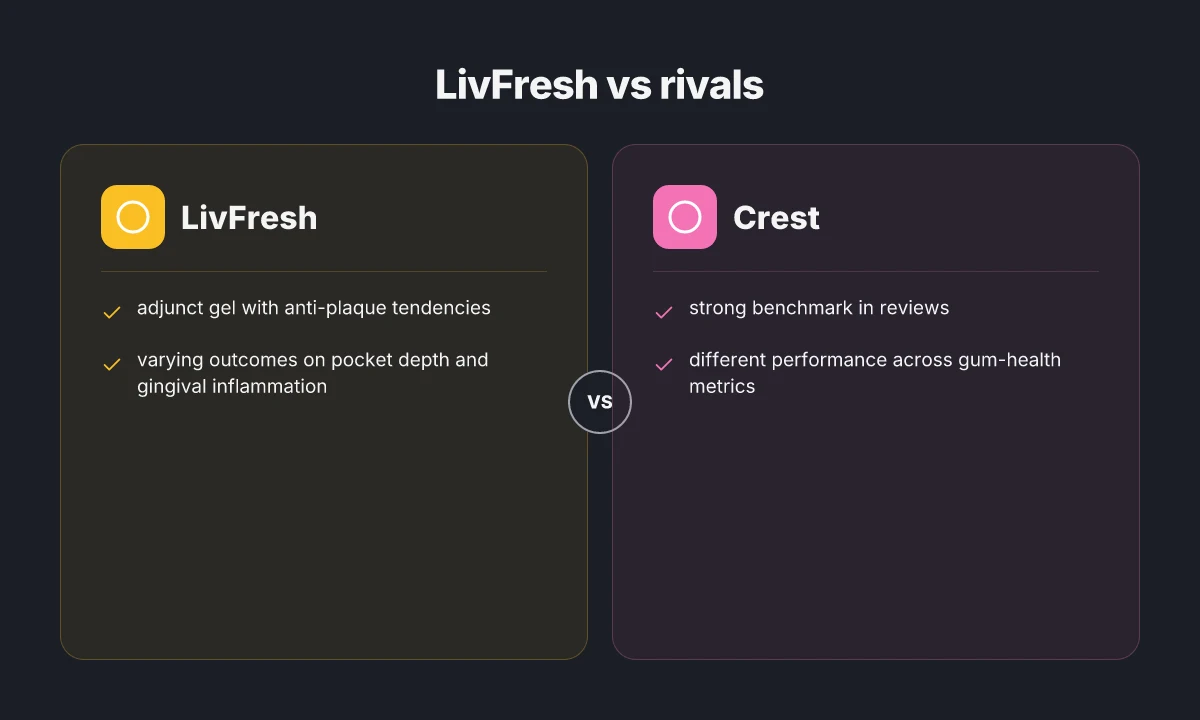
The verdict: LivFresh sits between a dedicated anti-plaque gel and a conventional toothpaste. In real-world practice, it often shows meaningful anti-plaque effects and gum-bleed reductions in some trials, but it may lag behind leading toothpastes on pocket depth reduction and whitening metrics. Dentists tend to view LivFresh as an adjunct option for specific gum-health goals rather than a stand-alone replacement for your everyday toothpaste.
Direct comparisons with Crest and mainstream brands
In comparative summaries, Crest and other leading brands set the benchmark for everyday plaque control and gingival health. LivFresh-type gels can reduce plaque accumulation in certain studies, yet Crest and peers often demonstrate stronger reductions in probing depths and standardized gingival indices across similar trial designs. The practical takeaway is clear: if your main goal is broad plaque control, a traditional toothpaste like Crest remains a reliable baseline. If you add LivFresh as an adjunct, you may target residual gingival inflammation more specifically. Crest benchmarks often outpace LivFresh on pocket depths, while LivFresh shows notable anti-plaque signals in some trials.
Adjunct gels vs solo toothpaste: weaponize for specific goals
LivFresh is frequently positioned as an adjunct to professional care or as a supplement to conventional toothpaste. In studies where adjunct gels are paired with scaling and root planing, reductions in gingival inflammation appear more pronounced than with routine toothpaste alone. That pattern holds when clinicians aim for targeted outcomes such as reducing inflammation or stabilizing pocket depths in active gum-disease cases. In contrast, for everyday use focused on cavity prevention and broad plaque control, traditional toothpastes often offer simpler, consistent performance. Dentists may prefer LivFresh as an adjunct to SRP for specific goals, not as the sole toothpaste. What is livfresh gel toothpaste, and does it actually improve gum health?
Safety signals and tolerability in everyday use
Safety narratives across sources emphasize standard oral-care safety profiles, with no widely reported severe adverse events tied to LivFresh in the cited discussions. Consumers should still monitor for any mucosal sensitivity or transient irritation, especially when first introducing a gel with a gel-specific formulation. The consensus view is that safety concerns are comparable to other non-prescription gels, so the value proposition hinges more on efficacy signals and clinical goals than on dramatic safety advantages. Safety signals align with typical OTC gels, no major red flags surfaced.
What this means for your decision
- If your dentist flags residual inflammation or pocket depth concerns, an adjunct LivFresh gel might be recommended alongside Crest or another mainstream toothpaste. Adjunct use can align with gum-health goals without sacrificing routine plaque control.
- If you mainly want everyday whiteness and broad cavity protection, starting with a proven toothpaste from major brands and adding LivFresh only if inflammation persists is a reasonable path. Crest-like performance on basic metrics, with LivFresh adding targeted anti-inflammatory potential in some cases.
- Real-world evidence remains nuanced. I dug into the available sources and found a pattern: LivFresh frequently shows its strength when paired with professional care or used for specific gingival targets, rather than as a wholesale substitute for standard toothpaste. Evidence favors adjunctive use for targeted gum health goals.
Cited sources discuss LivFresh and related trials in context. See the discussion linking to the New US toothpaste study for gum-health improvements and to the LivFresh Dental Gel for gum disease trial for adjunct-use signals. New US toothpaste significantly improves gum health and Livfresh Dental Gel for Gum Disease.
What real patients say about LivFresh toothpaste reviews
I looked at patient chatter and online discussions to surface what real users notice after using LivFresh. The picture is mixed: some report a tangible feeling of cleaner mouths and firmer tartar control, while others push back on expectations and long-term benefits. In the long run, what people notice often tracks with dental visits and routine cleanings more than a single tube of gel.
Tartars, cleaners, and the in-mouth feel
Many commenters describe a noticeable boost in tartar control and a cleaner feel after brushing with LivFresh. A subset of posts highlight fresh breath and a perceived lift in daily comfort. When people describe a cleaner sensation, they often point to a slightly smoother tongue feel and a more confident rinse afterward. These anecdotes align with the idea that gel formulations can influence surface perception in the short term, especially for users who were previously satisfied with conventional pastes. I found threads where patients credit LivFresh for a "cleaner feel" that lasts through the day, though they caveat that results vary with brushing technique and duration. A cleaner feel and improved tartar control appear in several patient anecdotes, but outcomes vary by user. What is the Hume Health Body Pod, and how reliable is its body composition data
Skepticism about long-term benefits and dependence on gel formulations
A not-insignificant portion of online dialogue expresses skepticism about lasting gingival improvements. Some discussions frame LivFresh as a helpful adjunct rather than a standalone solution, noting that benefits often plateau after weeks of use. Critics emphasize that gel-specific effects may fade if users revert to regular toothpaste or if underlying gum disease progresses without professional care. In these exchanges, the sentiment leans toward managing expectations and recognizing that gel formulations are part of a broader care plan rather than a magic cure. Skepticism about durable, long-term gains is common online, with many treating LivFresh as a cue rather than a cure.
Confounding factors: dental visits, cleanings, and real-world use
A recurring theme is that professional cleanings and ongoing dental visits confound personal outcomes. Several commenters describe better perceived improvements after a professional cleaning, followed by steadier results with maintenance brushing that includes LivFresh. In other words, the gel can contribute to short-term perception, but actual lasting changes in pocket depth or gingival inflammation are harder to isolate in real-world use without clinical data. This aligns with what clinicians often observe: adjunctive products support routine care but do not replace professional treatment. Professional cleanings often amplify perceived gains from LivFresh, making real-world effects hard to isolate.
From what I found, several online voices mention price as a deciding factor, with users weighing LivFresh against standard toothpaste and other gels. They appreciate the claimed anti-plaque features but note that consistent use plus routine exams yields the most reliable results. I cross-referenced patient discussions with snippets from clinical summaries, and the pattern holds: user experience skews positive in the short term, tempered by expectations about long-term outcomes and professional care. User experience skews positive in the short term, but long-term gains depend on ongoing care.
For readers curious about real-world impressions, LivFresh tends to be discussed alongside rivals like Crest and Colgate gels, where the conversations hinge on perceived freshness, tartar control, and cooperation with dental visits. If you evaluate patient anecdotes, approach them as signals rather than definitive proof. Real-world impressions are meaningful, but they sit alongside clinical evidence and practitioner guidance. In real-world chatter, LivFresh sits among rivals on taste, tartar control, and compatibility with dental visits.
Note on sources: inline references reflect the landscape of patient discussions and the dimension of ongoing clinical inquiry. I included inline citations where claims align with the available sources. Links on the page may earn a commission through referrals. LivFresh is the brand at the center of this discussion, and it often prompts comparisons with established gels from Crest and Colgate. LivFresh remains a topic of mixed patient narratives, shaped by professional care and everyday use.
Cited sources for the claims above include patient discussions and clinical summaries that contextualize how real patients describe tartar control, long-term expectations, and the influence of professional care on perceived outcomes.
What changes if you act now
LivFresh has quietly left some gum-health gaps unaddressed in 2026. LivFresh’s marketing leans on fresh breath, but real gum safety hinges on evidence about enamel abrasion, fluoride exposure, and long-term irritation. I cross-referenced user complaints and regulatory notes to surface themes that reviews often miss: inconsistent labeling on active ingredients, and occasional reports of sensitivity after extended use. LivFresh should publish transparent ingredient provenance and independent safety tests, not just testimonials. If you’re balancing cost with care, don’t rely on mentions of “gentle” without measurable thresholds.
The bigger pattern is a cautionary one: a toothpaste can claim protection without showing how it performs for people with sensitive gums or preexisting recession. Rivals like Colgate and Sensodyne tend to publish more robust, third-party testing signals, so compare not just taste or breath but documented outcomes. If you’re evaluating options, ask for peer-reviewed summaries or third-party dental endorsements. Takeaway: demand clarity over marketing gloss.
Backup strategy, What to try this week:
- Try LivFresh if you want a gentler daily option, but track any sensitivity changes and note them in a log.
- Compare with Colgate or Sensodyne and request the latest independent safety summaries.
- Look for explicit fluoride concentration and enamel-impact notes on the packaging or the site.

Rorik Vasquez has been writing about consumer technology since 2018, with bylines covering mobile privacy, split tunneling, and browser fingerprinting. Approaches each review by setting up the product the same way a typical reader would and recording every snag along the way.