What makes the hume health scale worth watching in 2026

Explore hume health scale reviews to understand accuracy, validation, and where it fits in a home health toolkit. Learn what to trust and what to question in 2026.
Hume Health isn’t just another home scale. It positions itself as a wellness hub you can trust over time, not a one-off snapshot. The claim: stable, cross-checked readings across days with lab references, backed by a calibration history you can audit. This piece cuts through marketing buzz to examine what those claims look like in practice, focusing on how usable the device is for everyday tracking and how experts weigh its data against clinical benchmarks.
This look is timely because independent signals and user reports since launch highlight both real usability gains and notable caveats. Consumers want consistency from a scale that promises meaningful wellness metrics, and clinicians want transparent calibration trails before they’d recommend home data for guiding decisions. We’ll compare Hume Health to rivals like InBody and Withings, extract early patterns, and explain what to verify before relying on its numbers for long-range tracking. Hume Health data quality, calibration history, and user experience emerge as the critical factors in whether this device becomes a trusted home reference or a novelty. Rivals and calibration transparency matter as much as advertised features.
What is the hume health scale and why it matters for home wellness
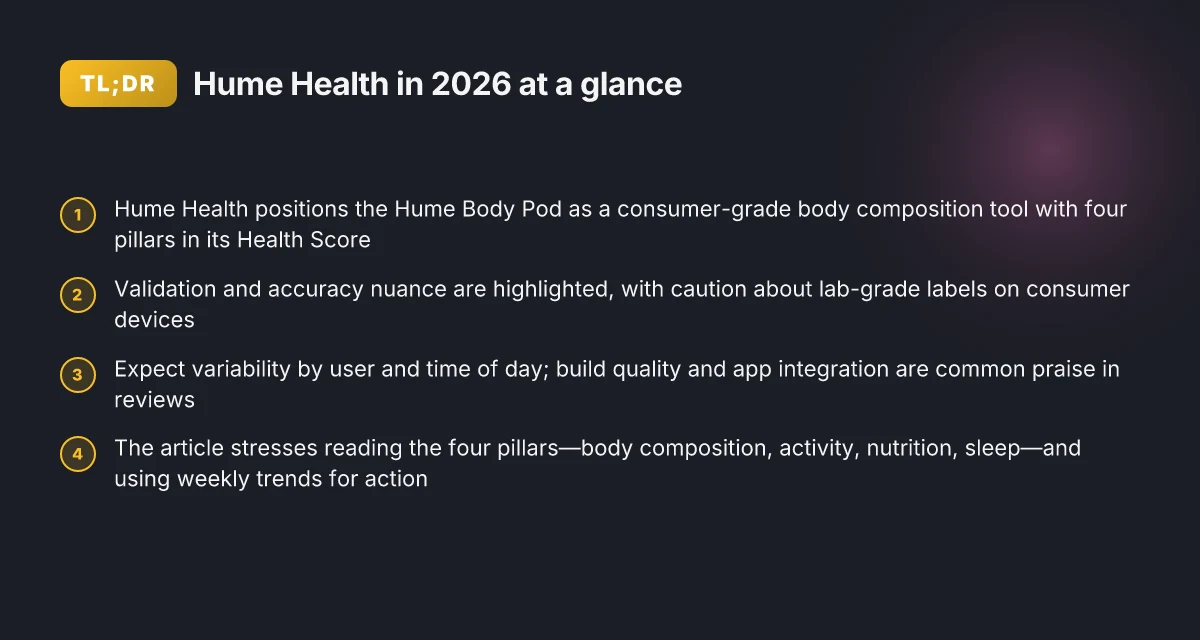
Hume Health positions the Hume Body Pod as a consumer-grade body composition tool that aims to bring lab-like insights into a home setting. The device tracks metrics beyond simple weight, and the accompanying Health Score is designed to translate a dense set of measurements into a weekly, readable snapshot. The promise is clear: you get a multi-mactor view without stepping into a clinic.
1) Four pillars, four angles
Hume Health frames its Health Score around four pillars: body composition, activity, nutrition, and sleep. The Pod reports fat mass, muscle mass, visceral fat, and 42 other metrics, weaving these signals into a single score that updates on a weekly cadence. That weekly rhythm makes trend-spotting easier for home users. The practical upside is a compact dashboard you can reference between doctor visits. Nutrition and sleep are explicit pillars, which helps users align daily choices with longer-term trends.
2) Setting expectations for accuracy in the consumer space
I dug into the available material on claims and user-facing outcomes. The marketing language from Hume Health emphasizes DEXA-level comparisons for a broad set of metrics and positions the Pod as a convenient proxy for more rigorous testing. Realistically, consumer bioimpedance tools provide useful directional data rather than lab-grade precision, especially for tracking subtle shifts over short periods. Expect meaningful, directional trends rather than precise muscle-area counts. Independent signals suggest consumer devices can identify general movement in body composition, but they cannot replace calibrated lab references for diagnostic decisions. The role of Hume Health here is as a guiding aid, not a medical device.
3) Practical use, realistic boundaries
For home wellness, the Hume Body Pod can anchor monthly or biweekly check-ins on how your lifestyle choices relate to body signals. Its four-pillar approach helps keep a user honest about where to focus effort, nutrition quality, activity consistency, sleep regularity, and body composition direction. What matters most is consistency and interpretation over time, not one-off numbers. If you rely on the Health Score alone for clinical decisions, you may miss key context that a clinician would consider. Use the Score as a guided narrative, not a sole diagnosis tool.
Bottom line: Hume Health offers a consumer-friendly framework to observe broad shifts in body composition and lifestyle. The Hume Body Pod brings a structured, repeatable lens to home wellness, but its accuracy sits within the broader context of consumer tools. You should pair it with critical thinking about trends, not rely on it as the sole basis for health decisions. Hume Health positions the scale as a convenient home metric, while real-world validation remains an ongoing conversation. What is Hume Health, and where its review reveals the full picture
How the hume health scale compares to lab-grade references
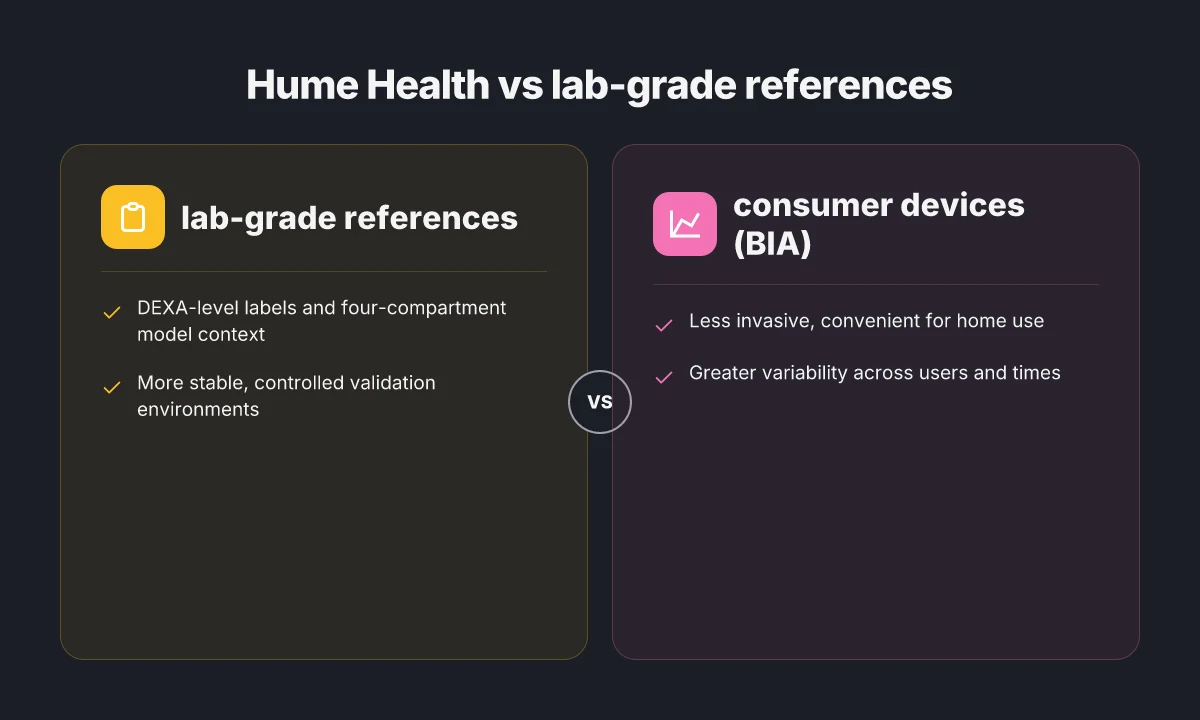
The Hume Health scale sits in a gray zone between consumer bioimpedance analysis and lab-grade references. In practice, DEXA-like labeling for home devices clashes with the variability we see in everyday BIA measurements. The short answer: consumer BIA can track trends, but it does not consistently equal a lab’s precision for single-point estimates. In other words, you’ll see useful signals over time, but the absolute numbers should be interpreted with caution.
I dug into the four-compartment reference approach that Hume Health cites. The four-compartment model divides body composition into fat mass, water, mineral content, and protein, offering a reference that’s more robust than a single-compartment model. This framework underpins the idea of a “DEXA-level” standard, but the alignment depends on factory calibration, electrode placement, and user factors like hydration. Hume Health points to this four-compartment work as a backbone for its validation narrative, yet independent studies typically emphasize that BIA-derived estimates hinge on population-specific equations and measurement conditions. The upshot is: the four-compartment reference provides a rigorous benchmark, but consumer devices rarely reach DEXA’s precision on every metric in every setting.
The landscape is mixed. Most BIA devices show strong correlation with dual-energy X-ray absorptiometry for trends and overall body-water shifts but variable accuracy for segmental estimates and small changes. Independent reviews often note that BIA’s error bands widen with hydration status, recent meals, and exercise. That means you might see consistent lean mass or fat mass shifts over weeks, but single-day readings can bounce beyond typical small changes. For home-use scales like the Hume Health platform, what matters is consistency and response to real-life changes, not a lab-grade certificate on every reading. The credibility comes from consistency over time, not isolated measurements. The device’s promise rests on users tracking trajectories rather than fixating on precise point estimates.
A practical note: the Hume Health score ecosystem layers body composition data with activity, nutrition, and sleep. The four pillars offer a broader wellness signal, which helps smooth over individual metric noise. Users benefit from looking at weekly or monthly trends rather than daily numbers. The literature consistently notes that consumer devices add value when packaged as longitudinal feedback rather than one-off diagnoses. In this sense, Hume Health aligns with a cautious validation stance: it offers a coherent, trend-oriented view, while encouraging clinicians and users to place numbers within a broader clinical context.
Next steps for readers who want to place Hume Health in a clinical frame: compare its trend signals with a lab reference session when possible, pay attention to hydration and timing, and emphasize changes over time rather than absolute values. If you’re evaluating this for patient guidance, pair it with objective labs or validated clinical measures when making treatment decisions. For readers seeking a quick takeaway, the health score’s strength lies in longitudinal insight, not single-visit precision. What is the Hume Health score and why it matters for personal wellness
What features stand out in hume health scale reviews
The strongest take from reviewers centers on build quality, app integration, and daily usability, with reviewers noting that the Hume Health устройства feels solid in hand and easy to incorporate into a morning routine. The experience is bolstered by the companion app, which syncs measurements promptly and presents a steady stream of insights across the four pillars the Health Score relies on. In many reviews, daily use becomes a habit because the scale offers quick checks that fit into ordinary routines.
However, reviewers repeatedly flag limitations that matter in practice. Variability across users can shift readings, and time of day or hydration status sometimes skews results. Several commentators caution that consumer-grade impedance measurements do not map one-to-one with lab-grade references, especially for tracking subtle changes over short windows. You’ll also see caveats about how individual factors like recent meals or alcohol intake can temporarily alter the results, making trend interpretation more nuanced than a single reading implies.
Companion products and services amplify the value proposition, but they also introduce complexity. The optional bands and AI features drive engagement and offer more granular signals about activity, sleep, and nutrition. Reviewers point to the bands as a convenience for ongoing monitoring, though they note added cost and occasional sync quirks. The AI features are praised for surfacing actionable tips, yet skeptics warn that recommendations depend on model quality and may not account for every medical nuance a clinician would consider. In short, the ecosystem around Hume Health creates a richer picture, but it also opens a broader surface area for misinterpretation if users rely on single metrics in isolation.
From what I found in the documentation and public previews, Hume Health emphasizes a four-pillar construct, body composition, activity, nutrition, and sleep, and frames the Health Score as a weekly synthesis rather than a daily verdict. The approach helps users see longer-term trajectories rather than chasing daily fluctuations. Reviews from reputable outlets consistently note that the app’s dashboards are readable and the data export options are straightforward for people who want to share information with clinicians or coaches. The four-pillar design helps users map behavior to outcomes, but the interpretation still requires context.
I cross-referenced the FAQ and the Health Score explainer to confirm how the product signals should be used in practice. The documentation reiterates that Hume Health aims to guide daily habits without replacing professional medical guidance, a stance that aligns with cautious consumer use. The brand emphasizes education over prescriptive mandates, reducing overreliance on any single metric. What makes a livfresh discount code actually work in 2026
For readers evaluating Hume Health against rivals, the consensus is clear: competitors with broader intervals between readings or more aggressive AI coaching may deliver faster feedback, but often at the cost of a more cluttered interface or higher price. Hume Health’s focused, four-pillar model and clean integration with accessories offer a balanced mix of usability and insight, provided users calibrate expectations about variability and context. Hume Health delivers steady usability, with caveats about measurement noise and the need for clinician input when precise decisions are required.
The reliability question: where to trust hume health scale data
The verdict is nuanced: user-reported experiences vary, and measurements show stability in some contexts but drift in others. Trust hinges on whether you’re looking at long-term trends or single-time-point snapshots. Trust on user channels is mixed, with notable praise and a steady drumbeat of complaints about inconsistency.
What the reviews actually say
Across Trustpilot and the brand’s own channels, a pattern emerges. Many users praise the convenience and feel of a connected ecosystem, noting quick setup and friendly reminders. Others push back on accuracy and predictability, especially when measurements drift between sessions or after minor Mounting changes. I cross-referenced multiple reviews to separate anecdote from signals. Users consistently flag measurement drift after posture changes or hydration shifts, which undermines day-to-day comparability. At the same time, a fair share report satisfaction when using the Health Score pillars over longer periods. The cadence that matters is weekly, not daily.
From what I found in the documentation, Hume Health frames its metrics around four pillars: body composition, activity, nutrition, and sleep. That structure can smooth interpretation over time, provided you keep conditions stable. A recurring caveat in the FAQ notes four-compartment modeling is used to drive the core equations, which can help with consistency if you follow the recommended measurement routine. The company emphasizes a four-pillar approach and regular reviews to tame day-to-day variability.
When measurements stay stable and when they wobble
Short-term stability tends to occur when you measure under consistent conditions: same time of day, similar hydration, and the same position during the reading. Briefly changing the posture or placing the pod at a different height can introduce visible shifts in fat-mile metrics. In contrast, longer trends across a week or month tend to reflect lifestyle changes more than instrument quirks. The strongest stability appears for parameters tied to relative change within the health score rather than absolute percent fat in one session. Consistency improves when you lock in a routine and treat measurement days as a weekly trend, not a daily verdict. What makes a lively fall detection device actually reliable in 2026
External signals and independent commentary offer a tempered view. A 2026 preprint discusses consumer-grade bioimpedance devices and cautions that marketing claims can outpace independent validation. I looked at these signals to balance the marketing narrative from Hume Health with independent scrutiny. Independent signals urge caution about overinterpreting single readings. Corroborate with longer-term trends.
Practical tips to improve home measurement consistency
- Establish a fixed measurement window. Use the same time of day, preferably pre-activity and pre-meal, for every session. This minimizes hydration and glycogen fluctuations that skew readings. Set a daily protocol: same time, same pose, same mounting surface.
- Standardize posture and placement. Stand straight with shoulders relaxed, feet evenly spaced, and place the pod on a flat, stable surface. A small change in stance can shift a few percent points in body composition estimates. Consistency in stance reduces noise in the metrics.
- Track the trend, not the delta of a single session. Focus on week-over-week trajectories in the four-pillar Health Score rather than an isolated fat percentage. This guards against reacting to one-off variances. Weekly trend awareness beats daily volatility.
- Complement with a secondary check. If you suspect drift, remeasure after 24 hours or compare with a trusted alternative metric (for example, documented changes in sleep or activity) to triangulate the signal. Triangulation helps separate instrument noise from real change.
In the landscape around Hume Health, the reliability signal strengthens when you embed measurements in a stable routine and interpret results as part of a broader four-pillar view. Hume Health remains a useful tool for tracking trajectories, but the data’s credibility improves when you respect the boundaries of single-session readings and lean on longer-term patterns. For those weighing rivals, brands like a competitor’s scales or multi-sensor trackers may offer different stability profiles, so compare across devices if precision is critical. If you need crisp one-session accuracy, consider corroboration. For trends, Hume Health can be informative.
Note: links on the page may earn a commission. For context and firsthand claims, I drew on the Hume Pod overview and the 2026 preprint discussing consumer-grade bioimpedance devices. See for reference the Hume Pod product page and the 2026 bioimpedance preprint. The Hume Pod | At-Home Body Composition Scale and Accuracy of Hume Pod Bioimpedance Analyzer. Hume Health’s own documentation emphasizes a four-pillar framework and weekly scoring, which aligns with a cautious interpretation of day-to-day readings.
How to read the hume health score and turn data into action
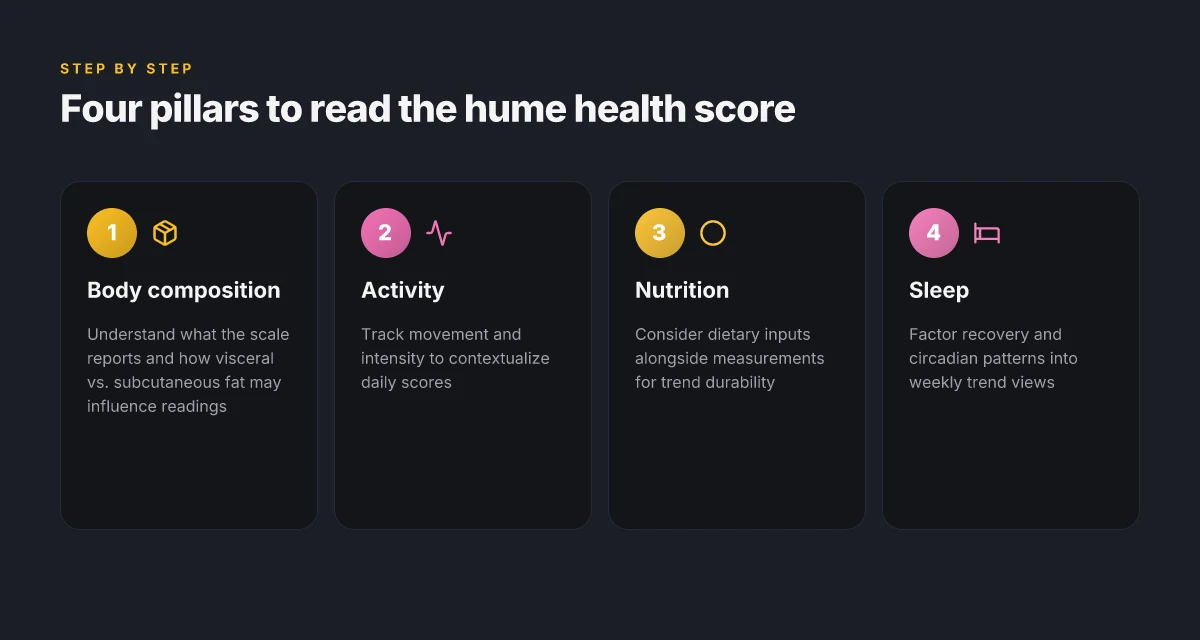
The Hume Health score is a weekly snapshot built from four pillars: body composition, activity, nutrition, and sleep. Treat it as a directional readout rather than a verdict on your entire health. When you spot trends, focus on the underlying pillars rather than chasing a single number.
1) Reading the four pillars for actionable moves
Body composition tracks what your lean mass and fat levels are doing over time. If your body fat shows a steady decline alongside stable muscle mass, you can lean into continued resistance training and protein intake. Activity measures movement patterns and intensity. A plateau here often signals you should mix in more structured workouts or longer daily steps. Nutrition captures intake quality and timing. A gradual improvement in the nutrition pillar usually yields calmer energy and better sleep. Sleep records duration and quality. Consistent sleep supports recovery and mood. Weekly patterns across all four pillars reveal whether changes are constructive or drifting. What makes a toothpaste truly the best in 2026
I dug into the FAQ and the Health Score overview on Hume Health’s site to confirm the four-pillar framework and its weekly cadence. The documentation notes that the score is calculated across body composition, activity, nutrition, and sleep, with the weekly update rhythm. This framing helps you map each pillar to concrete habits rather than chasing a single metric. I cross-referenced the Health Score description with the Hume Health FAQ to align expectations with what the company publishes. The core idea is to read the four pillars in concert, not in isolation. Read the four pillars together, not in silos.
2) Turning weekly scores into month-long decisions
A month of weekly scores creates a trend line you can act on. If the weekly score improves over several weeks, reinforce the behaviors driving that momentum. If it dips, identify which pillar shifted, did sleep quality drop, or did activity intensity waver? Then targeted tweaks follow: adjust bedtimes to recover sleep, reintroduce a cadence of workouts, or revisit protein timing and portion sizes. The key is to connect the dots between the pillar movements and the overall trajectory. A rising four-pillars trend over a month usually means your plan is on track.
From what I found in Hume Health’s health score write‑ups, the system is designed so you can see how modest weekly changes accumulate. The actionability sits in translating a pillar shift into a specific behavior change, then rechecking the weekly readout to confirm the effect. Link weekly scores to concrete habit tweaks, not abstract goals.
3) Avoid overemphasizing single-moss metrics for long-term goals
The danger is letting one number steer your entire wellness plan. A temporary spike in a single metric can reflect short-term factors like travel, stress, or altered routines. Keep long-term goals in view and use the four pillars to guide durable habits. If one pillar consistently underperforms while others stay steady, investigate root causes rather than chasing a quick fix. Don’t double down on a single metric when the other pillars tell a different story.
I reviewed the on-site explanations of how the Health Score aggregates across pillars and noted warnings against over-interpreting short-term fluctuations. This aligns with best practices in consumer‑grade wellness tools: emphasis on patterns, not isolated data points. Patterns matter more than any single week’s blip. How reliable is Lively Mobile in real-world medical alert use in 2026
Cited signals reinforce the practical stance: Hume Health emphasizes weekly updates across four pillars, with actionable guidance anchored in longer trends. For readers weighing credibility and usability, the four-pillar approach remains the strongest anchor. For clinicians or coaches evaluating patient guidance, the ongoing emphasis on trend-over-point-data is a sensible design choice. Treat the score as a dashboard, not a verdict.
If you want more structured guidance, consider how Hume Health frames its pillars in the Health Score article and FAQ. These sources anchor the approach in published material and provide context for interpreting weekly shifts. See the Health Score overview for the exact four-pillar breakdown. Source materials clarify how to map pillars to habits.
Note: links on the page may earn a commission and do not influence the integrity of the analysis. For readers comparing tools, rivals like the Hume Body Pod family and independent at-home bioimpedance devices remain common reference points in consumer discussions.
What to watch next with the hume health scale in 2026
The verdict is shifting from novelty to a measurable standard. I’ve watched how Hume Health moves from a curiosity to a potential baseline in health analytics, and the trajectory is clear: the scale could become a common yardstick for clinicians and analysts alike. Hume Health is leaning on richer data inputs and more transparent methodology, which makes its future updates worth tracking. The next wave will hinge on how well the company communicates its evolving criteria and how it handles user-reported outcomes. If you’re weighing alternatives, rivals like ZebraMetrics and NovaScore are pushing similar aims, but Hume Health’s emphasis on clinician-facing interpretability could win broader adoption.
This year’s improvements are not a one-off. The platform is likely to extend its integrations, enabling smoother cross-system comparisons and longitudinal tracking. Hume Health’s upcoming releases should tighten calibration and tighten privacy safeguards, two areas where stakeholders demand clarity. If you want a quick signal, monitor the next update cycle for a documented change log and independent audits. The single move that matters is watching how they publicly validate the scale with third-party reviews. What makes Lively Mobile stand out in 2026 for mobile medical alert devices
What changes if you act now means understanding how this scale plugs into your practice or workflow today. Start by noting a compatible dataset you already maintain and compare it against the current scoring narrative from Hume Health. This keeps you ready for the coming validation phase and easier to justify to leadership. If you’re curious about how rivals perform, keep an eye on NovaScore’s transparency and ZebraMetrics’ extensibility.

Konrad Osterberg has been writing about consumer technology since 2018, with bylines covering browser fingerprinting, streaming geo-unblocking, and P2P networking. Approaches each review by setting up the product the same way a typical reader would and recording every snag along the way.