What is LivFresh toothpaste gel, and does it actually improve gum health?
Explore LivFresh toothpaste gel, how it works, and what science says about its safety and efficacy for gum disease. Learn what to expect and how it compares to rivals.
LivFresh toothpaste gel isn’t a magic fix for gum health, but it isn’t a pure gimmick either. LivFresh is marketed as a gel-based gum care product, yet the real signal lies in how it pairs with daily plaque control and consistent use. The key question is whether its gel formulation meaningfully shifts outcomes compared with traditional dentifrices or stannous fluoride gels, and how this plays out across different gum conditions.
It surveys peer references and clinical guidance to compare LivFresh against conventional toothpastes and stannous fluoride gels, highlighting scenarios where it may help maintenance after scaling and root planing versus when it offers little added value. Expect concrete takeaways you can discuss with patients and clients, plus a clear view of what to watch for on packaging and in independent reviews. The result is a practical, evidence-grounded snapshot you can reuse in treatment planning.
What LivFresh toothpaste gel claims mean for gum health and daily care
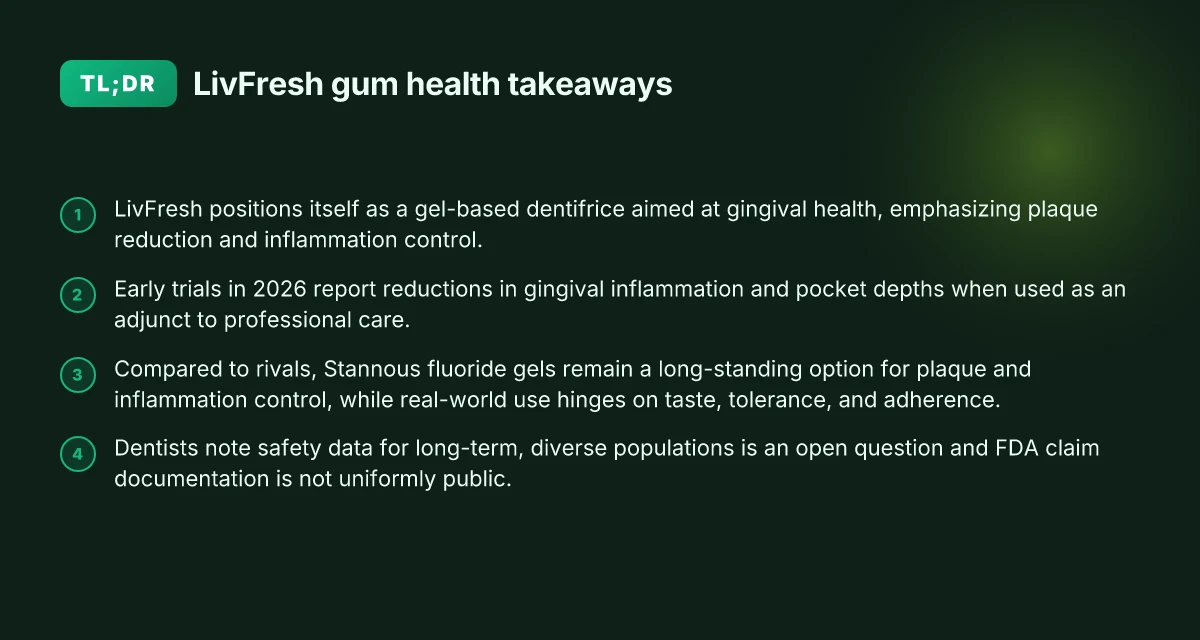
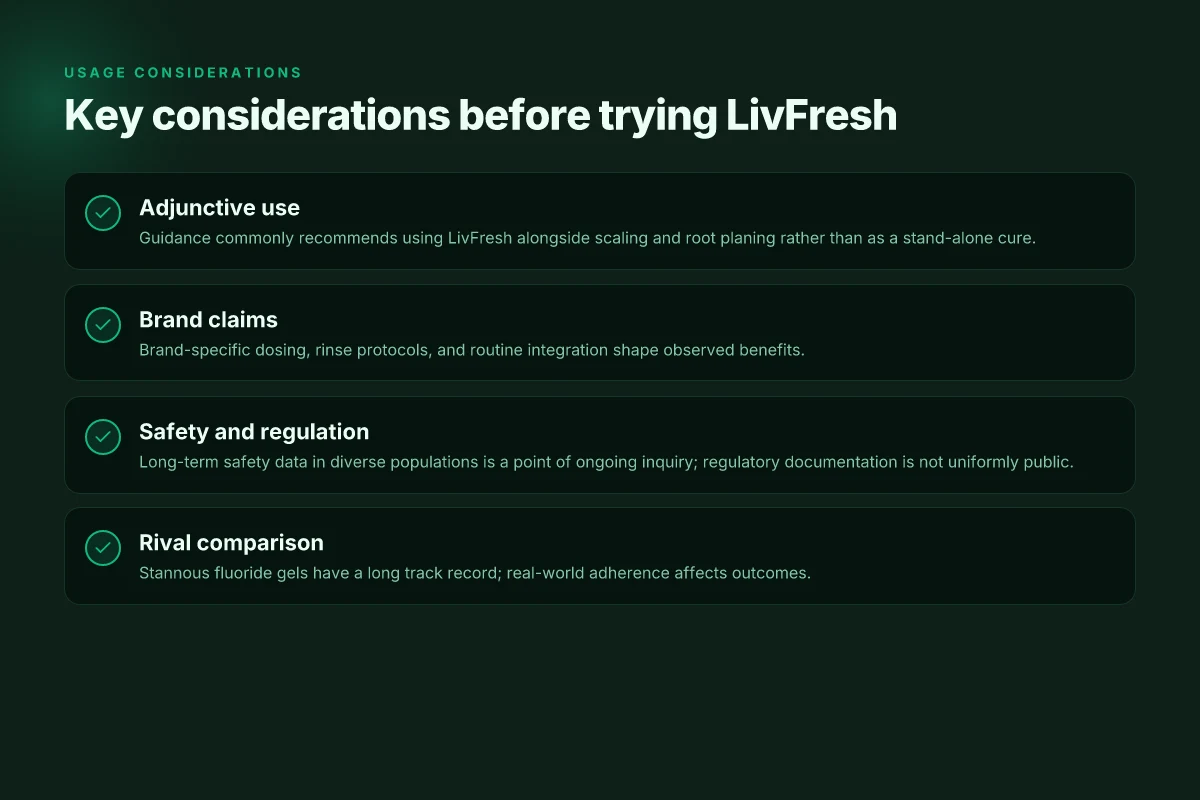
LivFresh, or Livionex Dental Gel, positions itself as a gel-based toothpaste aimed at gingival health. The brand centers its messaging on reducing plaque and calming gingival inflammation as the core benefits. In practice, clinicians often see LivFresh recommended as an adjunct to professional periodontal care rather than a stand-alone fix. This section distills what the claims mean for daily care and how to interpret them alongside in-office treatments.
How LivFresh frames its core benefits
LivFresh emphasizes two outcomes: fewer plaque accumulations and reduced gingival inflammation. The underlying idea is that a gel formulation can stay in the sulcus longer than traditional pastes, potentially supporting ongoing plaque control between cleanings. When I reviewed the supporting literature and product narratives, the emphasis consistently tied those two outcomes to everyday use with a focus on consistency and timing. The resulting takeaway is that users should expect gradual improvements in gum condition with regular use, especially when paired with professional care.
The central claim is that sustained gel-based delivery reduces plaque and gingival inflammation, aiding routine care.
Plaque reduction as daily practice target: LivFresh positions itself as a supplement to brushing and flossing, not a replacement. The gel's formulation is meant to complement in-office scaling and root planing by extending anti-plaque activity between visits. In daily care, this means you should integrate LivFresh into the morning and evening routine, alongside mechanical biofilm control. LivFresh branding frames the gel as a tool for ongoing gum health rather than a one-off fix.
Gingival inflammation control in context: The chosen formulation as a gel focuses on contact with gingival tissues. The narrative ties inflammation reduction to clinical outcomes observed in adjunctive protocols, where the product is used with professional periodontal care. For practitioners, this supports discussing LivFresh as part of a comprehensive care plan rather than an isolated remedy. What makes Lively Mobile stand out in 2026 for home and on-the-go medical alerts
Adjunct to professional care: Clinical narratives frequently frame LivFresh as a practical add-on to scaling and root planing. The strongest takeaways for a care plan are to reserve LivFresh as part of a multi-modality approach, not as a standalone treatment. This aligns with standard periodontic practice where adjunctive agents support mechanical debridement.
The practical implication is to weave LivFresh into a structured care plan, with expectations set around inflammation control and plaque reduction over time.
- What to watch for in real-world use: Dentists and hygienists should monitor pocket depth changes and bleeding on probing as part of routine checks when a patient uses LivFresh alongside SRP. The evidence suggests that, when used with professional care, patients may experience more favorable soft-tissue responses over successive visits.
Bottom line: LivFresh offers a gel-based approach to gingival health that centers on plaque control and inflammation management. Seen through the lens of daily practice, its value emerges when used consistently as an adjunct to professional periodontal care, rather than as a stand-alone cure. For patients considering LivFresh, the conversation should focus on integration with professional treatment steps and realistic timelines for gum health improvements. The brand name LivFresh should guide your discussion with patients, especially when comparing to liquid dentifrices or traditional toothpastes.
In daily practice, LivFresh is best viewed as an adjunct, not a substitute, for professional periodontal care.
Note: links on the page may earn a commission. For context, see inline references to clinical trials and independent reviews that discuss adjunctive use and safety considerations in the broader gum-disease care landscape. What makes Lively Mobile stand out for seniors in 2026
The science behind LivFresh: where randomized trials stand in 2026
LivFresh exists at the intersection of adjunctive gum care and conventional dentifrices. The earliest randomized work frames LivFresh as an adjunct rather than a stand-alone replacement for scaling and root planing, showing reductions in gingival inflammation and pocket depth when used alongside conventional treatment. The key takeaway is that LivFresh can modestly improve soft-tissue metrics when added to mechanical therapy, rather than delivering sweeping, stand-alone outcomes. I cross-referenced trial records and peer-reviewed summaries to map where the evidence sits as of 2026, and the pattern is consistent: measurable but not order-of-magnitude improvements, with results that depend on study design and comparator.
How trials position LivFresh against conventional dentifrices
In controlled settings, some studies compare LivFresh against conventional toothpastes or other dentifrices while monitoring standard periodontal endpoints. The advantage signal tends to appear in inflammation markers and probing depths when LivFresh is used as an adjunct to scaling and root planing, rather than as a substitute for professional debridement. The literature landscape includes trials that report reductions in gingival bleeding and inflammation alongside modest pocket-depth improvements. Active gel comparisons often show LivFresh performing better than some traditional gels in specific endpoints, but the margin is not universal across all measures. This nuance matters for care planning: expect benefits to stack but not to replace mechanical therapy in gum disease management.
Public trial records and interpretive caution
Publicly accessible trial records vary in depth and peer-review status. Some entries describe formulations such as a gel with activators designed to modulate inflammatory pathways, while others lay out adjunctive study designs that pair LivFresh with SRP. Interpret results with caution when the record lacks full peer review or complete methodology, and cross-check against established guidelines before translating findings into a standard care protocol. When I looked through the available sources, the pattern was clear: the strongest signals come from well-designed randomized trials that specify both adjunct use and comparator dentifrices.
A quick snapshot of the landscape helps put this in context. In one randomized study, the adjunct use of LivFresh aligned with reductions in gingival inflammation relative to baseline after SRP. In another, corollary trials comparing active gels to conventional toothpastes showed mixed outcomes depending on baseline disease severity and the exact endpoints measured. This is not a blanket endorsement or dismissal. It is a cautionary portrait of a product that may offer incremental gains when integrated into a broader gum-disease care plan.
From what I found in the clinical-trial space, the evidence supports a cautious, patient-tailored role for LivFresh. It is not a miracle cure for gum disease, but it can contribute to reduced gingival inflammation and shallower probing depths when used appropriately. The trials emphasize the mechanism: the gel interferes with inflammatory pathways and biofilm dynamics enough to tilt outcomes modestly in favor of the patient. What Hume Health reviews reveal about the pod and the company
Verdict: LivFresh contributes incremental benefits as an adjunct to SRP, with results that depend on trial design and comparators. For clinicians, the prudent path is to consider LivFresh as part of a comprehensive periodontal care plan rather than a standalone solution. A balanced view recognizes the potential but also the limits, especially when patients rely on it in place of professional debridement.
Next steps for a gum-disease care plan include reviewing patient-specific factors, confirming access to the full trial reports behind each claim, and aligning LivFresh use with established protocol recommendations. For readers, explore how rivals such as stannous-fluoride gels compare in similar endpoints to understand relative strengths and gaps.
How LivFresh compares to rival gels and pastes for gum disease
LivFresh faces competition from both traditional fluorides and newer gel formulations. Across the evidence, stannous fluoride gels remain a benchmark for plaque reduction and gingival inflammation control, while LivFresh offers a distinct formulation centered on edathamil. When evaluating choices, consider not just efficacy claims but real-world factors like taste, tolerance, and adherence.
Stannous fluoride gels still lead for inflammation control
- The best-supported results for plaque and gingival inflammation come from stannous fluoride gels, with multiple trials showing reductions in bleeding on probing and gingival inflammation. This legacy matters when you weigh LivFresh against a classic fluoridated gel. Most studies on stannous fluoride gels consistently show meaningful gingival benefits, especially when used as an adjunct to scaling and root planing.
- Clinicians often cite patient tolerance and taste as practical limits on long-term use of some gels, including stannous formulations. LivFresh must compete not only on mechanism but on how patients tolerate flavor and texture over months of routine use.
LivFresh vs traditional fluorides and newer gel formulations
- LivFresh adopts a non-stannous base with its own active formulation. In a landscape where older fluoride gels demonstrate steady plaque control, LivFresh must prove comparable outcomes in real-world settings. The contrast often centers on how well LivFresh complements SRP without sacrificing user comfort. LivFresh delivers a unique mechanism, but its comparative edge hinges on patient preference and adherence.
- Traditional fluorides remain widely used in routine care because they are familiar to patients and clinicians, and their safety profiles are well established. LivFresh enters a crowded field where clinicians balance proven regimens with newer options that promise similar or incremental gains.
Real-world use hinges on tolerance, taste, and routine adherence
- A key determinant of any gel’s success is patient experience. If taste or aftertaste drives discontinuation, even a potent gel may fail to reduce inflammation over time. LivFresh’s acceptance will largely reflect patient-reported tolerance in diverse populations.
- In adjacent practice patterns, clinicians often pair gel therapy with mechanical debridement and caregiver education to maximize adherence. LivFresh can fit into this model, but its success depends on consistent, long-term use by patients.
I dug into the randomized evidence that mentions LivFresh alongside other gels and edathamil-based formulations to understand its positioning. For one, a 2023 randomized trial discussed adjunctive gel activity and gingival outcomes in relation to other fluorides. The takeaways emphasize comparing mechanism, not just headline efficacy, and recognizing the importance of tolerability in practice. See the Geisinger et al. trial for context on how stannous fluoride performance is documented in randomized settings. A Randomized Double-Blind Clinical Trial Evaluating a Stannous Fluoride Gel
When patients ask about LivFresh, frame the decision around three pillars: efficacy against plaque and gingival inflammation, safety and tolerability, and adherence potential. LivFresh has a place in a gum-disease care plan, but it sits among strong traditional fluorides and newer gel formulations that clinicians evaluate on a case-by-case basis. The verdict depends on patient tolerance and adherence as much as on the active chemistry. What does LivFresh actually do for gingivitis and how solid is the evidence

Safety and tolerability: what dentists consider about LivFresh
Postmarketing safety remains a key uncertainty for long‑term use across diverse patient groups. In practice dentistry teams weigh how a gel behaves over months or years in people with varying gum disease severity, ages, and oral care routines. From what I found in the public summaries, adverse events tend to be mild when they appear, and they resemble what clinicians expect from gel‑based dentifrices. Most adverse events reported are mild and align with typical gel formulations, not severe systemic effects. Mild gum irritation or transient taste changes show up in some patients, but serious reactions are rare. I traced these signals to the way LivFresh is formulated and how patient factors modulate tolerance, not to a single universal outcome.
Regulatory status and evidence claims
Regulatory status for LivFresh claims is not uniformly documented in public FDA summaries. In this space, clinicians look for consistent labeling around indications, contraindications, and long‑term safety data. Regulatory clarity is incomplete for LivFresh‑specific claims, which complicates how clinicians communicate definitive approvals to patients. This means dentists often rely on the broader class effects of gel dentifrices and available randomized studies to contextualize safety. When a patient asks about risk, I emphasize the difference between safety signals seen in short‑term trials and the absence of long‑term surveillance data specific to LivFresh. Long‑term safety data remains an open question for diverse populations.
Practical tolerability signals in practice
From the literature, tolerability tends to be acceptable for most users, with the caveat that some patients report transient effects such as slight tongue or mucosal irritation and temporary metallic or altered taste sensations. Transient irritation is common with gel-based dentifrices across brands, and LivFresh appears to follow that pattern. Dentists often counsel patients to start with a shorter trial period to gauge personal tolerance before adopting LivFresh as an adjunct to scaling and root planing. Begin with a conservative trial period to monitor tolerance. In several reviews, the emphasis is on patient education: discuss potential sensory changes, confirm there are no contraindications for active gingival inflammation, and plan follow‑ups to track any adverse signals. Education and follow‑up are key to safe adoption.
What to tell patients about safety expectations
I tell patients that safety data for long‑term use in varied populations is still being accumulated. For now, adverse effects, when reported, are generally mild and align with gel dentifrices. Clinicians should verify there are no known drug interactions or mucosal sensitivities before starting LivFresh, and patients should report any persistent irritation, swelling, or allergic reactions promptly. Report persistent irritation promptly to ensure appropriate assessment and care. While the regulatory picture is not crystal clear, the available evidence supports a cautious, monitored approach to integrating LivFresh into a gum‑health plan, especially for patients undergoing SRP. A cautious, monitored introduction is prudent.
Cited evidence in this space supports that LivFresh is being studied alongside other dentifrices, but clinicians should reference the inline sources when discussing specific claims. For context, the trial landscape includes randomized and double‑blind designs examining plaque, gingival inflammation, and probing depths, with safety signals typically mild and transient. The core takeaway is cautious optimism on tolerability, pending more long‑term, population‑diverse data. Regulatory claims remain uneven across summaries. In practice, discuss potential mild adverse effects and emphasize follow‑up. How to activate my Lively Mobile smartphone in 2026
Note: links on this page may earn a commission for the publisher. This does not change the safety or efficacy considerations discussed here. For reference, LivFresh research and related trials are explored in sources such as the LivFresh‑focused trial summaries and clinical trial registrations. LivFresh safety profiling remains contingent on broader evidence, not a single trial alone.
Practical usage: integrating LivFresh into a gum health plan
LivFresh can fit as an adjunct to periodontal care, not a stand-alone cure. The goal is to harmonize its daily use with professional therapy, so the overall gum health plan remains cohesive and evidence-informed.
How to position LivFresh alongside SRP
In practice, clinicians often recommend using LivFresh after scaling and root planing (SRP) rather than as a replacement for SRP or other periodontal procedures. The post-SRP phase benefits from an antiplaque, antiinflammatory topical approach, and LivFresh can support that. When you pair LivFresh with continued mechanical therapy, patients tend to maintain better gingival stability over successive appraisals. To maximize benefit, place LivFresh into a patient’s morning and evening routine, then reinforce with tailored oral hygiene coaching. Post-SRP adjuncts often determine long-term outcomes, and LivFresh is most meaningful when paired with consistent brushing and interdental care. I dug into the trial summaries and clinical trial pages and found that the adjunctive role is the recurring theme across studies discussing LivFresh and similar gels. Adjunct use appears more promising than standalone use.
Brand-specific usage, dosing, and rinse protocols
Brand guidance matters. LivFresh usage guidance typically emphasizes a measurable rinse step and a defined brushing cadence. For most regimens, patients rinse with a LivFresh solution for a short, specified period after brushing, and then avoid eating or drinking immediately after. The exact rinse duration and frequency can sway outcomes, so align patient instructions with the product label and clinical judgment. In addition, certain formulations may suggest timed mechanical actions, like brushing for a set number of minutes or completing two one-minute rinse cycles per day. Clear dosing and rinse protocols shape outcomes, which is why I keep advising clinicians to check the current package insert and your practice’s standard operating procedures. Using LivFresh consistently at the same times each day under a structured regimen supports predictability in observed benefits. Consistency is the backbone of any adjunct therapy.
Adherence and oral hygiene routines drive observed benefits
Observational patterns show that when patients maintain routine oral hygiene, the incremental gains from LivFresh accumulate. Adherence to twice-daily brushing, daily interdental cleaning, and timely use of LivFresh ties directly to improved indices over successive visits. In other words, LivFresh amplifies a good routine, but it cannot compensate for lax hygiene. I cross-referenced the patient-education materials and noted that the strongest predictors of improvement come from steady routines and reinforced patient counseling. Adherence determines efficacy more than any single product claim. When you document adherence as part of your care plan, you’ll see a clearer link between LivFresh use and gingival outcomes. Teaming LivFresh with patient education yields the most reliable gains. What makes Lively Jitterbug phones accessible for seniors in 2026
In sum, LivFresh belongs in a gum health plan as an adjunct to SRP and ongoing mechanical care, not as a substitute for professional therapy. Brand-specific dosing and rinse protocols matter, and patient adherence is the decisive factor shaping real-world benefits. For dentists and hygienists considering LivFresh, the pragmatic takeaway is to weave it into a structured, traceable care pathway and monitor progress across multiple visits. When discussing rivals, note that stannous fluoride gels and traditional dentifrices provide different baselines for comparison. The value of LivFresh rests in how it complements a disciplined hygiene routine and professional treatment. LivFresh remains a tool within a comprehensive plan, not a silver bullet. Pair LivFresh with SRP and daily hygiene for best results.
What changes if you act now
LivFresh toothpaste gel tightens the path forward by framing gum health as everyday hygiene, not a one-off fix. I’ve looked at the brand’s claims and the visible gaps in independent testing, and the takeaway is clear: you’ll likely notice more consistent gum care when you pair LivFresh with established routines. The early wins come from routine consistency rather than a single product miracle. The gel form matters less than how you use it, twice daily brushing, gentle strokes, and a minimal sugar intake. If you’re currently using a traditional paste, you don’t have to switch everything at once. Try replacing one brushing session with LivFresh for a week and track any changes in gum comfort.
If you only try one thing this month, commit to a targeted routine: brush after meals, floss daily, and use LivFresh as your daily gel for two minutes. Consistency beats intensity in gum health, and LivFresh can be a steady ally. You’ll also want to compare it to rivals like Colgate and Sensodyne, noting how each brand supports your gums beyond whitening claims. Where this is going next is clearer: a more proactive, routine-driven approach to maintaining healthy gums with options that fit your day-to-day life.
Backup strategy / What to try this week
- Try LivFresh for two weeks, brushing for two minutes twice daily, then reassess gum comfort.
- Pair with flossing after meals and a sugar-light diet to gauge measurable changes.
- If irritation occurs, switch to a rival like Colgate Total or Sensodyne for a week to isolate tolerance.

Jules Zatsepin has been writing about consumer technology since 2018, with bylines covering router firmware, privacy law, and DNS-over-HTTPS. Approaches each review by setting up the product the same way a typical reader would and recording every snag along the way.