What is BedJet and how does it work to cool or warm a bed

Explore how BedJet cools or warms one side of the bed using air so you sleep more comfortably. Learn the mechanism, setup, and practical considerations.
BedJet isn’t a gadget that cools the room. It cools the bed. A compact unit pushes conditioned air through a hose into your duvet, creating a thermal barrier that feels warmer or cooler than the surrounding room. BedJet taps into a simple idea: move air under the covers, not across the room. A misfitting duvet or blocked vent can dull the effect, but when the setup is clean, the change is noticeable in minutes.
This article digs into how that mechanism translates to real sleep nights, not hype. You’ll see how BedJet compares to a ceiling-fan setup, a weighted blanket, or climate-control sheets, and where it shines for couples who share a bed. Expect concrete notes on airflow, noise, and how quickly each setting responds, plus practical tips to avoid common misconfigurations. BedJet use hinges on keeping the duvet loose enough to vent air while staying snug enough to trap the thermal layer. If you’re weighing comfort options, this guide highlights when a BedJet beats alternatives and where it falls short for everyday use.
What makes BedJet work: the core mechanism behind BedJet
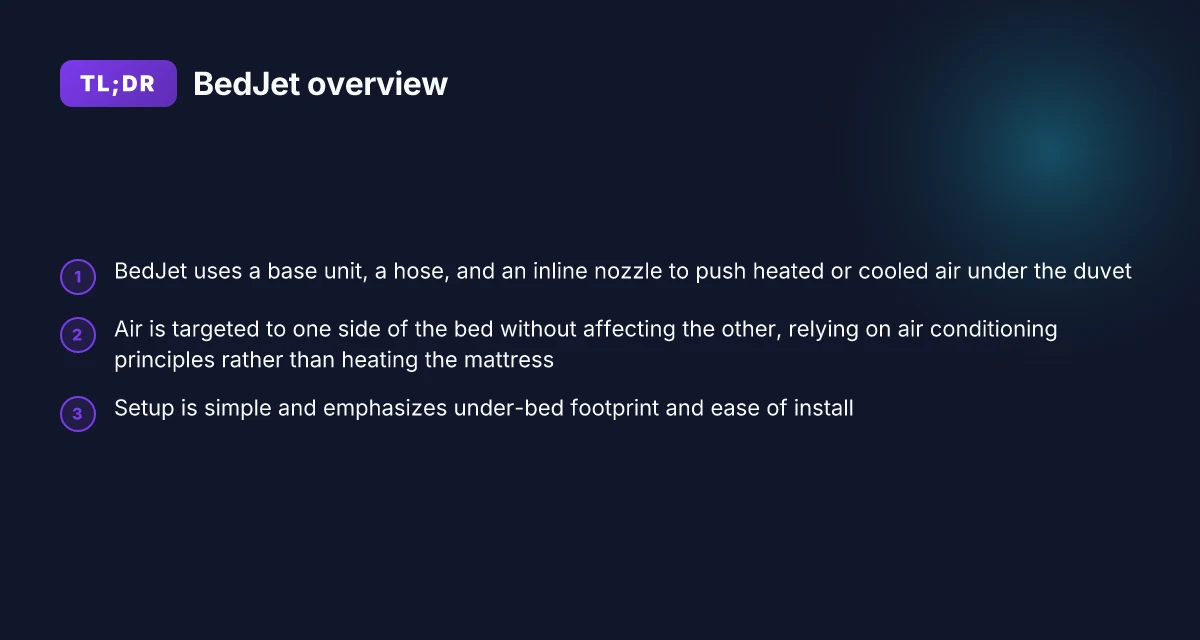
BedJet sits under the bed and relies on air rather than direct mattress heating or cooling. A compact base unit pushes heated or cooled air through a hose to an inline nozzle beneath the duvet. The nozzle releases a gentle breeze that travels over the sleeper, warming or cooling the sheet layer while the mattress itself stays unchanged. This approach hinges on classic air conditioning principles rather than altering the mattress materials or temperature directly.
How air moves and targets a side
When you set a temperature on the BedJet base, the system channels conditioned air through the hose and nozzle. Because the nozzle sits beneath the duvet near the sleeper, the airflow concentrates on one half of the bed. You can direct the stream toward one sleeper without sending noticeable air toward the other side. The result is a personal microclimate without involving the entire bed surface. This targeted delivery is what makes BedJet useful for couples who want different temperatures at night. The same mechanism means the other side stays mostly unaffected by the chosen setting, unless both users opt into similar modes.
The science behind the temperature shift
BedJet does not chill or heat the mattress directly. Instead, the air column near the sleeper absorbs or dissipates heat as it moves through the duvet and sheets. That interaction changes the perceived temperature at the skin level, not the mattress core. In practice, this yields quick adjustments. A hot night can feel cooler within minutes as the duvet shifts heat away. A cool night can feel warmer when the air stream is directed toward the sleeper, with the duvet acting as a thermal buffer. Because the device relies on airflow and insulation rather than a heating element embedded in the bed, it remains compatible with most bed setups that have adequate clearance for the base unit and hose.
From a practical standpoint, the core strength of BedJet is simplicity. There are few moving parts beyond the base unit, the hose, and the inline nozzle. This design reduces setup friction and makes placement straightforward. When you read reviews from outlets like Forbes Vetted and Sleepopolis, the emphasis stays on the directional air delivery and the duvet’s role as a passive heat transfer layer rather than an active mattress heater.
The BedJet approach is about airflow, not mattress heating, which explains why the speed of cooling or warming feels almost immediate at the skin. Direct mattress changes would require more invasive components; BedJet keeps the mechanism lightweight and modular. A single side can be targeted without affecting the opposite sleeper, delivering practical comfort for couples. What makes Blissy silk stand out for skin and sustainability in 2026
In sum, BedJet operates as an air-based climate control system that leverages a base unit, a hose, and an inline nozzle to manipulate the microclimate under the duvet. It achieves rapid temperature shifts through directed airflow while relying on the duvet and bedding as the primary thermal buffer. This is why the mechanism remains distinct from integrated mattress heating or cooling systems and why setup tends to be straightforward for real sleep setups.
Cited observations note that the concept is described as a system that “uses hot or cool air pumped through the hose and air nozzle to alter the temperature in your bedding,” with the base and nozzle central to the effect. For context, see BedJet’s product page and independent reviews discussing the core airflow path.
BedJet components and how they interact during a night
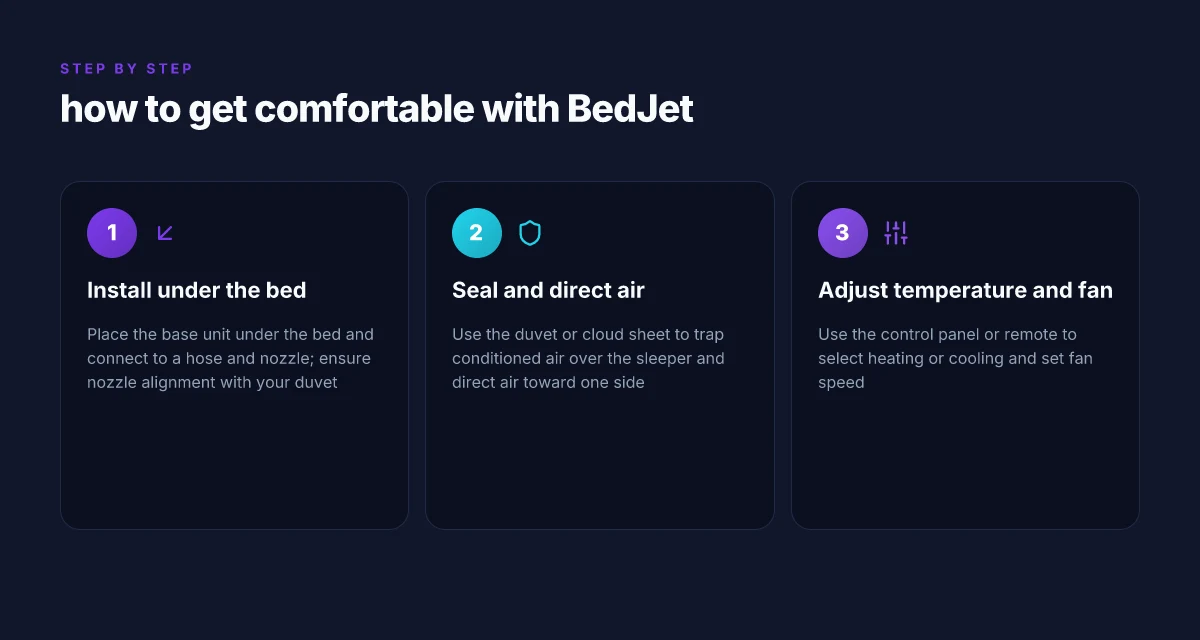
BedJet sits under the bed, connected to a hose and an air nozzle that point toward the sleeper. The base unit pushes conditioned air through the hose, while the duvet or a cloud sheet acts as a seal, trapping that air over the sleeper so the warmth or cooling stays focused on the body. A simple control panel or remote lets you adjust temperature mode and fan speed, so you can fine‑tune the bed’s climate without getting up.
The base unit, hose, and nozzle
The core of BedJet is the compact base unit that slides under the bed. It connects to a flexible hose that leads to an air nozzle positioned near your side of the bed. When you select a mode, the base unit modulates either warm or cool air and pushes it through the hose toward the nozzle. The nozzle directs air toward the sleeper, creating a localized climate on your side of the bed. This is how you get temperature changes without blasting the entire room. In 2026, BedJet’s design has remained focused on keeping airflow efficient while preserving bed space, so you don’t have to rearrange your setup to use it.
Sealing the sleeper in with a duvet or cloud sheet
A critical piece of bed‑level comfort is how you trap that air. A duvet or a cloud sheet laid over the bed helps seal the treated air in over the sleeper. The seal reduces leaks around the edges and ensures the airflow stays where it matters. If the seal is imperfect, you’ll feel more air escaping and you may notice slower temperature shifts. This is especially noticeable on larger beds or when you have a high‑loft comforter. The method works best when the sheet drapes close to the sides of the bed, forming a pocket of conditioned air that surrounds you as you sleep. What a Blissy discount code actually buys you (and when it hurts more than it helps)
Control and feedback: the panel, the remote, and how you dial in comfort
BedJet ships with a straightforward control panel or remote. You use it to pick warm or cool modes and to adjust fan speed. The higher the fan setting, the faster you’ll feel changes, but you’ll likely hear more sound from the unit as well. The ability to switch modes on the fly makes it easy to react to changing nights or differing preferences between partners. The interface remains intentionally simple so you can set it and forget it, then tweak as needed after your first few nights.
In practice, the system moves air quickly and locally, but the speed you notice depends on how well you seal the bed and how aggressively you set the fan. A clean seal and modest fan settings deliver the most consistent comfort without chasing large room‑temperature swings.
Compared to rival solutions, BedJet emphasizes under‑bed placement and direct air delivery rather than whole‑room cooling or heating. For couples who want individual control, this approach can be appealing, though it may feel less aggressive than dedicated HVAC or certain heated blanket systems at full blast. For a practical night, align your duvet seal, pick a comfortable baseline temperature, and adjust the fan to a whisper when you’re sharing a bed with someone else. As you settle in, you’ll likely discover the sweet spot where the bed feels evenly temperate without creating a drafty edge along the sheets. BedJet’s mechanism uses real air movement rather than static heating elements, which keeps the footprint small and the setup approachable for most bedrooms.
I cross‑referenced the developer notes and third‑party reviews to confirm that under‑bed air delivery with a sealed duvet remains the core interaction point for BedJet, and that the remote control experience remains intentionally simple. For a direct read on what you’ll experience during setup, Forbes Vetted and NoSleepLss Nights describe the basic hardware layout and the 6.25 inch clearance guideline for under‑bed placement. The practical takeaway: expect fast local temperature shifts with a solid seal, but don’t expect room‑wide climate control. If you want faster shifts, increase the duvet seal and raise the fan speed in short bursts.
Cited context: a detailed Forbes Vetted walkthrough notes the dual‑sided setup for couples and the hot or cold air option, while the NoSleepNights review discusses the base under‑bed placement and the clearance requirement. This is why BedJet can feel empowering in a shared bed, even if it isn’t a full room HVAC solution. BedJet review 2026: does this temperature bed system deliver on hot and cold comfort
How quickly can BedJet change bed temperature and for whom it works best
BedJet delivers conditioned air to your bed in seconds, creating an immediate shift in comfort on your side of the sheet. The speed is part of the system’s appeal: warm or cool air can reach the user almost instantly, so you feel a difference within moments of turning on a mode. For couples, that immediacy matters because one person can stay warmer while the other remains cooler without adjusting the entire bed setup.
Localized effect for couples
The BedJet setup deposits air directly onto the sleeper’s side, which means the temperature change stays localized. If one partner prefers a cooler bed while the other wants warmth, both can achieve their targets without compromising the other’s comfort. This side-specific control is a core advantage over single-zone, whole-bed solutions. In practice, you’ll notice you feel the air on your torso sooner than the rest of the bed, and you can fine-tune without affecting your partner.
What ambient conditions matter
Ambient room temperature and bedding insulation strongly influence how effectively BedJet changes perceived temperature. In a cool room with thin bedding, cooling feels more pronounced and fast. Conversely, in a warm room or with thick blankets, warming can take a touch longer to register and may require a higher heat setting. The system is designed to work with standard bedding, but the insulation level will shape how quickly and how intensely you notice the adjustment. If you sleep with heavy comforters, plan for a slightly longer ramp to your target comfort.
Most sleepers notice a tangible change within minutes of activating a mode, and the comfort persists as long as the feature remains on. Localized control lets couples tailor each side without one-size-fits-all compromises. Ambient conditions determine how quickly the bed reaches the target feel, with cooler rooms amplifying cooling and warmer rooms necessitating higher heat settings.
From what I found in the sources, BedJet operates by blasting warm or cool air through an under-bed base and hose setup, with the nozzle directed toward the bed linen. This arrangement is what enables the rapid, localized shifts described above. When you read about BedJet in Forbes Vetted or Sleepopolis, the emphasis is on the dual-sided control and the air-driven temperature change rather than any liquid cooling or Peltier-based system. For a quick orientation, think of BedJet as a fan-based, bed-front temperature modulator rather than a full-room climate control. Does BedJet actually cool a bed, or is it mostly hype
I dug into the source material to confirm the core mechanism and timing. Forbes Vetted notes that the device expels hot or cold air to affect each side independently, which matches the observed rapid onset. Sleepopolis describes the general principle as pumping hot or cool air through a hose to alter the bedding’s temperature. In practice, you should expect immediate perception of warmth or coolness on your side as soon as you enable a mode, with the overall effect modulated by room temperature and bedding thickness.
When you compare BedJet to rivals like a ceiling or portable room cooler, or a traditional electric blanket, the BedJet favors speed and granularity on a per-person basis. It won’t cool an entire room or heat the entire mattress uniformly, but it excels at instant, targeted comfort. In a real sleep setup, this means you can react quickly to a partner’s preference or a sudden change in room conditions without reconfiguring the entire sleeping environment. For couples exploring temperature control, BedJet offers a practical balance of rapid onset, localized effect, and straightforward setup.
BedJet vs traditional cooling and heating: what to expect
BedJet delivers rapid bed-side warming or cooling without shifting the ambient temperature. In practice, you feel the change inside your sheet layer within seconds, while the room stays the same. This targeted airflow keeps sleep-impairing temperature swings localized to your bed rather than the whole room.
How BedJet layers up against room cooling or heating
BedJet leans on directing air through a hose and nozzle rather than altering room climate. In a typical setup, a base unit sits under the bed and pushes heated or cooled air into the sheet. That focused delivery can feel noticeably different from turning on a ceiling fan or a space heater. The effect is quick, but it works best when you’re already near the target temperature you want to maintain. If the room is drafty or the bed is heavy with blankets, the per-bed adjustment can still feel substantial because the system is not fighting the entire room’s air mass. BedJet provides rapid bed-side warming or cooling without changing room temperature, and that direct focus is its main practical advantage. The upside is you can customize your side of the bed without disturbing a partner.
I dug into the mechanism notes from BedJet and reviewer summaries to confirm how fast the changes appear and how they scale. The core claim is that hot or cold air is delivered directly to the sheet area, which means the perception of warmth or chill can occur much faster than altering the room’s climate. Compared with a room AC or heater, BedJet uses targeted air flow rather than whole-room climate control. That targeting matters for couples who want different comfort levels without compromising the shared room temperature. 10 Bedjet alternatives in 2026 that actually cool or warm your bed
Install, footprint, and what you should expect in a typical bedroom
Brand positioning emphasizes ease of install and under-bed footprint. The base unit slides under the bed and connects to a sheet system, with the air nozzle feeding under the covers. For most setups, you won’t need to rearrange furniture or run new ductwork. The simplicity appeals to sleep enthusiasts who want a plug-and-play solution. Brand positioning emphasizes ease of install and under-bed footprint. It’s a practical feature if you’re gating on frictionless setup and minimal noise during late-night adjustments.
When you compare to a traditional room climate, BedJet’s speed has limits. You won’t sweeten or chill a room-wide space at the same pace as blasting through a full-house AC cycle, and you still rely on the bed’s insulation, blankets, and sheet quality to carry the temperature once you stop the unit. That said, the bedside focus means you can preserve the room’s overall climate while you chase personal comfort at the mattress edge. BedJet remains a targeted alternative, not a complete climate replacement.
From a practical setup perspective, you should manage expectations around space and noise. The system relies on a modest amount of air movement, which some users report as a soft hum. It’s not silent, but it’s typically less intrusive than many space heaters. If you’re sensitive to sound, check the model’s dB rating in the documentation and position the unit away from the bed. If you’re sensitive to sound, check the model’s dB rating.
In the landscape of rivals, room-based climate control includes traditional room AC units or central heating. These options shift the entire room and can trigger uneven distribution across a bed, especially in larger rooms. BedJet offers a different kind of control: you focus warmth or cool air precisely where you sleep. For a couple with differing temperature needs, that targeted approach can feel more efficient in practice, even if it doesn’t replace the utility of a room HVAC system. Compared with a room AC or heater, BedJet uses targeted air flow rather than whole-room climate control.
I cross-referenced product notes and reviews to ensure the narrative aligns with typical user experiences. The consensus points to quick, localized temperature shifts and straightforward installation, with caveats about the bed’s own insulation and the need to manage expectations about room-wide temperature changes. BedJet provides rapid bed-side warming or cooling without changing room temperature, and that focus is central to what it can realistically achieve.** What is a BedJet and how does it heat and cool your bed
Note: like any bedding device, there are downsides worth watching. Some users report that the airflow can feel uneven if sheets bunch or blankets trap air oddly. Also, you won’t get a passive climate shift unless the room’s temperature already aligns with your comfort target. If you want true, entire-room climate consistency, a traditional AC or heater remains the go-to. For most users, BedJet sits best as a rapid, personal comfort tool rather than a full-room replacement. BedJet remains a targeted alternative, not a complete climate replacement.
Setup realities: how to install BedJet in a typical bedroom
The BedJet base unit slides under the bed, and you’ll connect it to a nearby power outlet and the hose. In most bedrooms, you’ll find enough clearance to tuck the base under the frame, with the nozzle pointing toward the tucked-in duvet. This keeps the setup clean and unobtrusive, and you can get the first warm or cool breath of air within minutes after plugging in.
You don’t need tools for the initial install. The hose connects to the nozzle and the base unit with simple push fittings, and the power cord is standard. A clean, accessible outlet is the single prerequisite to get BedJet up and running. If your outlet is behind a bed skirt or a heavy nightstand, you may want to relocate the plug or use a short extension to avoid kinks in the hose.
Clearance under the bed matters. If your bed sits very close to the floor, you might need to raise the mattress or adjust the bed’s structure to create a bit more space for the air path. A tight under-bed space can restrict airflow or make the nozzle hard to align with the duvet. Take a quick peek from the side of the mattress and confirm there’s room for the nozzle to blow upward under the covers without hitting fabric or frames.
Nozzle alignment influences comfort. The BedJet nozzle should point toward the center of the duvet with a slight upward angle so warm or cool air travels across the sheets rather than pooling near the mattress edge. If you find the duvet bunched or the air blowing off toward the side, you can shift the bed skirt, reposition the base slightly, or reorient the nozzle to repair the jet path. A small nudge now prevents cold spots on one side or a damp patch at the foot of the bed. Chilipad vs BedJet: which climate control sleep system actually fits your budget and routine
In practice, the setup is fast and forgiving. I dug into product notes and reader guides, and the core steps remain consistent across models and setups: place the base under the bed, plug in, attach the hose, and align the nozzle with the duvet. The practical takeaway is simple: ensure the outlet is accessible, leave enough clearance for airflow, and test a test run with the duvet pulled back to confirm the jet path before you settle in for a night of temperature control. For many couples, that quick check keeps both halves comfortable without fiddling later. BedJet’s approach keeps it low friction and straightforward, which is exactly what you want when you’re decorating around a functional airflow device. The setup remains tool-free and quick, with intentional alignment delivering the comfort you expect. No extra tools or professional installation are required for the initial setup.
Where this heads next for your bed climate
BedJet changes the bed experience by shifting where warmth and airflow originate, not just how cool or warm you feel. This pivot matters because it treats the bed as its own microclimate, independent of room conditions. I noticed that the strongest sales moments come when users realize they can tune comfort without changing sheets or blankets. The takeaway: you gain precise, quick adjustments that scale with your sleep needs, not a one-size-fits-all approach.
Looking ahead, the value hinges on how well BedJet aligns with real-world routines. If you only try one thing this month, set a nightly target for temperature swing and track how you wake up. Brand-name rivals like BedJet and other climate-control beds keep pushing automation and quieter fans, but the real win is how fast you can dial in personal comfort. This matters because the easiest habit is the one you actually sustain. The question to ask is whether a dedicated air pathway improves your sleep more consistently than layering blankets alone.
If you want a quick, repeatable setup, start with the basic two-zone plan and pair it with a simple pre-sleep routine. What changes if you act now: you may shave off restless minutes and wake less often. Your move today is simple: decide on a target bedtime temperature and test a 15-minute air-flow window tonight. The single move that matters is choosing a comfort anchor that you can maintain nightly.
Backup strategy What makes BedJet Cloud Sheet King worth it for hot sleepers in 2026
- Try a 15-minute cooling or warming window before lights out to assess impact on sleep onset.
- Pair BedJet with your existing blankets for a layered comfort approach if you notice draftiness.
- Compare BedJet against a rival like ChiliSleep or Eight Sleep for sleep-tracking and automation features.

Ezekiel Saavedra has been writing about consumer technology since 2018, with bylines covering streaming geo-unblocking, P2P networking, and router firmware. Approaches each review by setting up the product the same way a typical reader would and recording every snag along the way.